
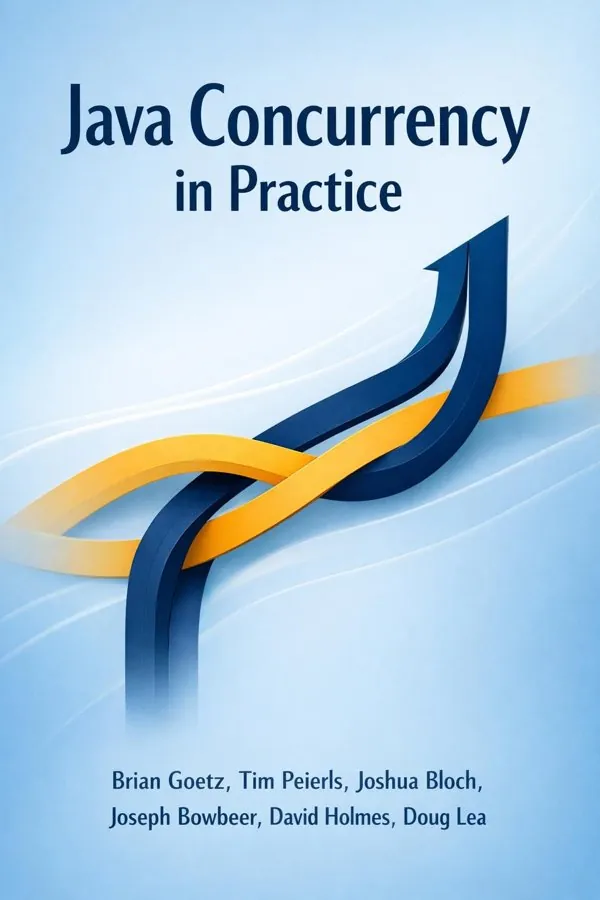
Java Concurrency in Practice: Summary & Key Insights
by Brian Goetz, Tim Peierls, Joshua Bloch, Joseph Bowbeer, David Holmes, Doug Lea
 10 min9 chaptersAudio available
What Is Java Concurrency in Practice About?
Java Concurrency in Practice by Brian Goetz, Tim Peierls, Joshua Bloch, Joseph Bowbeer, David Holmes, Doug Lea is a programming book spanning 9 pages. Java Concurrency in Practice is a comprehensive guide to writing reliable, scalable, and maintainable concurrent programs in Java. It explains the principles of concurrency, thread safety, synchronization, and performance optimization, providing practical examples and best practices for developers working with multithreaded applications.
This FizzRead summary covers all 9 key chapters of Java Concurrency in Practice in approximately 10 minutes, distilling the most important ideas, arguments, and takeaways from Brian Goetz, Tim Peierls, Joshua Bloch, Joseph Bowbeer, David Holmes, Doug Lea's work. Also available as an audio summary and Key Quotes Podcast.
Java Concurrency in Practice
Java Concurrency in Practice is a comprehensive guide to writing reliable, scalable, and maintainable concurrent programs in Java. It explains the principles of concurrency, thread safety, synchronization, and performance optimization, providing practical examples and best practices for developers working with multithreaded applications.
Who Should Read Java Concurrency in Practice?
This book is perfect for anyone interested in programming and looking to gain actionable insights in a short read. Whether you're a student, professional, or lifelong learner, the key ideas from Java Concurrency in Practice by Brian Goetz, Tim Peierls, Joshua Bloch, Joseph Bowbeer, David Holmes, Doug Lea will help you think differently.
- ✓Readers who enjoy programming and want practical takeaways
- ✓Professionals looking to apply new ideas to their work and life
- ✓Anyone who wants the core insights of Java Concurrency in Practice in just 10 minutes
Want the full summary?
Get instant access to this book summary and 100K+ more with Fizz Moment.
Get Free SummaryAvailable on App Store • Free to download
Key Chapters
Concurrency begins with a mental model: independent threads performing tasks, sometimes sharing data, sometimes cooperating. In Java, a thread represents an active execution path. Each application can spawn many threads that execute code seemingly in parallel. Yet this apparent parallelism hides subtle details of memory visibility, ordering, and synchronization.
When two threads access shared data, one must ensure that the results are predictable. Without synchronization, operations on shared objects can interleave in unexpected ways, producing race conditions or inconsistent states. This is why concurrency in Java is not just about creating threads but managing how threads interact.
The Java Memory Model defines how and when changes made by one thread become visible to others. Understanding this model is essential. For instance, writing a value to a shared variable does not automatically guarantee that another thread will see the updated value unless synchronization or a volatile variable ensures visibility.
This is where synchronized blocks, locks, and volatile fields come in. A synchronized method or block guarantees mutual exclusion and establishes happens-before relationships. Volatile ensures visibility of changes but does not guarantee atomicity for compound operations. Recognizing these distinctions is key to writing correct concurrent code.
At the foundation lies the motivation: responsiveness and scalability. In GUI applications, concurrency keeps interfaces active while processing data. In server systems, concurrency enables many requests to be handled simultaneously. These are compelling reasons, but without clear understanding, concurrency becomes dangerous. The early chapters of this book emphasize how essential it is to think in terms of correctness first, because incorrect concurrency problems—like races, deadlocks, and visibility issues—often remain invisible until systems are under real-world stress.
Thread safety means the program behaves correctly when executed by multiple threads, no matter how those threads interleave. Achieving this isn’t about making every operation synchronized—it’s about reasoning systematically about data consistency and isolation.
There are several proven strategies. I first emphasize immutability. Immutable objects, once constructed, cannot change. That single property makes them inherently thread-safe because no thread can observe a partially modified state. Examples like String or Integer in Java illustrate how immutability simplifies everything.
Next, confinement: keep data within the boundaries of a single thread, avoiding sharing altogether. If no other thread can access the state, you don’t need synchronization. ThreadLocal variables embody this principle.
The third pillar is safe publication—how you share an object so that other threads see it fully constructed, not a partially visible state. Proper publication can be achieved through volatile variables, synchronized blocks, or static initializers. The focus here is controlled visibility.
In each technique, the emphasis is understanding invariants—the conditions that must always hold true in your object design. A class is thread-safe if it maintains its invariants under concurrent access. This principle guides design: protect the invariants, and thread safety will follow naturally.
Developers often believe adding synchronized to every method guarantees safety, but that over-simplification leads to inefficiency and even deadlocks. True thread safety comes from deliberate design, recognizing what data requires protection and what can remain independent. Through examples like counters, collections, and caching structures, the book shows that safe design is thoughtful design.
+ 7 more chapters — available in the FizzRead app
All Chapters in Java Concurrency in Practice
About the Authors
Brian Goetz is a software engineer and Java language architect at Oracle, known for his expertise in concurrency and performance. He has contributed extensively to the design of the Java platform and is a frequent speaker at software development conferences.
Get This Summary in Your Preferred Format
Read or listen to the Java Concurrency in Practice summary by Brian Goetz, Tim Peierls, Joshua Bloch, Joseph Bowbeer, David Holmes, Doug Lea anytime, anywhere. FizzRead offers multiple formats so you can learn on your terms — all free.
Available formats: App · Audio · PDF · EPUB — All included free with FizzRead
Download Java Concurrency in Practice PDF and EPUB Summary
Key Quotes from Java Concurrency in Practice
“Concurrency begins with a mental model: independent threads performing tasks, sometimes sharing data, sometimes cooperating.”
“Thread safety means the program behaves correctly when executed by multiple threads, no matter how those threads interleave.”
Frequently Asked Questions about Java Concurrency in Practice
Java Concurrency in Practice by Brian Goetz, Tim Peierls, Joshua Bloch, Joseph Bowbeer, David Holmes, Doug Lea is a programming book that explores key ideas across 9 chapters. Java Concurrency in Practice is a comprehensive guide to writing reliable, scalable, and maintainable concurrent programs in Java. It explains the principles of concurrency, thread safety, synchronization, and performance optimization, providing practical examples and best practices for developers working with multithreaded applications.
You Might Also Like

ANSI Common Lisp
Paul Graham
10 min
Automate the Boring Stuff with Python: Practical Programming for Total Beginners
Al Sweigart
10 min
Black Hat Python: Python Programming for Hackers and Pentesters
Justin Seitz
10 min
Building Microservices: Designing Fine-Grained Systems
Sam Newman
10 min
C++ Primer
Stanley B. Lippman, Josée Lajoie, Barbara E. Moo
10 min
Clean Code: A Handbook of Agile Software Craftsmanship
Robert C. Martin
10 minBrowse by Category
Ready to read Java Concurrency in Practice?
Get the full summary and 100K+ more books with Fizz Moment.