
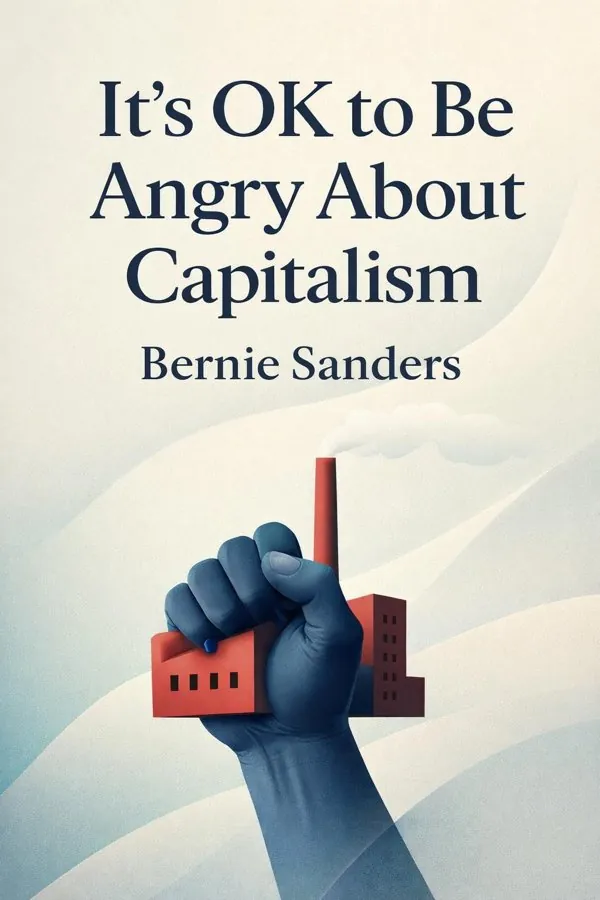
It’s OK to Be Angry About Capitalism: Summary & Key Insights
 10 min12 chaptersAudio available
What Is It’s OK to Be Angry About Capitalism About?
It’s OK to Be Angry About Capitalism by Bernie Sanders is a politics book spanning 12 pages. In this book, Bernie Sanders presents a passionate critique of the current economic system in the United States, arguing that capitalism has created vast inequality and undermined democracy. He calls for transformative change through policies that prioritize human needs over corporate profits, addressing healthcare, education, climate, and workers’ rights. The work blends political analysis with Sanders’s personal reflections on his decades-long fight for social and economic justice.
This FizzRead summary covers all 12 key chapters of It’s OK to Be Angry About Capitalism in approximately 10 minutes, distilling the most important ideas, arguments, and takeaways from Bernie Sanders's work. Also available as an audio summary and Key Quotes Podcast.
It’s OK to Be Angry About Capitalism
In this book, Bernie Sanders presents a passionate critique of the current economic system in the United States, arguing that capitalism has created vast inequality and undermined democracy. He calls for transformative change through policies that prioritize human needs over corporate profits, addressing healthcare, education, climate, and workers’ rights. The work blends political analysis with Sanders’s personal reflections on his decades-long fight for social and economic justice.
Who Should Read It’s OK to Be Angry About Capitalism?
This book is perfect for anyone interested in politics and looking to gain actionable insights in a short read. Whether you're a student, professional, or lifelong learner, the key ideas from It’s OK to Be Angry About Capitalism by Bernie Sanders will help you think differently.
- ✓Readers who enjoy politics and want practical takeaways
- ✓Professionals looking to apply new ideas to their work and life
- ✓Anyone who wants the core insights of It’s OK to Be Angry About Capitalism in just 10 minutes
Want the full summary?
Get instant access to this book summary and 100K+ more with Fizz Moment.
Get Free SummaryAvailable on App Store • Free to download
Key Chapters
My own political awakening didn’t happen overnight. Growing up in Brooklyn, I saw firsthand what economic insecurity looked like—the worry written on parents’ faces when they couldn’t pay rent, the quiet sacrifices of workers who labored long hours with little recognition. Those early experiences shaped my conviction that inequality is not inevitable; it’s manufactured by policy and power. I carried that awareness into the University of Chicago, where I was introduced to the civil rights movement and saw how ordinary people could confront systems of oppression through collective action.
Over the decades, from being mayor of Burlington to serving in the U.S. Senate, I have fought against the entrenched interests that dominate American political life. Each fight—whether to raise the minimum wage, to demand affordable healthcare, or to oppose reckless wars—has revealed how systematically our democracy has been undermined by economic privilege. When I ran for president, the ideas I championed were called impractical or radical, yet today millions agree that ensuring healthcare, housing, and education for all is just plain common sense.
This book draws from that journey—one driven by the belief that politics is about human lives, not corporate profit margins. I want readers to understand that change is possible, but only when we’re honest about who holds power and whom the system truly serves.
We live in an era where a single billionaire can possess more wealth than millions of families combined. That’s not a quirk of capitalism—it’s its logical outcome. Corporate greed has become the defining force of our economy, driving wages down, inflating prices, and stripping workers of security. I have seen how CEOs receive bonuses in the millions while their employees rely on food stamps. This inequality isn’t just immoral; it’s destabilizing. It erodes trust, undermines democracy, and feeds resentment.
When we deregulated industries and slashed taxes for the wealthy, we were promised prosperity for all. What we got instead was an economy skewed so far toward the top that even college graduates can’t afford homes and millions of Americans live paycheck to paycheck. I often remind people that these outcomes are political choices, not economic inevitabilities. The United States could easily afford decent healthcare, free education, and fair wages—if we stopped prioritizing stock buybacks and offshore profits.
Inequality isn’t simply a statistical problem; it’s a statement about our values. The vast concentration of wealth says to working people: your labor isn’t valued, your future isn’t secure, and your democracy isn’t yours. Challenging that reality is not an act of envy—it’s an act of justice.
+ 10 more chapters — available in the FizzRead app
All Chapters in It’s OK to Be Angry About Capitalism
About the Author
Bernie Sanders is an American politician and activist who has served as a U.S. Senator from Vermont since 2007. Known for his progressive views, he has been a leading voice for economic equality, universal healthcare, and workers’ rights. Sanders ran for the Democratic presidential nomination in 2016 and 2020, inspiring a movement focused on social justice and political reform.
Get This Summary in Your Preferred Format
Read or listen to the It’s OK to Be Angry About Capitalism summary by Bernie Sanders anytime, anywhere. FizzRead offers multiple formats so you can learn on your terms — all free.
Available formats: App · Audio · PDF · EPUB — All included free with FizzRead
Download It’s OK to Be Angry About Capitalism PDF and EPUB Summary
Key Quotes from It’s OK to Be Angry About Capitalism
“My own political awakening didn’t happen overnight.”
“We live in an era where a single billionaire can possess more wealth than millions of families combined.”
Frequently Asked Questions about It’s OK to Be Angry About Capitalism
It’s OK to Be Angry About Capitalism by Bernie Sanders is a politics book that explores key ideas across 12 chapters. In this book, Bernie Sanders presents a passionate critique of the current economic system in the United States, arguing that capitalism has created vast inequality and undermined democracy. He calls for transformative change through policies that prioritize human needs over corporate profits, addressing healthcare, education, climate, and workers’ rights. The work blends political analysis with Sanders’s personal reflections on his decades-long fight for social and economic justice.
More by Bernie Sanders
You Might Also Like

Antifa: The Anti-Fascist Handbook
Mark Bray
10 min
Attack from Within: How Disinformation Is Sabotaging America
Barbara McQuade
10 min
Coercion, Capital, and European States, AD 990–1992
Charles Tilly
10 min
Digital Democracy: Concepts, Methodologies, Tools, and Applications
Various Authors
10 min
Fascism
Stanley G. Payne
10 min
Fire And Fury: Inside The Trump White House
Michael Wolff
10 minBrowse by Category
Ready to read It’s OK to Be Angry About Capitalism?
Get the full summary and 100K+ more books with Fizz Moment.