
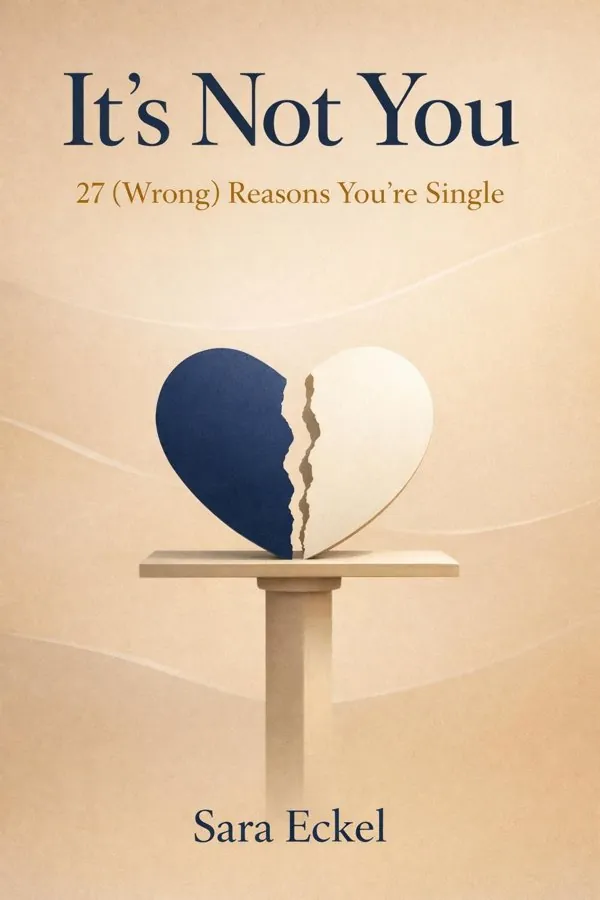
It's Not You: 27 (Wrong) Reasons You're Single: Summary & Key Insights
by Sara Eckel
 10 min9 chaptersAudio available
What Is It's Not You: 27 (Wrong) Reasons You're Single About?
It's Not You: 27 (Wrong) Reasons You're Single by Sara Eckel is a relationships book spanning 9 pages. In this candid and compassionate book, Sara Eckel challenges the cultural myths surrounding singlehood. Drawing from personal experience and psychological research, she argues that being single is not a sign of personal failure or deficiency. Instead, she encourages readers to embrace self-acceptance and reject the false narratives that blame individuals for their relationship status.
This FizzRead summary covers all 9 key chapters of It's Not You: 27 (Wrong) Reasons You're Single in approximately 10 minutes, distilling the most important ideas, arguments, and takeaways from Sara Eckel's work. Also available as an audio summary and Key Quotes Podcast.
It's Not You: 27 (Wrong) Reasons You're Single
In this candid and compassionate book, Sara Eckel challenges the cultural myths surrounding singlehood. Drawing from personal experience and psychological research, she argues that being single is not a sign of personal failure or deficiency. Instead, she encourages readers to embrace self-acceptance and reject the false narratives that blame individuals for their relationship status.
Who Should Read It's Not You: 27 (Wrong) Reasons You're Single?
This book is perfect for anyone interested in relationships and looking to gain actionable insights in a short read. Whether you're a student, professional, or lifelong learner, the key ideas from It's Not You: 27 (Wrong) Reasons You're Single by Sara Eckel will help you think differently.
- ✓Readers who enjoy relationships and want practical takeaways
- ✓Professionals looking to apply new ideas to their work and life
- ✓Anyone who wants the core insights of It's Not You: 27 (Wrong) Reasons You're Single in just 10 minutes
Want the full summary?
Get instant access to this book summary and 100K+ more with Fizz Moment.
Get Free SummaryAvailable on App Store • Free to download
Key Chapters
One of the first accusations that lands on the shoulders of singles is that we’re too picky. The narrative is familiar: you have impossibly high standards, you keep searching for perfection, you never give anyone a real chance. If only you’d lower your expectations, they say, love would find you. I remember hearing this so often that I began to wonder if selectiveness was my fatal flaw. But what’s rarely asked is why discernment is suddenly suspect when it comes to love. In every other area of life—careers, friendships, home choices—we celebrate those who know what they want. Why, then, do we shame that clarity in romance?
The deeper truth is that much of what gets labeled as 'picky' is actually self-awareness. The ability to recognize compatibility, shared values, and emotional safety isn’t arrogance—it’s maturity. The notion that singles are too selective often doubles as an attempt to police women in particular, suggesting that wanting both emotional intimacy and respect makes us unrealistic. Yet, when we peel back the layers, we see that these judgments reflect cultural discomfort with people—especially women—who set boundaries.
Rather than seeing standards as the problem, I came to understand that what truly matters is authenticity. Dating without pretending to want less, or to feel more, is a courageous act. Discernment means acknowledging when someone doesn’t meet your emotional needs, not because you’re broken, but because you value connection enough not to settle. Too often, people confuse scarcity with realism—believing love is so rare that one must compromise on fulfillment to attain it. But true discernment stems from abundance—from the quiet knowing that love doesn’t require you to shrink yourself. The path to partnership isn’t about surrendering your standards; it’s about honoring them with both gentleness and patience.
Another familiar diagnosis singles receive is that we are emotionally unavailable or afraid of commitment. It’s a subtle kind of indictment—that somewhere in our psyche we are secretly rejecting intimacy, pushing away what we say we want. The problem with this story is that it reduces complex human attachment patterns into morality tales. Psychological research paints a more nuanced picture: readiness for partnership is not a fixed trait, nor is it revealed by one’s current relationship status. You can be deeply open to intimacy and still find yourself unattached for long stretches of time. You can also be committed in name only and completely unavailable in heart.
In writing this chapter, I wanted to separate readiness from worthiness. Being single doesn’t prove an inability to love. Sometimes it’s simply the mathematics of life—timing, geography, or circumstance. Yet, when we internalize the cultural script that says 'if you were truly ready, you’d already be partnered,' we begin to rewrite our lives as cautionary tales. We scan our emotional histories searching for evidence of fear, commitment phobia, or sabotage. The self-examination spirals into self-reproach.
Through many interviews, I learned that emotional availability isn’t a state that one perfects in isolation; it is something that evolves in connection. You can practice self-awareness, therapy, and vulnerability—but relational readiness isn’t a solitary project. It unfolds when two people meet under conditions where they can view each other with safety and curiosity. No amount of solo preparation guarantees that moment will align. What helped me was understanding that being open to love doesn’t mean being perpetually on trial for my emotional adequacy. It means staying sincere, curious, and present even when connection doesn’t arrive on schedule.
+ 7 more chapters — available in the FizzRead app
All Chapters in It's Not You: 27 (Wrong) Reasons You're Single
About the Author
Sara Eckel is an American writer and essayist whose work has appeared in The New York Times, The Washington Post, and other major publications. She writes about relationships, self-acceptance, and emotional well-being.
Get This Summary in Your Preferred Format
Read or listen to the It's Not You: 27 (Wrong) Reasons You're Single summary by Sara Eckel anytime, anywhere. FizzRead offers multiple formats so you can learn on your terms — all free.
Available formats: App · Audio · PDF · EPUB — All included free with FizzRead
Download It's Not You: 27 (Wrong) Reasons You're Single PDF and EPUB Summary
Key Quotes from It's Not You: 27 (Wrong) Reasons You're Single
“One of the first accusations that lands on the shoulders of singles is that we’re too picky.”
“Another familiar diagnosis singles receive is that we are emotionally unavailable or afraid of commitment.”
Frequently Asked Questions about It's Not You: 27 (Wrong) Reasons You're Single
It's Not You: 27 (Wrong) Reasons You're Single by Sara Eckel is a relationships book that explores key ideas across 9 chapters. In this candid and compassionate book, Sara Eckel challenges the cultural myths surrounding singlehood. Drawing from personal experience and psychological research, she argues that being single is not a sign of personal failure or deficiency. Instead, she encourages readers to embrace self-acceptance and reject the false narratives that blame individuals for their relationship status.
You Might Also Like
The 5 Love Languages
Gary Chapman
10 min
Men Are from Mars, Women Are from Venus
John Gray
10 min
She Comes First
Ian Kerner
10 min
No More Mr Nice Guy
Robert Glover
10 min
Hold Me Tight
Sue Johnson
10 min
Mating in Captivity
Esther Perel
10 minBrowse by Category
Ready to read It's Not You: 27 (Wrong) Reasons You're Single?
Get the full summary and 100K+ more books with Fizz Moment.