
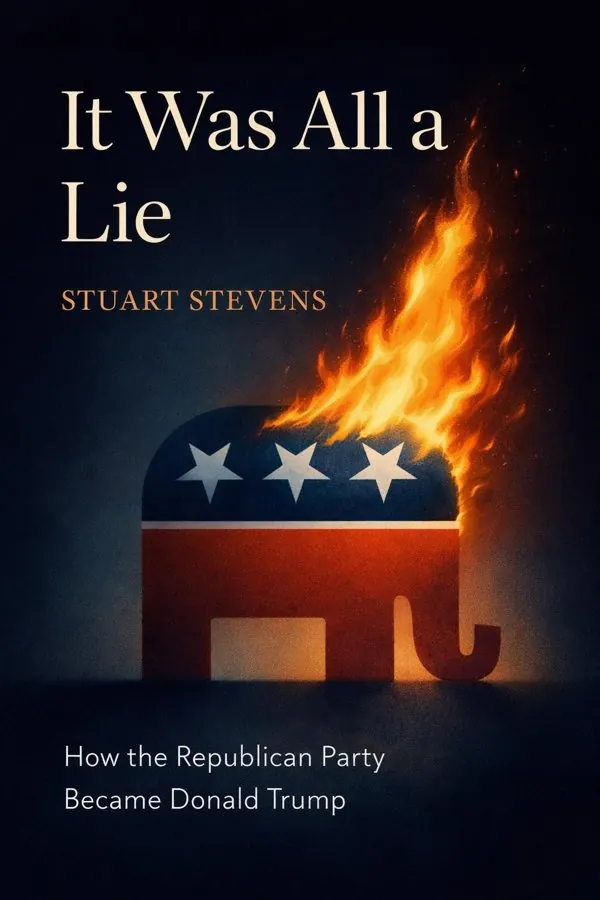
It Was All a Lie: How the Republican Party Became Donald Trump: Summary & Key Insights
 10 min9 chaptersAudio available
What Is It Was All a Lie: How the Republican Party Became Donald Trump About?
It Was All a Lie: How the Republican Party Became Donald Trump by Stuart Stevens is a politics book spanning 9 pages. In this candid political memoir, longtime Republican strategist Stuart Stevens reflects on his decades within the party and argues that the rise of Donald Trump was not an aberration but the culmination of a long moral and ideological decline. Stevens examines how the GOP abandoned its principles of character, fiscal responsibility, and truth, replacing them with cynicism and tribal loyalty. The book offers both a personal reckoning and a critique of the modern conservative movement in the United States.
This FizzRead summary covers all 9 key chapters of It Was All a Lie: How the Republican Party Became Donald Trump in approximately 10 minutes, distilling the most important ideas, arguments, and takeaways from Stuart Stevens's work. Also available as an audio summary and Key Quotes Podcast.
It Was All a Lie: How the Republican Party Became Donald Trump
In this candid political memoir, longtime Republican strategist Stuart Stevens reflects on his decades within the party and argues that the rise of Donald Trump was not an aberration but the culmination of a long moral and ideological decline. Stevens examines how the GOP abandoned its principles of character, fiscal responsibility, and truth, replacing them with cynicism and tribal loyalty. The book offers both a personal reckoning and a critique of the modern conservative movement in the United States.
Who Should Read It Was All a Lie: How the Republican Party Became Donald Trump?
This book is perfect for anyone interested in politics and looking to gain actionable insights in a short read. Whether you're a student, professional, or lifelong learner, the key ideas from It Was All a Lie: How the Republican Party Became Donald Trump by Stuart Stevens will help you think differently.
- ✓Readers who enjoy politics and want practical takeaways
- ✓Professionals looking to apply new ideas to their work and life
- ✓Anyone who wants the core insights of It Was All a Lie: How the Republican Party Became Donald Trump in just 10 minutes
Want the full summary?
Get instant access to this book summary and 100K+ more with Fizz Moment.
Get Free SummaryAvailable on App Store • Free to download
Key Chapters
When I first came of age politically, the Republican Party was not just a brand—it was a moral identity. We prided ourselves on personal responsibility, on the quiet dignity of hard work, on living within one’s means both individually and as a nation. We believed that character mattered, that leaders who told the truth were the backbone of a functioning democracy. These were not abstractions to me. They were the faith by which I constructed my professional life.
The Republican ideal, as I understood it then, was rooted in a love of country that expressed itself through prudence and principle. Fiscal conservatism wasn’t about greed; it was about stewardship. Limited government wasn’t about neglecting the poor; it was about respecting the capacity of individuals to decide for themselves. And truth—truth was supposed to be nonnegotiable. I remember the way we used to talk about “the adults in the room,” the people who would put duty ahead of passion. Barry Goldwater, Ronald Reagan, George H.W. Bush—each in his own way promised to lead with character. We convinced ourselves that character was what set us apart from the cynicism of politics as usual.
But even in the beginning, there were cracks. The gap between theory and practice was wide. We extolled freedom while tolerating injustice; we preached morality while cutting deals. Yet we called this compromise “governing” because it allowed us to win and stay in power. I didn’t see then what I see now: that we were laying down the moral scaffolding for hypocrisy. The language of virtue became a marketing slogan, and the loyalty we pledged was less to ideals than to victory itself.
Every political movement has a choice to make between principle and expedience. For the modern Republican Party, that choice became clear in the wake of the civil rights movement. The so-called Southern Strategy turned resentment—anger at change, fear of social loss—into an electoral weapon. For those of us inside the machinery, it seemed tactical, not moral. We told ourselves we were expanding the map, speaking to cultural disquiet. But beneath the rhetoric, we were using race as code.
Over time, the party’s moral vocabulary shifted. Diversity was no longer a mark of national strength but of liberal corruption. Cultural anger became currency, and many of us learned how to spend it with ruthless efficiency. We wrapped prejudice in the flag and called it patriotism. We told ourselves that we weren’t exploiting race but merely defending tradition. The truth is that we were performing an elaborate political self-deception, one that would eventually consume the party’s capacity for empathy and self-restraint.
That moral compromise, once made, metastasized. You cannot promote division without becoming divided. The line between strategy and belief blurred until the two were indistinguishable. By the time we reached the twenty-first century, the seeds of Trumpism were already in the soil—planted decades earlier by our own hands.
+ 7 more chapters — available in the FizzRead app
All Chapters in It Was All a Lie: How the Republican Party Became Donald Trump
About the Author
Stuart Stevens is an American political consultant, author, and television writer. He has worked on numerous Republican campaigns, including those of George W. Bush, Mitt Romney, and Bob Dole. A graduate of the University of Oxford and UCLA Film School, Stevens has also written for television and published several books on politics and travel.
Get This Summary in Your Preferred Format
Read or listen to the It Was All a Lie: How the Republican Party Became Donald Trump summary by Stuart Stevens anytime, anywhere. FizzRead offers multiple formats so you can learn on your terms — all free.
Available formats: App · Audio · PDF · EPUB — All included free with FizzRead
Download It Was All a Lie: How the Republican Party Became Donald Trump PDF and EPUB Summary
Key Quotes from It Was All a Lie: How the Republican Party Became Donald Trump
“When I first came of age politically, the Republican Party was not just a brand—it was a moral identity.”
“Every political movement has a choice to make between principle and expedience.”
Frequently Asked Questions about It Was All a Lie: How the Republican Party Became Donald Trump
It Was All a Lie: How the Republican Party Became Donald Trump by Stuart Stevens is a politics book that explores key ideas across 9 chapters. In this candid political memoir, longtime Republican strategist Stuart Stevens reflects on his decades within the party and argues that the rise of Donald Trump was not an aberration but the culmination of a long moral and ideological decline. Stevens examines how the GOP abandoned its principles of character, fiscal responsibility, and truth, replacing them with cynicism and tribal loyalty. The book offers both a personal reckoning and a critique of the modern conservative movement in the United States.
You Might Also Like
Antifa: The Anti-Fascist Handbook
Mark Bray
10 min
Attack from Within: How Disinformation Is Sabotaging America
Barbara McQuade
10 min
Coercion, Capital, and European States, AD 990–1992
Charles Tilly
10 min
Digital Democracy: Concepts, Methodologies, Tools, and Applications
Various Authors
10 min
Fascism
Stanley G. Payne
10 min
Fire And Fury: Inside The Trump White House
Michael Wolff
10 minBrowse by Category
Ready to read It Was All a Lie: How the Republican Party Became Donald Trump?
Get the full summary and 100K+ more books with Fizz Moment.