
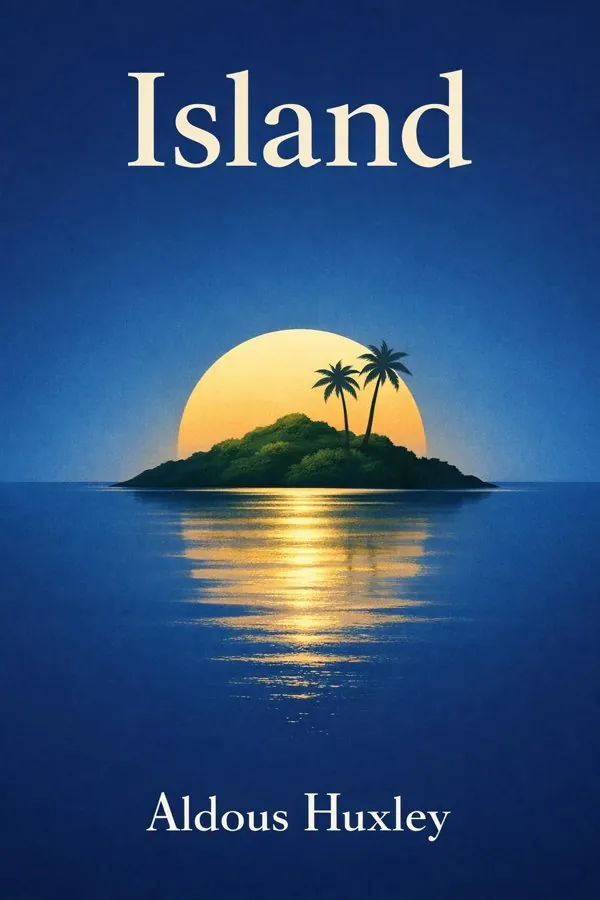
Island: Summary & Key Insights
 10 min9 chaptersAudio available
Key Takeaways from Island
Real change often begins when a stranger enters a world that exposes the poverty of his own assumptions.
A healthy society is not produced by good intentions alone; it must be consciously built.
Happiness is not simply felt; it is practiced.
The deepest purpose of education is not to produce efficient workers, but conscious people.
Transformation does not happen when pain disappears; it happens when pain is met without evasion.
What Is Island About?
Island by Aldous Huxley is a classics book spanning 5 pages. Aldous Huxley’s Island, published in 1962, is both a novel and a philosophical thought experiment: a vision of what a humane society might look like if it were built on awareness rather than fear, cooperation rather than domination, and wisdom rather than mere efficiency. The story begins when cynical journalist Will Farnaby is shipwrecked on Pala, a small island nation in the Indian Ocean. Expecting to find another vulnerable territory ready for political manipulation and commercial exploitation, he instead discovers a culture that has carefully woven together modern science, Buddhist-inspired mindfulness, sexual honesty, ecological balance, and compassionate education. As Will encounters Pala’s people and institutions, he is forced to confront not only the island’s ideals but also the wounds, habits, and compromises within himself. Island matters because it asks a rare question in modern literature: not simply what is wrong with the world, but what a wiser world might actually require. Huxley, already famous for Brave New World and his lifelong exploration of psychology, spirituality, and social organization, uses this final novel to offer his most mature statement about consciousness, freedom, and the fragile possibility of a better civilization.
This FizzRead summary covers all 9 key chapters of Island in approximately 10 minutes, distilling the most important ideas, arguments, and takeaways from Aldous Huxley's work. Also available as an audio summary and Key Quotes Podcast.
Island
Aldous Huxley’s Island, published in 1962, is both a novel and a philosophical thought experiment: a vision of what a humane society might look like if it were built on awareness rather than fear, cooperation rather than domination, and wisdom rather than mere efficiency. The story begins when cynical journalist Will Farnaby is shipwrecked on Pala, a small island nation in the Indian Ocean. Expecting to find another vulnerable territory ready for political manipulation and commercial exploitation, he instead discovers a culture that has carefully woven together modern science, Buddhist-inspired mindfulness, sexual honesty, ecological balance, and compassionate education. As Will encounters Pala’s people and institutions, he is forced to confront not only the island’s ideals but also the wounds, habits, and compromises within himself. Island matters because it asks a rare question in modern literature: not simply what is wrong with the world, but what a wiser world might actually require. Huxley, already famous for Brave New World and his lifelong exploration of psychology, spirituality, and social organization, uses this final novel to offer his most mature statement about consciousness, freedom, and the fragile possibility of a better civilization.
Who Should Read Island?
This book is perfect for anyone interested in classics and looking to gain actionable insights in a short read. Whether you're a student, professional, or lifelong learner, the key ideas from Island by Aldous Huxley will help you think differently.
- ✓Readers who enjoy classics and want practical takeaways
- ✓Professionals looking to apply new ideas to their work and life
- ✓Anyone who wants the core insights of Island in just 10 minutes
Want the full summary?
Get instant access to this book summary and 100K+ more with Fizz Moment.
Get Free SummaryAvailable on App Store • Free to download
Key Chapters
Real change often begins when a stranger enters a world that exposes the poverty of his own assumptions. That is exactly how Island opens. Will Farnaby arrives on Pala injured, suspicious, and emotionally exhausted. Officially, he is a journalist and political intermediary. In reality, he is also part of a larger scheme to help outside powers gain access to the island’s oil. His shipwreck seems accidental, but Huxley quickly turns it into a moral collision between two ways of living. Will comes from a culture shaped by ambition, resentment, and manipulation; Pala greets him with calm attention, medical care, and an unsettling absence of hostility.
This first stage of the novel matters because Huxley shows that utopia is not introduced through grand speeches. It is encountered in ordinary responses: how strangers are treated, how illness is handled, how children speak, how fear is met. Will expects secrecy, ideology, or sentimental naivete. Instead, he finds a society grounded in self-awareness. The islanders are not innocent in the childish sense; they are practiced in noticing the movements of mind. Even the famous mynah birds, crying “Attention!” and “Here and now, boys,” symbolize a culture that trains perception rather than distraction.
In practical terms, this idea applies whenever we enter unfamiliar systems—organizations, relationships, or communities. We often judge too quickly because we assume our normal is universal. Huxley suggests that growth starts with disciplined observation. Before deciding whether another way of life is foolish or admirable, we must first see it clearly.
Actionable takeaway: When encountering a new person, culture, or idea, delay judgment and ask, “What assumptions am I bringing with me that might be preventing me from seeing what is actually here?”
A healthy society is not produced by good intentions alone; it must be consciously built. One of Huxley’s most powerful achievements in Island is his insistence that wisdom can be institutionalized. Pala did not become humane by accident. Its culture emerged from a historical partnership between a Buddhist ruler and a Scottish doctor, who combined contemplative insight with scientific intelligence. Out of that synthesis came a civilization designed to cultivate sanity rather than merely manage disorder.
Huxley presents Pala as a working answer to a central modern dilemma: must we choose between rational progress and spiritual depth? On Pala, the answer is no. Medicine is modern, but it serves wholeness rather than profit. Education includes biology and psychology, but also self-knowledge. Social customs encourage intimacy without possession, and political life tries to reduce concentrations of power. Religion is not dogma; it is practice. Science is not worshipped; it is integrated.
This idea remains strikingly relevant. Many societies today are technologically advanced but psychologically fragmented. We often innovate in tools while neglecting attention, emotional maturity, and community structures. Huxley argues that a civilization should be evaluated not by its wealth or military strength, but by the quality of consciousness it nurtures. Schools, workplaces, media systems, and healthcare all shape inner life, whether intentionally or not.
A practical application is to look at any institution and ask what kind of human being it rewards. Does it encourage anxiety, competition, and numbness, or responsibility, clarity, and compassion? This can apply to a family system just as much as to a nation.
Actionable takeaway: Choose one environment you belong to—your home, team, or workplace—and identify one rule, ritual, or habit that could better support attention, honesty, and psychological well-being.
The deepest purpose of education is not to produce efficient workers, but conscious people. Huxley’s portrait of Pala includes one of the novel’s most compelling social ideas: children should be raised to develop intelligence, emotional resilience, bodily health, and ethical awareness together. In contrast to systems that sort students by obedience, competition, or test performance, Palanese education aims at integration. It teaches people how to think, how to feel, how to relate, and how to live with reality.
This is why children on Pala are not trapped within narrow family possessiveness or rigid institutional hierarchies. The island’s “mutual adoption” practices distribute care across a broader social network, reducing dependence on a single set of flawed adults. Education includes exposure to nature, practical skills, self-knowledge, and the management of desire. Huxley understands that neurosis often begins early, when societies teach children repression without understanding, achievement without purpose, or freedom without discipline.
This idea has broad relevance today. Many educational systems still focus on information transfer while neglecting attention, emotional literacy, and moral imagination. As a result, students may become highly trained yet inwardly fragmented. Huxley argues that learning should not merely prepare people to survive society; it should prepare them to improve it. Adults can apply the same principle. Growth does not end with formal schooling. Reading, therapy, conversation, and reflective practice are all forms of continuing education.
Practical examples include teaching children how to name feelings, giving adolescents responsibility with guidance, and balancing intellectual work with community service or time outdoors. For adults, it might mean pairing professional development with practices that deepen self-awareness.
Actionable takeaway: Add one dimension of “whole-person learning” to your week—emotional reflection, practical skill-building, time in nature, or meaningful dialogue—so education becomes development, not just information.
Transformation does not happen when pain disappears; it happens when pain is met without evasion. Will Farnaby’s journey through Pala is not simply a tour of utopian institutions. It is also an interior reckoning. Beneath his cynicism lies grief, guilt, damaged intimacy, and long-standing habits of self-betrayal. The island becomes transformative for him because its people do not flatter his defenses. They invite him to look directly at what he has avoided.
Huxley is especially insightful here because he refuses to present enlightenment as decorative serenity. Awareness is often uncomfortable. Will must confront the wreckage of his marriage, the emotional compromises of his professional life, and the ways he has participated in a corrupt system while blaming others. Pala offers him not moral condemnation, but the possibility of honest seeing. Through conversations, psychological reflection, and carefully structured experiences, Huxley shows that suffering can become instruction if one stops turning away.
This idea has enduring practical value. Many people cope with pain through busyness, sarcasm, ideology, or addiction to stimulation. These strategies may dull discomfort temporarily, but they also prevent real change. Healing usually begins with naming what hurts and seeing the patterns around it. That can happen through therapy, meditation, journaling, trusted relationships, or periods of solitude.
A practical example is examining repeated conflicts in one’s life. Instead of asking only, “Why does this keep happening to me?” one might ask, “What familiar wound or belief keeps shaping my reactions?” That shift turns suffering into inquiry.
Actionable takeaway: Set aside twenty minutes this week to write honestly about one recurring source of pain in your life, focusing not on blame but on what truth you may have been avoiding.
A society becomes dangerous when it confuses freedom with the unrestricted satisfaction of impulses. One of Huxley’s major concerns across his work is the manipulation of desire, and Island offers a more balanced answer than either repression or indulgence. On Pala, people are not taught to fear pleasure, but neither are they encouraged to become its servants. The island’s culture recognizes that appetites—sexual, economic, emotional, chemical—can enrich life or dominate it depending on whether they are held within awareness.
This theme is visible in Palanese attitudes toward relationships, consumption, and the use of ritual experiences. Huxley is careful to distinguish conscious enjoyment from compulsion. Pleasure is not the enemy; unconsciousness is. A person ruled by craving is easily controlled, whether by advertisers, political demagogues, or inner compulsions. By contrast, someone who can enjoy without clinging retains autonomy.
The idea feels especially contemporary in a world optimized to capture attention and monetize impulse. Social media, instant shopping, addictive entertainment, and endless stimulation reward reflex over reflection. Huxley anticipated this problem. He suggests that the central political battle is also psychological: can people remain awake enough to choose rather than merely react?
A practical application is to examine where convenience has become dependence. This could involve food, phone use, gossip, status seeking, or emotional reassurance. The goal is not puritanism but freedom. Small acts of restraint—delaying a purchase, sitting with boredom, having a difficult conversation instead of escaping into distraction—build sovereignty over desire.
Actionable takeaway: Identify one habit of immediate gratification in your life and practice a small delay before acting, using that pause to ask, “Do I want this, or am I simply obeying an impulse?”
Human beings do not become whole in isolation; they become whole in relationships shaped by honesty and care. Pala’s social organization reflects Huxley’s belief that many modern pathologies arise from loneliness, possessiveness, and the overvaluation of the separate self. The island’s communal life is designed to counter these tendencies. Families are important, but they do not function as closed emotional fortresses. Care is distributed. Friendship matters. Interdependence is treated as strength rather than weakness.
This does not mean Pala erases individuality. Rather, it places individual growth within a web of mutual responsibility. People are less likely to be crushed by one role, one relationship, or one source of identity. Children benefit from multiple adults. Adults are less trapped by status competition and private neurosis. The result is a society with built-in buffers against alienation. Huxley implies that emotional health is not merely personal achievement; it is supported by social design.
This insight applies strongly today, when many people are hyperconnected digitally yet deeply isolated in daily life. Mental health struggles are often intensified by fragmented communities, transient relationships, and economic systems that privatize stress. While personal practices matter, Huxley reminds us that well-being also depends on belonging.
Practical examples include building circles of mutual aid, deepening neighborhood ties, creating intergenerational contact, or reducing the expectation that one partner or one parent must meet every emotional need. Even small habits—shared meals, regular check-ins, collaborative childcare, local gatherings—can rebuild communal resilience.
Actionable takeaway: Strengthen one real-world connection this week by initiating a shared meal, an honest conversation, or a concrete offer of help, and treat community as something you build, not something you wait to find.
No enlightened society exists outside history, and no amount of wisdom makes it invulnerable to power. One of the most sobering aspects of Island is that Pala’s achievements do not guarantee its survival. External greed, internal uncertainty, and geopolitical pressure gather around the island throughout the novel. Oil reserves attract foreign interest. Militarism waits nearby. Ambitious figures are willing to sacrifice long-term well-being for status and immediate gain. Huxley insists that even a conscious culture lives under threat from appetites it has not fully eliminated in the wider world.
This is what keeps Island from becoming simplistic fantasy. Pala is admirable, but it is not magically protected. Its very decency makes it vulnerable in a world still organized around domination. The novel therefore asks a difficult question: can a sane society endure when surrounded by systems driven by money, force, and spectacle? Huxley offers no easy reassurance. Utopia, if it exists at all, is precarious.
The lesson is highly practical. Good values are not enough without political realism. Communities, institutions, and even healthy relationships can be undermined if they fail to account for manipulation, concentrated power, or economic temptation. Ethical life requires vigilance. One must not only cultivate the good, but also protect it.
Examples include mission-driven organizations corrupted by funding pressures, families destabilized by unaddressed control dynamics, or public institutions hollowed out by short-term profit logic. Huxley encourages readers to examine how noble intentions can be defeated without structural defense.
Actionable takeaway: Look at one valuable part of your life or community and ask what external pressure most threatens it—money, distraction, hierarchy, or fear—then make one concrete plan to protect what matters before crisis arrives.
Sometimes an author spends a lifetime correcting his own warning. Island can be read as Huxley’s direct response to Brave New World. In the earlier novel, technological power, conditioning, consumerism, and shallow pleasure produce a society that is stable but spiritually dead. In Island, Huxley revisits many of the same concerns and asks whether the same tools—science, psychology, pharmacology, education—could serve awakening rather than control.
This contrast is crucial to understanding the book’s significance. Huxley did not become naively optimistic late in life. Instead, he refined his diagnosis. The problem was never science itself, nor pleasure, nor organization. The problem was the use of these forces without wisdom. Pala demonstrates an alternative alignment: medicine that heals instead of pacifies, education that liberates instead of conditions, contemplative practice that deepens freedom instead of enforcing obedience, and social planning that supports maturity rather than mass conformity.
For readers today, this idea offers a valuable framework for evaluating progress. The question is not whether a tool is modern or traditional, efficient or inefficient. The real question is what kind of consciousness it creates. A smartphone, a school curriculum, a drug, a corporate policy, or a political campaign can either increase awareness or diminish it.
A practical use of this insight is to assess any innovation by three questions: Does it make people more attentive? More manipulable? More humane? Huxley urges us to move beyond simplistic pro-technology or anti-technology positions toward wiser judgment.
Actionable takeaway: Choose one technology or system you use every day and evaluate whether it is helping you become more awake, more dependent, or more distracted—and adjust your use accordingly.
All Chapters in Island
About the Author
Aldous Huxley (1894–1963) was an English novelist, essayist, and cultural critic whose work explored the tensions between science, technology, spirituality, and human freedom. Born into a distinguished intellectual family, he was educated at Eton and Oxford, and went on to become one of the most important literary voices of the twentieth century. Huxley is best known for Brave New World, his enduring dystopian novel about social control and engineered happiness, but his interests ranged widely across philosophy, mysticism, psychology, politics, and consciousness. Later works, including The Doors of Perception and Island, reflect his deep engagement with spiritual experience and human potential. His writing remains influential because it combines sharp social analysis with a lasting concern for how people might live more consciously and compassionately.
Get This Summary in Your Preferred Format
Read or listen to the Island summary by Aldous Huxley anytime, anywhere. FizzRead offers multiple formats so you can learn on your terms — all free.
Available formats: App · Audio · PDF · EPUB — All included free with FizzRead
Download Island PDF and EPUB Summary
Key Quotes from Island
“Real change often begins when a stranger enters a world that exposes the poverty of his own assumptions.”
“A healthy society is not produced by good intentions alone; it must be consciously built.”
“Happiness is not simply felt; it is practiced.”
“The deepest purpose of education is not to produce efficient workers, but conscious people.”
“Transformation does not happen when pain disappears; it happens when pain is met without evasion.”
Frequently Asked Questions about Island
Island by Aldous Huxley is a classics book that explores key ideas across 9 chapters. Aldous Huxley’s Island, published in 1962, is both a novel and a philosophical thought experiment: a vision of what a humane society might look like if it were built on awareness rather than fear, cooperation rather than domination, and wisdom rather than mere efficiency. The story begins when cynical journalist Will Farnaby is shipwrecked on Pala, a small island nation in the Indian Ocean. Expecting to find another vulnerable territory ready for political manipulation and commercial exploitation, he instead discovers a culture that has carefully woven together modern science, Buddhist-inspired mindfulness, sexual honesty, ecological balance, and compassionate education. As Will encounters Pala’s people and institutions, he is forced to confront not only the island’s ideals but also the wounds, habits, and compromises within himself. Island matters because it asks a rare question in modern literature: not simply what is wrong with the world, but what a wiser world might actually require. Huxley, already famous for Brave New World and his lifelong exploration of psychology, spirituality, and social organization, uses this final novel to offer his most mature statement about consciousness, freedom, and the fragile possibility of a better civilization.
More by Aldous Huxley

You Might Also Like






Browse by Category
Ready to read Island?
Get the full summary and 100K+ more books with Fizz Moment.