
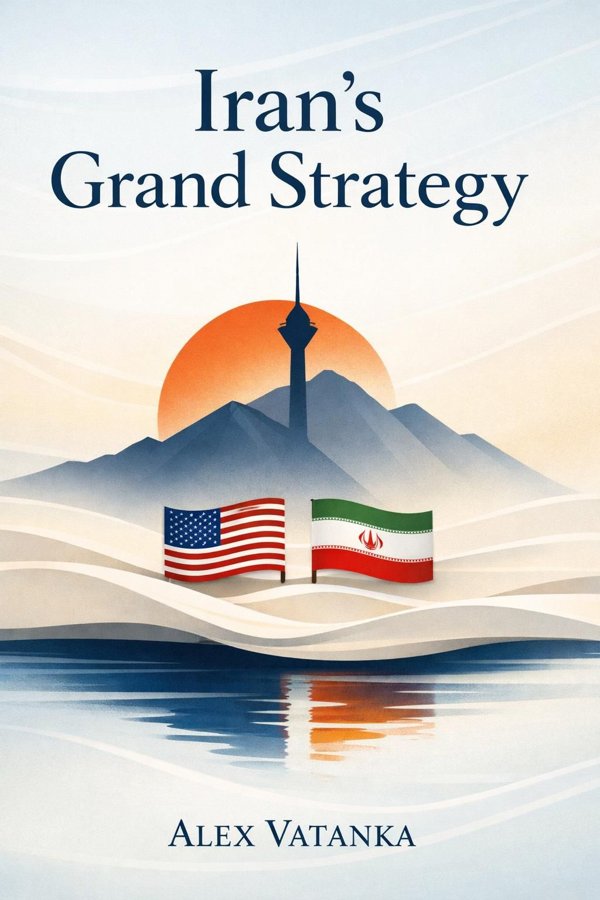
Iran's Grand Strategy: Summary & Key Insights
by Alex Vatanka
 10 min11 chaptersAudio available
What Is Iran's Grand Strategy About?
Iran's Grand Strategy by Alex Vatanka is a politics book spanning 11 pages. This book provides a comprehensive analysis of Iran’s foreign policy and strategic objectives since the 1979 revolution. Alex Vatanka examines how ideology, national interests, and leadership dynamics have shaped Tehran’s approach to regional and global affairs, including its relations with the United States, Russia, China, and neighboring Middle Eastern states. The work offers insight into Iran’s long-term ambitions and the internal debates that influence its strategic decisions.
This FizzRead summary covers all 11 key chapters of Iran's Grand Strategy in approximately 10 minutes, distilling the most important ideas, arguments, and takeaways from Alex Vatanka's work. Also available as an audio summary and Key Quotes Podcast.
Iran's Grand Strategy
This book provides a comprehensive analysis of Iran’s foreign policy and strategic objectives since the 1979 revolution. Alex Vatanka examines how ideology, national interests, and leadership dynamics have shaped Tehran’s approach to regional and global affairs, including its relations with the United States, Russia, China, and neighboring Middle Eastern states. The work offers insight into Iran’s long-term ambitions and the internal debates that influence its strategic decisions.
Who Should Read Iran's Grand Strategy?
This book is perfect for anyone interested in politics and looking to gain actionable insights in a short read. Whether you're a student, professional, or lifelong learner, the key ideas from Iran's Grand Strategy by Alex Vatanka will help you think differently.
- ✓Readers who enjoy politics and want practical takeaways
- ✓Professionals looking to apply new ideas to their work and life
- ✓Anyone who wants the core insights of Iran's Grand Strategy in just 10 minutes
Want the full summary?
Get instant access to this book summary and 100K+ more with Fizz Moment.
Get Free SummaryAvailable on App Store • Free to download
Key Chapters
Iran’s grand strategy begins with ideology. Since 1979, the Islamic Republic has framed its foreign policy around an Islamic worldview that rejects Western domination and promotes sovereignty through resistance. Ayatollah Khomeini envisioned Iran as both a moral guiding light and a political model for oppressed nations. This revolutionary ideology shaped the country's early assertiveness: support for liberation movements, export of the revolution, and rejection of bilateral relations rooted in perceived subservience.
But ideology was never static. Over time, it confronted realities—economic pressures, war, and isolation—that forced Iran’s leaders to reinterpret its principles. Khomeini’s insistence on Islamic unity collided with ethnic, sectarian, and geopolitical divides; his successors had to find a balance between ideological purity and the necessities of statecraft. The ideological commitment to independence remained the lodestar, even as pragmatic considerations led to tactical compromises.
Through this ideological prism, Iran views sovereignty as sacred—its foreign policy a moral struggle against hegemonic powers. The U.S., often depicted as the ‘Great Satan,’ represents not just a geopolitical adversary but the embodiment of a world order Iran seeks to challenge. This sense of mission explains Tehran’s willingness to endure sanctions and international criticism: it perceives these as proof of fidelity to revolutionary ideals. Ideology, therefore, serves both as the justification for resistance and as the emotional anchor of national identity.
Iran’s leadership structure is central to understanding its strategic direction. In the early years under Ayatollah Khomeini, foreign policy was dominated by revolutionary zeal and moral absolutism. Decisions were centralized, and diplomacy often secondary to ideological considerations. However, following the Iran–Iraq War and Khomeini’s death in 1989, Ayatollah Khamenei oversaw a gradual institutionalization of foreign policy decision-making.
Under Khamenei, strategy became less about exporting revolution and more about preserving the system. The Supreme Leader’s office emerged as the ultimate arbiter among competing factions—the Islamic Revolutionary Guard Corps (IRGC), the presidency, and religious institutions. This structure allowed Tehran to project power through a combination of state and non-state instruments, enabling flexibility without losing control.
Leaders such as Rafsanjani and Rouhani brought pragmatism, seeking economic recovery and international legitimacy. Ahmadinejad’s tenure restored populist, defiant rhetoric. Khamenei, however, maintained continuity: a cautious mix of resistance and negotiation. Decisions in Iran are not spontaneous; they represent a negotiated balance within the political elite, always bound by the Supreme Leader’s strategic vision—preserve the Islamic Republic, resist domination, and ensure influence in the region.
+ 9 more chapters — available in the FizzRead app
All Chapters in Iran's Grand Strategy
About the Author
Alex Vatanka is a senior fellow at the Middle East Institute in Washington, D.C., specializing in Middle Eastern geopolitics and Iranian foreign policy. He has written extensively on Iran’s domestic and international affairs and is recognized as an expert commentator on the region.
Get This Summary in Your Preferred Format
Read or listen to the Iran's Grand Strategy summary by Alex Vatanka anytime, anywhere. FizzRead offers multiple formats so you can learn on your terms — all free.
Available formats: App · Audio · PDF · EPUB — All included free with FizzRead
Download Iran's Grand Strategy PDF and EPUB Summary
Key Quotes from Iran's Grand Strategy
“Iran’s grand strategy begins with ideology.”
“Iran’s leadership structure is central to understanding its strategic direction.”
Frequently Asked Questions about Iran's Grand Strategy
Iran's Grand Strategy by Alex Vatanka is a politics book that explores key ideas across 11 chapters. This book provides a comprehensive analysis of Iran’s foreign policy and strategic objectives since the 1979 revolution. Alex Vatanka examines how ideology, national interests, and leadership dynamics have shaped Tehran’s approach to regional and global affairs, including its relations with the United States, Russia, China, and neighboring Middle Eastern states. The work offers insight into Iran’s long-term ambitions and the internal debates that influence its strategic decisions.
You Might Also Like
Antifa: The Anti-Fascist Handbook
Mark Bray
10 min
Attack from Within: How Disinformation Is Sabotaging America
Barbara McQuade
10 min
Coercion, Capital, and European States, AD 990–1992
Charles Tilly
10 min
Digital Democracy: Concepts, Methodologies, Tools, and Applications
Various Authors
10 min
Fascism
Stanley G. Payne
10 min
Fire And Fury: Inside The Trump White House
Michael Wolff
10 minBrowse by Category
Ready to read Iran's Grand Strategy?
Get the full summary and 100K+ more books with Fizz Moment.