
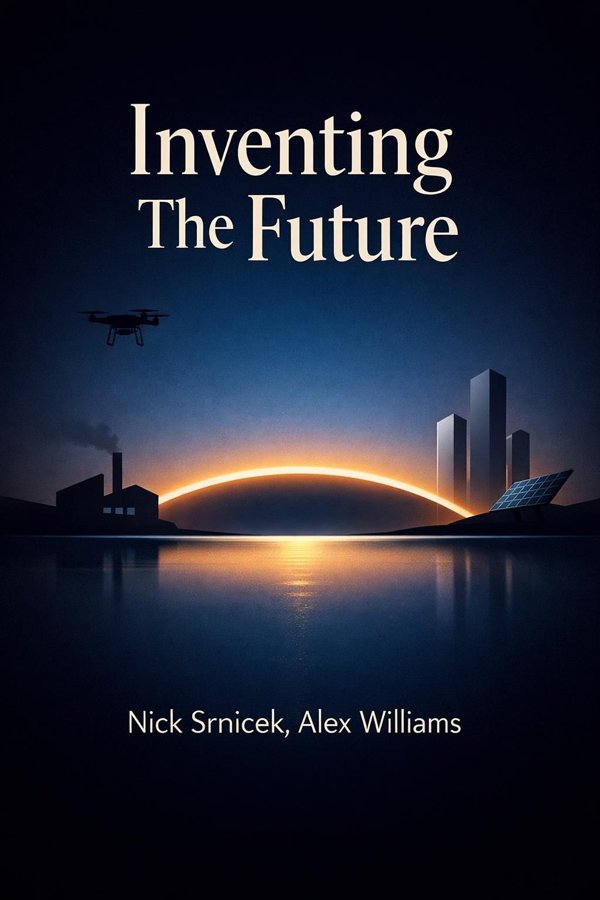
Inventing The Future: Postcapitalism And A World Without Work: Summary & Key Insights
by Nick Srnicek, Alex Williams
 10 min8 chaptersAudio available
What Is Inventing The Future: Postcapitalism And A World Without Work About?
Inventing The Future: Postcapitalism And A World Without Work by Nick Srnicek, Alex Williams is a politics book spanning 8 pages. Inventing the Future: Postcapitalism and a World Without Work is a major manifesto for a high-tech future free from work. The authors argue that neoliberalism has failed, forcing millions into poverty, and propose a radical transformation of society through automation, reduced working hours, and universal basic income to create a postcapitalist world.
This FizzRead summary covers all 8 key chapters of Inventing The Future: Postcapitalism And A World Without Work in approximately 10 minutes, distilling the most important ideas, arguments, and takeaways from Nick Srnicek, Alex Williams's work. Also available as an audio summary and Key Quotes Podcast.
Inventing The Future: Postcapitalism And A World Without Work
Inventing the Future: Postcapitalism and a World Without Work is a major manifesto for a high-tech future free from work. The authors argue that neoliberalism has failed, forcing millions into poverty, and propose a radical transformation of society through automation, reduced working hours, and universal basic income to create a postcapitalist world.
Who Should Read Inventing The Future: Postcapitalism And A World Without Work?
This book is perfect for anyone interested in politics and looking to gain actionable insights in a short read. Whether you're a student, professional, or lifelong learner, the key ideas from Inventing The Future: Postcapitalism And A World Without Work by Nick Srnicek, Alex Williams will help you think differently.
- ✓Readers who enjoy politics and want practical takeaways
- ✓Professionals looking to apply new ideas to their work and life
- ✓Anyone who wants the core insights of Inventing The Future: Postcapitalism And A World Without Work in just 10 minutes
Want the full summary?
Get instant access to this book summary and 100K+ more with Fizz Moment.
Get Free SummaryAvailable on App Store • Free to download
Key Chapters
When we speak of folk politics, we do not do so to deride the passion or sincerity that animates today’s social movements. Rather, we seek to name a pattern—a recurring disposition on the contemporary Left that valorizes immediacy, spontaneity, and prefigurative ethics at the expense of scale, mediation, and strategic duration. Folk politics is visible in the preference for local cooperatives over global organizations, for temporary occupations over enduring institutions, for personal moral purity over programmatic vision. It operates on the assumption that proximity and authenticity guarantee political virtue.
But power today is not local; it is abstract and planetary. Supply chains stretch across continents, algorithms coordinate financial flows in milliseconds, and international institutions set parameters that no municipality can escape. To respond to such a system with handcrafted politics is to remain permanently outmatched. The Occupy movement, which arose with so much promise, illustrated both the beauty and the limits of this logic: horizontal forms of organization fostered solidarity but prevented the creation of enduring political instruments capable of transforming the state or economy.
Our critique of folk politics is therefore also an invitation—to remember that winning matters. Symbolic gestures cannot build a postcapitalist world. What is needed is a shift from reactive to proactive politics, from protest to proposition. As long as we celebrate immediacy as the purest form of politics, we will remain spectators of history rather than architects of it. The challenge is to retain the democratic spirit of these movements while marrying it to modern forms of strategic coordination. Only then can we begin to operate on the scale at which capitalism itself functions.
To imagine the future, we must first understand how the present came to be. Neoliberalism did not win by accident; it was built deliberately, brick by intellectual brick. In the mid-twentieth century, figures like Friedrich Hayek, Milton Friedman, and their allies recognized that social democracy had consolidated a powerful consensus. Rather than retreating, they began constructing their own counter-hegemony through think tanks, academic networks, business alliances, and political institutions. Over decades, they crafted a coherent narrative—one that celebrated individual freedom, market efficiency, and the moral virtue of competition. By the 1970s, this architecture of ideas stood ready to seize the political crisis of Keynesianism and reshape the world.
This is the crucial lesson: politics is won not in moments of explosion but through sustained strategic preparation. When the crisis came, neoliberalism had its alternative ready to implement. For the Left today, this reveals both our weakness and our opportunity. We have the capacity to build global networks of theory, media, and policy that can rival the Right’s infrastructure—but only if we commit to long-term strategic thinking. The revival of intellectual courage, the establishment of institutions capable of developing and disseminating alternative visions, is not optional; it is the precondition for transformation.
To ‘invent the future’ means precisely this: to refuse the short-termism of both markets and movements, and to undertake the slow work of constructing a new consensus that can one day become common sense. Neoliberalism was invented. It can be superseded.
+ 6 more chapters — available in the FizzRead app
All Chapters in Inventing The Future: Postcapitalism And A World Without Work
About the Authors
Nick Srnicek is a British political theorist and lecturer known for his work on digital economy and postcapitalism. Alex Williams is a researcher and writer specializing in contemporary political theory and technology. Both are key figures in the left accelerationist movement.
Get This Summary in Your Preferred Format
Read or listen to the Inventing The Future: Postcapitalism And A World Without Work summary by Nick Srnicek, Alex Williams anytime, anywhere. FizzRead offers multiple formats so you can learn on your terms — all free.
Available formats: App · Audio · PDF · EPUB — All included free with FizzRead
Download Inventing The Future: Postcapitalism And A World Without Work PDF and EPUB Summary
Key Quotes from Inventing The Future: Postcapitalism And A World Without Work
“When we speak of folk politics, we do not do so to deride the passion or sincerity that animates today’s social movements.”
“To imagine the future, we must first understand how the present came to be.”
Frequently Asked Questions about Inventing The Future: Postcapitalism And A World Without Work
Inventing The Future: Postcapitalism And A World Without Work by Nick Srnicek, Alex Williams is a politics book that explores key ideas across 8 chapters. Inventing the Future: Postcapitalism and a World Without Work is a major manifesto for a high-tech future free from work. The authors argue that neoliberalism has failed, forcing millions into poverty, and propose a radical transformation of society through automation, reduced working hours, and universal basic income to create a postcapitalist world.
You Might Also Like

Antifa: The Anti-Fascist Handbook
Mark Bray
10 min
Attack from Within: How Disinformation Is Sabotaging America
Barbara McQuade
10 min
Coercion, Capital, and European States, AD 990–1992
Charles Tilly
10 min
Digital Democracy: Concepts, Methodologies, Tools, and Applications
Various Authors
10 min
Fascism
Stanley G. Payne
10 min
Fire And Fury: Inside The Trump White House
Michael Wolff
10 minBrowse by Category
Ready to read Inventing The Future: Postcapitalism And A World Without Work?
Get the full summary and 100K+ more books with Fizz Moment.