
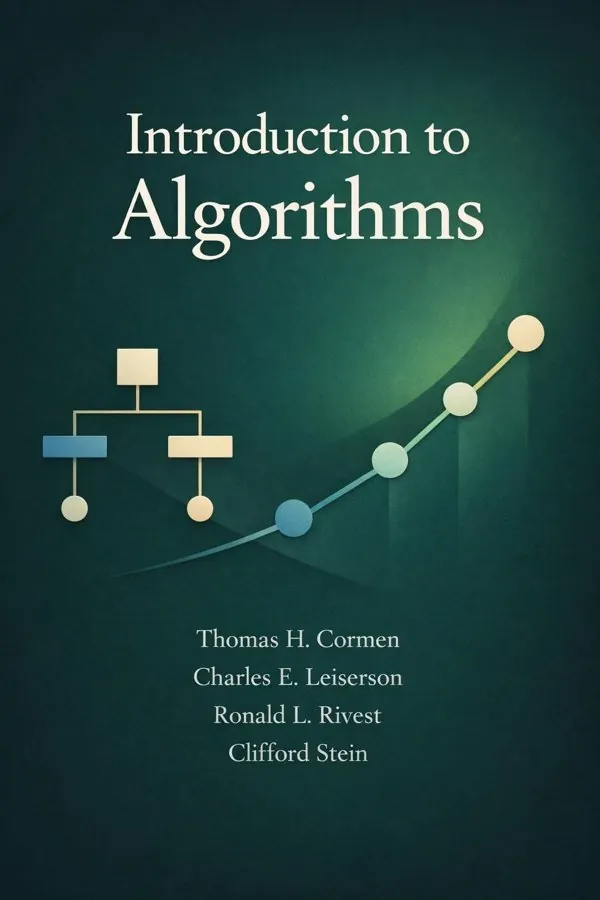
Introduction to Algorithms: Summary & Key Insights
by Thomas H. Cormen, Charles E. Leiserson, Ronald L. Rivest, Clifford Stein
 10 min9 chaptersAudio available
Key Takeaways from Introduction to Algorithms
Every algorithm works eventually on small inputs; the real question is what happens when the input stops being small.
Good algorithmic intuition is powerful, but intuition alone is unreliable when complexity rises.
If you want to understand algorithms deeply, study sorting.
An algorithm is only as effective as the data structure that supports it.
Many hard problems become manageable once you recognize the pattern hiding inside them.
What Is Introduction to Algorithms About?
Introduction to Algorithms by Thomas H. Cormen, Charles E. Leiserson, Ronald L. Rivest, Clifford Stein is a programming book spanning 8 pages. Introduction to Algorithms is one of the most important books ever written about how computers solve problems. More than a catalog of techniques, it is a deep, structured guide to algorithmic thinking: how to break a problem into steps, analyze the cost of those steps, and choose or design solutions that scale. The book moves from mathematical foundations and sorting methods to dynamic programming, graph algorithms, NP-completeness, approximation, randomized methods, and advanced topics such as string processing and computational geometry. What makes it enduring is its balance of rigor and usability. The authors present formal analysis and proofs, but they also show why these ideas matter in practice, from database operations and routing systems to scheduling, compression, and machine learning. Its authority is unmatched: Thomas H. Cormen, Charles E. Leiserson, Ronald L. Rivest, and Clifford Stein are leading computer scientists whose teaching and research helped shape modern computer science education. For students, engineers, and ambitious self-learners, this book is both a textbook and a lifelong reference on the logic that powers efficient software.
This FizzRead summary covers all 9 key chapters of Introduction to Algorithms in approximately 10 minutes, distilling the most important ideas, arguments, and takeaways from Thomas H. Cormen, Charles E. Leiserson, Ronald L. Rivest, Clifford Stein's work. Also available as an audio summary and Key Quotes Podcast.
Introduction to Algorithms
Introduction to Algorithms is one of the most important books ever written about how computers solve problems. More than a catalog of techniques, it is a deep, structured guide to algorithmic thinking: how to break a problem into steps, analyze the cost of those steps, and choose or design solutions that scale. The book moves from mathematical foundations and sorting methods to dynamic programming, graph algorithms, NP-completeness, approximation, randomized methods, and advanced topics such as string processing and computational geometry. What makes it enduring is its balance of rigor and usability. The authors present formal analysis and proofs, but they also show why these ideas matter in practice, from database operations and routing systems to scheduling, compression, and machine learning. Its authority is unmatched: Thomas H. Cormen, Charles E. Leiserson, Ronald L. Rivest, and Clifford Stein are leading computer scientists whose teaching and research helped shape modern computer science education. For students, engineers, and ambitious self-learners, this book is both a textbook and a lifelong reference on the logic that powers efficient software.
Who Should Read Introduction to Algorithms?
This book is perfect for anyone interested in programming and looking to gain actionable insights in a short read. Whether you're a student, professional, or lifelong learner, the key ideas from Introduction to Algorithms by Thomas H. Cormen, Charles E. Leiserson, Ronald L. Rivest, Clifford Stein will help you think differently.
- ✓Readers who enjoy programming and want practical takeaways
- ✓Professionals looking to apply new ideas to their work and life
- ✓Anyone who wants the core insights of Introduction to Algorithms in just 10 minutes
Want the full summary?
Get instant access to this book summary and 100K+ more with Fizz Moment.
Get Free SummaryAvailable on App Store • Free to download
Key Chapters
Every algorithm works eventually on small inputs; the real question is what happens when the input stops being small. That is the starting insight of Introduction to Algorithms. The book treats an algorithm not just as a sequence of instructions, but as an object that must be measured, compared, and justified. Efficiency matters because the difference between a linear-time method and a quadratic-time one can be the difference between a program finishing instantly and becoming unusable at scale.
The authors introduce asymptotic analysis to give a language for performance: big-O, big-Theta, and big-Omega describe growth rates as input size increases. Instead of obsessing over machine-specific details, they focus on how running time grows in the long term. This allows readers to compare algorithms fairly. A simple example is searching a sorted array: linear search examines elements one by one, while binary search repeatedly cuts the problem in half. On a list of millions of items, that difference is dramatic.
The book also emphasizes worst-case, average-case, and amortized thinking. An algorithm may be fast on average yet fail under pressure, or expensive occasionally but cheap overall. These distinctions matter in applications like database indexing, web services, and file systems, where predictable performance is often as important as raw speed.
The deeper lesson is that algorithm design is inseparable from analysis. You do not truly understand a solution until you can explain why it works and how much it costs. Actionable takeaway: whenever you evaluate code, ask two questions before anything else: is it correct, and how does its running time grow as the input scales?
Good algorithmic intuition is powerful, but intuition alone is unreliable when complexity rises. This book shows that mathematics is not there to intimidate readers; it exists to sharpen thought. Summations, logarithms, inequalities, recurrences, and probabilistic reasoning become tools for turning vague performance claims into precise conclusions.
A central example is recurrence analysis, which appears whenever an algorithm solves a problem by breaking it into smaller subproblems. Merge sort is the classic case: split the array, sort both halves, then merge the results. Its running time is naturally described by a recurrence relation rather than a single formula. The book teaches methods such as substitution, recursion trees, and the master method so readers can solve these expressions systematically. This mathematical machinery is not abstract decoration; it is how we understand why divide-and-conquer algorithms often scale so well.
The authors also use proof techniques like induction and loop invariants. A loop invariant, for instance, explains why insertion sort remains correct at every stage of execution. This kind of reasoning trains readers to think like careful engineers: not just “it seems to work,” but “here is why it must work.” Probabilistic tools extend this mindset to randomized algorithms, where the guarantee is often about expected behavior rather than deterministic outcomes.
In practical terms, these ideas help in performance tuning, system design, and technical interviewing. Engineers constantly need to reason about growth, prove correctness, and estimate trade-offs. Actionable takeaway: treat mathematical analysis as a design aid, not a separate academic exercise; if you can model your algorithm precisely, you can improve it confidently.
If you want to understand algorithms deeply, study sorting. Sorting may seem like a narrow task, but it exposes many of the field’s most important ideas: iterative improvement, recursion, partitioning, lower bounds, stability, and trade-offs between time and space. Introduction to Algorithms uses sorting not as filler material, but as a laboratory for algorithmic thinking.
The book presents methods such as insertion sort, merge sort, heapsort, quicksort, counting sort, radix sort, and bucket sort. Each reveals a different design philosophy. Insertion sort is simple and works well on small or nearly sorted inputs. Merge sort guarantees O(n log n) time and demonstrates divide-and-conquer elegantly. Heapsort relies on a carefully structured data representation to deliver strong worst-case performance. Quicksort is often fastest in practice despite weaker worst-case guarantees, showing that real-world performance can differ from theoretical extremes.
Order statistics broaden the topic further. Sometimes you do not need a fully sorted list; you only need the median or the kth smallest element. Selection algorithms solve that problem more efficiently than full sorting. This teaches an important engineering principle: solve exactly the problem you have, not a larger one by habit.
Sorting appears everywhere in practice: preparing data for binary search, organizing transaction records, ranking search results, scheduling tasks, and deduplicating large datasets. By comparing sorting methods, readers learn to match algorithms to context rather than worship a single “best” solution.
Actionable takeaway: when facing any performance problem, ask whether a familiar task like sorting hides a deeper design pattern you can reuse elsewhere.
An algorithm is only as effective as the data structure that supports it. One of the book’s most valuable lessons is that performance does not come from clever logic alone; it comes from representing information in a way that makes desired operations cheap. Choosing the wrong data structure can quietly turn a good idea into a slow system.
The text covers foundational structures such as stacks, queues, linked lists, hash tables, binary search trees, heaps, and disjoint-set structures, then extends into balanced trees and more advanced designs. Each structure embodies a particular trade-off. Arrays provide fast indexing but expensive insertions in the middle. Linked lists allow easier insertion and deletion but poor random access. Hash tables offer expected constant-time lookup, while balanced trees maintain order and support logarithmic updates.
These differences matter in real applications. A heap is ideal for priority scheduling, such as selecting the next task in an operating system or the next event in a simulation. A hash table supports fast dictionary operations for compilers, caches, and symbol tables. Union-find structures efficiently track connected components in network analysis or image segmentation. Balanced search trees power ordered maps, range queries, and dynamic sets.
The book makes clear that data structures and algorithms are inseparable. Dijkstra’s shortest-path algorithm, for example, performs very differently depending on how the priority queue is implemented. The abstract algorithm stays the same, but its practical speed changes dramatically.
Actionable takeaway: before optimizing code line by line, revisit the underlying data structure. Often the biggest speedup comes not from rewriting the algorithm, but from storing the data differently.
Many hard problems become manageable once you recognize the pattern hiding inside them. Introduction to Algorithms organizes a large part of the subject around three major design paradigms: divide-and-conquer, dynamic programming, and greedy algorithms. Each is a disciplined way of turning complexity into structure.
Divide-and-conquer works by decomposing a problem into smaller instances, solving them recursively, and combining the results. Merge sort and closest-pair algorithms illustrate how recursive decomposition can reduce enormous tasks to elegant repeated routines. Dynamic programming tackles overlapping subproblems and optimal substructure. Instead of recomputing the same answers repeatedly, it stores partial results and builds toward the final solution. Classic examples include matrix-chain multiplication, longest common subsequence, rod cutting, and shortest paths. These techniques show up in bioinformatics, natural language processing, and resource planning.
Greedy algorithms take a different route: make the best local choice at each step and prove that those local choices lead to a global optimum. Activity selection, Huffman coding, and minimum spanning trees demonstrate when greed is not reckless but mathematically justified. The key lesson is not that one paradigm is superior; it is that each fits certain structural conditions.
In professional software work, these patterns help teams move faster. Rather than inventing every solution from scratch, experienced engineers ask: does the problem split cleanly, reuse subproblems, or reward local choices? That question often reveals the right framework immediately.
Actionable takeaway: when you face a new problem, classify it before coding. Try to identify whether divide-and-conquer, dynamic programming, or a greedy strategy matches its structure.
Much of modern computing is really about relationships: roads between cities, links between web pages, dependencies between tasks, connections in social networks, or routes across communication systems. Graphs provide the language for these relationships, and this book shows how graph algorithms convert abstract connectivity into actionable solutions.
The text develops core algorithms for breadth-first search, depth-first search, topological sorting, strongly connected components, minimum spanning trees, and shortest paths. These are not isolated tricks. Breadth-first search finds shortest paths in unweighted networks and can model everything from friend recommendations to puzzle solving. Depth-first search uncovers structural properties such as cycles and connectivity, making it invaluable for compilers, dependency analysis, and scheduling. Topological sorting organizes tasks with prerequisites, like course planning or build systems.
Minimum spanning tree algorithms, such as Kruskal’s and Prim’s, solve network design problems efficiently: how do you connect many locations with minimal total cost? Shortest-path algorithms like Dijkstra’s and Bellman-Ford guide routing, navigation, and logistics platforms. The book also connects graph theory to flow problems, where one wants to maximize movement through a network under capacity constraints, a model used in transportation, matching markets, and communication networks.
What makes this section especially important is its demonstration that very different real-world systems share the same underlying structure. Once you can model a situation as a graph, a rich toolbox becomes available.
Actionable takeaway: when a problem involves entities plus relationships, redraw it as a graph. The right representation often exposes a proven algorithm you can apply immediately.
The most sobering lesson in algorithmics is that intelligence and effort are not always enough. Some problems resist efficient exact solutions, not because we have not tried hard enough, but because their structure appears intrinsically difficult. Introduction to Algorithms introduces computational complexity to help readers distinguish between tractable problems and those that likely cannot be solved efficiently.
The book explains classes such as P, NP, and NP-complete, showing how reductions link the difficulty of problems together. A reduction is a way of transforming one problem into another so that solving the second efficiently would also solve the first efficiently. This becomes a powerful tool for classifying new problems. Once a problem is shown to be NP-complete, expectations shift. Instead of searching endlessly for a perfect polynomial-time algorithm, we may focus on heuristics, approximation, or special cases.
This perspective has practical importance in scheduling, circuit design, routing, resource allocation, and combinatorial optimization. For example, the traveling salesperson problem captures the challenge of finding the shortest possible route through many locations. It is easy to state, useful in real logistics, and computationally difficult in general. Understanding that difficulty changes how engineers plan systems and promises.
Complexity theory also teaches intellectual humility. Not every performance issue can be fixed by cleaner code or faster hardware. Sometimes the problem itself is the bottleneck.
Actionable takeaway: when a problem remains stubbornly expensive, ask whether it belongs to a hard complexity class. Recognizing inherent difficulty early can save enormous time and lead you toward approximation or constrained formulations instead.
When exact certainty is too slow, controlled uncertainty can be surprisingly powerful. One of the book’s most modern and practical insights is that algorithms do not always need to be deterministic or exact to be valuable. Randomized and approximation algorithms widen the range of problems we can solve effectively.
Randomized algorithms use random choices as part of their logic. This can simplify design, improve expected performance, or avoid adversarial worst-case patterns. Randomized quicksort is the familiar example: by choosing pivots randomly, it achieves strong expected behavior even when inputs are unfriendly. Hashing also benefits from probabilistic reasoning, distributing keys more evenly across storage.
Approximation algorithms address optimization problems that are likely too hard to solve exactly in polynomial time. Instead of returning the perfect solution, they guarantee one that is provably close. For NP-hard problems in logistics, scheduling, and network design, this is often the difference between practicality and paralysis. A near-optimal route available in seconds can be more valuable than an exact route that requires days of computation.
The broader message is that algorithm design is not a moral contest between perfect and imperfect methods. It is about matching guarantees to real needs. Sometimes expected efficiency is good enough. Sometimes a bounded approximation is the only realistic choice. This mindset is crucial in large-scale systems, data science, and operations research, where speed, robustness, and quality must be balanced.
Actionable takeaway: if exact deterministic solutions are too costly, consider whether randomness or approximation can provide reliable performance with acceptable trade-offs.
A mature algorithms education does not end with sorting and graphs. The later parts of Introduction to Algorithms reveal how algorithmic principles extend into specialized domains that power modern computing. These chapters demonstrate that once core ideas are mastered, they can be adapted to very different types of data and hardware.
String algorithms become essential when data is textual, symbolic, or sequential. Pattern matching drives search engines, DNA sequence analysis, plagiarism detection, and command-line tools. Efficient methods prevent the naive cost of checking every pattern against every position. Computational geometry addresses problems involving points, segments, and spatial structure: collision detection in games, mapping software, robotics, computer-aided design, and geographic information systems all depend on geometric reasoning.
Parallelism adds another dimension altogether. Instead of asking only how many operations an algorithm performs, we ask how much work can be done simultaneously. This matters on multicore processors, distributed systems, GPUs, and large-scale data platforms. Some algorithms parallelize naturally, while others are limited by dependencies that force sequential execution. Understanding this distinction is essential for modern high-performance computing.
These topics underline one of the book’s strongest themes: algorithms are universal. The same disciplined thinking about representation, decomposition, and complexity applies whether you are scanning a genome, rendering a 3D scene, or coordinating thousands of processors.
Actionable takeaway: once you master core algorithmic patterns, deliberately apply them to a specialized domain. Real growth comes from transferring principles across contexts, not just memorizing standard textbook problems.
All Chapters in Introduction to Algorithms
About the Authors
Thomas H. Cormen, Charles E. Leiserson, Ronald L. Rivest, and Clifford Stein are among the most respected names in computer science. Cormen is a longtime educator and author known for making complex algorithmic ideas teachable. Leiserson, a professor at MIT, has made major contributions to algorithms and parallel computing. Rivest is a legendary cryptographer and one of the inventors of the RSA public-key cryptosystem, one of the foundations of modern digital security. Stein, a professor at Columbia University, is known for his work in algorithms, optimization, and computational biology. Together, they combined deep research expertise with exceptional teaching ability to create Introduction to Algorithms, a book that has shaped how generations of students and engineers learn the principles of efficient computation.
Get This Summary in Your Preferred Format
Read or listen to the Introduction to Algorithms summary by Thomas H. Cormen, Charles E. Leiserson, Ronald L. Rivest, Clifford Stein anytime, anywhere. FizzRead offers multiple formats so you can learn on your terms — all free.
Available formats: App · Audio · PDF · EPUB — All included free with FizzRead
Download Introduction to Algorithms PDF and EPUB Summary
Key Quotes from Introduction to Algorithms
“Every algorithm works eventually on small inputs; the real question is what happens when the input stops being small.”
“Good algorithmic intuition is powerful, but intuition alone is unreliable when complexity rises.”
“If you want to understand algorithms deeply, study sorting.”
“An algorithm is only as effective as the data structure that supports it.”
“Many hard problems become manageable once you recognize the pattern hiding inside them.”
Frequently Asked Questions about Introduction to Algorithms
Introduction to Algorithms by Thomas H. Cormen, Charles E. Leiserson, Ronald L. Rivest, Clifford Stein is a programming book that explores key ideas across 9 chapters. Introduction to Algorithms is one of the most important books ever written about how computers solve problems. More than a catalog of techniques, it is a deep, structured guide to algorithmic thinking: how to break a problem into steps, analyze the cost of those steps, and choose or design solutions that scale. The book moves from mathematical foundations and sorting methods to dynamic programming, graph algorithms, NP-completeness, approximation, randomized methods, and advanced topics such as string processing and computational geometry. What makes it enduring is its balance of rigor and usability. The authors present formal analysis and proofs, but they also show why these ideas matter in practice, from database operations and routing systems to scheduling, compression, and machine learning. Its authority is unmatched: Thomas H. Cormen, Charles E. Leiserson, Ronald L. Rivest, and Clifford Stein are leading computer scientists whose teaching and research helped shape modern computer science education. For students, engineers, and ambitious self-learners, this book is both a textbook and a lifelong reference on the logic that powers efficient software.
You Might Also Like

ANSI Common Lisp
Paul Graham
10 min
Automate the Boring Stuff with Python: Practical Programming for Total Beginners
Al Sweigart
10 min
Black Hat Python: Python Programming for Hackers and Pentesters
Justin Seitz
10 min
Building Microservices: Designing Fine-Grained Systems
Sam Newman
10 min
C++ Primer
Stanley B. Lippman, Josée Lajoie, Barbara E. Moo
10 min
Clean Code: A Handbook of Agile Software Craftsmanship
Robert C. Martin
10 minBrowse by Category
Ready to read Introduction to Algorithms?
Get the full summary and 100K+ more books with Fizz Moment.