
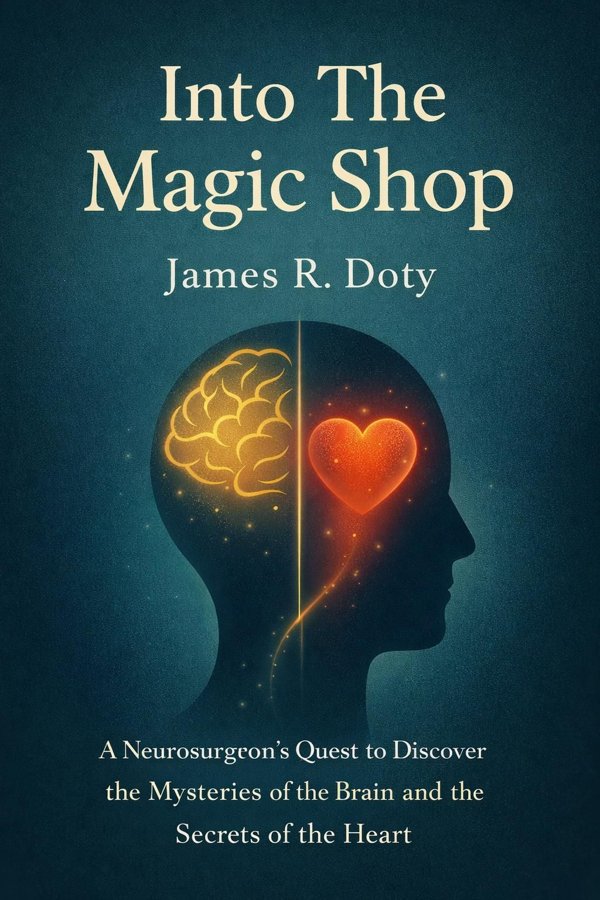
Into the Magic Shop: Summary & Key Insights
by James Doty
 10 min10 chaptersAudio available
Key Takeaways from Into the Magic Shop
Adversity does not only wound us; it also teaches us what kind of healing we will someday need.
Sometimes the most life-changing teachers arrive in ordinary disguises.
A restless mind cannot hold a clear future.
We move more powerfully toward what we can imagine clearly.
Achievement without compassion eventually feels hollow.
What Is Into the Magic Shop About?
Into the Magic Shop by James Doty is a memoir book published in 2016 spanning 10 pages. Into the Magic Shop is a memoir about how inner training can alter the course of an outer life. In this deeply personal book, James R. Doty recounts his journey from a chaotic childhood marked by poverty, addiction, and emotional instability to a career as a world-renowned neurosurgeon at Stanford. The pivot in that journey begins in an unlikely place: a small magic shop in Lancaster, California, where a woman named Ruth teaches him a set of practices for calming the mind, opening the heart, and directing intention. What first sounds mystical gradually becomes grounded in experience, neuroscience, and hard-earned wisdom. The book matters because it bridges worlds that are often kept apart: medicine and spirituality, ambition and compassion, success and meaning. Doty writes not as a detached self-help guru, but as someone who has known fear, shame, material success, and profound loss. His authority comes from both science and suffering. As a neurosurgeon, researcher, and founder of Stanford’s Center for Compassion and Altruism Research and Education, Doty is uniquely positioned to explore how attention, emotion, and kindness shape the brain—and ultimately shape a life.
This FizzRead summary covers all 10 key chapters of Into the Magic Shop in approximately 10 minutes, distilling the most important ideas, arguments, and takeaways from James Doty's work. Also available as an audio summary and Key Quotes Podcast.
Into the Magic Shop
Into the Magic Shop is a memoir about how inner training can alter the course of an outer life. In this deeply personal book, James R. Doty recounts his journey from a chaotic childhood marked by poverty, addiction, and emotional instability to a career as a world-renowned neurosurgeon at Stanford. The pivot in that journey begins in an unlikely place: a small magic shop in Lancaster, California, where a woman named Ruth teaches him a set of practices for calming the mind, opening the heart, and directing intention. What first sounds mystical gradually becomes grounded in experience, neuroscience, and hard-earned wisdom.
The book matters because it bridges worlds that are often kept apart: medicine and spirituality, ambition and compassion, success and meaning. Doty writes not as a detached self-help guru, but as someone who has known fear, shame, material success, and profound loss. His authority comes from both science and suffering. As a neurosurgeon, researcher, and founder of Stanford’s Center for Compassion and Altruism Research and Education, Doty is uniquely positioned to explore how attention, emotion, and kindness shape the brain—and ultimately shape a life.
Who Should Read Into the Magic Shop?
This book is perfect for anyone interested in memoir and looking to gain actionable insights in a short read. Whether you're a student, professional, or lifelong learner, the key ideas from Into the Magic Shop by James Doty will help you think differently.
- ✓Readers who enjoy memoir and want practical takeaways
- ✓Professionals looking to apply new ideas to their work and life
- ✓Anyone who wants the core insights of Into the Magic Shop in just 10 minutes
Want the full summary?
Get instant access to this book summary and 100K+ more with Fizz Moment.
Get Free SummaryAvailable on App Store • Free to download
Key Chapters
Adversity does not only wound us; it also teaches us what kind of healing we will someday need. Doty begins in Lancaster, California, where his early life was defined by instability. His father was an alcoholic, his mother struggled with severe depression, and money was scarce. Home was not a refuge but a source of confusion, fear, and emotional unpredictability. In that environment, a child learns to stay alert, to scan for danger, and to live with the constant feeling that life could collapse at any moment.
Doty’s account is important because it shows how deeply early experience shapes the nervous system. A chaotic home does not simply create bad memories; it can create a body and mind trained for stress. When survival becomes the priority, hope, imagination, and trust are harder to access. Yet Doty also shows that pain can create sensitivity. Growing up around suffering gave him an early encounter with vulnerability, even if he did not yet know how to respond to it constructively.
Many readers will recognize some version of this pattern in their own lives. Childhood may not have included alcoholism or poverty, but it may have included emotional neglect, anxiety, or instability. Doty’s story reminds us that our starting point matters, but it does not have to dictate our destination. Understanding our early conditioning is the first step toward changing it.
Actionable takeaway: Identify one belief or emotional habit from childhood that still shapes your reactions today, and write down how it affects your choices now.
Sometimes the most life-changing teachers arrive in ordinary disguises. Doty’s turning point begins when he wanders into a magic shop and meets Ruth, a woman who sees beyond his rough circumstances and offers him something far more powerful than tricks or illusions. Over several weeks, she teaches him practices that she presents as a kind of real magic: relax the body, quiet the mind, visualize clearly, and most importantly, open the heart.
What makes this encounter so compelling is that Ruth does not rescue Doty by giving him money, status, or escape. She gives him attention, presence, and instruction. For a boy who had little stability, her calm interest itself was transformative. She modeled a different way of being—one rooted in kindness rather than fear. Her lessons suggested that although he could not control every external condition, he could begin to influence his inner state.
Ruth’s role highlights a truth often overlooked in stories of achievement: transformation is relational. We often become who we are through the people who believe in us before we believe in ourselves. A mentor, therapist, teacher, coach, or even a single compassionate adult can interrupt a cycle of despair.
In practical terms, this idea encourages readers to take both sides seriously. Seek out wise people who help you expand rather than shrink. And when possible, become that person for someone else. A brief interaction delivered with genuine care can alter another person’s life trajectory.
Actionable takeaway: Think of one person who once offered you encouragement or guidance, and reach out with gratitude—or offer that same kind of encouragement to someone who needs it now.
A restless mind cannot hold a clear future. One of Ruth’s earliest lessons is that before intention can become effective, the mind must first be calmed. Doty learns techniques of relaxation and focused attention that help him settle the noise generated by fear, shame, and constant stress. This is not escapism. It is preparation. A mind caught in agitation is reactive; a calm mind can choose.
The book presents mental calm as both a spiritual and neurological practice. From a scientific perspective, chronic stress narrows perception and keeps the body in defensive mode. When we slow the breath, relax the body, and focus attention, we create conditions for greater emotional regulation and clearer thinking. What Ruth intuited, Doty later came to understand through neuroscience: the state of the nervous system shapes the quality of thought.
This idea is highly practical in modern life. Many people try to make major decisions while overstimulated, sleep-deprived, and emotionally flooded. They confuse urgency with clarity. Doty’s experience suggests that inner stillness is not a luxury but a prerequisite for wise action. Whether you are preparing for an exam, a difficult conversation, or a career move, your first task is not to force a result but to regulate your state.
Simple practices can help: sitting quietly for five minutes, breathing slowly, scanning the body for tension, or bringing attention back whenever the mind wanders. These are small acts, but repeated regularly, they reshape how we meet challenge.
Actionable takeaway: For the next seven days, spend five minutes daily practicing slow breathing and body relaxation before beginning important work.
We move more powerfully toward what we can imagine clearly. Another of Ruth’s lessons is the disciplined use of visualization: forming a vivid picture of the life one wants to create. For Doty, this was radical. His circumstances had trained him to expect limitation, not possibility. Visualization gave him a way to rehearse a different future before there was external evidence to support it.
The book does not present visualization as magical wish fulfillment. It works because attention influences behavior. When we repeatedly imagine a meaningful goal, we become more likely to notice opportunities, persist through setbacks, and align our actions with what we say we want. Intention organizes the mind. It helps separate passing desire from deeper commitment.
Doty’s story shows both the usefulness and the limits of this practice. Visualization can help a person envision medical school, financial stability, or a meaningful career. But it must be paired with effort, discipline, and courage. Intention without action becomes fantasy; action without intention becomes drift. The power lies in their combination.
Readers can apply this by creating a specific mental image rather than a vague hope. Instead of saying, “I want a better life,” imagine the details: the work you are doing, how you carry yourself, the people you serve, the habits you maintain. Repeated mental rehearsal can strengthen commitment and reduce self-sabotage.
Actionable takeaway: Choose one important goal and spend three minutes each day vividly imagining not just the outcome, but the daily actions required to achieve it.
Achievement without compassion eventually feels hollow. Perhaps the most important lesson Ruth gives Doty is that mental focus alone is not enough; the heart must also be open. This is the book’s central correction to many success narratives. You can train attention, build ambition, and attain wealth, yet still remain disconnected, anxious, and unsatisfied if you neglect kindness, empathy, and genuine human connection.
Doty learns that the heart is not opposed to intelligence or discipline. Instead, it gives them moral direction. Without compassion, our talents can become tools for ego, status, or domination. With compassion, they can become instruments of healing and service. This insight becomes especially meaningful later in Doty’s life, when he experiences professional success but also the emotional costs of losing touch with what matters.
The practical value of this idea is immense. In competitive cultures, people are often taught to harden themselves in order to succeed. But chronic emotional armor comes at a price: loneliness, numbness, and a shrinking capacity for joy. Opening the heart does not mean becoming naive or boundaryless. It means staying connected to one’s humanity and the humanity of others.
This can begin in small ways: listening without rushing, speaking more gently, noticing another person’s pain, or pausing before reacting defensively. Compassion is not sentimental. It is a disciplined willingness to remain present to suffering—our own and others’—without turning away.
Actionable takeaway: In your next conversation, focus fully on understanding the other person before trying to impress, correct, or persuade them.
External escape often begins with internal order. As Doty grows older, the lessons Ruth taught him become tools for navigating school, ambition, and the possibility of a life beyond Lancaster. His environment has not suddenly improved, but his relationship to it has changed. He begins to see that he is not only a product of his circumstances; he can also become an agent within them.
This is where the memoir becomes especially motivating. Doty does not portray transformation as dramatic or instantaneous. It unfolds through repeated choices: staying focused, persisting in education, believing that another future is possible, and resisting the fatalism that often grips people raised in hardship. The real breakthrough is not luck alone, but the gradual development of self-command.
For readers, this idea is a reminder that adversity requires both vision and structure. Hope matters, but so do habits. A dream without a system easily collapses under pressure. Whether someone is trying to leave a dead-end job, recover from family dysfunction, or return to school, progress often depends on simple disciplines carried out consistently over time.
Doty’s story also highlights the emotional challenge of outgrowing one’s origin. Leaving behind limiting environments can provoke guilt, fear, and self-doubt. Inner practices help because they create a stable center amid external change.
Actionable takeaway: Identify one routine that would support your next stage of growth—such as studying daily, saving money weekly, or limiting distractions—and commit to it for 30 days.
Success can become a seduction when it promises to heal wounds it cannot actually touch. As Doty advances in medicine and eventually attains wealth and status, he discovers a difficult truth: the tools that helped him rise can also become distorted by ego. Ambition, once a vehicle for liberation, begins to drift toward acquisition, image, and self-importance. He reaches impressive heights, yet finds himself increasingly disconnected from the deeper lessons Ruth taught him.
This section of the book adds moral complexity to the memoir. Doty does not present himself as someone who learned wisdom once and then lived it perfectly. He shows how easy it is to substitute achievement for meaning. Wealth and recognition can create the illusion of fulfillment while quietly intensifying emptiness if they are not grounded in compassion and purpose.
The lesson here is not that ambition is bad. Doty’s life demonstrates the value of striving, discipline, and excellence. The warning is that ambition needs a compass. If success becomes mainly about proving worth, outrunning shame, or collecting external validation, it will never feel like enough. What once energized us can begin to consume us.
This idea is especially relevant for high performers—students, entrepreneurs, doctors, executives—who are praised for results but rarely invited to ask what those results are for. Doty’s story encourages a more mature ambition, one linked to contribution rather than ego inflation.
Actionable takeaway: Ask yourself about one major goal: “If I achieve this, who will I become?” If the answer centers only on status, redefine the goal to include service and integrity.
Some truths are felt long before they are measured. As a neurosurgeon and researcher, Doty eventually explores through science what Ruth had taught him experientially: attention, emotional regulation, and compassion affect the brain and body in profound ways. This gives the memoir one of its most distinctive strengths. It is not merely a personal story of inspiration; it is also an argument that inner practices have biological consequences.
Doty’s work helps bridge skepticism and spirituality. Practices like meditation, visualization, and compassion training are often dismissed as soft or vague. Yet neuroscience increasingly shows that repeated mental and emotional habits shape neural pathways, stress responses, and interpersonal behavior. The brain is plastic, not fixed. What we practice, we strengthen.
This matters because it reframes personal growth. Becoming calmer, kinder, or more focused is not just a matter of personality. It is a trainable process. Compassion, too, is not only a moral ideal; it can be cultivated deliberately. By linking contemplative practices with research, Doty expands the conversation beyond memoir into a broader understanding of human potential.
For everyday readers, this means that small inner exercises are more consequential than they appear. A daily meditation, a gratitude practice, or a conscious pause before reacting is not trivial. Over time, such habits help create a different nervous system and therefore a different life.
Actionable takeaway: Treat one inner practice—such as meditation, gratitude, or compassion reflection—as brain training, and repeat it consistently for two weeks before judging its value.
True success matures into service. One of the clearest expressions of Doty’s later life is the founding of Stanford’s Center for Compassion and Altruism Research and Education, known as CCARE. This work represents a return to the deepest part of Ruth’s teaching: that the most meaningful use of knowledge is not self-glorification but the alleviation of suffering.
CCARE symbolizes the integration of Doty’s two worlds. On one side is rigorous science, with its studies, evidence, and institutional credibility. On the other is the lived wisdom of compassion, mindfulness, and heart-centered intention. By bringing these together, Doty helped create a space where empathy and altruism could be studied seriously rather than dismissed as sentimental extras.
The importance of this idea goes beyond the institution itself. It suggests that personal healing reaches completion when it becomes communal. The question is no longer only, “How can I improve my life?” but also, “How can what I have learned benefit others?” This shift from self-focus to contribution is one of the clearest markers of growth in the book.
Readers do not need to found a center at Stanford to apply the lesson. Service can begin where you are: mentoring younger colleagues, supporting a struggling family member, volunteering, or simply bringing more compassion into your profession. What matters is using your skills in a way that enlarges life beyond the self.
Actionable takeaway: Choose one concrete act of service this week that uses a strength you already have to reduce someone else’s burden.
The deepest transformation is not becoming powerful; it is becoming whole. By the end of Into the Magic Shop, Doty’s journey points to a unifying insight: the mind and heart are not rival centers of human life but partners. The brain offers focus, planning, and adaptability. The heart offers compassion, meaning, and connection. When one is developed without the other, life becomes distorted. When both are cultivated together, healing becomes possible.
This is the memoir’s ultimate message. We often divide ourselves into categories—rational or emotional, scientific or spiritual, ambitious or kind. Doty argues through story that these oppositions are false. The most effective, grounded, and humane life is built through integration. The capacity to regulate attention, imagine possibility, and pursue goals is strengthened—not weakened—by empathy and love.
The book also offers a more generous definition of healing. It does not mean erasing the past or never failing again. Doty remains shaped by his childhood, his errors, and his losses. Healing means no longer being ruled by them. It means creating enough inner space to respond rather than react, to care rather than harden, and to live with intention rather than compulsion.
For readers, this final synthesis is both inspiring and demanding. It asks us not just to optimize performance, but to examine character. What kind of nervous system are we building? What kind of heart are we protecting—or neglecting?
Actionable takeaway: Create a daily two-part practice: spend a few minutes training attention in silence, then a few minutes intentionally generating goodwill toward yourself and others.
All Chapters in Into the Magic Shop
About the Author
James R. Doty, M.D., is an American neurosurgeon, professor, researcher, and author whose work explores the connection between the brain, compassion, and human flourishing. He is a clinical professor of neurosurgery at Stanford University and the founder and director of the Center for Compassion and Altruism Research and Education, known as CCARE. Doty has spent much of his career examining how mindfulness, empathy, and emotional regulation affect both health and behavior. His writing is shaped not only by his scientific expertise but also by his personal history of growing up in poverty and instability. That combination gives his work unusual depth and credibility. In Into the Magic Shop, he brings together memoir and neuroscience to show how intention and compassion can profoundly reshape a life.
Get This Summary in Your Preferred Format
Read or listen to the Into the Magic Shop summary by James Doty anytime, anywhere. FizzRead offers multiple formats so you can learn on your terms — all free.
Available formats: App · Audio · PDF · EPUB — All included free with FizzRead
Download Into the Magic Shop PDF and EPUB Summary
Key Quotes from Into the Magic Shop
“Adversity does not only wound us; it also teaches us what kind of healing we will someday need.”
“Sometimes the most life-changing teachers arrive in ordinary disguises.”
“A restless mind cannot hold a clear future.”
“We move more powerfully toward what we can imagine clearly.”
“Achievement without compassion eventually feels hollow.”
Frequently Asked Questions about Into the Magic Shop
Into the Magic Shop by James Doty is a memoir book that explores key ideas across 10 chapters. Into the Magic Shop is a memoir about how inner training can alter the course of an outer life. In this deeply personal book, James R. Doty recounts his journey from a chaotic childhood marked by poverty, addiction, and emotional instability to a career as a world-renowned neurosurgeon at Stanford. The pivot in that journey begins in an unlikely place: a small magic shop in Lancaster, California, where a woman named Ruth teaches him a set of practices for calming the mind, opening the heart, and directing intention. What first sounds mystical gradually becomes grounded in experience, neuroscience, and hard-earned wisdom. The book matters because it bridges worlds that are often kept apart: medicine and spirituality, ambition and compassion, success and meaning. Doty writes not as a detached self-help guru, but as someone who has known fear, shame, material success, and profound loss. His authority comes from both science and suffering. As a neurosurgeon, researcher, and founder of Stanford’s Center for Compassion and Altruism Research and Education, Doty is uniquely positioned to explore how attention, emotion, and kindness shape the brain—and ultimately shape a life.
You Might Also Like






Featured In
Browse by Category
Ready to read Into the Magic Shop?
Get the full summary and 100K+ more books with Fizz Moment.