
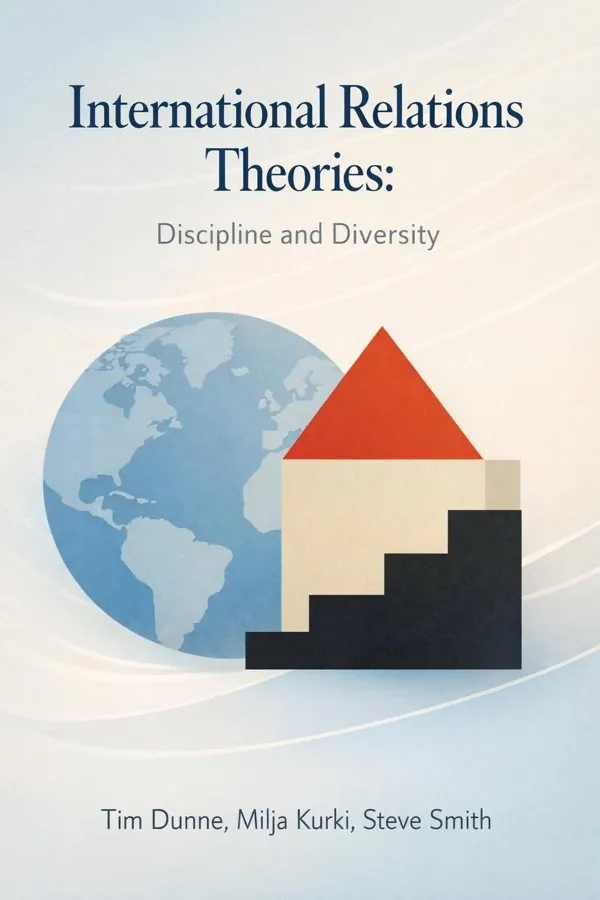
International Relations Theories: Discipline and Diversity: Summary & Key Insights
by Tim Dunne, Milja Kurki, Steve Smith
 10 min12 chaptersAudio available
What Is International Relations Theories: Discipline and Diversity About?
International Relations Theories: Discipline and Diversity by Tim Dunne, Milja Kurki, Steve Smith is a politics book spanning 12 pages. This comprehensive textbook provides an authoritative overview of the main theoretical approaches in the field of international relations. It explores realism, liberalism, constructivism, Marxism, feminism, postcolonialism, and other perspectives, emphasizing their historical development, key concepts, and contemporary relevance. The book encourages critical engagement with the discipline’s diversity and the debates that shape global politics.
This FizzRead summary covers all 12 key chapters of International Relations Theories: Discipline and Diversity in approximately 10 minutes, distilling the most important ideas, arguments, and takeaways from Tim Dunne, Milja Kurki, Steve Smith's work. Also available as an audio summary and Key Quotes Podcast.
International Relations Theories: Discipline and Diversity
This comprehensive textbook provides an authoritative overview of the main theoretical approaches in the field of international relations. It explores realism, liberalism, constructivism, Marxism, feminism, postcolonialism, and other perspectives, emphasizing their historical development, key concepts, and contemporary relevance. The book encourages critical engagement with the discipline’s diversity and the debates that shape global politics.
Who Should Read International Relations Theories: Discipline and Diversity?
This book is perfect for anyone interested in politics and looking to gain actionable insights in a short read. Whether you're a student, professional, or lifelong learner, the key ideas from International Relations Theories: Discipline and Diversity by Tim Dunne, Milja Kurki, Steve Smith will help you think differently.
- ✓Readers who enjoy politics and want practical takeaways
- ✓Professionals looking to apply new ideas to their work and life
- ✓Anyone who wants the core insights of International Relations Theories: Discipline and Diversity in just 10 minutes
Want the full summary?
Get instant access to this book summary and 100K+ more with Fizz Moment.
Get Free SummaryAvailable on App Store • Free to download
Key Chapters
Let us begin with the theory that has shaped international relations more powerfully than any other: realism. The realist tradition starts from a core premise—that the international system is anarchic, meaning no higher authority stands above states. In such a world, states must rely on themselves to survive, accumulating power to secure their interests. Classical realists such as Hans Morgenthau viewed this struggle as rooted in a tragic truth about human nature: people, and therefore states, are driven by the desire for power and fear of insecurity. A moral project to eliminate conflict is therefore doomed; the best we can hope for is a prudent balance of power.
Later, neorealists like Kenneth Waltz refined this into a structural argument, suggesting that human nature is less important than the distribution of capabilities among states. Whether a system is bipolar, unipolar, or multipolar determines how actors behave. Realism’s unifying logic is that survival compels rational behavior under conditions of uncertainty. Cooperation is fleeting; alliances form and dissolve according to shifts in relative power.
Yet realism, despite its apparent simplicity, contains many variations. Defensive realists counsel restraint, warning that overexpansion triggers counterbalancing, while offensive realists argue that states must seek dominance to prevent vulnerability. More recent realist scholarship engages with nontraditional concerns such as regional orders, nuclear deterrence, and power transitions in Asia, reminding us that realism evolves in response to new realities.
The realism chapter in our book does not glorify cynicism; rather, it emphasizes realism’s enduring relevance as a warning against naïveté. Realism reminds us that aspirations for world governance must contend with the stubborn persistence of sovereign interests. What it offers is clarity—a sobering reminder that the international realm, at its core, is a place where survival often trumps harmony.
If realism teaches us caution, liberalism teaches hope. Liberalism begins with the conviction that human beings possess a capacity for reason and moral progress. It envisions international politics not as an endless struggle for dominance, but as a space where cooperation and institutional development are possible. Historically, liberalism emerged alongside Enlightenment thought and expanded through the rise of democracy and global commerce. In this tradition, peace is not a naïve dream but an achievable outcome when societies become interdependent.
Liberal institutionalism, developed in reaction to realism, argues that institutions—whether international organizations, regimes, or laws—help mitigate anarchy by providing information, reducing uncertainty, and enforcing rules. Neoliberal thought, exemplified by Robert Keohane and Joseph Nye, recognizes that states remain self-interested but sees cooperation as rational when long-term benefits outweigh short-term gains. The democratic peace thesis extends this optimism further by claiming that democracies, bound by internal norms of transparency and accountability, are less likely to fight each other.
In today’s interconnected world, liberalism’s insights resonate in the architecture of global governance: the United Nations, the World Trade Organization, and networks of international cooperation. But liberalism is not without critique. It has been challenged for privileging Western conceptions of democracy and globalization that often exclude marginalized voices. Yet, its fundamental idea—that international politics can be improved through institutions and shared norms—forms the backbone of many global arrangements.
When I reflect on liberalism, I see a theory that dares to imagine progress without denying hardship. It teaches that while power constrains behavior, ideas and mutual interests can shape outcomes. Liberalism is the discipline’s moral compass, urging us to design cooperative frameworks even within a contested world.
+ 10 more chapters — available in the FizzRead app
All Chapters in International Relations Theories: Discipline and Diversity
About the Authors
Tim Dunne is a Professor of International Relations and Provost at the University of Surrey. Milja Kurki is a Professor of International Relations at Aberystwyth University. Steve Smith is a Professor of International Studies and former Vice-Chancellor of the University of Exeter. All three are leading scholars in the field of international relations theory.
Get This Summary in Your Preferred Format
Read or listen to the International Relations Theories: Discipline and Diversity summary by Tim Dunne, Milja Kurki, Steve Smith anytime, anywhere. FizzRead offers multiple formats so you can learn on your terms — all free.
Available formats: App · Audio · PDF · EPUB — All included free with FizzRead
Download International Relations Theories: Discipline and Diversity PDF and EPUB Summary
Key Quotes from International Relations Theories: Discipline and Diversity
“Let us begin with the theory that has shaped international relations more powerfully than any other: realism.”
“If realism teaches us caution, liberalism teaches hope.”
Frequently Asked Questions about International Relations Theories: Discipline and Diversity
International Relations Theories: Discipline and Diversity by Tim Dunne, Milja Kurki, Steve Smith is a politics book that explores key ideas across 12 chapters. This comprehensive textbook provides an authoritative overview of the main theoretical approaches in the field of international relations. It explores realism, liberalism, constructivism, Marxism, feminism, postcolonialism, and other perspectives, emphasizing their historical development, key concepts, and contemporary relevance. The book encourages critical engagement with the discipline’s diversity and the debates that shape global politics.
You Might Also Like
Antifa: The Anti-Fascist Handbook
Mark Bray
10 min
Attack from Within: How Disinformation Is Sabotaging America
Barbara McQuade
10 min
Coercion, Capital, and European States, AD 990–1992
Charles Tilly
10 min
Digital Democracy: Concepts, Methodologies, Tools, and Applications
Various Authors
10 min
Fascism
Stanley G. Payne
10 min
Fire And Fury: Inside The Trump White House
Michael Wolff
10 minBrowse by Category
Ready to read International Relations Theories: Discipline and Diversity?
Get the full summary and 100K+ more books with Fizz Moment.