
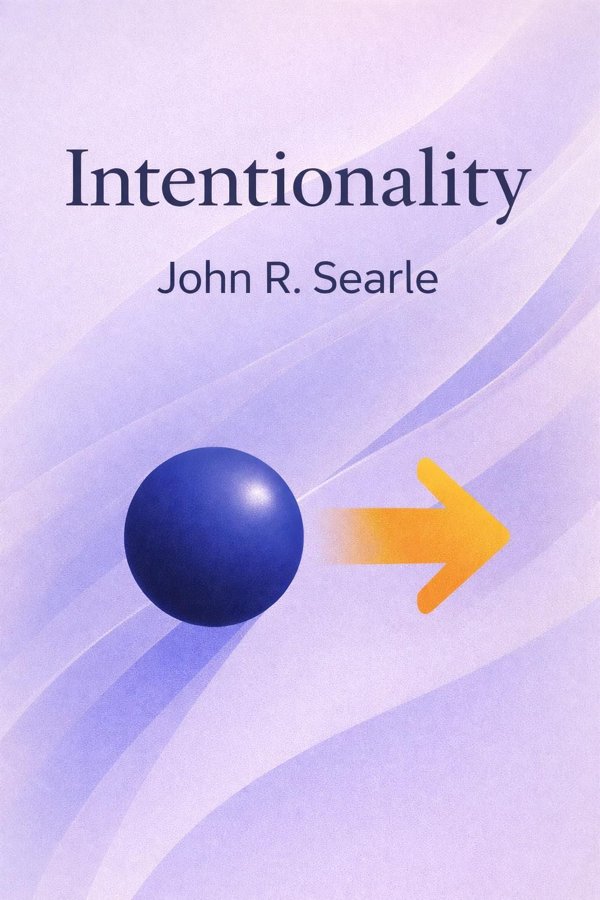
Intentionality: Summary & Key Insights
 10 min6 chaptersAudio available
What Is Intentionality About?
Intentionality by John R. Searle is a western_phil book spanning 6 pages. Intentionality: An Essay in the Philosophy of Mind es una obra fundamental del filósofo estadounidense John R. Searle, publicada originalmente en 1983. En este libro, Searle desarrolla una teoría sistemática sobre la intencionalidad, el rasgo de los estados mentales que los hace ser acerca de algo o dirigidos hacia objetos y estados de cosas. Explora cómo la mente representa el mundo y cómo los actos de pensamiento, percepción y lenguaje se relacionan con la realidad externa.
This FizzRead summary covers all 6 key chapters of Intentionality in approximately 10 minutes, distilling the most important ideas, arguments, and takeaways from John R. Searle's work. Also available as an audio summary and Key Quotes Podcast.
Intentionality
Intentionality: An Essay in the Philosophy of Mind es una obra fundamental del filósofo estadounidense John R. Searle, publicada originalmente en 1983. En este libro, Searle desarrolla una teoría sistemática sobre la intencionalidad, el rasgo de los estados mentales que los hace ser acerca de algo o dirigidos hacia objetos y estados de cosas. Explora cómo la mente representa el mundo y cómo los actos de pensamiento, percepción y lenguaje se relacionan con la realidad externa.
Who Should Read Intentionality?
This book is perfect for anyone interested in western_phil and looking to gain actionable insights in a short read. Whether you're a student, professional, or lifelong learner, the key ideas from Intentionality by John R. Searle will help you think differently.
- ✓Readers who enjoy western_phil and want practical takeaways
- ✓Professionals looking to apply new ideas to their work and life
- ✓Anyone who wants the core insights of Intentionality in just 10 minutes
Want the full summary?
Get instant access to this book summary and 100K+ more with Fizz Moment.
Get Free SummaryAvailable on App Store • Free to download
Key Chapters
To grasp intentionality, one must first survey its intellectual lineage. Brentano reintroduced the term to modern philosophy, defining intentionality as the mark of the mental: all mental phenomena are characterized by an intentional inexistence, an orientation toward an object. Descartes had already placed mental reality within the domain of the res cogitans—the thinking substance—but his dualism left the relationship between thought and world obscure. Brentano sought to restore this relation by describing intentionality as an intrinsic feature of mental acts.
Yet Brentano’s formulation, though revolutionary, raised as many problems as it solved. How could a thought be about something that did not exist, such as a unicorn or a golden mountain? Husserl extended Brentano’s idea through phenomenology, positing that consciousness is always consciousness of something, structured by intentional content. His analysis revealed the internal structure of intentional acts—the noesis (act) and noema (object as intended)—a distinction that guided continental and analytic thinkers alike.
I draw from these traditions but move beyond them. My goal is to reconcile the phenomenological insight into the directedness of consciousness with a naturalistic theory of mind. Against the Cartesian model of mental representation as a purely inner occurrence, I argue for intentionality as a feature of certain biological states, realized in brains. Against Brentano’s notion of intentional inexistence, I hold that intentionality can be understood in terms of satisfaction conditions, not ontological mysteries. And against Husserl’s transcendental approach, I propose an account that makes intentional phenomena causal and empirical, integrated into the world of science.
This historical descent, then, is not a mere recounting of predecessors. It is a way of clarifying what I take to be at stake: whether we can hold on to the irreducibly representational character of mental life without positing a separate mental realm. Intentionality must remain a phenomenon of meaning, but one that can be described within a unified natural world.
At the foundation of my theory lies the distinction between the psychological mode and the intentional content of a mental state. When I believe that it is raining, when I hope that it will stop, and when I fear that it will continue—all these states share the same content (it is raining) but differ in psychological mode (belief, hope, fear). The mode defines the kind of state it is, the attitude taken toward the represented content. The content, in turn, specifies what the state is about, the condition under which it would succeed or fail.
This conceptual separation enables us to analyze the intricate ways in which mental states relate both to the subject and the world. The psychological mode determines the type of fit we expect between mind and world, whereas the content defines the conditions of satisfaction. A belief aims to match reality; its success depends on truth. A desire aims to bring reality into conformity with its content; its success depends on fulfillment. Thus, even though both share intentional content, their internal structure dictates different directions of fit.
In developing this analysis, I insist that intentionality is not exhausted by content alone. The mode is essential, for it constitutes the internal character of mental life. Without the mode, we would have mere content-like entities detached from the experience of believing, doubting, imagining, or intending. Understanding intentionality, therefore, requires an appreciation of both the object-directed nature and the subjective attitude embedded within every mental state.
This structural view provides the scaffolding for all that follows in the book. It allows us to articulate not only how the mind can represent but also how those representations can be true, false, satisfied, frustrated, or otherwise causally effective. By focusing on this inner architecture, intentionality begins to appear not as an occult power but as a systematic feature of mental organization.
+ 4 more chapters — available in the FizzRead app
All Chapters in Intentionality
About the Author
John R. Searle es un filósofo estadounidense nacido en 1932, conocido por sus contribuciones a la filosofía del lenguaje, la filosofía de la mente y la teoría de los actos de habla. Profesor en la Universidad de California, Berkeley, Searle ha influido profundamente en la filosofía contemporánea con obras como Speech Acts, Intentionality y The Construction of Social Reality.
Get This Summary in Your Preferred Format
Read or listen to the Intentionality summary by John R. Searle anytime, anywhere. FizzRead offers multiple formats so you can learn on your terms — all free.
Available formats: App · Audio · PDF · EPUB — All included free with FizzRead
Download Intentionality PDF and EPUB Summary
Key Quotes from Intentionality
“To grasp intentionality, one must first survey its intellectual lineage.”
“At the foundation of my theory lies the distinction between the psychological mode and the intentional content of a mental state.”
Frequently Asked Questions about Intentionality
Intentionality by John R. Searle is a western_phil book that explores key ideas across 6 chapters. Intentionality: An Essay in the Philosophy of Mind es una obra fundamental del filósofo estadounidense John R. Searle, publicada originalmente en 1983. En este libro, Searle desarrolla una teoría sistemática sobre la intencionalidad, el rasgo de los estados mentales que los hace ser acerca de algo o dirigidos hacia objetos y estados de cosas. Explora cómo la mente representa el mundo y cómo los actos de pensamiento, percepción y lenguaje se relacionan con la realidad externa.
You Might Also Like
A Little History of Philosophy
Nigel Warburton
10 min
Areopagitica
John Milton
10 min
How To Think Like A Philosopher: Essential Principles For Clear Thinking
Peter Cave
10 min
Language, Truth and Logic
A. J. Ayer
10 min
The Age of Reason
Thomas Paine
10 min
The Essays
Michel De Montaigne
10 minBrowse by Category
Ready to read Intentionality?
Get the full summary and 100K+ more books with Fizz Moment.