
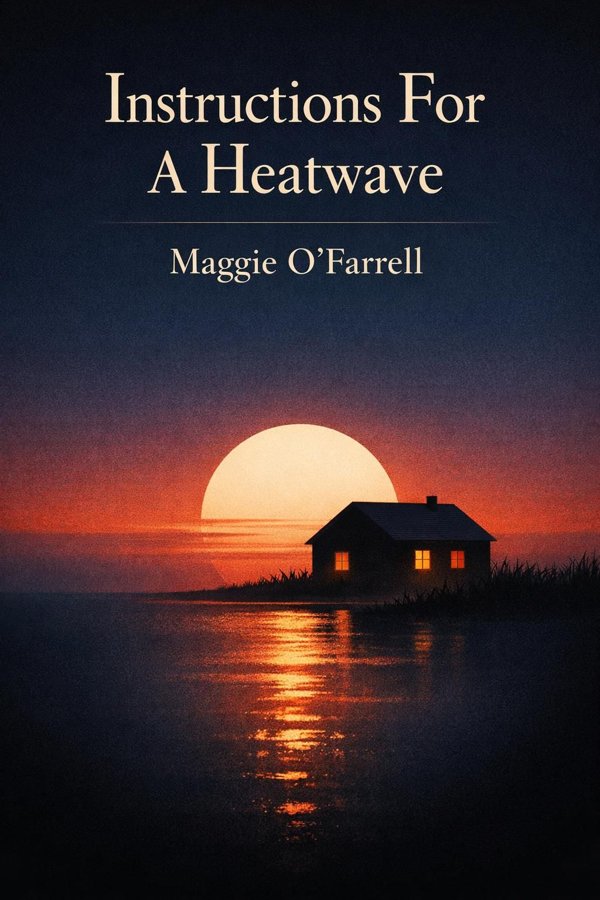
Instructions For A Heatwave: Summary & Key Insights
 10 min9 chaptersAudio available
Key Takeaways from Instructions For A Heatwave
Sometimes the most devastating events arrive disguised as routine.
A crisis can shatter denial, but it can also create clarity.
Families do not stop shaping us when we become adults; they simply change the form of their influence.
The past is never finished when it has been buried instead of understood.
Weather in fiction often creates atmosphere, but here it also becomes argument.
What Is Instructions For A Heatwave About?
Instructions For A Heatwave by Maggie O'Farrell is a bestsellers book spanning 4 pages. Set against the sweltering backdrop of Britain’s unforgettable summer of 1976, Instructions For A Heatwave begins with a small, ordinary act that turns seismic: Robert Riordan steps out to buy a newspaper and does not return. His disappearance pulls his wife, Gretta, and their three adult children back into the same emotional orbit, forcing them to confront years of silence, misunderstanding, and buried pain. What unfolds is not a mystery in the conventional sense, but a deeply human portrait of a family under pressure. Maggie O’Farrell uses the heatwave brilliantly, turning weather into metaphor. The oppressive heat mirrors the family’s emotional climate: tense, airless, and ready to break. As old wounds reopen, the novel explores marriage, parenthood, Irish identity, memory, and the uneasy bond between love and resentment. O’Farrell is especially gifted at capturing how families communicate indirectly—through omission, habit, and half-truths—as much as through words. This novel matters because it understands a difficult truth: families are shaped as much by what they refuse to discuss as by what they share. With compassion, wit, and psychological precision, O’Farrell shows how crisis can expose fragility, but also create the possibility of renewal.
This FizzRead summary covers all 9 key chapters of Instructions For A Heatwave in approximately 10 minutes, distilling the most important ideas, arguments, and takeaways from Maggie O'Farrell's work. Also available as an audio summary and Key Quotes Podcast.
Instructions For A Heatwave
Set against the sweltering backdrop of Britain’s unforgettable summer of 1976, Instructions For A Heatwave begins with a small, ordinary act that turns seismic: Robert Riordan steps out to buy a newspaper and does not return. His disappearance pulls his wife, Gretta, and their three adult children back into the same emotional orbit, forcing them to confront years of silence, misunderstanding, and buried pain. What unfolds is not a mystery in the conventional sense, but a deeply human portrait of a family under pressure.
Maggie O’Farrell uses the heatwave brilliantly, turning weather into metaphor. The oppressive heat mirrors the family’s emotional climate: tense, airless, and ready to break. As old wounds reopen, the novel explores marriage, parenthood, Irish identity, memory, and the uneasy bond between love and resentment. O’Farrell is especially gifted at capturing how families communicate indirectly—through omission, habit, and half-truths—as much as through words.
This novel matters because it understands a difficult truth: families are shaped as much by what they refuse to discuss as by what they share. With compassion, wit, and psychological precision, O’Farrell shows how crisis can expose fragility, but also create the possibility of renewal.
Who Should Read Instructions For A Heatwave?
This book is perfect for anyone interested in bestsellers and looking to gain actionable insights in a short read. Whether you're a student, professional, or lifelong learner, the key ideas from Instructions For A Heatwave by Maggie O'Farrell will help you think differently.
- ✓Readers who enjoy bestsellers and want practical takeaways
- ✓Professionals looking to apply new ideas to their work and life
- ✓Anyone who wants the core insights of Instructions For A Heatwave in just 10 minutes
Want the full summary?
Get instant access to this book summary and 100K+ more with Fizz Moment.
Get Free SummaryAvailable on App Store • Free to download
Key Chapters
Sometimes the most devastating events arrive disguised as routine. In Instructions For A Heatwave, Robert Riordan’s disappearance begins with an everyday errand: he leaves home to buy a newspaper and simply never comes back. That small rupture carries enormous force because it exposes something the family has long tried to ignore. Robert’s absence is not just shocking; it feels like the consequence of years of emotional distance, habitual silence, and accumulated disappointment.
O’Farrell uses this event to show how a family can function for years on unstable ground. From the outside, the Riordans appear ordinary enough. But Robert’s decision to leave reveals the fragility beneath the surface. His disappearance acts like a crack in a dam, allowing suppressed feelings to surge forward. Gretta must face the possibility that she never truly understood her husband’s private despair. Their children are forced to ask whether they knew either parent at all.
In real life, families often mistake continuity for stability. Shared routines—meals, calls, holidays, obligations—can conceal unresolved hurt. A marriage can continue without intimacy. Adult children can remain connected to parents while understanding very little about their inner lives. O’Farrell reminds us that crisis rarely creates dysfunction from nothing; more often, it exposes what was already there.
The power of Robert’s disappearance also lies in its refusal to offer immediate explanation. People do not always leave with dramatic speeches. Sometimes they retreat because they no longer know how to stay. That ambiguity makes the novel more truthful and unsettling.
Actionable takeaway: pay attention to ordinary patterns in your closest relationships. If connection has been replaced by habit, do not wait for a crisis to reveal the gap—start one honest conversation now.
A crisis can shatter denial, but it can also create clarity. Gretta Riordan begins the novel as a woman defined by duty, marriage, and the practical work of holding family life together. Robert’s disappearance initially leaves her stunned and destabilized. Yet as the days unfold, his absence becomes the very thing that forces her into a new awareness of herself, her marriage, and the life she has been carrying almost automatically.
Gretta is compelling because she is not drawn as a dramatic victim or a simple martyr. She is capable, loyal, and emotionally contained, but she has also accepted a life shaped by compromise and silence. O’Farrell shows how many women of Gretta’s generation were expected to endure rather than examine, to manage rather than question. When Robert disappears, she can no longer rely on routine to suppress reflection. She has to ask uncomfortable questions: Who was her husband beyond his role in the household? What had gone unsaid between them? What did she herself want or need?
This awakening is not sudden empowerment in a simplistic sense. It is painful, disorienting, and incomplete. Gretta confronts memories and histories she has long avoided, especially those tied to Ireland, migration, religion, and family expectation. That complexity is what makes her journey feel real. Personal growth often starts not with confidence, but with destabilization.
Many readers will recognize this pattern in their own lives. A job loss, illness, breakup, or family emergency can strip away the illusion that endurance alone is enough. In that moment, people may discover they have spent years protecting a structure that no longer sustains them.
Actionable takeaway: when disruption enters your life, resist the urge to restore normality too quickly. Ask what the crisis is revealing about your assumptions, your needs, and the compromises you have normalized.
The past is never finished when it has been buried instead of understood. One of the novel’s deepest achievements is the way it connects the Riordans’ present-day tensions to older histories of Ireland, migration, class, religion, and family shame. These forces are not presented as abstract background; they live inside the characters’ choices, silences, and identities.
Gretta and Robert’s marriage carries the weight of what could and could not be spoken in their earlier lives. Their movement from Ireland to England is not merely geographic. It involves reinvention, concealment, and adaptation. O’Farrell shows how migration can create opportunity while also demanding loss. People leave places physically, yet remain emotionally governed by the codes of the communities they came from. Certain subjects—love, pregnancy, resentment, failure, mental distress—become charged not only because of personal feeling, but because of inherited moral frameworks.
The novel is especially perceptive about secrecy as a generational inheritance. Families often keep secrets to preserve dignity, avoid scandal, or protect children. But what is hidden does not disappear. It leaks out through mood, distance, overreaction, and confusion. Children sense that something is wrong long before they understand its content. In adulthood, they may inherit consequences without ever having received an explanation.
This idea has practical relevance beyond literary analysis. Many people come from families shaped by migration, religious strictness, political upheaval, or economic hardship. Even if later generations live differently, they may still feel the aftereffects in expectations around obedience, success, emotion, or belonging. Understanding those inherited pressures can reduce self-blame and increase compassion.
Actionable takeaway: reflect on one unspoken family rule you grew up with—such as “don’t discuss problems” or “appear strong at all costs.” Ask where it came from historically and whether it still serves your life today.
Weather in fiction often creates atmosphere, but here it also becomes argument. The legendary heatwave of 1976 is far more than a colorful historical backdrop. O’Farrell uses the unrelenting heat as a physical manifestation of the Riordans’ emotional state: oppressive, dehydrating, irritating, and impossible to ignore. The environment strips everyone of comfort and composure, making restraint harder to maintain.
The brilliance of this choice lies in how concrete it feels. Readers can sense the sweat, the sleeplessness, the dryness, the stale air, the short tempers. Heat reduces patience. It sharpens smell, fatigue, and bodily awareness. In the same way, the family’s crisis heightens old sensitivities and exposes what normal conditions might allow them to hide. The weather becomes a pressure chamber in which each character’s coping mechanisms start to fail.
This makes the novel especially memorable because the outer world and inner world are synchronized. The city itself seems worn out. Water shortages, parched gardens, and heavy rooms mirror emotional depletion. O’Farrell suggests that there are moments in life when external conditions amplify what is already breaking internally. We are less separate from our circumstances than we imagine.
There is also a practical insight here. Stress is never purely psychological; it is physical and environmental as well. Sleep deprivation, crowding, noise, heat, illness, and overwork can all make conflict more likely. Many relationship breakdowns are intensified by conditions that leave people with fewer internal resources. Recognizing those factors does not solve deep problems, but it can change how we interpret behavior and choose when to have difficult conversations.
Actionable takeaway: when emotions are running high, assess the physical conditions around you. Before escalating a conflict, ask whether exhaustion, discomfort, or overload is intensifying the moment and whether a pause might lead to a better outcome.
Not all silence is peaceful; some of it is highly organized. Throughout Instructions For A Heatwave, O’Farrell examines how families use silence as a survival strategy. The Riordans avoid certain topics not because they are unimportant, but because they are too important, too painful, or too destabilizing to approach directly. Silence preserves daily functioning, yet it also prevents intimacy and understanding.
This tension is one of the novel’s central truths. Families often believe they are protecting one another by withholding information or suppressing conflict. Parents conceal difficult histories to spare their children. Siblings avoid confrontation to preserve contact. Spouses leave dissatisfactions unspoken because naming them might force change. In the short term, silence can maintain order. In the long term, it breeds distortion. People begin interpreting one another through fragments, assumptions, and old hurts.
O’Farrell is careful not to treat candor as a magic cure. Telling the truth can wound, destabilize, and arrive too late. Yet the novel insists that silence has a cost of its own. The Riordans’ estrangements are not caused only by cruelty or incompatibility, but by years of not saying what mattered when it still could have been heard.
This insight resonates widely. Many readers will recognize family cultures where certain subjects are effectively banned: money, addiction, grief, infidelity, mental health, religion, regret. The absence of language around these topics often creates more fear than clarity. Children and adults alike fill the gaps with their own narratives, which may be harsher than reality.
Actionable takeaway: choose one relationship where avoidance has become habitual. Start with one manageable truth rather than a full reckoning. Honest connection often begins with a sentence as simple as, “There’s something we never talk about, and I think it matters.”
One of the novel’s most moving insights is that love within families is rarely pure, graceful, or consistently legible. O’Farrell refuses sentimental simplifications. The Riordans hurt one another, misjudge one another, compete, withdraw, and fail to offer what is most needed. Yet beneath these failures runs a stubborn current of attachment. Love is present, but it is often obstructed by personality, history, fear, and pride.
This matters because many people inherit unrealistic expectations about family love. They assume that if love is real, it should look generous, articulate, and steady. In practice, family affection is often expressed through flawed substitutes: practical help instead of emotional openness, criticism instead of concern, humor instead of apology, presence instead of understanding. The novel asks readers to see these imperfect forms without romanticizing the damage they can do.
Gretta’s endurance, Monica’s control, Michael Francis’s sensitivity, Aoife’s volatility, even Robert’s failures—all are bound up with attempts, however limited, to manage pain and remain connected. O’Farrell’s compassion lies in showing that people can love deeply while still causing injury. Recognizing that complexity does not excuse harmful behavior, but it can make reconciliation imaginable.
In everyday life, this perspective helps people reinterpret difficult relationships. A parent who cannot say “I love you” may still show devotion through sacrifice. A sibling’s irritation may conceal jealousy, grief, or longing for closeness. Understanding the imperfect language of love does not mean settling for mistreatment. It means becoming more accurate about what is actually being communicated.
Actionable takeaway: in one strained relationship, ask yourself two questions at once: “What harm is happening here?” and “What form might care be taking, however poorly expressed?” Holding both truths can lead to wiser boundaries and more humane understanding.
We like to believe we know who we are, but pressure often reveals identities built on performance. As the Riordan family gathers, each character’s self-image begins to crack. Michael Francis cannot hide behind competence and irony. Monica’s orderliness looks less like strength and more like defense. Aoife’s independence reveals its entanglement with abandonment and rage. Gretta’s steadiness contains years of suppression. Crisis strips away polish and makes private contradictions visible.
This is one of O’Farrell’s strongest themes: identity is relational. People become certain versions of themselves in response to spouses, siblings, parents, children, and cultural expectations. Those identities can persist long after their original purpose has faded. The caretaker keeps managing. The rebel keeps provoking. The achiever keeps performing. The invisible one keeps disappearing. When a major event interrupts the pattern, people may feel frightened not only by what is happening, but by who they are without their usual role.
The novel’s emotional force comes from watching these performances falter. That process is painful, yet potentially liberating. Once a role stops working, a person gains the chance to ask whether it was ever truly chosen. In practical terms, this applies far beyond family drama. Careers, friendships, marriages, and communities all reward certain identities. People may be praised for being selfless, reliable, easygoing, successful, or strong, only to realize those traits have become prisons.
O’Farrell does not offer easy reinvention. Her characters do not transform overnight into perfectly self-aware adults. But the novel shows that disruption can create a rare opportunity: the chance to see the gap between self-presentation and self-knowledge.
Actionable takeaway: notice one identity label you rely on—such as “the responsible one” or “the one who never needs help.” Ask what that role protects you from, and experiment with one small behavior that challenges it.
Healing in families rarely arrives as a clean, final resolution. One of the novel’s most mature insights is that reconciliation is often incomplete, uneven, and built from partial truths rather than total disclosure. By the end of the Riordans’ ordeal, not everything is fixed, explained, or forgiven. Yet something important has shifted: illusions have weakened, empathy has widened, and some forms of contact become possible again.
O’Farrell resists the false comfort of perfect endings. Real families do not solve decades of tension in a single conversation. Some wounds remain tender. Some histories remain only partly known. Some apologies are inadequate. And still, change can occur. A person can be seen more clearly. A silence can be broken. A judgment can soften. Reconciliation, in this sense, is not the elimination of pain but the decision to live more honestly alongside it.
This perspective is especially helpful because it counters all-or-nothing thinking. Many people avoid difficult family conversations because they assume the outcome must be dramatic: either full estrangement or full healing. The novel suggests a middle path. Progress may look like setting a boundary without cutting ties, acknowledging hurt without demanding immediate repair, or understanding a parent’s limitations without erasing their impact.
In practical life, this is often the only sustainable form of family peace. Relationships shaped over decades are rarely transformed by insight alone. They improve through repeated, modest acts of truthfulness, restraint, and renewed attention. O’Farrell honors that slow realism.
Actionable takeaway: redefine reconciliation in one difficult relationship. Instead of aiming for complete closure, aim for one realistic improvement—clearer communication, a fairer boundary, a more accurate understanding, or one less layer of pretense.
All Chapters in Instructions For A Heatwave
About the Author
Maggie O’Farrell is a celebrated British novelist known for her lyrical prose, psychological depth, and acute understanding of family life. Born in Northern Ireland in 1972, she grew up in Wales and Scotland and later became one of the most acclaimed voices in contemporary fiction. Her novels often explore memory, grief, marriage, identity, and the hidden tensions within intimate relationships. O’Farrell has received numerous honors for her work, including the Costa Book Award, and earned wide international recognition for books such as Hamnet and The Marriage Portrait. Across her body of work, she is admired for creating emotionally complex characters and for revealing how personal histories and family secrets continue to shape the present. Instructions For A Heatwave reflects many of her signature strengths.
Get This Summary in Your Preferred Format
Read or listen to the Instructions For A Heatwave summary by Maggie O'Farrell anytime, anywhere. FizzRead offers multiple formats so you can learn on your terms — all free.
Available formats: App · Audio · PDF · EPUB — All included free with FizzRead
Download Instructions For A Heatwave PDF and EPUB Summary
Key Quotes from Instructions For A Heatwave
“Sometimes the most devastating events arrive disguised as routine.”
“A crisis can shatter denial, but it can also create clarity.”
“Families do not stop shaping us when we become adults; they simply change the form of their influence.”
“The past is never finished when it has been buried instead of understood.”
“Weather in fiction often creates atmosphere, but here it also becomes argument.”
Frequently Asked Questions about Instructions For A Heatwave
Instructions For A Heatwave by Maggie O'Farrell is a bestsellers book that explores key ideas across 9 chapters. Set against the sweltering backdrop of Britain’s unforgettable summer of 1976, Instructions For A Heatwave begins with a small, ordinary act that turns seismic: Robert Riordan steps out to buy a newspaper and does not return. His disappearance pulls his wife, Gretta, and their three adult children back into the same emotional orbit, forcing them to confront years of silence, misunderstanding, and buried pain. What unfolds is not a mystery in the conventional sense, but a deeply human portrait of a family under pressure. Maggie O’Farrell uses the heatwave brilliantly, turning weather into metaphor. The oppressive heat mirrors the family’s emotional climate: tense, airless, and ready to break. As old wounds reopen, the novel explores marriage, parenthood, Irish identity, memory, and the uneasy bond between love and resentment. O’Farrell is especially gifted at capturing how families communicate indirectly—through omission, habit, and half-truths—as much as through words. This novel matters because it understands a difficult truth: families are shaped as much by what they refuse to discuss as by what they share. With compassion, wit, and psychological precision, O’Farrell shows how crisis can expose fragility, but also create the possibility of renewal.
More by Maggie O'Farrell
You Might Also Like

The Godfather
Mario Puzo
10 min
The Handmaid's Tale
Margaret Atwood
10 min
The Hunger Games
Suzanne Collins
10 min
The Nightingale
Kristin Hannah
10 min
The Seven Husbands of Evelyn Hugo
Taylor Jenkins Reid
10 min
Backwater Justice
Fern Michaels
10 minBrowse by Category
Ready to read Instructions For A Heatwave?
Get the full summary and 100K+ more books with Fizz Moment.