
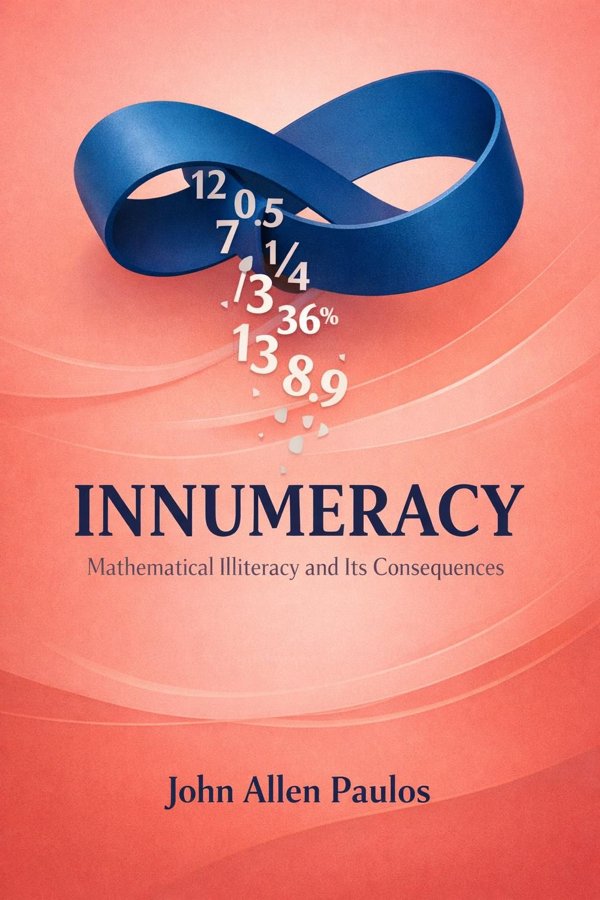
Innumeracy: Mathematical Illiteracy and Its Consequences: Summary & Key Insights
 10 min7 chaptersAudio available
What Is Innumeracy: Mathematical Illiteracy and Its Consequences About?
Innumeracy: Mathematical Illiteracy and Its Consequences by John Allen Paulos is a popular_sci book spanning 7 pages. Innumeracy: Mathematical Illiteracy and Its Consequences is a popular mathematics book by John Allen Paulos that explores the widespread lack of mathematical understanding in society. Through humor and accessible examples, Paulos demonstrates how innumeracy—an inability to deal comfortably with the fundamental notions of number and chance—affects decision-making, public policy, and everyday reasoning. The book encourages readers to develop a more quantitative mindset and to recognize the importance of numeracy in modern life.
This FizzRead summary covers all 7 key chapters of Innumeracy: Mathematical Illiteracy and Its Consequences in approximately 10 minutes, distilling the most important ideas, arguments, and takeaways from John Allen Paulos's work. Also available as an audio summary and Key Quotes Podcast.
Innumeracy: Mathematical Illiteracy and Its Consequences
Innumeracy: Mathematical Illiteracy and Its Consequences is a popular mathematics book by John Allen Paulos that explores the widespread lack of mathematical understanding in society. Through humor and accessible examples, Paulos demonstrates how innumeracy—an inability to deal comfortably with the fundamental notions of number and chance—affects decision-making, public policy, and everyday reasoning. The book encourages readers to develop a more quantitative mindset and to recognize the importance of numeracy in modern life.
Who Should Read Innumeracy: Mathematical Illiteracy and Its Consequences?
This book is perfect for anyone interested in popular_sci and looking to gain actionable insights in a short read. Whether you're a student, professional, or lifelong learner, the key ideas from Innumeracy: Mathematical Illiteracy and Its Consequences by John Allen Paulos will help you think differently.
- ✓Readers who enjoy popular_sci and want practical takeaways
- ✓Professionals looking to apply new ideas to their work and life
- ✓Anyone who wants the core insights of Innumeracy: Mathematical Illiteracy and Its Consequences in just 10 minutes
Want the full summary?
Get instant access to this book summary and 100K+ more with Fizz Moment.
Get Free SummaryAvailable on App Store • Free to download
Key Chapters
One of the first challenges I confront in this book is the widespread misunderstanding of large numbers and probabilities. People routinely confuse millions with billions, underestimate exponential growth, or misinterpret percentages and ratios. For example, when asked to imagine a billion seconds, few realize it’s roughly thirty-one years. The inability to grasp orders of magnitude distorts not only personal reasoning but also public discourse, making it easier for exaggerated figures to circulate unchallenged.
Consider also how this innumeracy manifests in probability. Many people believe that a streak of bad luck is destined to end soon, or that certain outcomes are 'due.' This is the gambler’s fallacy—misunderstanding independent events. When we fail to interpret probabilities correctly, we can be misled by coincidences and patterns that are products of pure chance.
I often emphasize that our discomfort with numbers isn’t innate; it’s cultural. We’re conditioned to treat mathematics as dry, separate from reality. But numbers are vivid descriptions of the world. To talk intelligently about risk, growth, or comparison, we must make numbers feel real again. Developing numerical intuition means pausing when we hear a figure in the news and asking, 'Relative to what? How large or small is that compared to something familiar?' These habits transform abstract quantities into tangible relationships. By practicing them, we gradually cultivate a sense of scale, which is the essence of numeracy.
One of the most striking examples of innumeracy’s social impact lies in how we perceive risk. Whether in public health, insurance, or gambling, our ability to evaluate probabilities often falters. People buy lottery tickets hoping for a fantastically unlikely windfall, yet they won’t buy insurance against risks that are far greater. The expected value concept—a core idea in probability—helps explain these paradoxes. But without a habit of thinking numerically, the public easily misjudges both.
Lotteries, for example, exploit our weakness for large but improbable numbers. I’ve always found it fascinating that many individuals who understand intellectually that the odds are microscopic still participate, as if imagination overpowered logic. Similarly, our fear responses to rare events—plane crashes, radiation, even shark attacks—far outweigh anxieties about far more probable dangers such as car accidents or smoking. The discrepancy is not just emotional; it stems from an inability to compare probabilities meaningfully.
The point I make repeatedly is that innumeracy leads us to both overreact and underreact. We panic at headlines describing 'one-in-a-million' dangers but ignore thousands of everyday risks whose likelihood is orders of magnitude higher. This distorted perception affects political decisions and personal behavior alike. Cultivating numerical literacy, on the other hand, grants calm perspective: we learn to see through sensationalism and personalize risk in rational proportions, not emotional ones.
+ 5 more chapters — available in the FizzRead app
All Chapters in Innumeracy: Mathematical Illiteracy and Its Consequences
About the Author
John Allen Paulos is an American professor of mathematics at Temple University and a well-known author of books that popularize mathematics and logical thinking. His works often combine wit and insight to reveal the role of mathematics in everyday reasoning and public discourse.
Get This Summary in Your Preferred Format
Read or listen to the Innumeracy: Mathematical Illiteracy and Its Consequences summary by John Allen Paulos anytime, anywhere. FizzRead offers multiple formats so you can learn on your terms — all free.
Available formats: App · Audio · PDF · EPUB — All included free with FizzRead
Download Innumeracy: Mathematical Illiteracy and Its Consequences PDF and EPUB Summary
Key Quotes from Innumeracy: Mathematical Illiteracy and Its Consequences
“One of the first challenges I confront in this book is the widespread misunderstanding of large numbers and probabilities.”
“One of the most striking examples of innumeracy’s social impact lies in how we perceive risk.”
Frequently Asked Questions about Innumeracy: Mathematical Illiteracy and Its Consequences
Innumeracy: Mathematical Illiteracy and Its Consequences by John Allen Paulos is a popular_sci book that explores key ideas across 7 chapters. Innumeracy: Mathematical Illiteracy and Its Consequences is a popular mathematics book by John Allen Paulos that explores the widespread lack of mathematical understanding in society. Through humor and accessible examples, Paulos demonstrates how innumeracy—an inability to deal comfortably with the fundamental notions of number and chance—affects decision-making, public policy, and everyday reasoning. The book encourages readers to develop a more quantitative mindset and to recognize the importance of numeracy in modern life.
You Might Also Like

Structures: Or Why Things Don"t Fall Down
J.E. Gordon
10 min
The Road to Wigan Pier
George Orwell
10 min
Bonk: The Curious Coupling of Science and Sex
Mary Roach
10 min
First Bite: How We Learn to Eat
Bee Wilson
10 min
In Pursuit Of The Unknown: 17 Equations That Changed The World
Ian Stewart
10 min
Napoleon's Buttons: 17 Molecules That Changed History
Penny Le Couteur and Jay Burreson
10 minBrowse by Category
Ready to read Innumeracy: Mathematical Illiteracy and Its Consequences?
Get the full summary and 100K+ more books with Fizz Moment.