
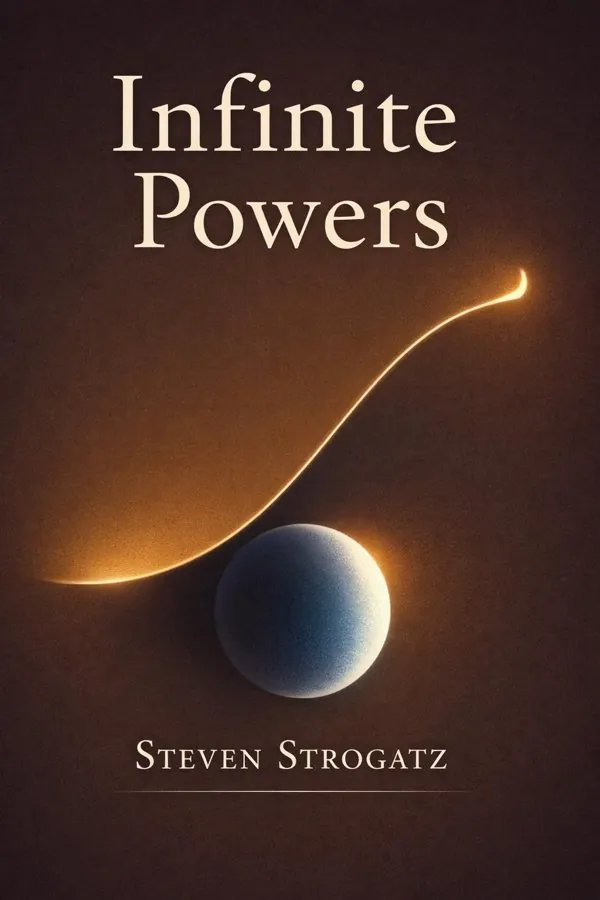
Infinite Powers: How Calculus Reveals the Secrets of the Universe: Summary & Key Insights
 10 min9 chaptersAudio available
Key Takeaways from Infinite Powers: How Calculus Reveals the Secrets of the Universe
Every major leap in mathematics begins with a question that feels almost dangerous, and for calculus that question was infinity.
The world does not move in still frames, yet for centuries mathematics was better at describing shapes than change.
A derivative is one of the simplest and most profound ideas ever invented: it tells you how fast something is changing right now.
If the derivative tells us how things change, the integral tells us how small changes add up to produce the whole.
The universe does not simply contain quantities; it contains relationships between quantities and their rates of change.
What Is Infinite Powers: How Calculus Reveals the Secrets of the Universe About?
Infinite Powers: How Calculus Reveals the Secrets of the Universe by Steven Strogatz is a popular_sci book spanning 7 pages. Calculus is often remembered as the subject that terrified students, but in Steven Strogatz’s Infinite Powers, it becomes something far more surprising: one of humanity’s greatest storytelling tools. This book explains how calculus emerged from deep questions about motion, change, space, and infinity, and how it became the mathematical language that lets us understand the living, moving world. From falling objects and orbiting planets to electric currents, epidemics, and population growth, Strogatz shows that calculus is not an abstract game. It is the method we use to describe how reality unfolds moment by moment. What makes the book especially compelling is its blend of history, intuition, and wonder. Strogatz does not teach calculus like a textbook author; he teaches it like a guide leading readers through one of civilization’s most powerful ideas. A professor of applied mathematics at Cornell and a celebrated popular science writer, he has rare authority in both advanced mathematics and clear explanation. Infinite Powers matters because it restores the original excitement of calculus and reveals why understanding change is the key to understanding the universe itself.
This FizzRead summary covers all 9 key chapters of Infinite Powers: How Calculus Reveals the Secrets of the Universe in approximately 10 minutes, distilling the most important ideas, arguments, and takeaways from Steven Strogatz's work. Also available as an audio summary and Key Quotes Podcast.
Infinite Powers: How Calculus Reveals the Secrets of the Universe
Calculus is often remembered as the subject that terrified students, but in Steven Strogatz’s Infinite Powers, it becomes something far more surprising: one of humanity’s greatest storytelling tools. This book explains how calculus emerged from deep questions about motion, change, space, and infinity, and how it became the mathematical language that lets us understand the living, moving world. From falling objects and orbiting planets to electric currents, epidemics, and population growth, Strogatz shows that calculus is not an abstract game. It is the method we use to describe how reality unfolds moment by moment.
What makes the book especially compelling is its blend of history, intuition, and wonder. Strogatz does not teach calculus like a textbook author; he teaches it like a guide leading readers through one of civilization’s most powerful ideas. A professor of applied mathematics at Cornell and a celebrated popular science writer, he has rare authority in both advanced mathematics and clear explanation. Infinite Powers matters because it restores the original excitement of calculus and reveals why understanding change is the key to understanding the universe itself.
Who Should Read Infinite Powers: How Calculus Reveals the Secrets of the Universe?
This book is perfect for anyone interested in popular_sci and looking to gain actionable insights in a short read. Whether you're a student, professional, or lifelong learner, the key ideas from Infinite Powers: How Calculus Reveals the Secrets of the Universe by Steven Strogatz will help you think differently.
- ✓Readers who enjoy popular_sci and want practical takeaways
- ✓Professionals looking to apply new ideas to their work and life
- ✓Anyone who wants the core insights of Infinite Powers: How Calculus Reveals the Secrets of the Universe in just 10 minutes
Want the full summary?
Get instant access to this book summary and 100K+ more with Fizz Moment.
Get Free SummaryAvailable on App Store • Free to download
Key Chapters
Every major leap in mathematics begins with a question that feels almost dangerous, and for calculus that question was infinity. Long before Newton and Leibniz gave the subject its formal shape, thinkers were already struggling with puzzles that seemed to break common sense. The ancient Greeks, especially through Zeno’s paradoxes, asked how motion could be possible if every journey could be divided into infinitely many smaller journeys. If an arrow must first travel half the distance, then half of what remains, and then half again, how can it ever arrive?
These paradoxes mattered because they exposed a tension between the continuous world we experience and the step-by-step logic we use to describe it. Infinity seemed to threaten reason itself. Yet the eventual triumph of calculus came from recognizing that an infinite process does not always produce an infinite result. An endless series of shrinking intervals can still add up to a finite total. That insight changed everything. It allowed mathematicians to tame the infinite rather than fear it.
Strogatz presents this history not as a dry prelude but as the emotional and intellectual foundation of calculus. The subject was born from a bold willingness to investigate the impossible. Today, that same logic appears in digital compression, signal analysis, and any system where tiny changes accumulate into meaningful outcomes.
The practical lesson is simple: when a problem feels overwhelming, break it into ever smaller parts and look for the pattern in their accumulation. That is often where clarity begins.
The world does not move in still frames, yet for centuries mathematics was better at describing shapes than change. That mismatch became unbearable once scientists tried to understand moving bodies. A falling apple, a swinging pendulum, a rolling cannonball, or a planet curving through space cannot be captured adequately by static geometry alone. Motion is continuous, and any math that hopes to explain nature must track how things evolve from one instant to the next.
This is where Strogatz shows why calculus was not just useful but necessary. To understand motion, we need a way to describe speed at a single instant, not just average speed over an interval. If a car travels 60 miles in one hour, average speed is easy. But what was its exact speed at 10:17 and 12 seconds? The answer requires zooming in on smaller and smaller time windows until we approach an instant. That act of conceptual zooming is the heart of calculus.
Once we can measure instantaneous change, we can predict trajectories, optimize systems, and explain physical laws. Engineers use this logic to design braking systems. Physicists use it to model acceleration. Biologists use it to track changing growth rates in cells or populations. Financial analysts even use related ideas to monitor rapidly changing prices and risk.
The deeper point is that reality is dynamic. Any field that studies a changing process eventually runs into calculus, because change itself demands a mathematical language of flow. The actionable takeaway: when facing a real-world problem, ask not only what something is, but how fast it is changing. That question often reveals the mechanism underneath.
A derivative is one of the simplest and most profound ideas ever invented: it tells you how fast something is changing right now. That may sound technical, but it is actually the key to making sense of countless everyday and scientific phenomena. When your car’s speedometer shows a number, it is giving you a real-time estimate of a derivative. When a doctor tracks how quickly a patient’s condition is worsening or improving, that is derivative thinking. When a business asks whether sales are growing faster or beginning to level off, it is looking at rates of change.
Strogatz explains that the derivative emerged from trying to solve two related problems: finding velocity at an instant and finding the slope of a curve at a point. These turn out to be the same problem in disguise. In both cases, you compare tiny changes in one quantity to tiny changes in another. By shrinking the interval and taking a limit, you reveal the hidden local behavior of the system.
This idea made modern science possible. Newton’s laws depend on changing velocity, which means acceleration, a derivative of a derivative. Optimization in economics and engineering often depends on identifying where derivatives become zero, signaling peaks, valleys, or equilibrium points. Machine learning also relies on gradient-based methods, which are built from derivatives.
The actionable takeaway is to train yourself to notice not just levels but trends. A number by itself is incomplete. Whether it is rising, falling, or stabilizing often matters more than the number alone. Derivative thinking helps you anticipate, not merely observe.
If the derivative tells us how things change, the integral tells us how small changes add up to produce the whole. This is the second great pillar of calculus, and Strogatz makes it feel wonderfully intuitive. Imagine trying to measure the area under a curved line. Straight-sided shapes are easy. Curves are not. But if you divide the region into many thin rectangles, estimate the area of each, and then add them together, you can get closer and closer to the exact answer. The integral is what happens when that approximation becomes perfect in the limit.
This concept reaches far beyond geometry. If speed tells you how fast you are traveling at every instant, integrating that speed over time gives total distance. If you know the rate at which water flows into a tank, integration tells you how much water has accumulated. In medicine, a changing drug concentration over time can be integrated to estimate total exposure. In economics, marginal costs can be integrated to recover total costs.
What makes the integral so powerful is that it converts local information into global understanding. It shows how a million tiny contributions can produce a visible outcome. That is true in physics, where force fields accumulate effects; in environmental science, where emissions build into climate impact; and in daily life, where habits compound into health, savings, or skill.
The practical takeaway is powerful: do not underestimate small increments. Tiny actions, repeated consistently, integrate into major results. When progress feels invisible, remember that accumulation is often the hidden engine of transformation.
The universe does not simply contain quantities; it contains relationships between quantities and their rates of change. That is why so many laws of nature take the form of differential equations. These equations describe how a system evolves by linking what is happening now to how it will change next. Strogatz shows that once calculus was invented, scientists could finally express the deep rhythms of the natural world in a precise and predictive way.
A differential equation can model the cooling of coffee, the spread of disease, the vibration of a guitar string, the growth of bacteria, or the motion of the planets. In each case, the future state depends on the current state and the rate at which that state changes. This framework is extraordinarily general, which is why calculus became the backbone of physics, engineering, biology, and beyond.
Consider public health. If a disease spreads proportionally to the number of infected people and the number of susceptible people, calculus helps model how quickly an outbreak accelerates, peaks, and declines. In ecology, it helps explain predator-prey cycles. In electrical engineering, it captures how current and voltage vary through circuits over time. These are not isolated applications; they reveal a common mathematical grammar underlying diverse systems.
The takeaway is to look for feedback loops. Many complex problems become easier to understand when you ask how the current state influences the rate of future change. Whether you are studying habits, teams, markets, or ecosystems, this perspective can uncover patterns that static snapshots miss.
One of calculus’s greatest achievements is that it turns vague intuitions into precise ideas, and the concept that makes this possible is the limit. A limit asks what value a quantity approaches as we get closer and closer to some point, even if we never quite arrive in the ordinary sense. This is how calculus resolves old paradoxes and gives rigorous meaning to derivatives, integrals, continuity, and infinite series.
Strogatz emphasizes that limits are not just technical formalities. They are acts of disciplined imagination. They allow us to reason about the infinitely small without pretending that infinitesimals are ordinary numbers. They let us define instantaneous velocity by examining average velocity over shrinking intervals. They let us define area under a curve by summing thinner and thinner slices. In short, limits are the bridge between approximation and exactness.
This way of thinking appears outside mathematics as well. In computing, algorithms are tested by how they behave as data grows large. In engineering, stress analysis often examines what happens near failure points. In everyday judgment, we often ask what trend a system is approaching, not just where it currently stands. Limits train the mind to focus on direction, not merely position.
The broader lesson is that precision often comes from examining what happens as uncertainty shrinks. Instead of demanding immediate certainty, move progressively closer to the answer. Refine the estimate. Reduce the interval. Increase the resolution. The actionable takeaway: in complex decisions, ask what your conclusion approaches as you gather more evidence. That limit-minded habit can improve both reasoning and patience.
Many people assume mathematics is about exact answers, but Strogatz reveals a subtler truth: much of mathematical power comes from intelligent approximation. Calculus flourishes because the world is often too complex to solve perfectly, yet simple local approximations can still produce astonishingly accurate predictions. In this sense, approximation is not second best. It is one of the main ways science progresses.
A curved function can often be approximated near a point by a straight line. More complex behavior can be captured by adding quadratic or higher-order terms. This principle underlies Taylor series, numerical methods, and countless scientific tools. Engineers approximate airflow to design wings. Physicists linearize systems to study stability. Economists use local approximations to analyze incentives. Computer simulations rely on breaking continuous processes into small computational steps.
This idea also helps explain why calculus remains central in the age of computers. Computers rarely solve real-world problems in one elegant symbolic stroke. Instead, they approximate solutions iteratively, refining them step by step. GPS systems, weather forecasting, animation physics, and machine learning all depend on this marriage between calculus and approximation.
Strogatz’s broader message is intellectually liberating. You do not need perfect knowledge to make progress. If you can understand the local behavior of a system, you can often build a useful model of the whole. The practical takeaway: stop waiting for flawless information. Start with a reasonable approximation, test it, and improve it. Iterative understanding is often the shortest path to mastery.
Some ideas change the world because they are useful. Others endure because they are beautiful. Calculus is remarkable because it is both. Strogatz repeatedly shows that its elegance is inseparable from its practical force. The same equations that describe the arc of a thrown ball also reveal the structure of physical law. The same methods that measure a curved area also help engineers design bridges, economists model growth, and scientists simulate weather systems.
This union of beauty and utility matters because it changes how we think about knowledge. Calculus is not merely a bag of tricks for specialists. It is a way of seeing patterns in change, continuity, and accumulation. It compresses a vast range of phenomena into a small set of powerful ideas. The derivative, the integral, the limit, and the differential equation are not isolated tools. Together they form a lens through which complexity becomes intelligible.
Strogatz also restores the human side of mathematics. Calculus emerged through struggle, imagination, rivalry, and wonder. It was built by people trying to answer urgent questions about motion, force, curves, and the cosmos. That history reminds readers that mathematics is a creative achievement, not just a technical requirement.
The practical takeaway is to approach difficult subjects with curiosity instead of intimidation. Often the most useful ideas are also the most beautiful once you see their inner logic. If a concept feels forbidding, stay with it long enough to glimpse its pattern. Beauty is frequently the sign that understanding is near.
The deepest payoff of calculus may not be a formula but a mental habit. Strogatz argues, implicitly and explicitly, that calculus trains a way of thinking suited to a changing world. It teaches you to move between the local and the global, between exactness and approximation, between discrete steps and continuous flow. It encourages you to ask how systems evolve, what variables matter, where feedback enters, and how small differences compound over time.
These habits are valuable far beyond mathematics classrooms. In business, leaders who understand rates of change can detect momentum before it becomes obvious in raw totals. In health, noticing trends in sleep, energy, or symptoms can be more informative than isolated snapshots. In public policy, knowing whether a problem is accelerating or stabilizing can guide intervention. In personal growth, calculus-like thinking encourages patience with gradual progress and alertness to compounding effects.
Perhaps most importantly, calculus fosters intellectual humility. It shows that many truths can only be approached through limiting processes, estimates, and models. We understand the world not by freezing it but by tracing its transformations. That mindset is especially valuable in an era defined by rapid technological, ecological, and social change.
The actionable takeaway is to adopt a calculus lens in everyday life: track trends, look for accumulation, focus on feedback, and expect gradual change to produce large outcomes. Even without solving equations, you can think like calculus. And once you do, the world becomes less like a collection of disconnected events and more like an intelligible, evolving system.
All Chapters in Infinite Powers: How Calculus Reveals the Secrets of the Universe
About the Author
Steven Strogatz is an American mathematician, educator, and popular science author best known for making complex mathematical ideas accessible to broad audiences. He is a professor of applied mathematics at Cornell University and has done influential research in nonlinear dynamics, synchronization, and complex systems. Beyond academia, he has earned wide recognition for his gift as a communicator, writing essays and books that connect mathematics to everyday life, science, and human curiosity. His work often explores how patterns emerge in nature and how mathematical thinking can illuminate seemingly unrelated phenomena. In Infinite Powers, Strogatz brings together his deep technical expertise and engaging narrative style to explain calculus as both a historic breakthrough and a practical language for understanding the changing universe.
Get This Summary in Your Preferred Format
Read or listen to the Infinite Powers: How Calculus Reveals the Secrets of the Universe summary by Steven Strogatz anytime, anywhere. FizzRead offers multiple formats so you can learn on your terms — all free.
Available formats: App · Audio · PDF · EPUB — All included free with FizzRead
Download Infinite Powers: How Calculus Reveals the Secrets of the Universe PDF and EPUB Summary
Key Quotes from Infinite Powers: How Calculus Reveals the Secrets of the Universe
“Every major leap in mathematics begins with a question that feels almost dangerous, and for calculus that question was infinity.”
“The world does not move in still frames, yet for centuries mathematics was better at describing shapes than change.”
“A derivative is one of the simplest and most profound ideas ever invented: it tells you how fast something is changing right now.”
“If the derivative tells us how things change, the integral tells us how small changes add up to produce the whole.”
“The universe does not simply contain quantities; it contains relationships between quantities and their rates of change.”
Frequently Asked Questions about Infinite Powers: How Calculus Reveals the Secrets of the Universe
Infinite Powers: How Calculus Reveals the Secrets of the Universe by Steven Strogatz is a popular_sci book that explores key ideas across 9 chapters. Calculus is often remembered as the subject that terrified students, but in Steven Strogatz’s Infinite Powers, it becomes something far more surprising: one of humanity’s greatest storytelling tools. This book explains how calculus emerged from deep questions about motion, change, space, and infinity, and how it became the mathematical language that lets us understand the living, moving world. From falling objects and orbiting planets to electric currents, epidemics, and population growth, Strogatz shows that calculus is not an abstract game. It is the method we use to describe how reality unfolds moment by moment. What makes the book especially compelling is its blend of history, intuition, and wonder. Strogatz does not teach calculus like a textbook author; he teaches it like a guide leading readers through one of civilization’s most powerful ideas. A professor of applied mathematics at Cornell and a celebrated popular science writer, he has rare authority in both advanced mathematics and clear explanation. Infinite Powers matters because it restores the original excitement of calculus and reveals why understanding change is the key to understanding the universe itself.
You Might Also Like

Structures: Or Why Things Don"t Fall Down
J.E. Gordon
10 min
The Road to Wigan Pier
George Orwell
10 min
Bonk: The Curious Coupling of Science and Sex
Mary Roach
10 min
First Bite: How We Learn to Eat
Bee Wilson
10 min
In Pursuit Of The Unknown: 17 Equations That Changed The World
Ian Stewart
10 min
Napoleon's Buttons: 17 Molecules That Changed History
Penny Le Couteur and Jay Burreson
10 minBrowse by Category
Ready to read Infinite Powers: How Calculus Reveals the Secrets of the Universe?
Get the full summary and 100K+ more books with Fizz Moment.