
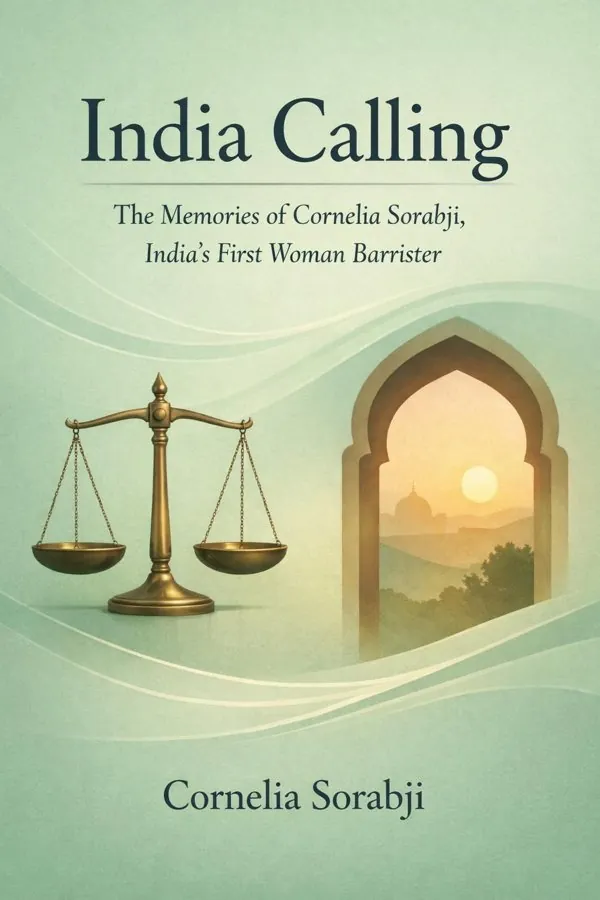
India Calling: The Memories of Cornelia Sorabji, India's First Woman Barrister: Summary & Key Insights
 10 min6 chaptersAudio available
What Is India Calling: The Memories of Cornelia Sorabji, India's First Woman Barrister About?
India Calling: The Memories of Cornelia Sorabji, India's First Woman Barrister by Cornelia Sorabji is a politics book spanning 6 pages. This autobiography recounts the life of Cornelia Sorabji, India's first female barrister. It spans her journey from childhood through her pioneering legal career, exploring her experiences as a woman navigating colonial India's legal and social systems. The book offers insights into her dedication to women's rights and her role in shaping early feminist and legal thought in India.
This FizzRead summary covers all 6 key chapters of India Calling: The Memories of Cornelia Sorabji, India's First Woman Barrister in approximately 10 minutes, distilling the most important ideas, arguments, and takeaways from Cornelia Sorabji's work. Also available as an audio summary and Key Quotes Podcast.
India Calling: The Memories of Cornelia Sorabji, India's First Woman Barrister
This autobiography recounts the life of Cornelia Sorabji, India's first female barrister. It spans her journey from childhood through her pioneering legal career, exploring her experiences as a woman navigating colonial India's legal and social systems. The book offers insights into her dedication to women's rights and her role in shaping early feminist and legal thought in India.
Who Should Read India Calling: The Memories of Cornelia Sorabji, India's First Woman Barrister?
This book is perfect for anyone interested in politics and looking to gain actionable insights in a short read. Whether you're a student, professional, or lifelong learner, the key ideas from India Calling: The Memories of Cornelia Sorabji, India's First Woman Barrister by Cornelia Sorabji will help you think differently.
- ✓Readers who enjoy politics and want practical takeaways
- ✓Professionals looking to apply new ideas to their work and life
- ✓Anyone who wants the core insights of India Calling: The Memories of Cornelia Sorabji, India's First Woman Barrister in just 10 minutes
Want the full summary?
Get instant access to this book summary and 100K+ more with Fizz Moment.
Get Free SummaryAvailable on App Store • Free to download
Key Chapters
I was born into a world full of contradictions—colonial, hierarchical, deeply spiritual, and yet awakening to reform. My family lived in Poona, where intellectual energy mingled with missionary zeal. My father, Reverend Sorabji, believed that faith must work through reason, and that the education of women was essential to the progress of India. My mother, Francina Ford, had herself been denied formal learning in her youth; perhaps that is why she built her life’s mission around founding schools for girls.
In our home, conversations about God and ethics, caste and justice, were as common as meals. My parents taught us that to be Indian was not to reject modernity, nor to imitate the English, but to insist upon dignity on our own terms. This conviction was my first inheritance—stronger than fortune, more enduring than comfort. I grew up among siblings equally ambitious and intellectually alive, yet the weight of being female was always present. There were walls invisible to men but palpable to me, shaping how far one could go before being reminded of one’s place.
Still, the seeds of rebellion grew quietly. My mother taught me that education was the highest act of devotion. When I attended Deccan College, I became the first woman to do so, surrounded by curious gazes and whispers. I learned early how loneliness becomes the fee for purpose. But I also discovered reciprocities of respect—professors who supported me, classmates who saw my mind before my gender. It was there that the idea first took form: if law governs the world, why should half of humanity be barred from it?
Leaving India for England was an act of both audacity and faith. I was sent to make good on a scholarship that never quite materialized, an early lesson that ideals often fracture on the rocks of bureaucracy. Yet I was fortunate in friends—Florence Nightingale, Lady Hobhouse, and Mary Hobhouse—who believed that education could transcend empire.
At Oxford, I felt both exhilaration and loneliness. The spires, the libraries, the lectures—they invited the mind to stretch and question. But for a colonial woman, and one of colour, the air was not always welcoming. I faced doubts, exclusions, polite disbelief that an Indian girl could master jurisprudence. Yet every doubt became a task. I studied Roman law and equity with hunger, wrote papers that were quietly admired yet officially unrecognized. When I completed my degree, Oxford could not confer it; women, by statute, could not yet be graduates. It would take years before I was awarded the certificate retroactively. Still, I never saw it as a slight—I saw it as a promise unfinished.
In England I also discovered the rhythm of advocacy. I debated with reformers, observed the courts, and realized that law was not mere rule-making—it was the architecture of moral life. If I could one day return home with this learning, perhaps I could help build foundations for the invisible women who had no forum, no plea, no voice.
+ 4 more chapters — available in the FizzRead app
All Chapters in India Calling: The Memories of Cornelia Sorabji, India's First Woman Barrister
About the Author
Cornelia Sorabji (1866–1954) was India's first woman to study law at Oxford University and the first female barrister in India. She worked extensively for the rights of women and children, particularly those in purdah, and became a prominent figure in early Indian legal and feminist history.
Get This Summary in Your Preferred Format
Read or listen to the India Calling: The Memories of Cornelia Sorabji, India's First Woman Barrister summary by Cornelia Sorabji anytime, anywhere. FizzRead offers multiple formats so you can learn on your terms — all free.
Available formats: App · Audio · PDF · EPUB — All included free with FizzRead
Download India Calling: The Memories of Cornelia Sorabji, India's First Woman Barrister PDF and EPUB Summary
Key Quotes from India Calling: The Memories of Cornelia Sorabji, India's First Woman Barrister
“I was born into a world full of contradictions—colonial, hierarchical, deeply spiritual, and yet awakening to reform.”
“Leaving India for England was an act of both audacity and faith.”
Frequently Asked Questions about India Calling: The Memories of Cornelia Sorabji, India's First Woman Barrister
India Calling: The Memories of Cornelia Sorabji, India's First Woman Barrister by Cornelia Sorabji is a politics book that explores key ideas across 6 chapters. This autobiography recounts the life of Cornelia Sorabji, India's first female barrister. It spans her journey from childhood through her pioneering legal career, exploring her experiences as a woman navigating colonial India's legal and social systems. The book offers insights into her dedication to women's rights and her role in shaping early feminist and legal thought in India.
You Might Also Like

Antifa: The Anti-Fascist Handbook
Mark Bray
10 min
Attack from Within: How Disinformation Is Sabotaging America
Barbara McQuade
10 min
Coercion, Capital, and European States, AD 990–1992
Charles Tilly
10 min
Digital Democracy: Concepts, Methodologies, Tools, and Applications
Various Authors
10 min
Fascism
Stanley G. Payne
10 min
Fire And Fury: Inside The Trump White House
Michael Wolff
10 minBrowse by Category
Ready to read India Calling: The Memories of Cornelia Sorabji, India's First Woman Barrister?
Get the full summary and 100K+ more books with Fizz Moment.