
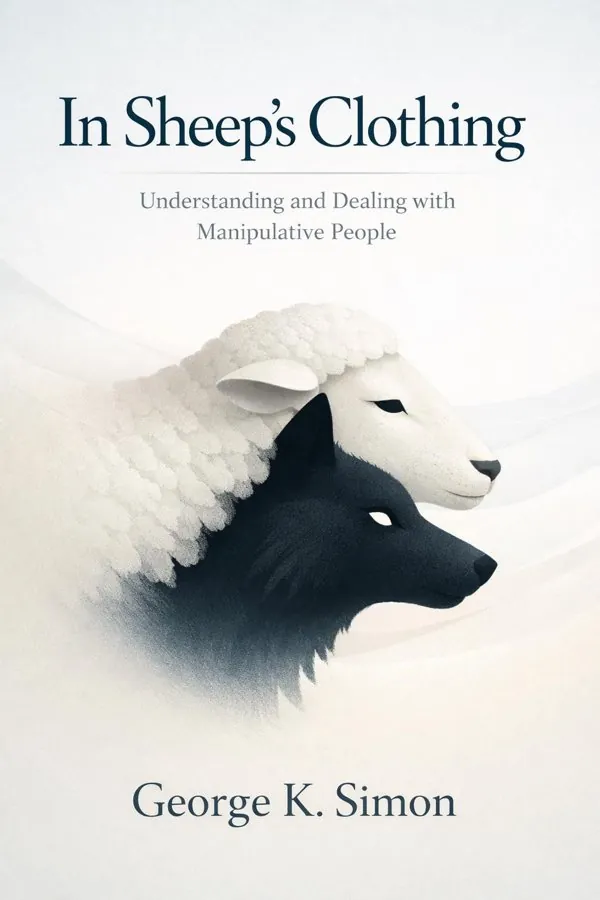
In Sheep's Clothing: Understanding and Dealing with Manipulative People: Summary & Key Insights
 10 min6 chaptersAudio available
What Is In Sheep's Clothing: Understanding and Dealing with Manipulative People About?
In Sheep's Clothing: Understanding and Dealing with Manipulative People by George K. Simon is a psychology book spanning 6 pages. In Sheep's Clothing is a psychological guide that explores the behavior of manipulative individuals who conceal their aggression under a facade of civility. Dr. George K. Simon, a clinical psychologist, explains how such people operate, the tactics they use to control others, and how to recognize and respond effectively to covert aggression. The book provides practical strategies for setting boundaries and maintaining self-respect when dealing with manipulative personalities.
This FizzRead summary covers all 6 key chapters of In Sheep's Clothing: Understanding and Dealing with Manipulative People in approximately 10 minutes, distilling the most important ideas, arguments, and takeaways from George K. Simon's work. Also available as an audio summary and Key Quotes Podcast.
In Sheep's Clothing: Understanding and Dealing with Manipulative People
In Sheep's Clothing is a psychological guide that explores the behavior of manipulative individuals who conceal their aggression under a facade of civility. Dr. George K. Simon, a clinical psychologist, explains how such people operate, the tactics they use to control others, and how to recognize and respond effectively to covert aggression. The book provides practical strategies for setting boundaries and maintaining self-respect when dealing with manipulative personalities.
Who Should Read In Sheep's Clothing: Understanding and Dealing with Manipulative People?
This book is perfect for anyone interested in psychology and looking to gain actionable insights in a short read. Whether you're a student, professional, or lifelong learner, the key ideas from In Sheep's Clothing: Understanding and Dealing with Manipulative People by George K. Simon will help you think differently.
- ✓Readers who enjoy psychology and want practical takeaways
- ✓Professionals looking to apply new ideas to their work and life
- ✓Anyone who wants the core insights of In Sheep's Clothing: Understanding and Dealing with Manipulative People in just 10 minutes
Want the full summary?
Get instant access to this book summary and 100K+ more with Fizz Moment.
Get Free SummaryAvailable on App Store • Free to download
Key Chapters
Throughout my clinical work, I observed a troubling pattern among certain individuals who skillfully concealed aggression. Unlike overtly angry or hostile personalities, these people operated subtly, often under the radar of social norms. They smiled as they attacked. They appeared reasonable while undermining others. This is what I call 'covert aggression' — aggression masked with politeness, reason, or victimhood.
A manipulative personality thrives in this hidden realm. Such individuals project an image of civility or wounded innocence, but their core drive remains power and control. They want to win, not through honest effort, but through tactical maneuvering. Their aggression rarely appears in raised voices or visible conflict; instead, it emerges through guilt trips, minimization, lying, and calculated charm. They’re experts at exploiting conscience — the one human quality that prevents us from fighting dirty. They understand that most decent people crave fairness and harmony, and they weaponize those very traits. To grasp manipulation, then, we must let go of the comforting notion that everyone acts from good intentions. The covert manipulator’s intentions are coldly strategic, not emotionally compassionate.
Understanding this psychological structure is liberating because it reveals that being targeted by manipulation doesn’t reflect personal weakness. It reflects strength — specifically, the presence of conscience. Manipulators select conscientious individuals precisely because they are easier to control through emotional hooks. By seeing aggression for what it is, disguised behind charm, you begin to interpret interactions differently. You no longer fall for the mask of civility, but instead, discern the intent underneath it. This shift is not about paranoia but about clarity: realizing that real peace comes from truth, not appeasement.
Psychology historically focused on neurosis—on people troubled by too much conscience, guilt, or anxiety. In my practice, however, I met a different kind of individual—one who caused distress but felt none themselves. Their suffering was externalized, borne by those around them. This condition I describe as 'character disturbance.' Whereas neurotic people question themselves relentlessly, disturbed characters refuse to question their motives. They rationalize self-serving behavior without shame.
The distinction matters deeply because we often misapply empathetic frameworks to manipulative personalities. Traditional therapeutic models urge understanding and compassion for inner conflict—but the manipulator usually has none. They act consciously yet without conscience. They do not seek reconciliation; they seek dominance. When we apply misplaced empathy, we feed their power. In relationships, this mistake translates into years of exhaustion and confusion, as caring individuals strive to heal those who never intended to change.
Recognizing character disturbance reorients responsibility. It tells us that not all emotional pain signifies a struggle for goodness. Some pain stems from others’ deliberate violation of limits. When we see this distinction clearly, we can protect ourselves without guilt. We stop trying to cure manipulation through kindness and start addressing it through boundaries. This insight reframes the entire emotional landscape in which manipulation thrives.
+ 4 more chapters — available in the FizzRead app
All Chapters in In Sheep's Clothing: Understanding and Dealing with Manipulative People
About the Author
Dr. George K. Simon is an American clinical psychologist and author specializing in character disturbance and manipulative behavior. He has worked extensively in counseling, correctional, and educational settings, and is known for his accessible writings on covert aggression and personality disorders.
Get This Summary in Your Preferred Format
Read or listen to the In Sheep's Clothing: Understanding and Dealing with Manipulative People summary by George K. Simon anytime, anywhere. FizzRead offers multiple formats so you can learn on your terms — all free.
Available formats: App · Audio · PDF · EPUB — All included free with FizzRead
Download In Sheep's Clothing: Understanding and Dealing with Manipulative People PDF and EPUB Summary
Key Quotes from In Sheep's Clothing: Understanding and Dealing with Manipulative People
“Throughout my clinical work, I observed a troubling pattern among certain individuals who skillfully concealed aggression.”
“Psychology historically focused on neurosis—on people troubled by too much conscience, guilt, or anxiety.”
Frequently Asked Questions about In Sheep's Clothing: Understanding and Dealing with Manipulative People
In Sheep's Clothing: Understanding and Dealing with Manipulative People by George K. Simon is a psychology book that explores key ideas across 6 chapters. In Sheep's Clothing is a psychological guide that explores the behavior of manipulative individuals who conceal their aggression under a facade of civility. Dr. George K. Simon, a clinical psychologist, explains how such people operate, the tactics they use to control others, and how to recognize and respond effectively to covert aggression. The book provides practical strategies for setting boundaries and maintaining self-respect when dealing with manipulative personalities.
You Might Also Like

The Body Keeps the Score
Bessel van der Kolk
10 min
Surrounded by Idiots
Thomas Erikson
10 min
Emotional Intelligence
Daniel Goleman
10 min
Attached
Amir Levine
10 min
Why Does He Do That
Lundy Bancroft
10 min
Women Who Run with the Wolves
Clarissa Pinkola Estés
10 minBrowse by Category
Ready to read In Sheep's Clothing: Understanding and Dealing with Manipulative People?
Get the full summary and 100K+ more books with Fizz Moment.