
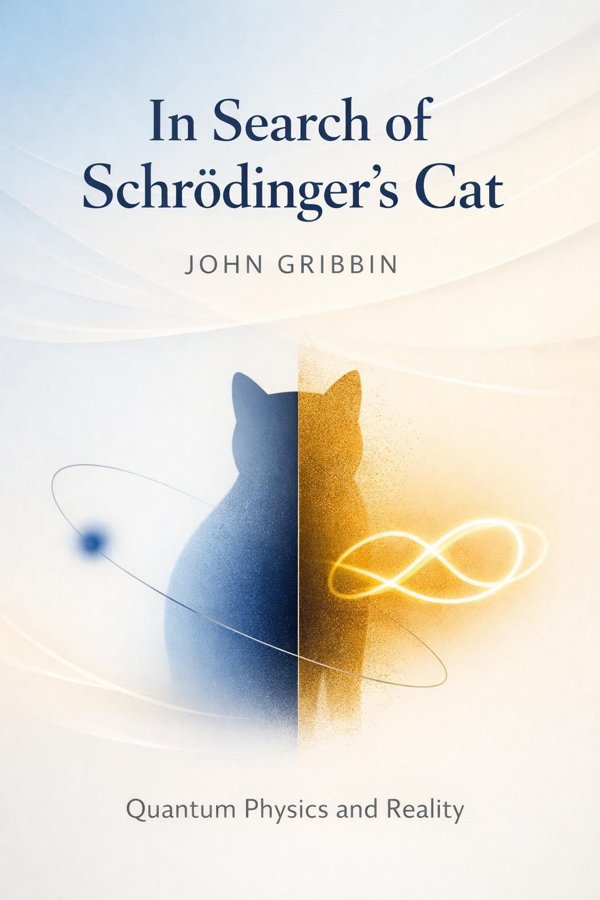
In Search of Schrödinger’s Cat: Quantum Physics and Reality: Summary & Key Insights
by John Gribbin
 10 min10 chaptersAudio available
Key Takeaways from In Search of Schrödinger’s Cat: Quantum Physics and Reality
A revolution often begins when certainty starts to crack.
Sometimes the smallest idea causes the biggest upheaval.
A beam of light seems gentle, continuous, and wave-like, but quantum physics reveals a sharper truth.
The stability of matter was once a mystery hiding in plain sight.
Quantum objects do not respect the categories our language prefers.
What Is In Search of Schrödinger’s Cat: Quantum Physics and Reality About?
In Search of Schrödinger’s Cat: Quantum Physics and Reality by John Gribbin is a popular_sci book spanning 10 pages. John Gribbin’s In Search of Schrödinger’s Cat is one of the classic introductions to quantum physics for general readers. Rather than treating quantum theory as a collection of intimidating equations, Gribbin tells it as a human story: a scientific revolution born from baffling experiments, bold ideas, and unsettling conclusions about the nature of reality itself. The book follows the path from late nineteenth-century confidence in classical physics to the astonishing discoveries that revealed a world governed by probability, uncertainty, and strange connections across space. What makes this book matter is not only that it explains concepts like quanta, wave-particle duality, uncertainty, and entanglement, but that it shows why these ideas change how we think about knowledge, matter, and observation. Quantum mechanics is not just a theory for laboratories; it underlies modern electronics, lasers, computing, and much of contemporary technology. Gribbin writes with the authority of a trained astrophysicist and the clarity of a seasoned science communicator. His gift is to make the weirdness of quantum theory feel intellectually exciting rather than inaccessible, inviting readers to confront one of the deepest questions in science: what kind of universe do we actually live in?
This FizzRead summary covers all 10 key chapters of In Search of Schrödinger’s Cat: Quantum Physics and Reality in approximately 10 minutes, distilling the most important ideas, arguments, and takeaways from John Gribbin's work. Also available as an audio summary and Key Quotes Podcast.
In Search of Schrödinger’s Cat: Quantum Physics and Reality
John Gribbin’s In Search of Schrödinger’s Cat is one of the classic introductions to quantum physics for general readers. Rather than treating quantum theory as a collection of intimidating equations, Gribbin tells it as a human story: a scientific revolution born from baffling experiments, bold ideas, and unsettling conclusions about the nature of reality itself. The book follows the path from late nineteenth-century confidence in classical physics to the astonishing discoveries that revealed a world governed by probability, uncertainty, and strange connections across space.
What makes this book matter is not only that it explains concepts like quanta, wave-particle duality, uncertainty, and entanglement, but that it shows why these ideas change how we think about knowledge, matter, and observation. Quantum mechanics is not just a theory for laboratories; it underlies modern electronics, lasers, computing, and much of contemporary technology.
Gribbin writes with the authority of a trained astrophysicist and the clarity of a seasoned science communicator. His gift is to make the weirdness of quantum theory feel intellectually exciting rather than inaccessible, inviting readers to confront one of the deepest questions in science: what kind of universe do we actually live in?
Who Should Read In Search of Schrödinger’s Cat: Quantum Physics and Reality?
This book is perfect for anyone interested in popular_sci and looking to gain actionable insights in a short read. Whether you're a student, professional, or lifelong learner, the key ideas from In Search of Schrödinger’s Cat: Quantum Physics and Reality by John Gribbin will help you think differently.
- ✓Readers who enjoy popular_sci and want practical takeaways
- ✓Professionals looking to apply new ideas to their work and life
- ✓Anyone who wants the core insights of In Search of Schrödinger’s Cat: Quantum Physics and Reality in just 10 minutes
Want the full summary?
Get instant access to this book summary and 100K+ more with Fizz Moment.
Get Free SummaryAvailable on App Store • Free to download
Key Chapters
A revolution often begins when certainty starts to crack. At the end of the nineteenth century, many physicists believed they were close to completing their understanding of the universe. Newton’s mechanics explained motion, Maxwell’s equations explained electromagnetism, and the world seemed to behave like a vast machine. If you knew the position and speed of every object, it seemed, you could predict the future with perfect confidence. This classical worldview was elegant, orderly, and deeply reassuring.
But nature had other plans. Certain experimental results refused to fit the old picture. The behavior of heated objects, the stability of atoms, and the way light interacted with matter all raised uncomfortable questions. Instead of a smooth, continuous universe, scientists began to glimpse a reality that worked in jumps, probabilities, and limits. The old framework was not wrong in everyday life, but it was incomplete at very small scales.
Gribbin shows that quantum theory did not emerge because scientists wanted to be mysterious. It emerged because evidence forced them there. That is one of the most important lessons in the history of science: reality does not have to match human intuition. When measurements disagree with assumptions, the assumptions must give way.
A practical example is the way we still use classical physics for bridges, baseballs, and planetary motion, while relying on quantum physics for semiconductors, lasers, and MRI technology. Different scales require different models.
Actionable takeaway: Treat certainty with caution. In science, work, and life, progress often begins when you notice where familiar explanations stop working.
Sometimes the smallest idea causes the biggest upheaval. In 1900, Max Planck was trying to solve the blackbody radiation problem, a technical puzzle about how hot objects emit energy. Classical physics predicted an absurd result: at certain frequencies, a heated body should radiate infinite energy. Since that clearly did not happen, something in the theory had to be wrong.
Planck found a mathematical fix by proposing that energy is not exchanged continuously, but in tiny discrete packets, which he called quanta. At first, even Planck treated this as a formal trick rather than a literal description of nature. Yet that single move shattered the assumption that energy flowed smoothly in all circumstances. It introduced the idea that the microscopic world comes in indivisible chunks.
Gribbin presents Planck’s insight as the opening crack in the wall of classical certainty. Once physicists accepted quantization, they had to rethink what matter and radiation actually were. The result was not merely a new equation, but a new ontology. Energy, long imagined as continuous, now behaved in a stop-start way under specific conditions.
This idea has practical consequences everywhere. The quantized energy levels of atoms explain the colors emitted by neon lights, the operation of fluorescent lamps, and the behavior of solid-state devices. Modern electronics depends on a world where energy does not vary arbitrarily, but often comes in allowed steps.
Actionable takeaway: When a problem produces impossible answers, do not just polish the old model. Ask whether the underlying assumptions need to be broken into entirely new pieces.
A beam of light seems gentle, continuous, and wave-like, but quantum physics reveals a sharper truth. In 1905, Albert Einstein extended Planck’s quantum idea to light itself. He argued that light sometimes behaves as if it consists of particles, later called photons, each carrying a specific amount of energy. This bold proposal explained the photoelectric effect, where light shining on a metal surface ejects electrons.
Classical wave theory could not account for the observed results. Increasing the brightness of low-frequency light did not knock out electrons, while even dim high-frequency light could. Einstein’s explanation was radical but precise: what mattered was not total intensity alone, but the energy of individual light quanta. If a single photon had enough energy, it could free an electron; if not, no amount of weak photons would help.
Gribbin uses this episode to show how quantum theory overturns common sense. Light is not simply a wave, nor simply a particle in the classical sense. It displays properties of both, depending on how we investigate it. This was one of the first major blows to the neat categories inherited from older physics.
The photoelectric effect is not just historically interesting. It is the basis of solar cells, light sensors, automatic doors, digital cameras, and many measurement tools. Every time a device converts light into electricity, it is exploiting a quantum process that once seemed paradoxical.
Actionable takeaway: Pay attention to anomalies that resist familiar categories. Breakthroughs often happen when you stop asking whether something is this or that, and start asking under what conditions it behaves like each.
The stability of matter was once a mystery hiding in plain sight. According to classical physics, electrons orbiting a nucleus should constantly radiate energy, spiral inward, and collapse the atom. Since atoms obviously do not self-destruct instantly, the prevailing model had a fatal flaw. Niels Bohr addressed this in 1913 with a daring hybrid idea: electrons occupy specific allowed orbits and can jump between them, emitting or absorbing energy in discrete amounts.
Bohr’s model was not the final truth, but it was a crucial bridge between classical imagery and quantum rules. It explained the spectral lines of hydrogen, showing why atoms emit light at exact frequencies rather than across a continuous smear. Each line corresponded to a jump between quantized energy levels. Matter was no longer just a tiny solar system; it was a structured quantum system constrained by rules unlike anything in everyday mechanics.
Gribbin highlights Bohr’s importance because he made quantum thinking concrete. The atom became a place where nature allowed some states and forbade others. That idea remains central in modern physics and chemistry. Chemical bonding, material properties, and the periodic table all depend on electron energy levels and quantum constraints.
In practical life, this principle helps explain why different elements produce distinct colors in flame tests, why LEDs emit specific wavelengths, and why spectroscopy can identify substances in laboratories, stars, and industrial processes.
Actionable takeaway: Not every possibility is equally allowed. In complex systems, learn to identify the states that are permitted, stable, and meaningful rather than assuming all outcomes are available.
Quantum objects do not respect the categories our language prefers. Electrons, like light, can behave as both particles and waves. This was one of the most shocking discoveries of early quantum theory. Louis de Broglie proposed that matter has wave-like properties, and later experiments confirmed that electrons can create interference patterns, just as waves do. Yet they also arrive in detectors as localized impacts, like particles.
Gribbin uses wave-particle duality to show that quantum mechanics is not merely weird because it is difficult. It is weird because the world itself does not sort neatly into intuitive boxes. A quantum entity is not secretly a classical object hiding behind confusing equations. It is something more fundamental that displays different aspects depending on the experimental setup.
The famous double-slit experiment captures this beautifully. Fire electrons one at a time through two slits and they build up an interference pattern, as though each electron somehow explores multiple paths. But measure which slit it goes through, and the pattern disappears. Observation changes the result because the conditions of the experiment define what kind of behavior becomes manifest.
This duality is not just philosophical. Electron microscopy, tunneling devices, and many nanotechnologies depend on wave-like matter. The ability to model particles as waves allows us to understand structures too small for ordinary light microscopes to resolve.
Actionable takeaway: When reality seems contradictory, consider whether your framework is too limited. In problem-solving, a system may show different valid behaviors depending on how you engage with it.
The universe does not always withhold information because our tools are clumsy; sometimes the limits are fundamental. Werner Heisenberg’s uncertainty principle states that certain pairs of properties, such as position and momentum, cannot both be known with unlimited precision at the same time. The more exactly one is defined, the less exact the other becomes. This is not merely a statement about imperfect measurement technique. It is woven into the structure of quantum reality.
Gribbin is careful to explain why this matters so deeply. Classical science assumed that complete knowledge was possible in principle, even if difficult in practice. Heisenberg demolished that dream at the microscopic level. The future of a quantum system cannot be predicted with exact certainty in the old deterministic sense; instead, physics provides probabilities for what may happen.
This principle explains why atoms do not collapse into the nucleus and why quantum systems maintain a kind of built-in fuzziness. It also reshapes how scientists think. The goal is no longer to describe exact trajectories for everything, but to calculate the range and likelihood of outcomes.
Practical applications include scanning tunneling microscopes, which rely on quantum uncertainty and tunneling to image surfaces at atomic scales. It also underpins modern quantum cryptography, where measurement disturbances can reveal eavesdropping.
Actionable takeaway: Replace the fantasy of total control with informed probability. In decisions and analysis, focus on ranges, risks, and confidence levels rather than pretending that all important variables can be pinned down exactly.
At the quantum level, what exists before measurement may be less like a solid fact and more like a spread of possibilities. Erwin Schrödinger developed wave mechanics, describing particles with a wave equation that predicts how their quantum state evolves over time. Instead of treating electrons as tiny billiard balls with definite paths, Schrödinger’s approach treated them as wavefunctions, mathematical entities containing information about possible measurement outcomes.
Gribbin explains that the wavefunction is not just a technical convenience. It lies at the heart of quantum theory’s unsettling power. Before a measurement, the system may be in a superposition of different possible states. The famous Schrödinger’s cat thought experiment dramatizes this by linking a quantum event to an ordinary object: until observation forces an outcome, the cat is described as both alive and dead in the mathematical formalism.
The point is not that cats in boxes are common, but that quantum theory appears to allow multiple possibilities to coexist until measured. That is deeply unlike classical reality, where we assume that things simply are one way whether anyone checks or not.
This framework enables real technologies. Quantum superposition is essential to quantum computing, where qubits can encode combinations of states and potentially solve certain problems more efficiently than classical bits.
Actionable takeaway: Learn to separate underlying possibility from observed outcome. In complex situations, several states may remain viable until a decision, interaction, or measurement forces one path to become actual.
One of quantum physics’ strangest lessons is that distance does not always mean independence. When particles become entangled, their properties are linked in such a way that measuring one immediately constrains what can be said about the other, even when they are far apart. Einstein famously disliked this implication, calling it “spooky action at a distance,” because it seemed to threaten the idea that physical influences must travel locally through space.
Gribbin treats entanglement as a turning point in our understanding of reality. The Einstein-Podolsky-Rosen argument tried to show that quantum mechanics must be incomplete. Later, John Bell devised a way to test whether hidden classical explanations could account for the correlations. Experiments strongly supported the quantum predictions. Nature appears to permit connections that cannot be reduced to ordinary local realism.
This does not mean information can be sent faster than light in a simple way. But it does mean that the world is not built from perfectly separate parts with independent properties waiting quietly to be revealed. At the deepest level, relationships can be fundamental.
Entanglement now has major practical applications. Quantum cryptography uses it to detect interference. Quantum teleportation transfers quantum states between systems. Quantum computing relies on entangled qubits to create computational power unavailable to ordinary machines.
Actionable takeaway: Do not assume that complex systems can always be understood by isolating parts. In science, organizations, and relationships, the connections between elements may carry more explanatory power than the elements alone.
In quantum mechanics, measurement is not a passive glance at an already settled world. It seems to play an active role in determining what becomes actual. This is the heart of the measurement problem, and Gribbin makes clear why it remains one of the most fascinating issues in modern thought. Quantum theory predicts probabilities with extraordinary accuracy, yet it leaves us with a difficult question: how does a spread of possibilities become a single observed result?
The Copenhagen interpretation, associated with Bohr and Heisenberg, treats the wavefunction as a tool for predicting outcomes and accepts that measurement yields a definite result without insisting on a deeper visualizable mechanism. Other thinkers have been dissatisfied with that pragmatic stance. If quantum theory is universal, then measuring devices and observers should also obey quantum rules. Where, exactly, does the transition from possibility to fact occur?
Gribbin explores how this problem pushes physics into philosophy without reducing it to empty speculation. The issue matters because it touches on objectivity, consciousness, and the status of the external world. Are observed properties created by measurement, selected by it, or merely revealed in some hidden framework? Quantum theory forces us to ask questions that classical science rarely had to confront.
In practical terms, the measurement problem shapes experimental design in quantum optics, computing, and precision sensing, where decoherence and environmental interaction can destroy delicate quantum states.
Actionable takeaway: Recognize that the way you measure a system can influence what you find. In research, management, and everyday judgment, the method of observation is often part of the result.
When a theory works brilliantly but resists intuitive explanation, interpretations multiply. Gribbin closes in on one of the most provocative dimensions of quantum physics: the competing ways scientists and philosophers try to understand what the mathematics means. The Copenhagen view emphasizes prediction and accepts indeterminacy. Hidden-variable approaches try to restore an underlying reality. Hugh Everett’s many-worlds interpretation suggests that all quantum possibilities are realized, each in a branching universe.
The appeal of many worlds is that it removes the mysterious collapse of the wavefunction. The equations simply evolve continuously, and every outcome happens somewhere in the universal wavefunction. The cost is conceptual extravagance: reality becomes a constantly branching multiverse. Other interpretations, such as decoherence-based accounts or pilot-wave theory, preserve different pieces of common sense while sacrificing others.
Gribbin’s achievement is not to force a final answer where none exists, but to show that quantum mechanics remains intellectually alive. The equations are powerful, the experiments are real, and the metaphysical implications are still open. This is part of the book’s enduring value: it invites readers to see science not as a closed monument of certainty, but as an evolving attempt to describe a reality that may be stranger than any single interpretation can capture.
These debates matter beyond theory. Interpretations influence how researchers think about quantum information, cosmology, and the limits of explanation itself.
Actionable takeaway: Distinguish between a model’s predictive success and your preferred story about what it means. Good thinking requires comfort with unresolved interpretation alongside solid evidence.
All Chapters in In Search of Schrödinger’s Cat: Quantum Physics and Reality
About the Author
John Gribbin is a British science writer and astrophysicist celebrated for bringing complex scientific ideas to a broad audience. Educated in astrophysics at the University of Cambridge, he has built a long career explaining physics, cosmology, astronomy, and environmental science with unusual clarity and narrative skill. Gribbin has written numerous popular science books and has contributed to respected publications such as Nature and New Scientist. His work is known for combining scientific accuracy with engaging storytelling, making difficult concepts approachable without losing their depth. In In Search of Schrödinger’s Cat, he draws on both his scientific training and his talent as a communicator to guide readers through the history, logic, and philosophical implications of quantum mechanics.
Get This Summary in Your Preferred Format
Read or listen to the In Search of Schrödinger’s Cat: Quantum Physics and Reality summary by John Gribbin anytime, anywhere. FizzRead offers multiple formats so you can learn on your terms — all free.
Available formats: App · Audio · PDF · EPUB — All included free with FizzRead
Download In Search of Schrödinger’s Cat: Quantum Physics and Reality PDF and EPUB Summary
Key Quotes from In Search of Schrödinger’s Cat: Quantum Physics and Reality
“A revolution often begins when certainty starts to crack.”
“Sometimes the smallest idea causes the biggest upheaval.”
“A beam of light seems gentle, continuous, and wave-like, but quantum physics reveals a sharper truth.”
“The stability of matter was once a mystery hiding in plain sight.”
“Quantum objects do not respect the categories our language prefers.”
Frequently Asked Questions about In Search of Schrödinger’s Cat: Quantum Physics and Reality
In Search of Schrödinger’s Cat: Quantum Physics and Reality by John Gribbin is a popular_sci book that explores key ideas across 10 chapters. John Gribbin’s In Search of Schrödinger’s Cat is one of the classic introductions to quantum physics for general readers. Rather than treating quantum theory as a collection of intimidating equations, Gribbin tells it as a human story: a scientific revolution born from baffling experiments, bold ideas, and unsettling conclusions about the nature of reality itself. The book follows the path from late nineteenth-century confidence in classical physics to the astonishing discoveries that revealed a world governed by probability, uncertainty, and strange connections across space. What makes this book matter is not only that it explains concepts like quanta, wave-particle duality, uncertainty, and entanglement, but that it shows why these ideas change how we think about knowledge, matter, and observation. Quantum mechanics is not just a theory for laboratories; it underlies modern electronics, lasers, computing, and much of contemporary technology. Gribbin writes with the authority of a trained astrophysicist and the clarity of a seasoned science communicator. His gift is to make the weirdness of quantum theory feel intellectually exciting rather than inaccessible, inviting readers to confront one of the deepest questions in science: what kind of universe do we actually live in?
You Might Also Like

Structures: Or Why Things Don"t Fall Down
J.E. Gordon
10 min
The Road to Wigan Pier
George Orwell
10 min
Bonk: The Curious Coupling of Science and Sex
Mary Roach
10 min
First Bite: How We Learn to Eat
Bee Wilson
10 min
In Pursuit Of The Unknown: 17 Equations That Changed The World
Ian Stewart
10 min
Napoleon's Buttons: 17 Molecules That Changed History
Penny Le Couteur and Jay Burreson
10 minBrowse by Category
Ready to read In Search of Schrödinger’s Cat: Quantum Physics and Reality?
Get the full summary and 100K+ more books with Fizz Moment.