
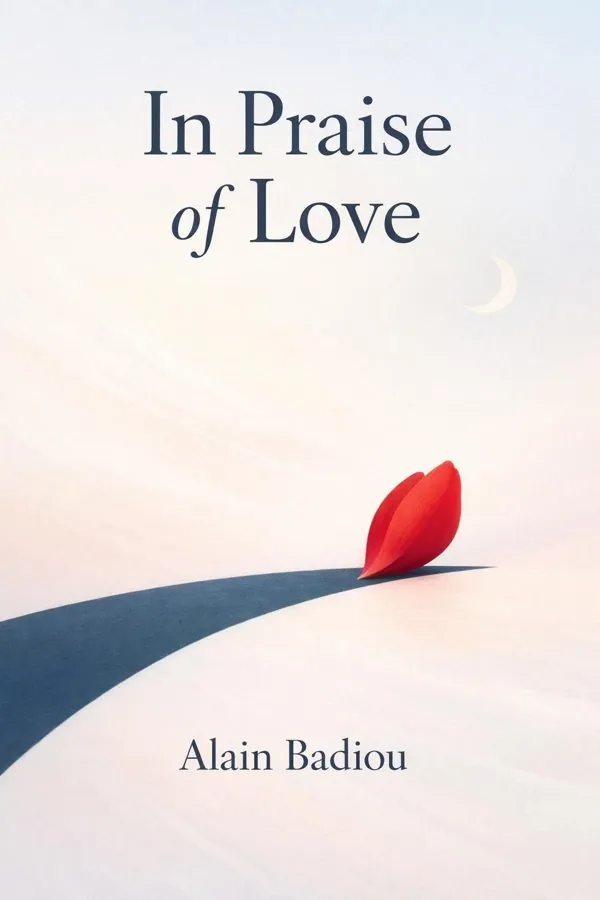
In Praise of Love: Summary & Key Insights
by Alain Badiou
 10 min10 chaptersAudio available
What Is In Praise of Love About?
In Praise of Love by Alain Badiou is a western_phil book spanning 10 pages. In this philosophical essay, Alain Badiou defends love as a fundamental experience of truth, opposing it to the logic of consumerism and contemporary fear. Through a dialogue with Nicolas Truong, he explores the philosophical, political, and existential dimensions of love, presenting it as an act of fidelity to the event of encounter.
This FizzRead summary covers all 10 key chapters of In Praise of Love in approximately 10 minutes, distilling the most important ideas, arguments, and takeaways from Alain Badiou's work. Also available as an audio summary and Key Quotes Podcast.
In Praise of Love
In this philosophical essay, Alain Badiou defends love as a fundamental experience of truth, opposing it to the logic of consumerism and contemporary fear. Through a dialogue with Nicolas Truong, he explores the philosophical, political, and existential dimensions of love, presenting it as an act of fidelity to the event of encounter.
Who Should Read In Praise of Love?
This book is perfect for anyone interested in western_phil and looking to gain actionable insights in a short read. Whether you're a student, professional, or lifelong learner, the key ideas from In Praise of Love by Alain Badiou will help you think differently.
- ✓Readers who enjoy western_phil and want practical takeaways
- ✓Professionals looking to apply new ideas to their work and life
- ✓Anyone who wants the core insights of In Praise of Love in just 10 minutes
Want the full summary?
Get instant access to this book summary and 100K+ more with Fizz Moment.
Get Free SummaryAvailable on App Store • Free to download
Key Chapters
I define love as an event; that is, an occurrence that interrupts the smooth continuity of our lives. It is not merely a feeling but an encounter that transforms the very coordinates of experience. One day, you are a solitary subject, perceiving the world from a single point of view. Then, through a chance meeting—often unexpected—a new world opens, a world seen from two perspectives interwoven. Love’s power rests in this: it creates the possibility of difference as truth. It does not erase difference but inaugurates it as the ground of a shared existence.
Think of that instant of recognition—the first encounter. Something happens that cannot be reduced to mere attraction. It is an accident that demands a response: do you affirm this event, or do you dismiss it? Once affirmed, the event introduces a new way of being in the world. Love begins as chance, but it asks for construction. This is where fidelity enters. To sustain the truth of love is to persist in giving form to the world opened by the event. In this sense, love is philosophical: it demonstrates that truth begins with chance but must be built through perseverance.
An event also resists repetition; it is unique, like the spark of revolution in politics or the inception of discovery in science. Two lovers become co-authors of a world—the world from two points of view. This experience teaches that our reality is never complete when seen from one perspective. Love thereby undoes the narcissism of contemporary culture, replacing the self-centered subject with what I call ‘the Two.’ The event signals the advent of the Two—a unity grounded not in identity but in difference.
The truth of love, I argue, is not sentimental. It is a process, an ongoing work of construction. After the event—the encounter that begins everything—comes the effort of maintaining fidelity, of translating the promise into an enduring truth. Love, thus, is not confined to the moment of falling in love. Falling in love is the beginning; but staying in love, continuing the adventure, is where truth emerges.
What truth? The truth that the world can be experienced and interpreted from more than one standpoint. Love’s duration transforms the solitary subject: it teaches that existence is collective and relational. When two beings construct a shared understanding of their world, they reveal something universal—that the world is not reducible to perspective or possession.
This truth is fragile. It demands patience, attention, and the courage to face disillusionment. Every crisis in love—jealousy, boredom, disappointment—tests fidelity to the initial event. Yet through fidelity, love creates the possibility of transformation. It reveals that beyond the fluctuating passions lies a creative truth about coexistence. In this, love aligns with philosophy itself: both reject the superficial in favor of something that lasts, that endures as evidence of the possible.
+ 8 more chapters — available in the FizzRead app
All Chapters in In Praise of Love
About the Author
Alain Badiou is a French philosopher, playwright, and novelist born in 1937. Emeritus professor at the École normale supérieure, he is known for his work on the philosophy of being, event, and truth, as well as his reflections on politics, art, and love.
Get This Summary in Your Preferred Format
Read or listen to the In Praise of Love summary by Alain Badiou anytime, anywhere. FizzRead offers multiple formats so you can learn on your terms — all free.
Available formats: App · Audio · PDF · EPUB — All included free with FizzRead
Download In Praise of Love PDF and EPUB Summary
Key Quotes from In Praise of Love
“I define love as an event; that is, an occurrence that interrupts the smooth continuity of our lives.”
“The truth of love, I argue, is not sentimental.”
Frequently Asked Questions about In Praise of Love
In Praise of Love by Alain Badiou is a western_phil book that explores key ideas across 10 chapters. In this philosophical essay, Alain Badiou defends love as a fundamental experience of truth, opposing it to the logic of consumerism and contemporary fear. Through a dialogue with Nicolas Truong, he explores the philosophical, political, and existential dimensions of love, presenting it as an act of fidelity to the event of encounter.
You Might Also Like
A Little History of Philosophy
Nigel Warburton
10 min
Areopagitica
John Milton
10 min
How To Think Like A Philosopher: Essential Principles For Clear Thinking
Peter Cave
10 min
Language, Truth and Logic
A. J. Ayer
10 min
The Age of Reason
Thomas Paine
10 min
The Essays
Michel De Montaigne
10 minBrowse by Category
Ready to read In Praise of Love?
Get the full summary and 100K+ more books with Fizz Moment.