
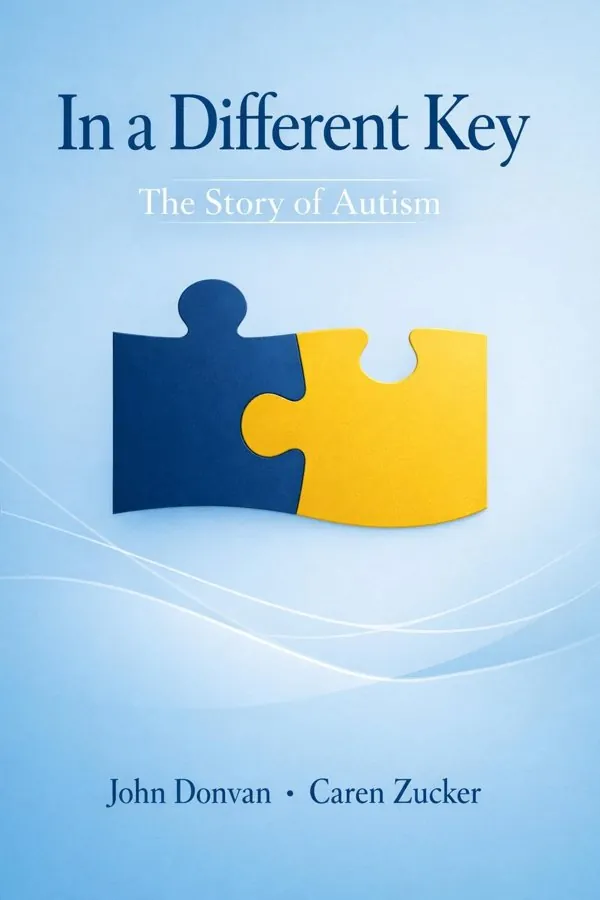
In a Different Key: The Story of Autism: Summary & Key Insights
 10 min5 chaptersAudio available
What Is In a Different Key: The Story of Autism About?
In a Different Key: The Story of Autism by John Donvan, Caren Zucker is a health_med book spanning 5 pages. In a Different Key: The Story of Autism is a comprehensive narrative history of autism, tracing its discovery, the evolution of its diagnosis, and the experiences of individuals and families affected by it. The book explores the scientific, social, and cultural dimensions of autism, from early misconceptions and institutionalization to the rise of advocacy and neurodiversity movements. Through extensive research and personal stories, the authors illuminate how society’s understanding of autism has changed over time.
This FizzRead summary covers all 5 key chapters of In a Different Key: The Story of Autism in approximately 10 minutes, distilling the most important ideas, arguments, and takeaways from John Donvan, Caren Zucker's work. Also available as an audio summary and Key Quotes Podcast.
In a Different Key: The Story of Autism
In a Different Key: The Story of Autism is a comprehensive narrative history of autism, tracing its discovery, the evolution of its diagnosis, and the experiences of individuals and families affected by it. The book explores the scientific, social, and cultural dimensions of autism, from early misconceptions and institutionalization to the rise of advocacy and neurodiversity movements. Through extensive research and personal stories, the authors illuminate how society’s understanding of autism has changed over time.
Who Should Read In a Different Key: The Story of Autism?
This book is perfect for anyone interested in health_med and looking to gain actionable insights in a short read. Whether you're a student, professional, or lifelong learner, the key ideas from In a Different Key: The Story of Autism by John Donvan, Caren Zucker will help you think differently.
- ✓Readers who enjoy health_med and want practical takeaways
- ✓Professionals looking to apply new ideas to their work and life
- ✓Anyone who wants the core insights of In a Different Key: The Story of Autism in just 10 minutes
Want the full summary?
Get instant access to this book summary and 100K+ more with Fizz Moment.
Get Free SummaryAvailable on App Store • Free to download
Key Chapters
Every historical story needs a beginning, and ours begins in Forest, Mississippi, with a boy named Donald Triplett. Born in the 1930s, Donald’s early life puzzled those around him. He seemed detached, distant, yet brilliantly perceptive in his interests. His parents sought help, and in 1943 his behaviors were described in a paper by Leo Kanner at Johns Hopkins University — the first time the word 'autism' was used as a separate diagnostic category. It is through Donald that we glimpse both the compassion and the limitations of early psychiatry. Kanner’s careful observation recognized a pattern distinct from schizophrenia: children who were highly intelligent yet withdrawn into their 'own worlds.' Donald’s story is not tragic. Against all odds, he grew up, returned to his community, and lived a full, independent life — an embodiment of resilience that shattered assumptions about institutionalization. His survival, and his small-town community’s acceptance, became symbolic of what could happen when understanding triumphed over fear.
In the decades following Kanner’s identification of autism, science and society struggled to interpret what this condition meant. Kanner himself maintained a diagnostic narrowness that excluded many children who did not fit his precise model. Meanwhile, in wartime Vienna, Hans Asperger was describing another group of children who exhibited similar patterns of intense focus and social difficulty, but who often excelled intellectually. Working under perilous conditions during the Nazi regime, Asperger’s insights languished in obscurity until rediscovered decades later. This parallel discovery hinted at what we now understand as the autism spectrum. Yet the path to that understanding was anything but linear. The mid-century years were riddled with misconception — perhaps none more painful than Bruno Bettelheim’s 'refrigerator mother' theory, which blamed cold, unaffectionate parenting for causing autism. His influence was devastating. Families already burdened with confusion were now shamed and ostracized. Our research uncovered mothers who still carry the scars of that blame. This era, though cruel, also sowed the seeds of rebellion. Parents, no longer willing to accept guilt or exclusion, began organizing. They refused to lose their children to institutions governed by pity rather than possibility.
+ 3 more chapters — available in the FizzRead app
All Chapters in In a Different Key: The Story of Autism
About the Authors
John Donvan is an American journalist and correspondent for ABC News, known for his work on Nightline. Caren Zucker is a television producer and reporter who has covered autism extensively for ABC News. Both authors have personal and professional connections to the autism community and have collaborated on multiple projects to raise awareness and understanding of autism.
Get This Summary in Your Preferred Format
Read or listen to the In a Different Key: The Story of Autism summary by John Donvan, Caren Zucker anytime, anywhere. FizzRead offers multiple formats so you can learn on your terms — all free.
Available formats: App · Audio · PDF · EPUB — All included free with FizzRead
Download In a Different Key: The Story of Autism PDF and EPUB Summary
Key Quotes from In a Different Key: The Story of Autism
“Every historical story needs a beginning, and ours begins in Forest, Mississippi, with a boy named Donald Triplett.”
“In the decades following Kanner’s identification of autism, science and society struggled to interpret what this condition meant.”
Frequently Asked Questions about In a Different Key: The Story of Autism
In a Different Key: The Story of Autism by John Donvan, Caren Zucker is a health_med book that explores key ideas across 5 chapters. In a Different Key: The Story of Autism is a comprehensive narrative history of autism, tracing its discovery, the evolution of its diagnosis, and the experiences of individuals and families affected by it. The book explores the scientific, social, and cultural dimensions of autism, from early misconceptions and institutionalization to the rise of advocacy and neurodiversity movements. Through extensive research and personal stories, the authors illuminate how society’s understanding of autism has changed over time.
You Might Also Like

On Immunity
Eula Biss
10 min
The Three-Body Problem
Liu Cixin
10 min
Community Health Volunteer Toolkit: Training and Practical Activities
World Health Organization
10 min
Healing Back Pain: The Mind-Body Connection
John E. Sarno
10 min
Health Literacy for All: Practical Guides to Communicate Health Information (Compilations)
World Health Organization
10 min
The Complete Guide to Sports Supplements: An Evidence-Based Review
Anita Bean
10 minBrowse by Category
Ready to read In a Different Key: The Story of Autism?
Get the full summary and 100K+ more books with Fizz Moment.