
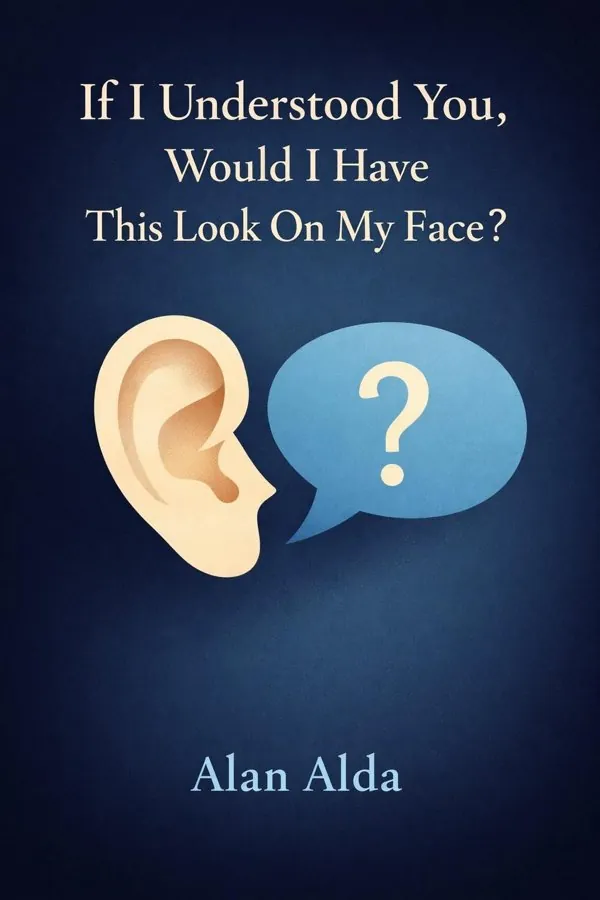
If I Understood You, Would I Have This Look On My Face?: My Adventures in the Art and Science of Relating and Communicating: Summary & Key Insights
by Alan Alda
 10 min9 chaptersAudio available
What Is If I Understood You, Would I Have This Look On My Face?: My Adventures in the Art and Science of Relating and Communicating About?
If I Understood You, Would I Have This Look On My Face?: My Adventures in the Art and Science of Relating and Communicating by Alan Alda is a communication book spanning 9 pages. Award-winning actor Alan Alda shares his journey to understand and improve human communication. Drawing from his experiences in acting, science, and teaching, Alda explores how empathy and clarity can transform the way people connect and relate to one another. The book blends storytelling with scientific insights to help readers communicate more effectively in everyday life.
This FizzRead summary covers all 9 key chapters of If I Understood You, Would I Have This Look On My Face?: My Adventures in the Art and Science of Relating and Communicating in approximately 10 minutes, distilling the most important ideas, arguments, and takeaways from Alan Alda's work. Also available as an audio summary and Key Quotes Podcast.
If I Understood You, Would I Have This Look On My Face?: My Adventures in the Art and Science of Relating and Communicating
Award-winning actor Alan Alda shares his journey to understand and improve human communication. Drawing from his experiences in acting, science, and teaching, Alda explores how empathy and clarity can transform the way people connect and relate to one another. The book blends storytelling with scientific insights to help readers communicate more effectively in everyday life.
Who Should Read If I Understood You, Would I Have This Look On My Face?: My Adventures in the Art and Science of Relating and Communicating?
This book is perfect for anyone interested in communication and looking to gain actionable insights in a short read. Whether you're a student, professional, or lifelong learner, the key ideas from If I Understood You, Would I Have This Look On My Face?: My Adventures in the Art and Science of Relating and Communicating by Alan Alda will help you think differently.
- ✓Readers who enjoy communication and want practical takeaways
- ✓Professionals looking to apply new ideas to their work and life
- ✓Anyone who wants the core insights of If I Understood You, Would I Have This Look On My Face?: My Adventures in the Art and Science of Relating and Communicating in just 10 minutes
Want the full summary?
Get instant access to this book summary and 100K+ more with Fizz Moment.
Get Free SummaryAvailable on App Store • Free to download
Key Chapters
I remember vividly the moment I realized that expertise often gets tangled in its own web. While hosting *Scientific American Frontiers*, I spoke with hundreds of scientists—physicists, neuroscientists, engineers. They were brilliant, articulate in their lab, but when the cameras rolled and I asked, “Can you tell me what that means?” they often froze. It wasn’t because they lacked words but because they hadn’t noticed how their listeners were hearing them. Their focus was on transmitting information, not ensuring understanding. I began to see the phenomenon everywhere: doctors who spoke in jargon, educators who assumed context, leaders who spoke at instead of with their teams. What I saw wasn’t inability—it was disconnection.
That gap ignited my mission. For decades, I had used empathy instinctively on stage to create rapport. Could that same sensitivity be harnessed to help experts communicate? I began questioning what separates clarity from confusion. It isn’t always vocabulary; sometimes it’s emotional distance. To understand someone means feeling what they feel as you speak to them—not just logically but viscerally. That realization became the seed for the Alan Alda Center for Communicating Science, where scientists began learning how to uncover the human inside their message.
Here’s the truth that changed my own worldview: communication breaks down when we aim to prove instead of connect. Every missed cue, every puzzled glance across a conference table stems from our failure to sense what the other person is experiencing. Once we start noticing their face, their tone, their energy—we begin to bridge the gap.
Empathy isn’t sentimental idealism; it’s the central mechanism of understanding. When actors convey emotion truthfully, they aren’t pretending—they’re identifying with another consciousness. In science communication, empathy works the same way. To explain something complex, I must first feel what it’s like to not understand it. Only then can I translate abstract ideas into relatable meaning.
Through my years of workshops, I saw countless professionals resist this idea. They feared that empathy might dilute rigor, that caring too much about the audience might compromise precision. But neuroscience tells us otherwise. Empathy activates cognitive pathways crucial for attention and learning; when someone feels understood, their brain literally becomes more receptive. Communication is not data transfer but emotional resonance.
In my own life, every act of understanding begins with listening to the unspoken. As an actor, I watch micro-expressions—the flicker of the eyes, the tension in the jaw. In daily conversation, those signs guide me to adjust, clarify, and meet the person where they are. When we practice empathy intentionally, understanding follows naturally, and persuasion needs no force. Clarity born of compassion doesn’t just deliver information—it opens trust. Once people feel safe enough to admit what they don’t know, real learning begins.
+ 7 more chapters — available in the FizzRead app
All Chapters in If I Understood You, Would I Have This Look On My Face?: My Adventures in the Art and Science of Relating and Communicating
About the Author
Alan Alda is an American actor, director, and writer best known for his role as Hawkeye Pierce in the television series M*A*S*H. He has also hosted PBS’s Scientific American Frontiers, where he developed a deep interest in science communication. Alda founded the Alan Alda Center for Communicating Science at Stony Brook University to help scientists and professionals convey complex ideas clearly and empathetically.
Get This Summary in Your Preferred Format
Read or listen to the If I Understood You, Would I Have This Look On My Face?: My Adventures in the Art and Science of Relating and Communicating summary by Alan Alda anytime, anywhere. FizzRead offers multiple formats so you can learn on your terms — all free.
Available formats: App · Audio · PDF · EPUB — All included free with FizzRead
Download If I Understood You, Would I Have This Look On My Face?: My Adventures in the Art and Science of Relating and Communicating PDF and EPUB Summary
Key Quotes from If I Understood You, Would I Have This Look On My Face?: My Adventures in the Art and Science of Relating and Communicating
“I remember vividly the moment I realized that expertise often gets tangled in its own web.”
“Empathy isn’t sentimental idealism; it’s the central mechanism of understanding.”
Frequently Asked Questions about If I Understood You, Would I Have This Look On My Face?: My Adventures in the Art and Science of Relating and Communicating
If I Understood You, Would I Have This Look On My Face?: My Adventures in the Art and Science of Relating and Communicating by Alan Alda is a communication book that explores key ideas across 9 chapters. Award-winning actor Alan Alda shares his journey to understand and improve human communication. Drawing from his experiences in acting, science, and teaching, Alda explores how empathy and clarity can transform the way people connect and relate to one another. The book blends storytelling with scientific insights to help readers communicate more effectively in everyday life.
You Might Also Like
Magic Words: The Science and Secrets Behind Seven Words That Motivate, Engage, and Influence
Tim David
10 min
Talking Across The Divide: How to Communicate with People You Disagree with and Maybe Even Change the World
Justin Lee
10 min
The Exceptional Presenter: A Proven Formula to Open Up! and Own the Room
Timothy J. Koegel
10 min
4 Essential Keys to Effective Communication in Love, Life, Work--Anywhere!: Including the 12-Day Communication Challenge!
Bento C. Leal III
10 min
Active Listening Techniques: 30 Practical Tools to Hone Your Communication Skills
Nisha Gupta
10 min
Bargaining for Advantage: Negotiation Strategies for Reasonable People
G. Richard Shell
10 minBrowse by Category
Ready to read If I Understood You, Would I Have This Look On My Face?: My Adventures in the Art and Science of Relating and Communicating?
Get the full summary and 100K+ more books with Fizz Moment.