
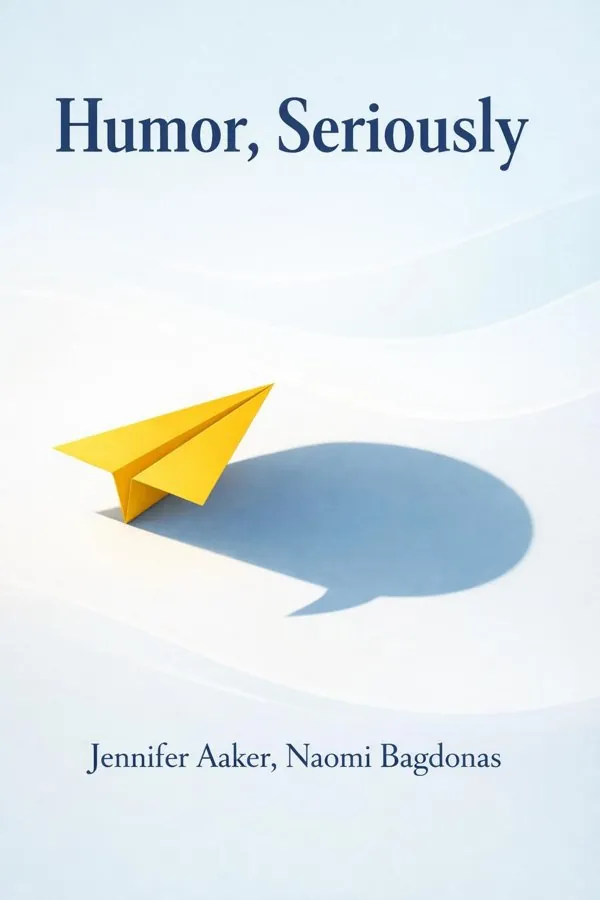
Humor, Seriously: Why Humor Is a Secret Weapon in Business and Life (And How Anyone Can Harness It. Even You.): Summary & Key Insights
by Jennifer Aaker, Naomi Bagdonas
 10 min9 chaptersAudio available
Key Takeaways from Humor, Seriously: Why Humor Is a Secret Weapon in Business and Life (And How Anyone Can Harness It. Even You.)
Laughter often looks light, but its effects are profound.
Many leaders believe authority requires seriousness.
Somewhere between childhood and adulthood, many people stop being playful.
One reason people avoid humor is that they imagine there is only one acceptable version of it: fast, witty, and performative.
People rarely remember the most precise sentence in a conversation.
What Is Humor, Seriously: Why Humor Is a Secret Weapon in Business and Life (And How Anyone Can Harness It. Even You.) About?
Humor, Seriously: Why Humor Is a Secret Weapon in Business and Life (And How Anyone Can Harness It. Even You.) by Jennifer Aaker, Naomi Bagdonas is a leadership book spanning 7 pages. Most people think humor is a nice extra—useful for comedians, optional for leaders, and risky in serious settings. Jennifer Aaker and Naomi Bagdonas argue the opposite. In Humor, Seriously, they show that humor is not a distraction from meaningful work but a powerful advantage in leadership, collaboration, creativity, and resilience. Used well, humor builds trust faster, makes communication more memorable, reduces stress, and helps people stay flexible under pressure. In a world of burnout, remote work, and constant uncertainty, that is not trivial. It is strategic. The book stands out because it combines rigorous behavioral science with practical workplace insight. Aaker, a Stanford professor known for her research on happiness and meaning, teams up with Bagdonas, an executive coach and lecturer who teaches humor and leadership. Together, they translate research and real-life business examples into techniques ordinary people can actually use. Their central promise is both encouraging and challenging: humor is not a rare talent reserved for naturally funny people. It is a learnable skill, a mindset, and a leadership tool that almost anyone can develop.
This FizzRead summary covers all 9 key chapters of Humor, Seriously: Why Humor Is a Secret Weapon in Business and Life (And How Anyone Can Harness It. Even You.) in approximately 10 minutes, distilling the most important ideas, arguments, and takeaways from Jennifer Aaker, Naomi Bagdonas's work. Also available as an audio summary and Key Quotes Podcast.
Humor, Seriously: Why Humor Is a Secret Weapon in Business and Life (And How Anyone Can Harness It. Even You.)
Most people think humor is a nice extra—useful for comedians, optional for leaders, and risky in serious settings. Jennifer Aaker and Naomi Bagdonas argue the opposite. In Humor, Seriously, they show that humor is not a distraction from meaningful work but a powerful advantage in leadership, collaboration, creativity, and resilience. Used well, humor builds trust faster, makes communication more memorable, reduces stress, and helps people stay flexible under pressure. In a world of burnout, remote work, and constant uncertainty, that is not trivial. It is strategic.
The book stands out because it combines rigorous behavioral science with practical workplace insight. Aaker, a Stanford professor known for her research on happiness and meaning, teams up with Bagdonas, an executive coach and lecturer who teaches humor and leadership. Together, they translate research and real-life business examples into techniques ordinary people can actually use. Their central promise is both encouraging and challenging: humor is not a rare talent reserved for naturally funny people. It is a learnable skill, a mindset, and a leadership tool that almost anyone can develop.
Who Should Read Humor, Seriously: Why Humor Is a Secret Weapon in Business and Life (And How Anyone Can Harness It. Even You.)?
This book is perfect for anyone interested in leadership and looking to gain actionable insights in a short read. Whether you're a student, professional, or lifelong learner, the key ideas from Humor, Seriously: Why Humor Is a Secret Weapon in Business and Life (And How Anyone Can Harness It. Even You.) by Jennifer Aaker, Naomi Bagdonas will help you think differently.
- ✓Readers who enjoy leadership and want practical takeaways
- ✓Professionals looking to apply new ideas to their work and life
- ✓Anyone who wants the core insights of Humor, Seriously: Why Humor Is a Secret Weapon in Business and Life (And How Anyone Can Harness It. Even You.) in just 10 minutes
Want the full summary?
Get instant access to this book summary and 100K+ more with Fizz Moment.
Get Free SummaryAvailable on App Store • Free to download
Key Chapters
Laughter often looks light, but its effects are profound. One of the book’s central insights is that humor is not merely entertainment; it is social glue. When people laugh together, they feel safer, closer, and more open. Research shows that humor can trigger the release of chemicals associated with bonding and pleasure, helping lower defenses and increase trust. That is why a shared laugh can change the emotional temperature of a meeting faster than a polished presentation ever could.
Aaker and Bagdonas emphasize that humor matters because work is fundamentally relational. Teams do better when people feel connected. Clients respond more positively when communication feels human. Leaders gain influence when they are seen as approachable rather than distant. Humor helps create these outcomes because it signals warmth, humility, and presence. It reminds people that behind every role, title, or conflict is a human being.
This does not mean every interaction needs a joke. Often, the most effective humor is small and natural: a playful observation, a light self-aware comment, or a shared acknowledgment of the absurdity of a situation. For example, a project manager opening a tense call by saying, “Welcome to our weekly episode of ‘Let’s Pretend This Deadline Was Realistic,’” can break tension without derailing focus. The humor works because it expresses a truth everyone feels.
The practical lesson is simple: use humor to connect, not to perform. Start by noticing moments of shared humanity—confusion, minor mishaps, common frustrations, or everyday absurdities. Then respond with warmth and lightness. Actionable takeaway: before your next meeting, prepare one small, genuine line that makes people feel seen rather than impressed.
Many leaders believe authority requires seriousness. The book argues that this assumption quietly weakens leadership. People do not trust leaders because they seem flawless or emotionally armored. They trust leaders who feel credible and human at the same time. Humor, when used wisely, helps leaders achieve that balance.
Aaker and Bagdonas show that humor enhances leadership because it reduces unnecessary distance. It communicates confidence without rigidity. A leader who can acknowledge setbacks with perspective, laugh at their own harmless mistakes, or lighten the mood during stressful moments signals emotional steadiness. That kind of levity does not trivialize challenges; it shows that challenges can be faced without panic.
Consider the difference between two managers responding to a failed product demo. One becomes tense, defensive, and overly formal. The other says, “Well, our software has chosen vulnerability today,” then calmly redirects the team toward solutions. The second leader is not less serious about results. They are simply more effective at managing the room. Humor can preserve morale, keep people engaged, and prevent fear from narrowing everyone’s thinking.
The authors are careful to distinguish empowering humor from status-based humor. Leaders should avoid jokes that punch down, embarrass others, or signal superiority. The strongest leadership humor is inclusive, self-aware, and mission-supportive. It creates psychological safety rather than social risk.
Actionable takeaway: in your next stressful leadership moment, replace forced perfection with light, grounded candor. Use one self-aware line to reduce tension, then move quickly into clarity and action. Levity works best when it supports competence, not replaces it.
Somewhere between childhood and adulthood, many people stop being playful. The authors call this drop-off the “humor cliff”: as responsibilities grow and professional norms harden, we begin to treat seriousness as maturity. We censor spontaneity, fear looking foolish, and start believing that humor belongs to a lucky few rather than to all of us. The result is not just less laughter. It is less creativity, less resilience, and less authentic connection.
Humor, Seriously challenges the myth that being funny is an inborn trait. Like storytelling, listening, or public speaking, humor can be strengthened through attention and repetition. The first step is adopting a humor mindset. That means seeing humor as something to notice before trying to produce it. Life is already absurd, awkward, ironic, and full of tiny surprises. People who seem naturally funny are often just more attuned to that material.
The book encourages readers to become collectors of amusement. Pay attention to strange phrases, workplace contradictions, minor inconveniences, and shared rituals that everyone recognizes but rarely names. For example, anyone who has sat through a meeting that should have been an email already has humor material. By noticing these patterns, you begin to build fluency.
The authors also suggest low-risk practice: write down one amusing observation each day, reframe small frustrations playfully, and experiment with humor in trusted settings before high-stakes ones. The goal is not to become a stand-up comic. It is to recover flexibility and play.
Actionable takeaway: keep a daily “humor notebook” for one week. Record three things that are mildly absurd, oddly phrased, or unintentionally funny. Training your attention is the fastest way to rebuild your humor instinct.
One reason people avoid humor is that they imagine there is only one acceptable version of it: fast, witty, and performative. The book dismantles this fear by showing that humor has many styles, and effective humor begins with authenticity. You do not need to sound like a late-night host or office extrovert. You need to find a mode of levity that fits your personality, values, and context.
Aaker and Bagdonas describe different forms of humorous expression. Some people are observational, noticing the obvious truth no one has said aloud. Some are dry and understated. Others use playful storytelling, gentle irony, or physical expressiveness. Some people are especially good at timing, while others excel through warmth and self-deprecation. The point is not to imitate another person’s style but to identify what feels natural and sustainable.
For example, an introverted leader may never enjoy high-energy banter, but might excel at quietly delivered one-liners that reset a room. A teacher may use recurring callbacks and funny examples to make lessons stick. A customer service manager might use light metaphors to ease tension with clients. In each case, the humor works because it aligns with the speaker’s real voice.
The authors warn against humor that feels borrowed or strained. Forced jokes reduce trust because audiences can sense when someone is performing a version of themselves that is not genuine. Better to be mildly amusing and real than highly polished and artificial.
Actionable takeaway: identify one humor style that already appears in your natural communication—dry observations, playful exaggeration, funny stories, or self-aware comments. Then use that style deliberately in one conversation this week instead of trying to “be funny” in a generic way.
People rarely remember the most precise sentence in a conversation. They remember the line that made them feel something. That is why humor is such a powerful communication tool. It sharpens attention, increases recall, and helps ideas land with more force. In business and life, being understood is valuable; being remembered is even more valuable.
The book explains that humor works in communication because surprise creates focus. A playful turn of phrase, an unexpected analogy, or a well-timed observation interrupts routine mental patterns. It wakes people up. More importantly, humor can make difficult messages easier to hear. Feedback delivered with kindness and lightness is often less threatening. Presentations with occasional levity are easier to follow. Even written communication becomes more engaging when it sounds like a person rather than a compliance manual.
Imagine a leader introducing a major change initiative. A dry explanation may be accurate but forgettable. A leader who says, “We are redesigning this process because our current system seems to have been built by three committees and a haunted spreadsheet,” creates instant clarity. The humor is not decoration; it highlights the problem in a way people can grasp.
Still, the authors stress that clarity comes first. Humor should support the message, not overshadow it. If people remember the joke but not the point, communication has failed. The best humor in communication illuminates truth, lowers resistance, and keeps people emotionally present.
Actionable takeaway: revise one upcoming email, presentation, or piece of feedback by adding a single line of human, relevant levity. Ask yourself: does this make the core message easier to understand and harder to forget?
Stressed minds narrow. Playful minds explore. One of the book’s most valuable contributions is its argument that humor is not just socially useful; it is cognitively useful. Humor helps people shift perspective, combine distant ideas, and stay mentally flexible. These are exactly the capacities needed for creativity, innovation, and problem-solving.
When teams operate under pressure, they often default to rigid thinking. People become cautious, literal, and afraid to propose unconventional ideas. Humor interrupts that pattern. It invites surprise and reframing. A joke works by connecting things in an unexpected way, which is also what creativity requires. In that sense, humor is training for innovation.
Aaker and Bagdonas show that playful environments often produce better ideas not because they are less disciplined, but because they are less constricted. Brainstorming sessions become more generative when people feel free to experiment. Product teams can use humorous prompts to break out of stale assumptions. Even individuals can unlock insight by deliberately exaggerating a problem, inventing absurd alternatives, or imagining what a comedian would notice about a stuck situation.
For example, if a team is struggling with a clunky onboarding process, asking, “If we wanted to make this ten times more confusing, what would we do?” may trigger laughter first, but useful diagnoses soon follow. The absurd frame exposes hidden flaws.
Humor also sustains creative stamina. Work that feels heavy all the time becomes psychologically expensive. Levity makes experimentation feel less threatening and setbacks less identity-defining.
Actionable takeaway: when a team is stuck, introduce one playful reframing question: “What is absurd here?” or “If we exaggerated this problem, what would it reveal?” Humor can loosen thinking enough for better ideas to emerge.
Humor does not erase difficulty, but it can change our relationship to it. The authors make a nuanced case that humor is one of the healthiest tools for resilience because it creates distance without denial. When people can laugh at an experience—not cruelly, not prematurely, but honestly—they regain perspective and a sense of agency.
This matters in both personal and professional life. Stress, setbacks, and embarrassment are unavoidable. Without some way to metabolize them, they become heavy and sticky. Humor helps transform them into stories, lessons, and shared moments of humanity. A missed flight, a failed pitch, a disastrous tech problem, or a parenting meltdown may still be frustrating, but once it becomes narratable with humor, it often becomes more manageable.
The book does not suggest forced positivity. Timing matters. Fresh pain often needs empathy before levity. But when used appropriately, humor can help people recover faster because it interrupts catastrophic thinking. It reminds us that one bad meeting is not an apocalypse and one awkward moment is not a permanent identity.
Teams benefit here too. A group that can laugh together after an honest postmortem often bounces back stronger than one that treats every mistake as proof of incompetence. Humor signals, “This was hard, but we are still intact.” It creates emotional breathing room.
Actionable takeaway: after your next minor setback, try a two-step reset. First name the difficulty honestly. Then ask, “What would be the funniest truthful way to describe what just happened?” That small reframing can restore perspective and help you move forward with more resilience.
Because humor is powerful, it can also misfire. One of the book’s most practical lessons is that not all humor is helpful. The difference often lies in direction and intent. Good humor creates belonging. Bad humor creates distance, embarrassment, or exclusion. If humor becomes a weapon, it destroys the very trust it is supposed to build.
Aaker and Bagdonas distinguish between humor that punches up, outward, or inward, and humor that punches down. Teasing someone with less power, mocking identity, using sarcasm as aggression, or hiding criticism behind “just kidding” are especially damaging. These habits may get a laugh from some people, but they erode psychological safety and make others more cautious, not more connected.
Context matters too. What is funny in one relationship or culture may be inappropriate in another. Leaders, in particular, need to be more careful because their words carry disproportionate weight. A comment that feels casual from the top can feel risky or coercive to others.
The safest forms of workplace humor are usually self-aware, situational, and inclusive. Shared frustrations, universal human quirks, and harmless observations are often better material than jokes about individuals. It also helps to read the room: are people tense, confused, grieving, or exhausted? Humor should respond to reality, not bulldoze over it.
Actionable takeaway: run humor through a quick filter before using it: Is it kind? Is it inclusive? Is it relevant? Would I still stand by it if repeated publicly? If the answer to any of these is no, choose a different line.
Humor is most valuable when it becomes cultural rather than occasional. The book argues that organizations should not treat levity as a lucky personality trait of a few employees. They should treat it as part of the environment they intentionally create. A workplace where people can laugh, speak candidly, and be a little less guarded is usually a workplace where people think better, collaborate faster, and burn out less quickly.
Culture-level humor does not mean endless jokes or performative fun. It means normalizing humanity. Teams can begin meetings with light check-ins, celebrate mistakes as learning moments, create rituals that encourage play, and allow leaders to model imperfection. Even small practices matter. A recurring “best typo of the week,” a funny team award, or a playful Slack channel can lower friction and remind people they are allowed to have personality at work.
The authors also highlight that levity supports belonging. In environments where pressure is high and mistakes feel dangerous, people self-protect. They contribute less and reveal less. But when a culture includes healthy humor, it signals emotional safety. People are more willing to speak up, take risks, and recover from errors.
That said, levity cannot compensate for toxic systems. A few laughs will not fix unclear expectations, unfair treatment, or chronic overload. Humor works best in cultures committed to respect and competence. It is an amplifier, not a substitute.
Actionable takeaway: introduce one recurring team ritual that invites lightness without forcing performance. The best rituals are optional, repeatable, and rooted in shared experience rather than pressure to entertain.
All Chapters in Humor, Seriously: Why Humor Is a Secret Weapon in Business and Life (And How Anyone Can Harness It. Even You.)
About the Authors
Jennifer Aaker is a behavioral scientist, author, and professor at Stanford Graduate School of Business. Her research explores happiness, meaning, time, money, and how people connect with ideas that matter. Naomi Bagdonas is a lecturer at Stanford, executive coach, and former comedian who works with leaders on communication, presence, and humor. Together, they teach the popular Stanford course "Humor: Serious Business," which examines how levity can improve leadership and life. Their collaboration blends academic rigor with practical coaching insight, making their work especially useful for professionals. In Humor, Seriously, they combine research, case studies, and real-world applications to show that humor is not a rare gift but a skill that can be cultivated by almost anyone.
Get This Summary in Your Preferred Format
Read or listen to the Humor, Seriously: Why Humor Is a Secret Weapon in Business and Life (And How Anyone Can Harness It. Even You.) summary by Jennifer Aaker, Naomi Bagdonas anytime, anywhere. FizzRead offers multiple formats so you can learn on your terms — all free.
Available formats: App · Audio · PDF · EPUB — All included free with FizzRead
Download Humor, Seriously: Why Humor Is a Secret Weapon in Business and Life (And How Anyone Can Harness It. Even You.) PDF and EPUB Summary
Key Quotes from Humor, Seriously: Why Humor Is a Secret Weapon in Business and Life (And How Anyone Can Harness It. Even You.)
“Laughter often looks light, but its effects are profound.”
“Many leaders believe authority requires seriousness.”
“Somewhere between childhood and adulthood, many people stop being playful.”
“One reason people avoid humor is that they imagine there is only one acceptable version of it: fast, witty, and performative.”
“People rarely remember the most precise sentence in a conversation.”
Frequently Asked Questions about Humor, Seriously: Why Humor Is a Secret Weapon in Business and Life (And How Anyone Can Harness It. Even You.)
Humor, Seriously: Why Humor Is a Secret Weapon in Business and Life (And How Anyone Can Harness It. Even You.) by Jennifer Aaker, Naomi Bagdonas is a leadership book that explores key ideas across 9 chapters. Most people think humor is a nice extra—useful for comedians, optional for leaders, and risky in serious settings. Jennifer Aaker and Naomi Bagdonas argue the opposite. In Humor, Seriously, they show that humor is not a distraction from meaningful work but a powerful advantage in leadership, collaboration, creativity, and resilience. Used well, humor builds trust faster, makes communication more memorable, reduces stress, and helps people stay flexible under pressure. In a world of burnout, remote work, and constant uncertainty, that is not trivial. It is strategic. The book stands out because it combines rigorous behavioral science with practical workplace insight. Aaker, a Stanford professor known for her research on happiness and meaning, teams up with Bagdonas, an executive coach and lecturer who teaches humor and leadership. Together, they translate research and real-life business examples into techniques ordinary people can actually use. Their central promise is both encouraging and challenging: humor is not a rare talent reserved for naturally funny people. It is a learnable skill, a mindset, and a leadership tool that almost anyone can develop.
You Might Also Like

Extreme Ownership
Jocko Willink
10 min
Dare to Lead
Brene Brown
10 min
Leaders Eat Last
Simon Sinek
10 min
The 21 Irrefutable Laws of Leadership
John Maxwell
10 min
Start With Why
Simon Sinek
10 min
How to Lead When You're Not in Charge
Clay Scroggins
10 minBrowse by Category
Ready to read Humor, Seriously: Why Humor Is a Secret Weapon in Business and Life (And How Anyone Can Harness It. Even You.)?
Get the full summary and 100K+ more books with Fizz Moment.