
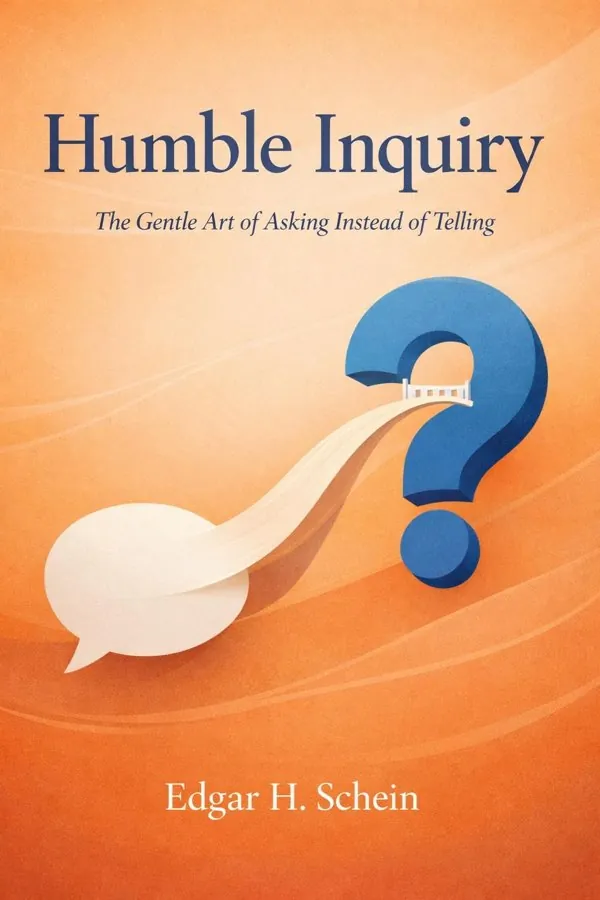
Humble Inquiry: The Gentle Art of Asking Instead of Telling: Summary & Key Insights
 10 min7 chaptersAudio available
What Is Humble Inquiry: The Gentle Art of Asking Instead of Telling About?
Humble Inquiry: The Gentle Art of Asking Instead of Telling by Edgar H. Schein is a leadership book spanning 7 pages. Humble Inquiry explores how leaders and professionals can build trust and improve communication by asking genuine, open-ended questions rather than giving orders or advice. Edgar H. Schein, a pioneer in organizational psychology, presents a practical framework for fostering collaboration and mutual respect in workplaces and beyond. The book emphasizes curiosity, empathy, and humility as essential tools for effective leadership and organizational culture.
This FizzRead summary covers all 7 key chapters of Humble Inquiry: The Gentle Art of Asking Instead of Telling in approximately 10 minutes, distilling the most important ideas, arguments, and takeaways from Edgar H. Schein's work. Also available as an audio summary and Key Quotes Podcast.
Humble Inquiry: The Gentle Art of Asking Instead of Telling
Humble Inquiry explores how leaders and professionals can build trust and improve communication by asking genuine, open-ended questions rather than giving orders or advice. Edgar H. Schein, a pioneer in organizational psychology, presents a practical framework for fostering collaboration and mutual respect in workplaces and beyond. The book emphasizes curiosity, empathy, and humility as essential tools for effective leadership and organizational culture.
Who Should Read Humble Inquiry: The Gentle Art of Asking Instead of Telling?
This book is perfect for anyone interested in leadership and looking to gain actionable insights in a short read. Whether you're a student, professional, or lifelong learner, the key ideas from Humble Inquiry: The Gentle Art of Asking Instead of Telling by Edgar H. Schein will help you think differently.
- ✓Readers who enjoy leadership and want practical takeaways
- ✓Professionals looking to apply new ideas to their work and life
- ✓Anyone who wants the core insights of Humble Inquiry: The Gentle Art of Asking Instead of Telling in just 10 minutes
Want the full summary?
Get instant access to this book summary and 100K+ more with Fizz Moment.
Get Free SummaryAvailable on App Store • Free to download
Key Chapters
From an early age, most of us are trained to value competence, to demonstrate that we know what we are doing. In Western, particularly American, culture, this manifests as a bias toward telling. We tell to assert expertise, to control outcomes, to appear decisive. Organizations reflect the same impulse: structures are built on hierarchies of command, with the assumption that authority flows from knowledge. Yet such a culture of telling creates invisible barriers. Those lower in the hierarchy hesitate to voice uncertainty or offer dissent, fearing they might appear ignorant or disrespectful. The result is miscommunication, withheld information, and missed opportunities for learning.
In my career as a consultant working with hospitals, technology firms, and the military, I observed that breakdowns in performance rarely stem from lack of technical skill. They stem from failures of communication—the pilot who doesn’t question the captain’s assumption, the nurse who hesitates to clarify a doctor’s order, the engineer who keeps quiet about an overlooked risk. In each case, a culture of telling stifles inquiry, and silence becomes dangerous.
Humble Inquiry stands in deliberate contrast. It begins by recognizing that no single person can know everything in complex, interdependent systems. The only way to coordinate effectively is through open dialogue, and the only way to invite that dialogue is to ask. When we replace telling with genuine asking, we signal trust in the other’s knowledge and establish a foundation for learning together. This shift is not merely polite—it is fundamental to creating truly adaptive and safe organizations.
The term humility often evokes images of modesty or deference, but in the context of human relations, it has deeper meaning. I distinguish among three kinds of humility: basic, optional, and here-and-now humility. Basic humility arises from our shared human condition—none of us can survive without the help of others. Optional humility occurs when we choose to show respect or admiration toward someone of higher status or greater accomplishment. But the most critical kind for our purposes is here-and-now humility, which emerges when circumstances make us dependent on another person. In those moments—whether we are asking a nurse what happened in the ward or turning to a technician for help with a system—we momentarily rely on someone else’s knowledge or action. Recognizing this dependency with grace rather than defensiveness opens the door to genuine connection.
Here-and-now humility is uncomfortable for many leaders. It requires admitting not knowing. Yet this is precisely where learning and trust begin. When I invite you to tell me about your experience, I am acknowledging that my perspective is limited, that you hold insight I do not. This admission is not weakness but strength—it dignifies the other and prepares the ground for authentic collaboration. Without humility, inquiry becomes manipulative; with it, inquiry becomes transformational. True leadership therefore begins not with asserting authority but with cultivating the capacity to be humbly curious.
+ 5 more chapters — available in the FizzRead app
All Chapters in Humble Inquiry: The Gentle Art of Asking Instead of Telling
About the Author
Edgar H. Schein (1928–2023) was a renowned social psychologist and professor emeritus at the MIT Sloan School of Management. He was a leading authority on organizational culture, leadership, and process consultation, and authored numerous influential works including 'Organizational Culture and Leadership' and 'Process Consultation Revisited.'
Get This Summary in Your Preferred Format
Read or listen to the Humble Inquiry: The Gentle Art of Asking Instead of Telling summary by Edgar H. Schein anytime, anywhere. FizzRead offers multiple formats so you can learn on your terms — all free.
Available formats: App · Audio · PDF · EPUB — All included free with FizzRead
Download Humble Inquiry: The Gentle Art of Asking Instead of Telling PDF and EPUB Summary
Key Quotes from Humble Inquiry: The Gentle Art of Asking Instead of Telling
“From an early age, most of us are trained to value competence, to demonstrate that we know what we are doing.”
“The term humility often evokes images of modesty or deference, but in the context of human relations, it has deeper meaning.”
Frequently Asked Questions about Humble Inquiry: The Gentle Art of Asking Instead of Telling
Humble Inquiry: The Gentle Art of Asking Instead of Telling by Edgar H. Schein is a leadership book that explores key ideas across 7 chapters. Humble Inquiry explores how leaders and professionals can build trust and improve communication by asking genuine, open-ended questions rather than giving orders or advice. Edgar H. Schein, a pioneer in organizational psychology, presents a practical framework for fostering collaboration and mutual respect in workplaces and beyond. The book emphasizes curiosity, empathy, and humility as essential tools for effective leadership and organizational culture.
More by Edgar H. Schein

You Might Also Like

Extreme Ownership
Jocko Willink
10 min
Dare to Lead
Brene Brown
10 min
Leaders Eat Last
Simon Sinek
10 min
The 21 Irrefutable Laws of Leadership
John Maxwell
10 min
Start With Why
Simon Sinek
10 min
How to Lead When You're Not in Charge
Clay Scroggins
10 minBrowse by Category
Ready to read Humble Inquiry: The Gentle Art of Asking Instead of Telling?
Get the full summary and 100K+ more books with Fizz Moment.