

Helping: Summary & Key Insights
 10 min9 chaptersAudio available
Key Takeaways from Helping
The surprising truth about helping is that it is rarely neutral.
One hidden force in every helping interaction is status.
Help is often treated as a moral good, but Schein reminds us that it also has an economics.
Many failures of helping begin long before help is given: they begin when people avoid asking.
One of Schein’s most important insights is that the urge to help often leads people to do the wrong thing first.
What Is Helping About?
Helping by Edgar H. Schein is a organization book spanning 11 pages. Edgar H. Schein’s Helping is a deceptively simple book about a familiar act that often goes wrong: one person tries to assist another. In workplaces, families, schools, and professional services, help is constantly offered, requested, resisted, and misunderstood. Schein argues that helping is never just a technical exchange of advice or expertise. It is a social and emotional process shaped by status, trust, role expectations, and the vulnerability of both parties. That is why even well-intentioned help can create embarrassment, dependence, defensiveness, or frustration. What makes this book so valuable is Schein’s ability to uncover the hidden psychology inside ordinary interactions. A pioneering organizational psychologist and long-time MIT Sloan professor, he draws on decades of work in consulting, leadership, and organizational culture to show why helping relationships succeed or fail. His central insight is that effective help begins not with expertise, but with humility, curiosity, and a genuine effort to build a balanced relationship. For managers, consultants, coaches, teachers, caregivers, and anyone who works with people, Helping offers a practical and humane framework for turning advice-giving into real support.
This FizzRead summary covers all 9 key chapters of Helping in approximately 10 minutes, distilling the most important ideas, arguments, and takeaways from Edgar H. Schein's work. Also available as an audio summary and Key Quotes Podcast.
Helping
Edgar H. Schein’s Helping is a deceptively simple book about a familiar act that often goes wrong: one person tries to assist another. In workplaces, families, schools, and professional services, help is constantly offered, requested, resisted, and misunderstood. Schein argues that helping is never just a technical exchange of advice or expertise. It is a social and emotional process shaped by status, trust, role expectations, and the vulnerability of both parties. That is why even well-intentioned help can create embarrassment, dependence, defensiveness, or frustration.
What makes this book so valuable is Schein’s ability to uncover the hidden psychology inside ordinary interactions. A pioneering organizational psychologist and long-time MIT Sloan professor, he draws on decades of work in consulting, leadership, and organizational culture to show why helping relationships succeed or fail. His central insight is that effective help begins not with expertise, but with humility, curiosity, and a genuine effort to build a balanced relationship. For managers, consultants, coaches, teachers, caregivers, and anyone who works with people, Helping offers a practical and humane framework for turning advice-giving into real support.
Who Should Read Helping?
This book is perfect for anyone interested in organization and looking to gain actionable insights in a short read. Whether you're a student, professional, or lifelong learner, the key ideas from Helping by Edgar H. Schein will help you think differently.
- ✓Readers who enjoy organization and want practical takeaways
- ✓Professionals looking to apply new ideas to their work and life
- ✓Anyone who wants the core insights of Helping in just 10 minutes
Want the full summary?
Get instant access to this book summary and 100K+ more with Fizz Moment.
Get Free SummaryAvailable on App Store • Free to download
Key Chapters
The surprising truth about helping is that it is rarely neutral. The moment one person needs assistance and another is positioned to provide it, a relationship forms that carries emotional weight. Even before any advice is given, the person receiving help may feel exposed, dependent, or inadequate, while the helper may feel responsible, superior, or impatient. Schein shows that helping is not merely an act; it is a social process that begins with uncertainty and can quickly go wrong if the human dynamics are ignored.
This matters because many people think of helping as a straightforward transfer of knowledge: one person knows something, the other does not. But in reality, successful helping depends on how the interaction is framed. If the helper moves too quickly, assumes too much, or ignores the other person’s perspective, resistance appears. If the person seeking help feels judged or diminished, they may withhold information, reject useful advice, or become passively dependent.
Consider a manager who immediately solves an employee’s problem without asking questions. The solution may be technically correct, yet the employee may feel dismissed or infantilized. By contrast, a manager who first asks, “How are you seeing the situation?” creates space for trust and partnership.
Schein’s point is that helping works best when both people recognize that a temporary imbalance exists and consciously work to make the relationship safe and respectful. The actionable takeaway: before offering solutions, focus on establishing a relationship in which the other person feels understood rather than managed.
One hidden force in every helping interaction is status. Even when people do not mention it, help creates an imbalance: one person appears competent, resourced, or knowledgeable, and the other appears to need something. Schein argues that this imbalance can trigger subtle anxieties on both sides. The receiver may feel one-down, embarrassed, or defensive. The helper may become one-up, overly confident, or unaware of how much power they are exercising.
This is why advice that seems generous can be experienced as controlling. A consultant, doctor, executive, or parent may believe they are simply offering expertise, but the recipient may hear a message of inferiority: “You cannot handle this without me.” Once that feeling sets in, cooperation becomes difficult. Instead of engaging openly, people protect their dignity.
Schein does not suggest pretending status differences do not exist. He argues that effective helpers manage them carefully. They avoid showing off knowledge, rushing to diagnosis, or treating the other person like a problem to be fixed. They signal respect by listening, asking permission, and acknowledging the other person’s agency.
In organizations, this is especially important when leaders “help” subordinates. A senior executive who enters a discussion with curiosity rather than authority can reduce fear and encourage honesty. Even simple phrases like “Help me understand what you’ve tried” or “What would be most useful from me?” can rebalance the exchange.
The actionable takeaway: whenever you are helping, assume a status gap exists and actively reduce it through respect, permission, and genuine curiosity.
Many failures of helping begin long before help is given: they begin when people avoid asking. Schein emphasizes that seeking help is psychologically difficult because it requires admitting uncertainty, dependence, or lack of control. In cultures that prize competence, independence, and expertise, asking can feel like a threat to identity. As a result, people wait too long, ask indirectly, or disguise their need in ways that make effective help nearly impossible.
This reluctance is common in organizations. Employees fear looking weak. Managers worry that seeking guidance will undermine authority. Experts hesitate because they are expected to already know. The irony is that these defenses often create bigger problems than the original issue. Small misunderstandings become crises because no one wanted to expose a gap in knowledge early.
Schein argues that good asking is not a sign of weakness but a sign of maturity. It requires clarity about what is needed and enough self-awareness to articulate the problem without surrendering all responsibility. Helpful questions include: What exactly am I struggling with? What kind of assistance do I want? Am I asking the right person? The more precise the request, the more useful and respectful the exchange becomes.
A team lead who says, “I need your input on how to structure this meeting because stakeholder dynamics are becoming difficult,” makes it easier to respond than someone who vaguely says, “Can you help?” Precision reduces confusion and preserves dignity.
The actionable takeaway: normalize asking early, ask specifically, and frame help-seeking as a responsible act of problem-solving rather than a confession of incompetence.
One of Schein’s most important insights is that the urge to help often leads people to do the wrong thing first. We rush to solve, prescribe, instruct, or reassure before we actually understand the situation. This is especially true for experts, whose training rewards diagnosis and answers. Yet premature advice frequently fails because it is based on incomplete information and weak relationships.
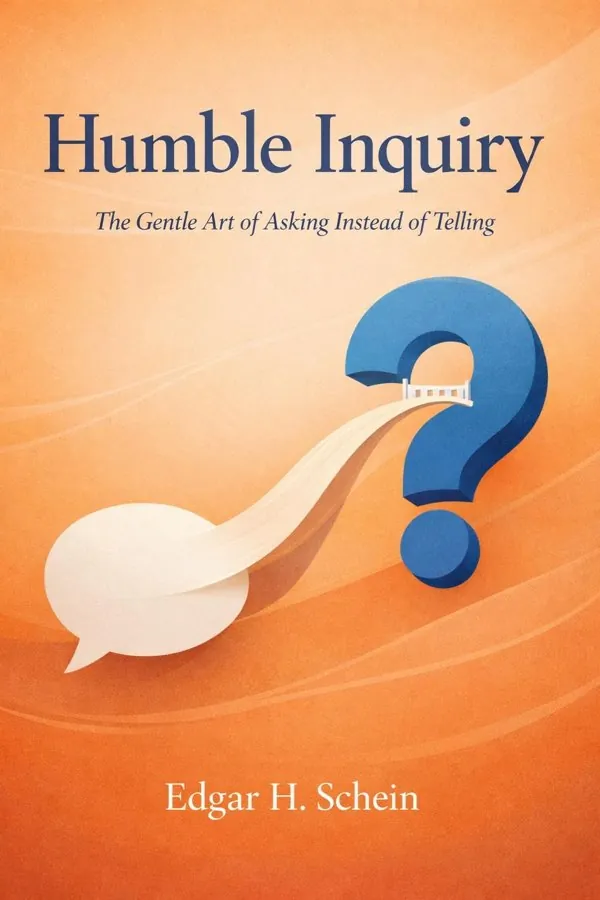
Schein proposes a different starting point: humble inquiry. This means asking genuine questions whose purpose is not to confirm a theory or display intelligence, but to learn how the other person sees the problem. Humble inquiry lowers defensiveness, communicates respect, and gives the receiver a more active role in shaping the conversation. It transforms helping from a one-way intervention into a shared exploration.
For example, instead of saying, “Here’s what you need to do,” a consultant might ask, “What have you noticed so far?” A leader might ask, “What is making this difficult?” A friend might ask, “Do you want me to listen, help you think, or offer suggestions?” These questions create alignment before solutions are proposed.
This approach does not reject expertise. Rather, it places expertise in the right sequence. First establish understanding, then offer help that fits the actual need. In many cases, inquiry alone helps the other person think more clearly and solve the issue themselves.
The actionable takeaway: when you feel the impulse to advise, pause and ask at least two sincere, open-ended questions before offering any recommendation.
Not all help is the same, and Schein stresses that confusion begins when we fail to diagnose what kind of helping situation we are in. Sometimes a person needs concrete information. Sometimes they need coaching to think through options. Sometimes the real issue is emotional, political, or relational rather than technical. If the helper misreads the situation, even a smart response can miss the mark.
Schein’s broader work distinguishes several forms of help, including expert help, doctor-patient help, and process consultation. Expert help assumes the problem is known and the helper has the answer. Doctor-patient help assumes the helper will diagnose and prescribe. Process consultation focuses on helping the other person understand and manage their own situation. Each model has value, but each fits different conditions.
Problems arise when helpers default to their preferred style rather than the style the situation requires. A manager may offer technical fixes when the employee really needs help clarifying priorities. A consultant may present a diagnosis when the client lacks trust in the data. A friend may give emotional support when direct feedback is actually needed.
Effective diagnosis begins with attention: What is being asked? What is not being said? How much does the other person understand their own problem? What constraints shape the context? The more carefully we diagnose, the less likely we are to over-help, under-help, or solve the wrong problem.
The actionable takeaway: before deciding how to help, identify whether the need is for expertise, diagnosis, reflection, emotional support, or collaborative problem-solving.
Help is only useful when it can be received, and reception depends on trust. Schein argues that trust is not a soft extra added after competence; it is the condition that allows competence to matter. People rarely accept guidance from someone who does not seem to respect them, understand them, or care about their interests. Without trust, advice is filtered through suspicion and self-protection.
Trust in helping relationships develops through small signals: attentive listening, discretion, consistency, patience, and honesty about limits. It is damaged by interruption, arrogance, hidden agendas, and overly rapid certainty. In workplaces, trust is especially fragile because helping often occurs within performance systems where information can affect reputation, evaluation, and power.
A senior leader asking for candor from direct reports may hear little if employees believe honesty will be punished. A consultant may not get accurate data if the client fears being judged. A coach may not be effective if the coachee senses pressure to conform. In each case, the technical content of the help matters less than the quality of the relationship carrying it.
Schein’s practical lesson is that trust is built through process, not declarations. You cannot demand openness; you create the conditions for it. This often means slowing down, clarifying intentions, maintaining confidentiality where appropriate, and following through on commitments.
The actionable takeaway: if help is not landing, do not just improve the advice—examine whether the relationship feels safe enough for the other person to truly hear and use it.
It is easy to assume helping problems are personal, but Schein shows that organizations often make them systemic. Hierarchies, role boundaries, incentives, and cultural norms can all distort when and how people seek or offer help. In many workplaces, asking for assistance is interpreted as weakness, while giving help can become a way to control, micromanage, or signal superiority. The result is a culture where people either struggle alone or intervene unskillfully.
Consider environments that reward individual heroics over collaboration. Employees may delay asking for support until problems become visible and expensive. Or think about bureaucratic settings where formal authority discourages honest upward communication. Subordinates may conceal confusion, and leaders may assume silence means competence. In such systems, helping breaks down not because people are unkind, but because norms punish vulnerability and overvalue certainty.
Schein argues that leaders have a special responsibility here. They shape whether help is seen as mutual learning or status loss. Leaders who admit limits, ask questions, and invite input make help-seeking safer for everyone. Systems also matter: cross-functional forums, mentoring structures, after-action reviews, and psychologically safe meetings can turn helping from an improvised act into a normal organizational capability.
The goal is not constant dependence, but interdependence—the recognition that complex work requires people to rely on one another intelligently.
The actionable takeaway: if helping is rare or ineffective in your workplace, look beyond individual behavior and redesign the norms, incentives, and routines that govern how people ask, listen, and respond.
At its deepest level, Schein’s message is cultural. The healthiest environments are not those with the most experts or the strongest authority figures, but those where people can move in and out of helping roles without humiliation. In a mature culture of mutual help, asking is normal, offering is respectful, and learning flows in multiple directions. People do not equate need with weakness or expertise with superiority.
This kind of culture is powerful because it improves both performance and humanity. Teams solve problems faster when they surface confusion early. Innovation improves when people can test ideas without fear. Relationships strengthen when support is given in ways that preserve dignity. Over time, mutual help reduces the isolating effects of hierarchy and specialization.
Creating such a culture requires repeated practices, not slogans. Leaders must model help-seeking themselves. Teams should discuss how they want to give feedback, ask for support, and handle mistakes. Organizations can reward collaboration, not just individual achievement. People at all levels can practice noticing when they are rescuing, controlling, or withdrawing instead of building genuine partnership.
A culture of mutual help does not eliminate conflict or difference. It simply creates better ways to work through them. By treating helping as a core relational skill, organizations become more adaptive, and people become more capable of growing together.
The actionable takeaway: build norms where asking for help is respected, offering help is collaborative, and everyone is expected to both teach and learn.
All Chapters in Helping
About the Author
Edgar H. Schein (1928–2023) was a pioneering American organizational psychologist and professor emeritus at the MIT Sloan School of Management. Over a long and distinguished career, he became one of the most influential thinkers in the study of organizational culture, leadership, career dynamics, and process consultation. His work helped managers and scholars understand how organizations really function beneath formal structures, especially through relationships, assumptions, and group behavior. Schein wrote several foundational books, including Organizational Culture and Leadership, and was widely respected for linking academic insight with practical application. In Helping, he brought that same clarity to one of the most basic yet misunderstood human activities: how people support one another effectively. His ideas continue to shape leadership, consulting, and organizational development around the world.
Get This Summary in Your Preferred Format
Read or listen to the Helping summary by Edgar H. Schein anytime, anywhere. FizzRead offers multiple formats so you can learn on your terms — all free.
Available formats: App · Audio · PDF · EPUB — All included free with FizzRead
Download Helping PDF and EPUB Summary
Key Quotes from Helping
“The surprising truth about helping is that it is rarely neutral.”
“One hidden force in every helping interaction is status.”
“Help is often treated as a moral good, but Schein reminds us that it also has an economics.”
“Many failures of helping begin long before help is given: they begin when people avoid asking.”
“One of Schein’s most important insights is that the urge to help often leads people to do the wrong thing first.”
Frequently Asked Questions about Helping
Helping by Edgar H. Schein is a organization book that explores key ideas across 9 chapters. Edgar H. Schein’s Helping is a deceptively simple book about a familiar act that often goes wrong: one person tries to assist another. In workplaces, families, schools, and professional services, help is constantly offered, requested, resisted, and misunderstood. Schein argues that helping is never just a technical exchange of advice or expertise. It is a social and emotional process shaped by status, trust, role expectations, and the vulnerability of both parties. That is why even well-intentioned help can create embarrassment, dependence, defensiveness, or frustration. What makes this book so valuable is Schein’s ability to uncover the hidden psychology inside ordinary interactions. A pioneering organizational psychologist and long-time MIT Sloan professor, he draws on decades of work in consulting, leadership, and organizational culture to show why helping relationships succeed or fail. His central insight is that effective help begins not with expertise, but with humility, curiosity, and a genuine effort to build a balanced relationship. For managers, consultants, coaches, teachers, caregivers, and anyone who works with people, Helping offers a practical and humane framework for turning advice-giving into real support.
More by Edgar H. Schein
You Might Also Like

A Guide to the Project Management Body of Knowledge (PMBOK® Guide)
Project Management Institute
10 min
Organizational Behavior
Stephen P. Robbins
10 min
Accelerate: The Science of Lean Software and DevOps – Building and Scaling High Performing Technology Organizations
Nicole Forsgren, Jez Humble, Gene Kim
10 min
Awakening Compassion at Work: The Quiet Power That Elevates People and Organizations
Monica C. Worline, Jane E. Dutton
10 min
Building an Inclusive Organization: Leveraging the Power of a Diverse Workforce
Stephen Frost
10 min
Collaborative Intelligence: Thinking with People Who Think Differently
Dawna Markova, Angie McArthur
10 minBrowse by Category
Ready to read Helping?
Get the full summary and 100K+ more books with Fizz Moment.