
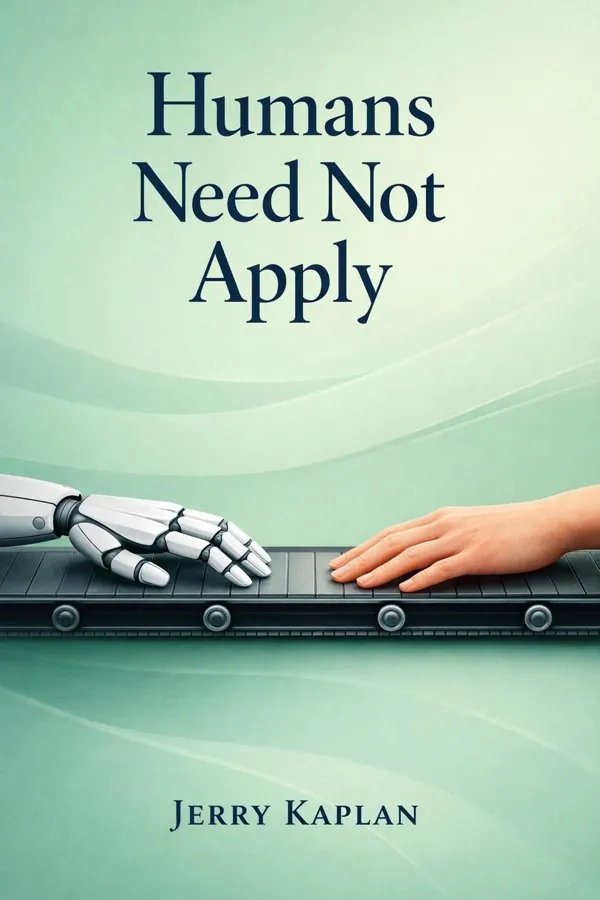
Humans Need Not Apply: A Guide to Wealth and Work in the Age of Artificial Intelligence: Summary & Key Insights
by Jerry Kaplan
 10 min9 chaptersAudio available
Key Takeaways from Humans Need Not Apply: A Guide to Wealth and Work in the Age of Artificial Intelligence
Artificial intelligence did not appear all at once as a magical breakthrough; it evolved through decades of ambition, disappointment, and reinvention.
For centuries, work has been more than a way to earn money; it has been a source of identity, discipline, pride, and social belonging.
The deepest economic impact of AI may not be unemployment alone but the concentration of wealth in the hands of those who own the machines.
Technological revolutions do not just change tools; they rearrange society.
One of Kaplan’s most useful clarifications is that automation usually replaces tasks before it replaces occupations.
What Is Humans Need Not Apply: A Guide to Wealth and Work in the Age of Artificial Intelligence About?
Humans Need Not Apply: A Guide to Wealth and Work in the Age of Artificial Intelligence by Jerry Kaplan is a ai_ml book spanning 4 pages. What happens when machines stop being simple tools and start becoming capable workers, decision-makers, and economic actors? In Humans Need Not Apply, Jerry Kaplan tackles this unsettling question with rare clarity. The book is not a technical manual on artificial intelligence, nor is it a sensational warning about robot uprisings. Instead, it is a sharp, accessible exploration of how intelligent machines are changing employment, wealth creation, social status, and the structure of modern capitalism. Kaplan argues that the real disruption of AI is not just technological but economic and political. As software and smart machines take over tasks once reserved for skilled professionals as well as routine laborers, societies will be forced to rethink the link between work, income, and dignity. Who benefits when machines produce more value than humans? What happens to people whose labor is no longer needed? And how should law, education, and public policy adapt? Kaplan writes with the authority of someone who has lived inside the technology industry. As a computer scientist, entrepreneur, and Stanford educator, he combines practical knowledge with philosophical depth, making this book an essential guide to one of the defining transitions of our time.
This FizzRead summary covers all 9 key chapters of Humans Need Not Apply: A Guide to Wealth and Work in the Age of Artificial Intelligence in approximately 10 minutes, distilling the most important ideas, arguments, and takeaways from Jerry Kaplan's work. Also available as an audio summary and Key Quotes Podcast.
Humans Need Not Apply: A Guide to Wealth and Work in the Age of Artificial Intelligence
What happens when machines stop being simple tools and start becoming capable workers, decision-makers, and economic actors? In Humans Need Not Apply, Jerry Kaplan tackles this unsettling question with rare clarity. The book is not a technical manual on artificial intelligence, nor is it a sensational warning about robot uprisings. Instead, it is a sharp, accessible exploration of how intelligent machines are changing employment, wealth creation, social status, and the structure of modern capitalism.
Kaplan argues that the real disruption of AI is not just technological but economic and political. As software and smart machines take over tasks once reserved for skilled professionals as well as routine laborers, societies will be forced to rethink the link between work, income, and dignity. Who benefits when machines produce more value than humans? What happens to people whose labor is no longer needed? And how should law, education, and public policy adapt?
Kaplan writes with the authority of someone who has lived inside the technology industry. As a computer scientist, entrepreneur, and Stanford educator, he combines practical knowledge with philosophical depth, making this book an essential guide to one of the defining transitions of our time.
Who Should Read Humans Need Not Apply: A Guide to Wealth and Work in the Age of Artificial Intelligence?
This book is perfect for anyone interested in ai_ml and looking to gain actionable insights in a short read. Whether you're a student, professional, or lifelong learner, the key ideas from Humans Need Not Apply: A Guide to Wealth and Work in the Age of Artificial Intelligence by Jerry Kaplan will help you think differently.
- ✓Readers who enjoy ai_ml and want practical takeaways
- ✓Professionals looking to apply new ideas to their work and life
- ✓Anyone who wants the core insights of Humans Need Not Apply: A Guide to Wealth and Work in the Age of Artificial Intelligence in just 10 minutes
Want the full summary?
Get instant access to this book summary and 100K+ more with Fizz Moment.
Get Free SummaryAvailable on App Store • Free to download
Key Chapters
Artificial intelligence did not appear all at once as a magical breakthrough; it evolved through decades of ambition, disappointment, and reinvention. That history matters because it helps us understand both what AI can really do and why public expectations are so often distorted. Kaplan begins by separating fantasy from reality. Early researchers believed human thinking could be translated into formal rules, so symbolic reasoning dominated the first wave of AI. Machines were expected to solve problems by manipulating logical representations of the world. But real life turned out to be far messier than neat rulebooks allowed.
As computing power increased, researchers shifted toward data-driven methods, statistical models, and machine learning. Instead of hand-coding every rule, engineers trained systems on vast examples. This change made AI useful in speech recognition, recommendation systems, image analysis, fraud detection, and many other domains. The important point is that intelligence in machines is often narrow, specialized, and highly dependent on context. A system can outperform humans in one task while remaining clueless outside it.
Kaplan’s historical framing also undercuts simplistic claims that machines either think exactly like people or are still too primitive to matter. Neither is true. AI systems do not need consciousness, emotion, or common sense to transform economies. A machine that can classify medical scans, optimize logistics, or draft legal documents already has enough capability to reshape industries.
In practice, this means leaders should stop asking whether AI is “truly intelligent” and start asking where it reliably performs valuable tasks. A business owner might use AI to forecast demand; a teacher might use it to personalize learning support; a hospital might use it to prioritize high-risk patients. The actionable takeaway: focus less on philosophical debates about whether machines think like humans and more on how task-specific intelligence is already changing real work and decision-making.
For centuries, work has been more than a way to earn money; it has been a source of identity, discipline, pride, and social belonging. Kaplan’s unsettling insight is that AI threatens not only jobs but the very cultural meaning of work. Once intelligent systems can perform cognitive tasks as well as, or better than, many people, labor is no longer the exclusive domain of human beings. That shift forces us to reconsider assumptions that have shaped modern life.
Automation has traditionally replaced repetitive manual labor, but AI reaches much further. It can analyze contracts, detect disease patterns, translate text, review loan applications, and manage customer interactions. This means disruption is no longer confined to factory floors. White-collar professionals, administrative staff, service workers, and even experts are now exposed. The important distinction Kaplan makes is between jobs and tasks. Entire occupations may not disappear overnight, but more and more of their components can be automated. Over time, the human role shrinks, changes, or becomes concentrated in fewer hands.
This matters because societies are built on the expectation that most adults will support themselves through paid employment. If machines can generate output without wages, benefits, or fatigue, employers will naturally prefer them where economically sensible. The result may be lower labor demand, wage pressure, and a growing gap between productivity and broad-based prosperity.
Examples are already visible. Retail uses self-checkout and automated inventory systems. Accounting software handles bookkeeping once done manually. AI assistants reduce the need for first-line support agents. Even if some jobs remain, they may require fewer workers and different skills. Kaplan urges readers to confront this honestly rather than hiding behind the comforting phrase that technology always creates new work.
The actionable takeaway: stop equating job security with role permanence. Instead, examine the tasks inside your profession, identify which are automatable, and strengthen the human capabilities, judgment, relationships, creativity, and adaptability, that are hardest to codify.
The deepest economic impact of AI may not be unemployment alone but the concentration of wealth in the hands of those who own the machines. Kaplan pushes readers to see automation not simply as a labor issue but as an ownership issue. When software, robots, and intelligent platforms produce value, the rewards do not flow automatically to society at large. They flow first to shareholders, founders, platform operators, and intellectual property holders.
In earlier industrial eras, rising productivity could still support large workforces because factories needed many people. In the AI economy, output can expand with far fewer employees. A digital business can serve millions of users with a relatively small team. A logistics platform can optimize operations with algorithms rather than middle managers. A financial system can execute decisions through code. This means productivity growth no longer guarantees broad participation in income growth.
Kaplan’s point is not that technology is inherently unjust but that market systems distribute gains according to ownership, not need. If a company replaces a thousand workers with software, the benefit appears as higher profit margins, lower costs, and increased investor returns. Unless institutions intervene, those gains accumulate upward. This creates a world in which economic value keeps growing while many people become less essential to its production.
The implications are far-reaching. Housing, healthcare, education, and retirement all assume households can earn wages. But if the income share going to labor declines, then social stability depends on rethinking taxation, public benefits, and access to capital. Some people may need stronger safety nets; others may need opportunities to share in technological wealth through investment, cooperative ownership, or public policy.
A practical example is platform capitalism. The company that owns the algorithm, data, and brand captures enormous value, while contractors or displaced workers absorb the risk. Kaplan wants readers to notice this structural design.
The actionable takeaway: when evaluating the future of AI, ask not only what jobs it replaces but who owns the systems creating new wealth, because that question will shape inequality more than the technology itself.
One of Kaplan’s most useful clarifications is that automation usually replaces tasks before it replaces occupations. This matters because debates about the future of work often become exaggerated. People ask whether doctors, teachers, lawyers, or drivers will vanish. Kaplan suggests a more precise question: which parts of these roles can be codified, predicted, optimized, or delegated to machines?
A job is a bundle of activities. Some are repetitive and rule-based. Some require pattern recognition. Some involve coordination, empathy, trust, or improvisation. AI enters by unbundling those activities and taking over the ones it handles best. For example, in law, software can review documents far faster than junior associates. In radiology, image-recognition systems can flag anomalies. In education, adaptive tools can help with assessment and pacing. Yet the full profession often still requires human communication, accountability, and contextual judgment.
This task-based lens explains why change can feel gradual at first and then sudden later. An occupation may survive while quietly hollowing out. Entry-level roles disappear, mid-level staff shrink, and only a smaller number of high-value human positions remain. That creates a pipeline problem. If machines take over beginner tasks, how do people gain the experience needed for senior roles? Kaplan’s analysis shows that automation can destabilize career ladders long before an industry is fully transformed.
For organizations, task-level analysis is practical. It helps identify where AI improves efficiency and where human oversight remains essential. For individuals, it offers a realistic adaptation strategy. Instead of waiting for a dramatic job extinction event, workers can map their daily responsibilities and assess which are vulnerable.
Consider customer service. Chatbots may handle standard inquiries, while humans deal with exceptions, emotional escalation, and relationship repair. The occupation remains, but its composition changes. Success then depends on moving toward the less automatable layers.
The actionable takeaway: break your role into tasks, identify what software can already do, and deliberately develop complementary abilities, such as complex judgment, persuasion, ethics, and human trust, that increase your value as routine functions are automated.
Machines may act intelligently, but our legal and ethical systems still struggle to classify what they are and how responsibility should work around them. Kaplan highlights a critical tension: technology evolves quickly, while law, regulation, and moral consensus evolve slowly. That gap creates confusion about liability, accountability, privacy, ownership, and rights in an AI-driven world.
If an autonomous vehicle causes harm, who is responsible, the manufacturer, software developer, owner, passenger, or data provider? If an algorithm denies someone a loan or parole, how transparent must its reasoning be? If a machine creates commercially valuable output, who owns it? These are not abstract puzzles. They determine how trust is built, how justice is administered, and how power is distributed.
Kaplan warns against treating AI systems as mystical beings beyond regulation. They are products designed by organizations, trained on data, and deployed in institutional settings. That means human accountability cannot disappear simply because a machine made a recommendation. At the same time, forcing new technologies into outdated legal categories can be clumsy. AI does not fit neatly into the box of a person, a tool, or a corporation. Policymakers therefore need flexible frameworks that preserve responsibility without blocking innovation.
Practical examples are everywhere. Hiring algorithms can unintentionally reproduce bias if trained on flawed historical data. Predictive policing tools may amplify unequal treatment. Medical AI can improve diagnosis but still needs standards for oversight and error reporting. Businesses that use AI irresponsibly may gain short-term efficiency while creating long-term legal and reputational risks.
Kaplan’s larger point is that societies must govern automation deliberately. Rules about transparency, auditability, safety standards, and recourse are not barriers to progress; they are part of making progress legitimate.
The actionable takeaway: whenever AI is used in a high-stakes setting, insist on clear lines of accountability, human review where appropriate, and mechanisms for affected people to question or appeal machine-driven outcomes.
A common response to automation is to tell workers to retrain, upskill, and prepare for the jobs of the future. Kaplan does not reject education, but he argues that this answer is often too simple for the scale of the problem. The comforting narrative says that if workers learn new skills, the market will absorb them into better opportunities. But what if the number of high-value jobs grows far more slowly than the number of displaced workers? What if AI also starts performing parts of those newly trained roles?
Education has real value. It helps people adapt, think critically, and participate in a changing economy. Yet it cannot by itself overcome structural shifts in labor demand. Not everyone can become a machine-learning engineer, and societies do not need unlimited numbers of advanced specialists. Furthermore, older workers, caregivers, and people with limited time or money cannot easily reinvent themselves repeatedly each time technology advances.
Kaplan challenges the moralism hidden in some retraining rhetoric. It can imply that those left behind failed personally, when the deeper issue may be that the economy no longer offers enough stable, decently paid roles. In that case, reskilling is necessary but insufficient. It must be paired with broader reforms involving income support, labor protections, and new ways of sharing productivity gains.
We can see this in practice when workers complete training programs but still enter saturated markets, low-paid gigs, or unstable contract work. A coding bootcamp may help some participants, but it is not a national solution to labor displacement on its own. Similarly, digital literacy matters, but it does not guarantee bargaining power in a market tilted toward automation.
Kaplan’s insight encourages realism. Societies need schools and lifelong learning systems, but they also need policies that confront reduced demand for human labor directly.
The actionable takeaway: invest in education, but do not treat it as a magical cure; pair skill-building with concrete plans for income security, labor market transition, and broader access to the wealth created by intelligent machines.
Perhaps Kaplan’s most provocative idea is that modern societies may need to separate human dignity from paid work. For generations, employment has functioned as the primary gateway to income, status, routine, and social worth. But if machines steadily reduce the need for human labor, then a culture built entirely around earning one’s place through work becomes unstable and cruel. People can be responsible, talented, and willing, yet still find themselves economically unnecessary in the eyes of the market.
Kaplan does not celebrate idleness. Rather, he asks us to imagine a society in which a person’s right to security and respect does not depend exclusively on whether an employer can profit from their labor. This opens the door to debates about basic income, negative income taxes, public service guarantees, shorter workweeks, and stronger social insurance. Different models have different trade-offs, but the underlying challenge is the same: how can prosperity remain socially legitimate if fewer people are needed to produce it?
This is also a psychological issue. Unemployment is painful not only because it reduces income but because it erodes identity. If society continues to treat the jobless as morally deficient, automation will create humiliation alongside inequality. A healthier response would expand the meaning of contribution to include caregiving, volunteering, artistic creation, civic participation, and learning, forms of value that markets often underreward.
In practical terms, some communities are already experimenting with alternatives: portable benefits for gig workers, local income pilots, reduced-hours work arrangements, and public recognition of care labor. None is a complete answer, but all reflect the same realization that wage labor can no longer bear the full weight of social inclusion.
The actionable takeaway: begin redefining success and contribution beyond traditional employment, in your policies, institutions, and personal values, so dignity is not held hostage by the shrinking demand for human labor.
Kaplan’s central warning is not that AI will inevitably create a dystopia, but that technology without thoughtful governance will amplify existing inequalities and institutional weaknesses. The future of work and wealth is not predetermined by engineering alone. It will be shaped by tax systems, labor law, competition policy, education models, benefit structures, and political imagination. In other words, the biggest questions raised by AI are ultimately civic questions.
This perspective is powerful because it pushes back against technological determinism. People often speak as if innovation arrives, jobs disappear, and society simply adapts. Kaplan insists that adaptation is itself a political process. Governments can tax capital gains differently, encourage employee ownership, regulate monopolistic platforms, fund public goods, support displaced workers, and create systems that spread opportunity more widely. Or they can do very little and allow wealth concentration and social fragmentation to deepen.
The same technology can produce very different outcomes under different institutions. AI used in healthcare could reduce costs and expand access, or it could enrich a narrow set of firms while leaving patients behind. Automated logistics could generate broad public benefit, or it could intensify precarious labor. Data-driven systems could support more responsive government services, or they could centralize power and weaken accountability.
Kaplan therefore asks readers to move beyond passive fascination with smart machines. The real debate is about who the economy is for and how its gains should be distributed. Citizens, not just engineers and executives, have a stake in that answer. The challenge is to design rules that preserve innovation while ensuring that prosperity remains socially sustainable.
A practical response might include supporting portable benefits, antitrust enforcement, stronger data rights, experimental income policies, and public investment in transition support. These are not side issues; they are part of governing the AI era.
The actionable takeaway: engage with AI as a policy issue, not just a technology trend, because the institutions society builds now will determine whether automation expands shared prosperity or entrenches exclusion.
All Chapters in Humans Need Not Apply: A Guide to Wealth and Work in the Age of Artificial Intelligence
About the Author
Jerry Kaplan is an American computer scientist, serial entrepreneur, educator, and author whose career has long focused on the intersection of artificial intelligence, business, and society. He founded several Silicon Valley startups and became known for translating complex technological developments into practical and economic terms. Kaplan has also taught at Stanford University, where he has examined how emerging technologies reshape labor markets, law, and public policy. His writing stands out for combining technical understanding with entrepreneurial experience and philosophical reflection. Rather than treating AI as either a miracle or a menace, he approaches it as a powerful force that must be understood within real institutions and incentives. That perspective makes him a credible and influential voice on the future of work, wealth, and automation.
Get This Summary in Your Preferred Format
Read or listen to the Humans Need Not Apply: A Guide to Wealth and Work in the Age of Artificial Intelligence summary by Jerry Kaplan anytime, anywhere. FizzRead offers multiple formats so you can learn on your terms — all free.
Available formats: App · Audio · PDF · EPUB — All included free with FizzRead
Download Humans Need Not Apply: A Guide to Wealth and Work in the Age of Artificial Intelligence PDF and EPUB Summary
Key Quotes from Humans Need Not Apply: A Guide to Wealth and Work in the Age of Artificial Intelligence
“Artificial intelligence did not appear all at once as a magical breakthrough; it evolved through decades of ambition, disappointment, and reinvention.”
“For centuries, work has been more than a way to earn money; it has been a source of identity, discipline, pride, and social belonging.”
“The deepest economic impact of AI may not be unemployment alone but the concentration of wealth in the hands of those who own the machines.”
“Technological revolutions do not just change tools; they rearrange society.”
“One of Kaplan’s most useful clarifications is that automation usually replaces tasks before it replaces occupations.”
Frequently Asked Questions about Humans Need Not Apply: A Guide to Wealth and Work in the Age of Artificial Intelligence
Humans Need Not Apply: A Guide to Wealth and Work in the Age of Artificial Intelligence by Jerry Kaplan is a ai_ml book that explores key ideas across 9 chapters. What happens when machines stop being simple tools and start becoming capable workers, decision-makers, and economic actors? In Humans Need Not Apply, Jerry Kaplan tackles this unsettling question with rare clarity. The book is not a technical manual on artificial intelligence, nor is it a sensational warning about robot uprisings. Instead, it is a sharp, accessible exploration of how intelligent machines are changing employment, wealth creation, social status, and the structure of modern capitalism. Kaplan argues that the real disruption of AI is not just technological but economic and political. As software and smart machines take over tasks once reserved for skilled professionals as well as routine laborers, societies will be forced to rethink the link between work, income, and dignity. Who benefits when machines produce more value than humans? What happens to people whose labor is no longer needed? And how should law, education, and public policy adapt? Kaplan writes with the authority of someone who has lived inside the technology industry. As a computer scientist, entrepreneur, and Stanford educator, he combines practical knowledge with philosophical depth, making this book an essential guide to one of the defining transitions of our time.
You Might Also Like
Life 3.0
Max Tegmark
10 min
Superintelligence
Nick Bostrom
10 min
TensorFlow in Action
Thushan Ganegedara
10 min
AI Made Simple: A Beginner’s Guide to Generative AI, ChatGPT, and the Future of Work
Rajeev Kapur
10 min
AI Snake Oil
Arvind Narayanan, Sayash Kapoor
10 min
AI Superpowers: China, Silicon Valley, and the New World Order
Kai-Fu Lee
10 minBrowse by Category
Ready to read Humans Need Not Apply: A Guide to Wealth and Work in the Age of Artificial Intelligence?
Get the full summary and 100K+ more books with Fizz Moment.