
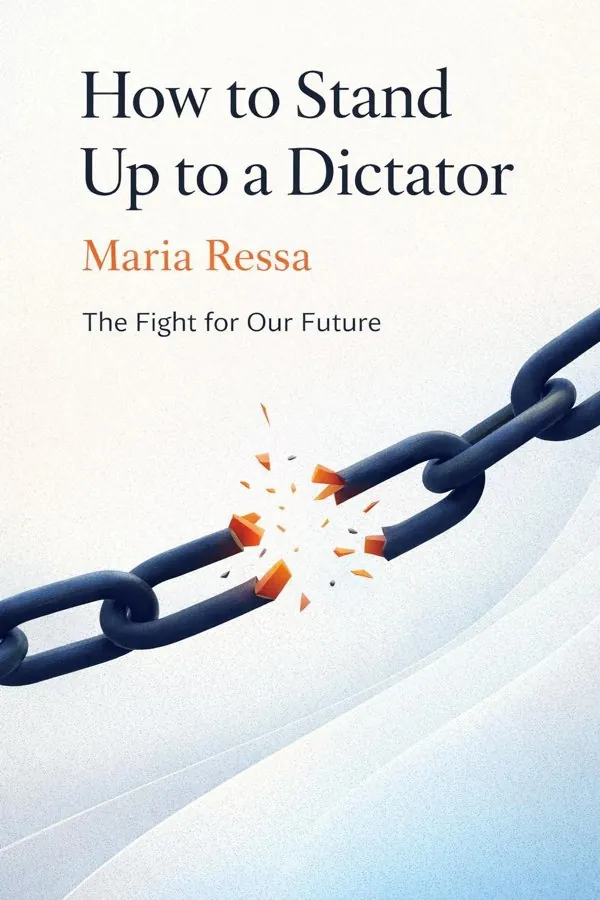
How to Stand Up to a Dictator: The Fight for Our Future: Summary & Key Insights
by Maria Ressa
 10 min9 chaptersAudio available
Key Takeaways from How to Stand Up to a Dictator: The Fight for Our Future
Identity often becomes clearest when you have to live between cultures.
News is never just about information; it is also about the kind of society information makes possible.
A lie does not need to be believable to be effective; it only needs to be repeated, amplified, and emotionally useful.
Dictatorship in the twenty-first century may look less like censorship alone and more like a flood of noise.
Technology is not neutral when its incentives consistently reward the worst parts of human behavior.
What Is How to Stand Up to a Dictator: The Fight for Our Future About?
How to Stand Up to a Dictator: The Fight for Our Future by Maria Ressa is a politics book spanning 10 pages. How do democracies collapse when elections still happen, news still circulates, and people still believe they are free? In How to Stand Up to a Dictator, journalist Maria Ressa answers that question from the front lines. Part memoir, part political warning, and part civic manifesto, the book traces her journey from a transnational childhood to a career in journalism, culminating in her leadership at Rappler, the Philippine news organization that exposed corruption, violence, and digital manipulation under Rodrigo Duterte’s government. Ressa shows that modern authoritarianism does not always arrive in military uniform. It often comes through algorithms, lies repeated at scale, and fear normalized one post at a time. What makes this book so urgent is Ressa’s authority: she is not a distant observer but a reporter who was harassed, arrested, prosecuted, and publicly attacked for telling the truth. Her experience in the Philippines becomes a warning for the world. This is a deeply personal account of courage under pressure, but also a practical argument that defending facts, accountability, and human dignity is now everyone’s responsibility.
This FizzRead summary covers all 9 key chapters of How to Stand Up to a Dictator: The Fight for Our Future in approximately 10 minutes, distilling the most important ideas, arguments, and takeaways from Maria Ressa's work. Also available as an audio summary and Key Quotes Podcast.
How to Stand Up to a Dictator: The Fight for Our Future
How do democracies collapse when elections still happen, news still circulates, and people still believe they are free? In How to Stand Up to a Dictator, journalist Maria Ressa answers that question from the front lines. Part memoir, part political warning, and part civic manifesto, the book traces her journey from a transnational childhood to a career in journalism, culminating in her leadership at Rappler, the Philippine news organization that exposed corruption, violence, and digital manipulation under Rodrigo Duterte’s government. Ressa shows that modern authoritarianism does not always arrive in military uniform. It often comes through algorithms, lies repeated at scale, and fear normalized one post at a time. What makes this book so urgent is Ressa’s authority: she is not a distant observer but a reporter who was harassed, arrested, prosecuted, and publicly attacked for telling the truth. Her experience in the Philippines becomes a warning for the world. This is a deeply personal account of courage under pressure, but also a practical argument that defending facts, accountability, and human dignity is now everyone’s responsibility.
Who Should Read How to Stand Up to a Dictator: The Fight for Our Future?
This book is perfect for anyone interested in politics and looking to gain actionable insights in a short read. Whether you're a student, professional, or lifelong learner, the key ideas from How to Stand Up to a Dictator: The Fight for Our Future by Maria Ressa will help you think differently.
- ✓Readers who enjoy politics and want practical takeaways
- ✓Professionals looking to apply new ideas to their work and life
- ✓Anyone who wants the core insights of How to Stand Up to a Dictator: The Fight for Our Future in just 10 minutes
Want the full summary?
Get instant access to this book summary and 100K+ more with Fizz Moment.
Get Free SummaryAvailable on App Store • Free to download
Key Chapters
Identity often becomes clearest when you have to live between cultures. Maria Ressa’s early life, split between the Philippines and the United States, trained her to notice contradiction, power, and belonging in ways that later shaped her work as a journalist. Growing up across different social and political environments gave her a double lens: she could see both the promises of democracy and the fragility beneath them. That outsider-insider perspective became one of her greatest strengths. It taught her to ask questions others stopped asking and to distrust easy narratives.
Ressa’s career did not begin as activism. It began with reporting, observation, and a disciplined search for truth. Her years at CNN covering Southeast Asia sharpened her ability to connect local events to broader patterns, particularly the rise of extremism, state power, and information warfare. She learned that violence is rarely spontaneous. It is often built through stories, resentments, and repeated manipulations of identity.
This background matters because How to Stand Up to a Dictator is not simply a reaction to one political leader. It is the product of decades spent watching institutions strain under pressure. Ressa’s life story explains why she recognized danger earlier than many others did. She had seen how fragile civic trust can be, and how quickly societies can be pushed toward fear.
In practical terms, her experience suggests that we should value perspective, especially from people who can compare systems and recognize what others normalize. Pay attention to those who move between worlds; they often detect democratic backsliding first. Actionable takeaway: broaden your own lens by reading across countries, cultures, and ideologies so you can better recognize when familiar systems start to fail.
News is never just about information; it is also about the kind of society information makes possible. When Maria Ressa co-founded Rappler in 2012 with three other women, the goal was not merely to launch another digital newsroom. It was to build a form of journalism suited to the social media age, one that could engage communities while still upholding verification, context, and public responsibility. Rappler was born from optimism: the belief that technology could deepen democratic participation rather than erode it.
At first, that optimism seemed justified. Social platforms offered reach, speed, and new ways to connect people around shared concerns. Rappler used data, storytelling, and digital tools to cover politics, corruption, and social issues in ways that traditional media often could not. But the same infrastructure that helped journalism spread also made it vulnerable. Platforms rewarded outrage more than accuracy, emotion more than nuance, and repetition more than evidence.
Ressa’s account of founding Rappler reveals a crucial lesson: media organizations can no longer think of themselves as separate from the systems that distribute their work. Editorial excellence alone is not enough if the architecture of attention favors manipulation. Independent journalism must understand technology, audience behavior, and network dynamics if it hopes to serve the public effectively.
For readers, this means supporting media is not passive. It involves choosing credible outlets, paying for original reporting, and understanding how stories travel online. If you run a team, organization, or publication, ask whether your communication channels reward clarity or merely reaction. Actionable takeaway: identify three news sources that consistently verify facts and support at least one of them through a subscription, donation, or regular engagement.
A lie does not need to be believable to be effective; it only needs to be repeated, amplified, and emotionally useful. One of the book’s most important contributions is its explanation of how disinformation reshapes political life. Ressa shows that falsehood today is not just random noise or fringe propaganda. It is a system. It spreads through coordinated networks, anonymous accounts, paid influencers, partisan operators, and platform algorithms designed to maximize engagement. The result is not simply that people believe wrong things. It is that shared reality begins to disappear.
In the Philippines, Ressa watched online attacks evolve into a political weapon that supported Duterte’s rise and punished critics. Journalists, activists, and ordinary citizens were flooded with abuse, intimidation, and fabricated claims. The strategy worked because it exploited human psychology. Fear travels fast. Anger binds groups. Repetition creates familiarity. Once enough people distrust institutions, evidence itself loses authority.
This is why disinformation is more dangerous than traditional propaganda. It is interactive, personalized, and socially reinforced. People do not just consume it; they perform it, share it, and build identity around it. The damage reaches beyond elections. It distorts public health, justice, security, and everyday trust.
Practically, Ressa’s analysis invites readers to rethink digital habits. Before sharing content, ask: who benefits if this is false? What emotion is this trying to trigger? Can I verify it independently? In organizations, build protocols for source-checking and rumor control. Actionable takeaway: adopt a simple rule for your online life—pause before reposting, verify before believing, and refuse to reward content designed to provoke without evidence.
Technology is not neutral when its incentives consistently reward the worst parts of human behavior. Ressa’s memoir forcefully argues that the internet, especially social media platforms, has been weaponized against democratic society. The problem is not simply that bad actors use digital tools. It is that the tools themselves are structured to amplify outrage, tribalism, and emotional contagion because those reactions generate attention and profit. In such a system, lies often outperform facts because they are more provocative, simpler, and easier to spread.
Ressa describes how coordinated harassment campaigns turned social media into an instrument of psychological warfare. Critics were swarmed, threatened, and dehumanized. False narratives were boosted until they dominated public conversation. Over time, these dynamics changed behavior. Journalists spent energy defending themselves instead of investigating. Citizens retreated from debate. Public discourse became more extreme because moderation was punished by invisibility.
This analysis matters far beyond the Philippines. It helps explain why many democracies now feel emotionally destabilized. The business model of surveillance capitalism rewards engagement above integrity. Users become both consumers and targets, while private companies acquire enormous power over what societies see, feel, and believe.
The practical implication is not to abandon technology altogether, but to use it with structural awareness. Parents can teach children how outrage bait works. Schools can include digital literacy alongside civics. Leaders can reconsider whether their institutions should rely on platforms that distort communication. Actionable takeaway: audit your digital environment—unfollow accounts that monetize rage, reduce exposure to algorithmic feeds, and deliberately spend more time with sources designed to inform rather than inflame.
Courage is often described as a noble ideal, but Ressa insists on its more difficult reality: courage is costly, repetitive, and frequently lonely. One of the book’s emotional centers is the personal toll of choosing not to yield. As Ressa and her colleagues at Rappler faced arrests, court cases, death threats, and relentless online abuse, the struggle for press freedom ceased to be abstract. It entered daily life. It affected sleep, safety, family, colleagues, and the basic ability to imagine a stable future.
What makes her account powerful is that she does not romanticize resilience. She shows fear as something real, not a weakness to be denied. She also shows that resilience is social. It comes from teams, routines, values, and communities of trust. Rappler survived not because its staff were fearless, but because they kept acting despite fear. They documented attacks, prepared legally, supported one another emotionally, and refused to let intimidation define reality.
This idea applies beyond journalism. Whistleblowers, teachers, public servants, and ordinary employees may all face moments when telling the truth becomes inconvenient or dangerous. In such moments, people need more than inspiration. They need systems: records, allies, procedures, and moral clarity.
Ressa’s example reminds readers that resistance is not a single grand gesture. It is a sequence of smaller decisions made under pressure. You may not control whether power retaliates, but you can control whether you prepare to withstand it. Actionable takeaway: if you are defending a principle in a hostile environment, build your resilience network now—document facts, know your rights, identify trusted allies, and create routines that protect your mental and emotional stamina.
When private companies shape public reality, they can no longer pretend to be mere neutral platforms. A central argument in Ressa’s book is that technology companies have become powerful political actors whether they acknowledge it or not. Their algorithms influence what billions of people see. Their moderation policies affect whose voices are amplified or suppressed. Their business models reward engagement, even when engagement is driven by hate, conspiracy, or coordinated deception. In this sense, platform design is not a technical matter alone; it is a democratic issue.
Ressa is especially compelling when she links corporate incentives to social harm. If falsehood spreads faster because outrage is profitable, then disinformation is not an accidental byproduct. It is embedded in the system. The platforms may not author the lies, but they create the conditions in which lies flourish. This is why appeals to personal responsibility, while important, are insufficient on their own. Citizens are navigating environments deliberately optimized to capture attention, fragment trust, and intensify emotion.
The broader implication is that regulation, transparency, and accountability are necessary parts of democratic self-defense. Just as societies regulate industries that affect health or safety, they must reckon with technologies that affect cognition, public discourse, and political legitimacy. This does not require suppressing free expression. It requires demanding openness about recommendation systems, content amplification, and data practices.
For individuals and institutions, the lesson is to stop treating platform choices as trivial. Ask what incentives govern the tools you use. Pressure companies, schools, employers, and governments to adopt more accountable standards. Actionable takeaway: support policies and organizations that push for algorithmic transparency, stronger platform accountability, and digital rights protections grounded in democratic values.
What happens in one country can preview what others will soon face. Although Ressa’s story is rooted in the Philippines, she repeatedly makes clear that the crisis she describes is global. The same patterns appear across democracies and fragile states alike: populist leaders attacking the press, online networks spreading coordinated lies, citizens retreating into identity-based camps, and institutions struggling to respond at the speed of digital manipulation. Her experience is therefore not a regional case study but an early warning system.
This global framing is one of the book’s greatest strengths. It helps readers avoid the comforting mistake of treating authoritarian drift as someone else’s problem. Democratic decline often advances through similar sequences in different places: trust erodes, language coarsens, enemies are invented, rules are selectively enforced, and public fatigue dulls resistance. The details vary, but the mechanisms rhyme.
Ressa also emphasizes that solidarity must be international. Journalists, civil society groups, academics, and democratic institutions need cross-border support because disinformation networks and platform power are already transnational. A local newsroom may confront harassment generated globally. A policy failure in one major tech market can produce political damage worldwide. The defense of truth therefore requires alliances that match the scale of the threat.
For readers, the practical application is to see civic responsibility beyond national boundaries. Learn from cases in other countries. Support international press freedom organizations. Resist the temptation to believe your own society is uniquely immune. Actionable takeaway: choose one global source of democratic or press freedom reporting to follow regularly so you can recognize patterns early and connect local events to wider trends.
Democracy does not collapse only because bad leaders attack it; it also weakens when ordinary people treat it as self-sustaining. Ressa’s ultimate message is that truth, freedom, and human dignity require active defense. Elections matter, laws matter, courts matter, but none of these institutions can function well if citizens surrender their responsibility to think critically, participate consistently, and stand with those under attack. Democracy is less a static system than a set of habits: attention, accountability, courage, memory, and solidarity.
Throughout the book, Ressa argues that facts are the foundation of freedom. Without shared facts, public reasoning becomes impossible. Without accountability, power turns predatory. Without moral courage, fear spreads unchecked. This is why the defense of democracy begins in small acts as much as dramatic ones: correcting falsehoods, supporting independent journalism, refusing dehumanizing language, voting, organizing, and protecting vulnerable people when they are targeted.
Her Nobel Peace Prize becomes meaningful in this context. It is not presented as personal triumph alone, but as recognition that journalism and truth telling are forms of peace work. A society detached from reality becomes easier to brutalize. A society able to name reality still has a chance to resist.
The book’s practical power lies in its refusal of passivity. It does not let readers remain spectators. Whether you are a student, professional, voter, or community leader, you are implicated in the information ecosystem and therefore in the future of democracy itself. Actionable takeaway: turn concern into a routine by choosing one concrete civic practice to sustain every month—support a newsroom, attend a local meeting, teach media literacy, or help others verify information before it spreads.
All Chapters in How to Stand Up to a Dictator: The Fight for Our Future
About the Author
Maria Ressa is a Filipino-American journalist, author, and media executive best known as the co-founder and CEO of Rappler, an independent digital news organization in the Philippines. Before launching Rappler in 2012, she spent many years as an investigative reporter and worked for CNN, serving as bureau chief in both Manila and Jakarta. Her reporting has focused on politics, extremism, corruption, and the impact of technology on democracy. Ressa became a global symbol of press freedom after facing arrests, legal harassment, and sustained online attacks linked to her criticism of authoritarian rule and disinformation networks. In 2021, she was awarded the Nobel Peace Prize for her efforts to protect freedom of expression. Her work continues to shape international debates about journalism, truth, and democratic resilience.
Get This Summary in Your Preferred Format
Read or listen to the How to Stand Up to a Dictator: The Fight for Our Future summary by Maria Ressa anytime, anywhere. FizzRead offers multiple formats so you can learn on your terms — all free.
Available formats: App · Audio · PDF · EPUB — All included free with FizzRead
Download How to Stand Up to a Dictator: The Fight for Our Future PDF and EPUB Summary
Key Quotes from How to Stand Up to a Dictator: The Fight for Our Future
“Identity often becomes clearest when you have to live between cultures.”
“News is never just about information; it is also about the kind of society information makes possible.”
“A lie does not need to be believable to be effective; it only needs to be repeated, amplified, and emotionally useful.”
“Dictatorship in the twenty-first century may look less like censorship alone and more like a flood of noise.”
“Technology is not neutral when its incentives consistently reward the worst parts of human behavior.”
Frequently Asked Questions about How to Stand Up to a Dictator: The Fight for Our Future
How to Stand Up to a Dictator: The Fight for Our Future by Maria Ressa is a politics book that explores key ideas across 9 chapters. How do democracies collapse when elections still happen, news still circulates, and people still believe they are free? In How to Stand Up to a Dictator, journalist Maria Ressa answers that question from the front lines. Part memoir, part political warning, and part civic manifesto, the book traces her journey from a transnational childhood to a career in journalism, culminating in her leadership at Rappler, the Philippine news organization that exposed corruption, violence, and digital manipulation under Rodrigo Duterte’s government. Ressa shows that modern authoritarianism does not always arrive in military uniform. It often comes through algorithms, lies repeated at scale, and fear normalized one post at a time. What makes this book so urgent is Ressa’s authority: she is not a distant observer but a reporter who was harassed, arrested, prosecuted, and publicly attacked for telling the truth. Her experience in the Philippines becomes a warning for the world. This is a deeply personal account of courage under pressure, but also a practical argument that defending facts, accountability, and human dignity is now everyone’s responsibility.
You Might Also Like

Antifa: The Anti-Fascist Handbook
Mark Bray
10 min
Attack from Within: How Disinformation Is Sabotaging America
Barbara McQuade
10 min
Coercion, Capital, and European States, AD 990–1992
Charles Tilly
10 min
Digital Democracy: Concepts, Methodologies, Tools, and Applications
Various Authors
10 min
Fascism
Stanley G. Payne
10 min
Fire And Fury: Inside The Trump White House
Michael Wolff
10 minBrowse by Category
Ready to read How to Stand Up to a Dictator: The Fight for Our Future?
Get the full summary and 100K+ more books with Fizz Moment.