
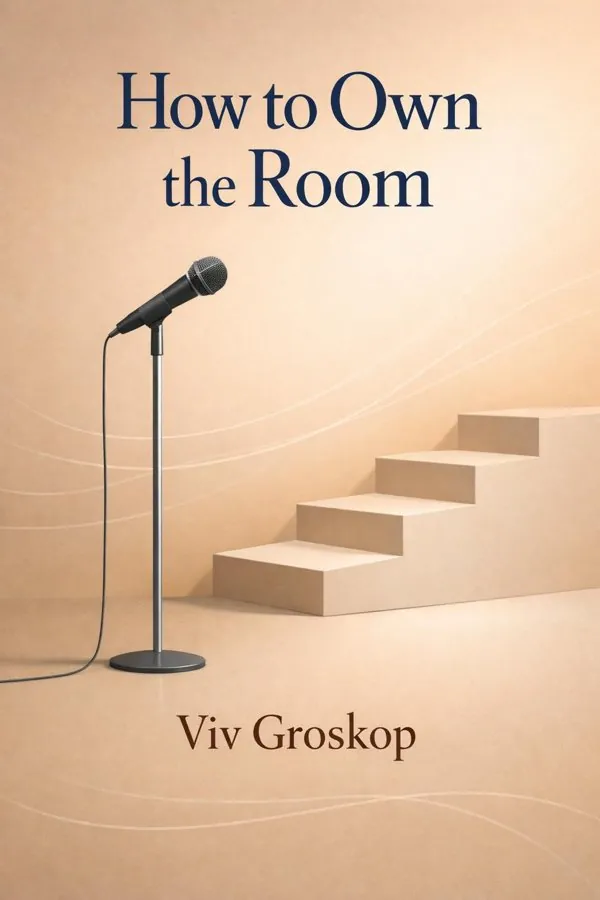
How to Own the Room: Women and the Art of Brilliant Speaking: Summary & Key Insights
by Viv Groskop
 10 min9 chaptersAudio available
Key Takeaways from How to Own the Room: Women and the Art of Brilliant Speaking
The most liberating truth about public speaking is that fear does not mean you are unprepared, untalented, or unsuited to the task.
Many people think confidence is something you project after you have earned it.
One of Groskop’s smartest insights is that role models are useful not because they offer a script to imitate, but because they expand your sense of what is possible.
Before your audience processes your argument, they are already reading your body and hearing your voice.
People often imagine that the best speakers are effortlessly spontaneous, but Groskop shows that apparent ease is usually built on thoughtful preparation.
What Is How to Own the Room: Women and the Art of Brilliant Speaking About?
How to Own the Room: Women and the Art of Brilliant Speaking by Viv Groskop is a communication book spanning 12 pages. How to Own the Room is a practical, energizing guide to public speaking that redefines what it means to have presence. Rather than treating brilliant speaking as a gift reserved for the naturally charismatic, Viv Groskop shows that authority, confidence, and connection can be learned. Her central idea is especially powerful: owning the room does not mean becoming louder, harder, or more dominant. It means becoming more fully yourself while learning how to command attention with clarity and purpose. The book matters because many women are taught to see speaking as a test of likability instead of a tool for influence. Groskop challenges that conditioning. Drawing on examples from politicians, actors, activists, performers, and leaders, she examines how different women speak powerfully in very different ways. This makes the book feel inclusive and realistic rather than prescriptive. Groskop writes with unusual authority because she combines personal experience, research, and years of interviewing accomplished women through her podcast and public work. As a writer, comedian, broadcaster, and interviewer, she understands both the fear of speaking and the craft behind it. The result is an inspiring book for anyone who wants to stop shrinking, start speaking, and be heard.
This FizzRead summary covers all 9 key chapters of How to Own the Room: Women and the Art of Brilliant Speaking in approximately 10 minutes, distilling the most important ideas, arguments, and takeaways from Viv Groskop's work. Also available as an audio summary and Key Quotes Podcast.
How to Own the Room: Women and the Art of Brilliant Speaking
How to Own the Room is a practical, energizing guide to public speaking that redefines what it means to have presence. Rather than treating brilliant speaking as a gift reserved for the naturally charismatic, Viv Groskop shows that authority, confidence, and connection can be learned. Her central idea is especially powerful: owning the room does not mean becoming louder, harder, or more dominant. It means becoming more fully yourself while learning how to command attention with clarity and purpose.
The book matters because many women are taught to see speaking as a test of likability instead of a tool for influence. Groskop challenges that conditioning. Drawing on examples from politicians, actors, activists, performers, and leaders, she examines how different women speak powerfully in very different ways. This makes the book feel inclusive and realistic rather than prescriptive.
Groskop writes with unusual authority because she combines personal experience, research, and years of interviewing accomplished women through her podcast and public work. As a writer, comedian, broadcaster, and interviewer, she understands both the fear of speaking and the craft behind it. The result is an inspiring book for anyone who wants to stop shrinking, start speaking, and be heard.
Who Should Read How to Own the Room: Women and the Art of Brilliant Speaking?
This book is perfect for anyone interested in communication and looking to gain actionable insights in a short read. Whether you're a student, professional, or lifelong learner, the key ideas from How to Own the Room: Women and the Art of Brilliant Speaking by Viv Groskop will help you think differently.
- ✓Readers who enjoy communication and want practical takeaways
- ✓Professionals looking to apply new ideas to their work and life
- ✓Anyone who wants the core insights of How to Own the Room: Women and the Art of Brilliant Speaking in just 10 minutes
Want the full summary?
Get instant access to this book summary and 100K+ more with Fizz Moment.
Get Free SummaryAvailable on App Store • Free to download
Key Chapters
The most liberating truth about public speaking is that fear does not mean you are unprepared, untalented, or unsuited to the task. It means you are human. Groskop begins by stripping away the fantasy that great speakers are fearless. In reality, many compelling speakers still feel nerves before stepping onto a stage, entering a boardroom, or raising a difficult point in a meeting. The difference is not the absence of fear, but the ability to move with it instead of obeying it.
For women especially, speaking anxiety is often intensified by social pressure. Many are judged not only on what they say, but on how warm, polished, attractive, calm, and agreeable they seem while saying it. That extra layer of scrutiny can make every speaking opportunity feel like a performance review of one’s entire identity. Groskop argues that once you recognize this pressure, you can stop treating your fear as a personal defect and start seeing it as a predictable response to a high-stakes environment.
She encourages readers to replace self-defeating inner dialogue with a more useful mindset. Instead of thinking, “What if I fail?” ask, “What is my job here?” Your job is not to be perfect. It is to communicate. A trembling voice, a dry mouth, or a racing heart do not cancel your message.
A practical application is to normalize nerves before important moments: rehearse aloud, arrive early, breathe slowly, and decide in advance that discomfort is part of the process. Fear often peaks just before you begin and subsides once you focus outward.
Actionable takeaway: Before your next speaking moment, name your fear, expect it, and then redirect your attention to the audience and the message you want them to remember.
Many people think confidence is something you project after you have earned it. Groskop turns that idea upside down. Confidence begins with permission: permission to take up space, to speak in your own voice, and to stop imitating someone else’s model of authority. This is especially important for women, who are often encouraged to be competent without appearing too forceful, visible without appearing too ambitious, and articulate without seeming threatening.
The book argues that authentic confidence is stronger than borrowed confidence. If you try to speak like a stereotypical powerful person, your delivery can become stiff, unnatural, or self-conscious. But when you work from your own strengths, confidence becomes more sustainable. Some speakers are fiery and commanding. Others are quiet, witty, precise, calm, or emotionally resonant. There is no single correct style.
Groskop’s point is not that preparation is unnecessary or that personality alone is enough. Instead, she shows that confidence deepens when preparation and authenticity work together. If you know what you want to say, understand your audience, and trust that your natural way of communicating has value, you become harder to shake.
In practice, this may mean keeping your language simple instead of trying to sound impressive, using humor if it comes naturally, or allowing warmth into your delivery instead of pretending to be detached. It also means dropping perfectionism. Authenticity does not require flawless performance; it requires alignment between your message and your manner.
Actionable takeaway: Identify three qualities that feel genuinely natural in your communication style, such as clarity, warmth, humor, or decisiveness, and deliberately build your next speech or presentation around them.
One of Groskop’s smartest insights is that role models are useful not because they offer a script to imitate, but because they expand your sense of what is possible. Many women grow up with too few visible examples of female authority in public speech. As a result, they may unconsciously assume that power must sound masculine, formal, or emotionally distant. The book challenges that assumption by drawing on a wide range of women who command attention in strikingly different ways.
When you study great speakers, the goal is not mimicry. Copying someone else’s gestures, tone, or rhythm usually feels artificial. Instead, Groskop encourages readers to analyze what specifically makes a speaker effective. Do they pause confidently? Use stories well? Make intense eye contact? Speak with unusual honesty? Convey conviction through stillness? Once you identify the mechanism behind the impact, you can adapt the principle to your own style.
This approach is practical because it turns inspiration into skill-building. For example, if you admire a speaker’s authority, ask whether it comes from vocal pace, structure, conviction, or physical composure. If you love someone’s warmth, examine how they make the audience feel included. This kind of observation trains your speaking intelligence.
You can apply this in everyday life by creating your own speaking reference library. Watch interviews, speeches, panel discussions, or even courtroom exchanges. Take notes on what works and why. Over time, you will build a flexible model of excellence rather than a single impossible ideal.
Actionable takeaway: Choose three speakers you admire, write down one specific trait each of them uses effectively, and practice translating those traits into your own voice rather than reproducing theirs.
Before your audience processes your argument, they are already reading your body and hearing your voice. Groskop emphasizes that physical presence is not superficial decoration; it is part of the message. A strong idea delivered with apologetic posture, rushed speech, or constricted breath can lose force. By contrast, a grounded stance and steady vocal rhythm can make even simple words feel authoritative.
This does not mean you need theatrical gestures or a booming voice. In fact, trying too hard to look powerful can backfire. The key is congruence. Your body and voice should support your message, not fight against it. Groskop encourages speakers to become more aware of the physical habits that show up under pressure: shrinking, fidgeting, speaking too fast, ending statements like questions, or smiling reflexively to soften every point.
Breath is a foundational tool here. When people are nervous, they breathe shallowly, which weakens projection and accelerates pace. Slowing the breath often slows the mind. Voice work can also be transformative. Lowering speed, adding pauses, and finishing sentences cleanly can make you sound more credible without changing your personality.
In practical terms, prepare physically as well as verbally. Stand with balanced weight. Plant your feet before you begin. Practice your opening lines aloud. Record yourself to notice habits you miss in real time. Even in virtual settings, posture, facial openness, and vocal energy matter.
Actionable takeaway: Before your next presentation, rehearse your first minute standing up, breathing deeply, and speaking 20 percent slower than feels natural so your body learns what grounded delivery feels like.
People often imagine that the best speakers are effortlessly spontaneous, but Groskop shows that apparent ease is usually built on thoughtful preparation. Preparation is not about memorizing every sentence until you sound robotic. It is about knowing your material so well that you can stay flexible, present, and calm. In that sense, preparation creates freedom.
The book highlights a crucial mindset shift: prepare for connection, not recital. If you over-script, you risk sounding detached from the room. If you under-prepare, nerves take over and your message fragments. The ideal middle ground is to know your structure, your key points, your opening, and your close, while leaving enough space to sound alive.
This is especially useful in situations where unpredictability is high, such as job interviews, media appearances, team meetings, or Q&A sessions. A prepared speaker can adjust because she knows what matters most. She is not trying to remember everything; she is trying to communicate what is essential.
Groskop also treats mindset as part of preparation. Instead of entering a speaking situation hoping not to be exposed, enter it ready to be useful. Ask: What does this audience need? What is the one thing I want them to think, feel, or do? That question sharpens content and reduces self-consciousness.
Useful preparation methods include outlining three key messages, practicing transitions, anticipating difficult questions, and rehearsing in conditions that resemble the real event. Preparation should also include emotional readiness: visualizing composure, not perfection.
Actionable takeaway: For any speaking event, reduce your message to one clear purpose and three memorable points, then practice delivering them aloud without reading from a script.
A powerful speaker is not someone who dazzles from a distance, but someone who creates a sense of relationship with the audience. Groskop repeatedly returns to the idea that brilliant speaking is fundamentally relational. Audiences do not simply want information; they want to feel that the speaker sees them, understands the moment, and is talking with purpose rather than performing at them.
This is why technically polished presentations can still feel flat. If the speaker seems hidden behind jargon, excessive formality, or over-rehearsed language, the audience may admire the competence but remain emotionally unengaged. Connection often comes from simpler things: directness, honesty, well-chosen stories, attentive pacing, and the willingness to sound human.
Groskop also emphasizes empathy and listening as essential speaking skills. To connect, you must understand the room. Are people anxious, skeptical, bored, excited, resistant, or rushed? Adapting to those conditions is not weakness; it is intelligence. A strong speaker reads reactions, notices energy shifts, and adjusts tone or emphasis accordingly.
In practical settings, this may mean opening with a question that acknowledges the audience’s concerns, using examples from their world, or cutting material that is not serving the moment. In meetings, connection can be as simple as listening carefully before you speak so that your contribution lands where it matters.
The deeper lesson is that influence comes less from trying to impress and more from helping people feel oriented, understood, and moved. When audiences feel included, they are far more likely to trust you.
Actionable takeaway: Before speaking, write one sentence answering this question: “What does my audience most need from me right now?” Let that answer shape your tone, examples, and priorities.
To own the room is not to dominate it. Groskop’s idea of power is more nuanced and more useful: presence is the ability to occupy space with conviction, clarity, and self-possession. It is not necessarily loud, glamorous, or extroverted. Some of the most commanding speakers are measured, still, and understated. What makes them powerful is that they seem fully aligned with what they are saying.
This matters because many women have absorbed conflicting messages about power. They may fear appearing too assertive, too emotional, too ambitious, or too visible. In response, they either hold back or overcompensate. Groskop argues for a third path: cultivate presence without pretending to be someone else. Real presence comes from coherence between your values, your message, and your delivery.
Different contexts require different versions of presence. In a team meeting, it may mean speaking earlier rather than waiting to be invited. On stage, it may mean taking a pause before you begin instead of rushing to fill silence. In a difficult conversation, it may mean holding eye contact and finishing your thought without softening it into apology.
Developing presence also means building a personal style over time. You learn what kinds of openings suit you, how much structure you need, what role stories play in your communication, and how you want others to feel when you speak. Presence is not a mask; it is a practiced expression of self.
Actionable takeaway: In your next speaking situation, choose one visible behavior that signals presence for you, such as pausing before you start, speaking first, or ending statements decisively, and practice it deliberately.
Perhaps the most encouraging idea in the book is that owning the room is not a one-time transformation. It is an ongoing practice. Confidence does not arrive permanently after one successful presentation, nor does one bad experience erase your progress. Groskop frames speaking as a craft that develops through repetition, reflection, and gradual expansion of your comfort zone.
This long-view approach helps readers escape all-or-nothing thinking. Many people judge themselves too quickly: one awkward meeting and they conclude they are not leadership material; one strong talk and they expect never to feel nervous again. Groskop offers a more realistic model. Every speaking opportunity teaches you something about preparation, presence, audience connection, and self-trust.
She also recognizes that speaking contexts vary widely. Owning the room in a conference keynote is different from owning the room in a negotiation, an online presentation, a media interview, or a family conversation where your voice has historically been minimized. The principles remain useful across settings, but they must be adapted. That is why continuous practice matters.
A helpful habit is to review each speaking experience afterward. What worked? Where did you feel most grounded? What lost the audience? What would you change next time? This turns experience into improvement instead of leaving growth to chance. Over time, small adjustments compound into noticeable authority.
The broader message is hopeful: you do not need to wait until you feel entirely ready to speak powerfully. You become ready by speaking, noticing, adjusting, and speaking again.
Actionable takeaway: After every important speaking event, spend five minutes writing down one strength to repeat, one lesson to remember, and one skill to practice before the next time.
All Chapters in How to Own the Room: Women and the Art of Brilliant Speaking
About the Author
Viv Groskop is a British writer, broadcaster, comedian, interviewer, and author whose work often explores communication, confidence, culture, and women’s public lives. She is widely known for her ability to combine sharp insight with humor, making complex ideas about speaking and self-presentation feel accessible and practical. Groskop is the creator and host of the podcast How to Own the Room, where she interviews influential women about leadership, visibility, and public speaking. Her career spans journalism, live performance, radio, and literary commentary, giving her a rich understanding of how voice, presence, and audience connection work in different contexts. That multidisciplinary background makes her especially credible on the subject of brilliant speaking and personal authority.
Get This Summary in Your Preferred Format
Read or listen to the How to Own the Room: Women and the Art of Brilliant Speaking summary by Viv Groskop anytime, anywhere. FizzRead offers multiple formats so you can learn on your terms — all free.
Available formats: App · Audio · PDF · EPUB — All included free with FizzRead
Download How to Own the Room: Women and the Art of Brilliant Speaking PDF and EPUB Summary
Key Quotes from How to Own the Room: Women and the Art of Brilliant Speaking
“The most liberating truth about public speaking is that fear does not mean you are unprepared, untalented, or unsuited to the task.”
“Many people think confidence is something you project after you have earned it.”
“One of Groskop’s smartest insights is that role models are useful not because they offer a script to imitate, but because they expand your sense of what is possible.”
“Before your audience processes your argument, they are already reading your body and hearing your voice.”
“People often imagine that the best speakers are effortlessly spontaneous, but Groskop shows that apparent ease is usually built on thoughtful preparation.”
Frequently Asked Questions about How to Own the Room: Women and the Art of Brilliant Speaking
How to Own the Room: Women and the Art of Brilliant Speaking by Viv Groskop is a communication book that explores key ideas across 9 chapters. How to Own the Room is a practical, energizing guide to public speaking that redefines what it means to have presence. Rather than treating brilliant speaking as a gift reserved for the naturally charismatic, Viv Groskop shows that authority, confidence, and connection can be learned. Her central idea is especially powerful: owning the room does not mean becoming louder, harder, or more dominant. It means becoming more fully yourself while learning how to command attention with clarity and purpose. The book matters because many women are taught to see speaking as a test of likability instead of a tool for influence. Groskop challenges that conditioning. Drawing on examples from politicians, actors, activists, performers, and leaders, she examines how different women speak powerfully in very different ways. This makes the book feel inclusive and realistic rather than prescriptive. Groskop writes with unusual authority because she combines personal experience, research, and years of interviewing accomplished women through her podcast and public work. As a writer, comedian, broadcaster, and interviewer, she understands both the fear of speaking and the craft behind it. The result is an inspiring book for anyone who wants to stop shrinking, start speaking, and be heard.
You Might Also Like

Magic Words: The Science and Secrets Behind Seven Words That Motivate, Engage, and Influence
Tim David
10 min
Talking Across The Divide: How to Communicate with People You Disagree with and Maybe Even Change the World
Justin Lee
10 min
The Exceptional Presenter: A Proven Formula to Open Up! and Own the Room
Timothy J. Koegel
10 min
4 Essential Keys to Effective Communication in Love, Life, Work--Anywhere!: Including the 12-Day Communication Challenge!
Bento C. Leal III
10 min
Active Listening Techniques: 30 Practical Tools to Hone Your Communication Skills
Nisha Gupta
10 min
Bargaining for Advantage: Negotiation Strategies for Reasonable People
G. Richard Shell
10 minBrowse by Category
Ready to read How to Own the Room: Women and the Art of Brilliant Speaking?
Get the full summary and 100K+ more books with Fizz Moment.