
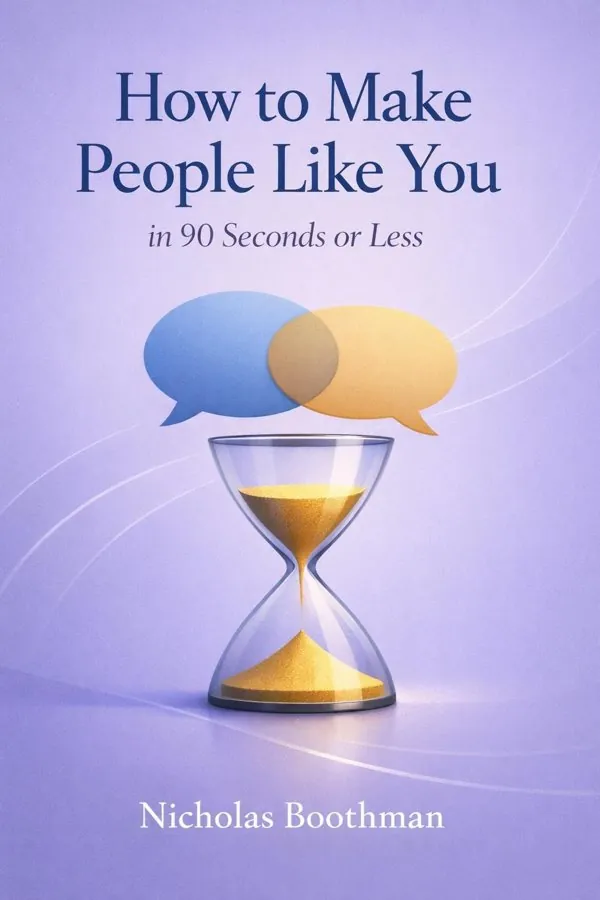
How to Make People Like You in 90 Seconds or Less: Summary & Key Insights
 10 min8 chaptersAudio available
What Is How to Make People Like You in 90 Seconds or Less About?
How to Make People Like You in 90 Seconds or Less by Nicholas Boothman is a communication book spanning 8 pages. This book by Nicholas Boothman offers practical techniques for making a positive first impression and building rapport quickly. Drawing on principles from neuro-linguistic programming (NLP) and communication psychology, Boothman explains how to use body language, tone, and words to connect with others in personal and professional settings within the first 90 seconds of meeting them.
This FizzRead summary covers all 8 key chapters of How to Make People Like You in 90 Seconds or Less in approximately 10 minutes, distilling the most important ideas, arguments, and takeaways from Nicholas Boothman's work. Also available as an audio summary and Key Quotes Podcast.
How to Make People Like You in 90 Seconds or Less
This book by Nicholas Boothman offers practical techniques for making a positive first impression and building rapport quickly. Drawing on principles from neuro-linguistic programming (NLP) and communication psychology, Boothman explains how to use body language, tone, and words to connect with others in personal and professional settings within the first 90 seconds of meeting them.
Who Should Read How to Make People Like You in 90 Seconds or Less?
This book is perfect for anyone interested in communication and looking to gain actionable insights in a short read. Whether you're a student, professional, or lifelong learner, the key ideas from How to Make People Like You in 90 Seconds or Less by Nicholas Boothman will help you think differently.
- ✓Readers who enjoy communication and want practical takeaways
- ✓Professionals looking to apply new ideas to their work and life
- ✓Anyone who wants the core insights of How to Make People Like You in 90 Seconds or Less in just 10 minutes
Want the full summary?
Get instant access to this book summary and 100K+ more with Fizz Moment.
Get Free SummaryAvailable on App Store • Free to download
Key Chapters
It takes less than two seconds for most people to decide how they feel about you. That’s not a figure of speech; psychological research confirms it. In under two seconds, someone’s brain registers your presence and assigns an emotional label — safe or unsafe, likable or unlikable, trustworthy or suspicious. What determines that label? Body language, facial expression, tone, posture, and attitude. Words don’t yet matter.
When you meet someone, your body speaks first. Your face, especially your eyes, tells the other person whether you’re open or guarded. A genuine smile — not the forced social grin, but the subtle, eye-crinkling expression of welcome — changes everything. Your posture signals confidence or anxiety. Your tone colors your words with sincerity or performance. These signals combine into the emotional imprint that becomes the first impression.
I want readers to recognize that these impressions are not about fake polish; they’re about congruence. If your body says one thing and your mind another, people will sense the mismatch. The secret is to make your exterior genuinely align with your interior intention: approach others with curiosity, not evaluation. Replace fear with empathy. When that attitude is genuine, your body language falls into harmony naturally.
The most powerful communication happens when people feel seen and safe. The book trains you to project openness, ease, and interest. That’s why I emphasize the ninety-second window — it’s just long enough to demonstrate those qualities and to invite someone into your energy field, but brief enough that if you mishandle it, the opportunity evaporates.
Neuro-linguistic programming (NLP) is one of the key foundations of this book. It’s a system for understanding how thoughts, language, and behavior interrelate. When I discovered NLP, it clarified for me why some people were naturally magnetic while others seemed invisible in social settings. They differed in how they perceived the world and how they reflected those perceptions back to others.
NLP suggests that people process experiences primarily through visual, auditory, or kinesthetic channels — seeing, hearing, or feeling. Visual people talk about how things look. Auditory people focus on tone and rhythm. Kinesthetic people need to feel comfortable — physically and emotionally — before trust develops. If you can identify someone’s dominant mode, you can mirror it back and instantly align your communication with their internal world.
For example, when you meet someone who says, “I see what you mean,” they are likely visual. Using phrases like “That looks clear” will click with them. Someone who says, “That sounds right to me,” aligns better with auditory phrasing. Someone who says, “That feels right,” responds to kinesthetic language. Rather than forcing others to meet you in your world, you travel to theirs. That’s rapport.
In this section, I teach readers how to observe clues in posture, voice, and eye movement that reveal a person’s sensory preference. Once you know it, matching their pace and rhythm becomes second nature. NLP isn’t about manipulation — it’s about respect. By entering another person’s representational frame, you show you care enough to understand them. Connection begins there.
+ 6 more chapters — available in the FizzRead app
All Chapters in How to Make People Like You in 90 Seconds or Less
About the Author
Nicholas Boothman is a British author and motivational speaker known for his work on communication and interpersonal skills. A former fashion photographer, he later trained in neuro-linguistic programming and has written several books on connecting and communicating effectively.
Get This Summary in Your Preferred Format
Read or listen to the How to Make People Like You in 90 Seconds or Less summary by Nicholas Boothman anytime, anywhere. FizzRead offers multiple formats so you can learn on your terms — all free.
Available formats: App · Audio · PDF · EPUB — All included free with FizzRead
Download How to Make People Like You in 90 Seconds or Less PDF and EPUB Summary
Key Quotes from How to Make People Like You in 90 Seconds or Less
“It takes less than two seconds for most people to decide how they feel about you.”
“Neuro-linguistic programming (NLP) is one of the key foundations of this book.”
Frequently Asked Questions about How to Make People Like You in 90 Seconds or Less
How to Make People Like You in 90 Seconds or Less by Nicholas Boothman is a communication book that explores key ideas across 8 chapters. This book by Nicholas Boothman offers practical techniques for making a positive first impression and building rapport quickly. Drawing on principles from neuro-linguistic programming (NLP) and communication psychology, Boothman explains how to use body language, tone, and words to connect with others in personal and professional settings within the first 90 seconds of meeting them.
You Might Also Like

Magic Words: The Science and Secrets Behind Seven Words That Motivate, Engage, and Influence
Tim David
10 min
Talking Across The Divide: How to Communicate with People You Disagree with and Maybe Even Change the World
Justin Lee
10 min
The Exceptional Presenter: A Proven Formula to Open Up! and Own the Room
Timothy J. Koegel
10 min
4 Essential Keys to Effective Communication in Love, Life, Work--Anywhere!: Including the 12-Day Communication Challenge!
Bento C. Leal III
10 min
Active Listening Techniques: 30 Practical Tools to Hone Your Communication Skills
Nisha Gupta
10 min
Bargaining for Advantage: Negotiation Strategies for Reasonable People
G. Richard Shell
10 minBrowse by Category
Ready to read How to Make People Like You in 90 Seconds or Less?
Get the full summary and 100K+ more books with Fizz Moment.