
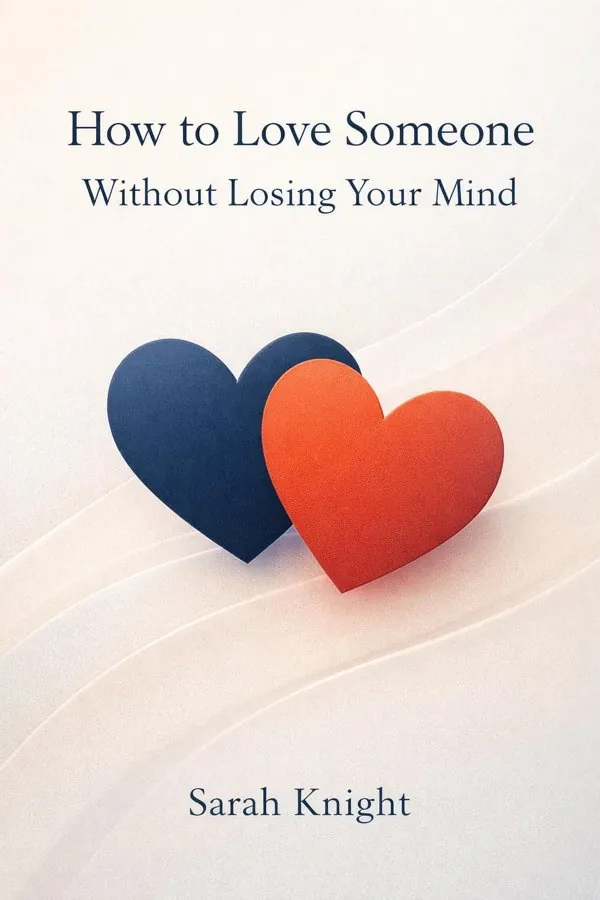
How to Love Someone Without Losing Your Mind: Summary & Key Insights
by Sarah Knight
 10 min9 chaptersAudio available
Key Takeaways from How to Love Someone Without Losing Your Mind
One of the most damaging myths about love is that the more you sacrifice, the more you care.
Love does not run on good intentions alone; it runs on resources, and emotional energy is one of the most precious.
A boundary is not a punishment, a rejection, or a sign that you do not care enough.
Few emotions keep people trapped in unhealthy relationships more effectively than guilt.
Not every difficult relationship is toxic, but every toxic relationship begins with patterns people rationalize for too long.
What Is How to Love Someone Without Losing Your Mind About?
How to Love Someone Without Losing Your Mind by Sarah Knight is a relationships book spanning 11 pages. How do you care deeply about someone without becoming their full-time fixer, emotional sponge, or crisis manager? In How to Love Someone Without Losing Your Mind, Sarah Knight tackles that question with the blunt humor and practical clarity that made her previous self-help books so popular. This is not a dreamy book about romance or a sentimental defense of endless sacrifice. It is a realistic guide to loving partners, relatives, friends, colleagues, and other complicated humans without abandoning your own peace, time, and sanity in the process. Knight argues that many people confuse love with obligation, overfunctioning, and emotional self-erasure. Instead of asking readers to become more patient, more giving, or more available, she asks them to become more honest about their limits. The result is a refreshing framework for setting boundaries, handling guilt, recognizing toxic dynamics, and communicating clearly without becoming cold or selfish. Drawing on lived experience, common relationship patterns, and her signature no-nonsense style, Knight shows that healthy love is not about doing everything for everyone. It is about caring with intention, respecting yourself, and preserving the emotional energy needed to sustain relationships over the long term.
This FizzRead summary covers all 9 key chapters of How to Love Someone Without Losing Your Mind in approximately 10 minutes, distilling the most important ideas, arguments, and takeaways from Sarah Knight's work. Also available as an audio summary and Key Quotes Podcast.
How to Love Someone Without Losing Your Mind
How do you care deeply about someone without becoming their full-time fixer, emotional sponge, or crisis manager? In How to Love Someone Without Losing Your Mind, Sarah Knight tackles that question with the blunt humor and practical clarity that made her previous self-help books so popular. This is not a dreamy book about romance or a sentimental defense of endless sacrifice. It is a realistic guide to loving partners, relatives, friends, colleagues, and other complicated humans without abandoning your own peace, time, and sanity in the process.
Knight argues that many people confuse love with obligation, overfunctioning, and emotional self-erasure. Instead of asking readers to become more patient, more giving, or more available, she asks them to become more honest about their limits. The result is a refreshing framework for setting boundaries, handling guilt, recognizing toxic dynamics, and communicating clearly without becoming cold or selfish. Drawing on lived experience, common relationship patterns, and her signature no-nonsense style, Knight shows that healthy love is not about doing everything for everyone. It is about caring with intention, respecting yourself, and preserving the emotional energy needed to sustain relationships over the long term.
Who Should Read How to Love Someone Without Losing Your Mind?
This book is perfect for anyone interested in relationships and looking to gain actionable insights in a short read. Whether you're a student, professional, or lifelong learner, the key ideas from How to Love Someone Without Losing Your Mind by Sarah Knight will help you think differently.
- ✓Readers who enjoy relationships and want practical takeaways
- ✓Professionals looking to apply new ideas to their work and life
- ✓Anyone who wants the core insights of How to Love Someone Without Losing Your Mind in just 10 minutes
Want the full summary?
Get instant access to this book summary and 100K+ more with Fizz Moment.
Get Free SummaryAvailable on App Store • Free to download
Key Chapters
One of the most damaging myths about love is that the more you sacrifice, the more you care. Sarah Knight pushes back against that belief by arguing that healthy love is not measured by how much of yourself you give away. It is measured by whether care can exist alongside dignity, autonomy, and mutual respect. When people equate love with endless accommodation, they often slide into codependent patterns: solving every problem, suppressing resentment, and tying their own emotional state to another person’s choices.
Knight’s distinction is simple but powerful. Genuine love supports another person without making you responsible for their moods, habits, deadlines, healing, or life direction. Codependence, by contrast, turns love into overmanagement. You stop asking, “How can I support them?” and start acting as if their stability depends entirely on your intervention. This can happen in romantic relationships, with anxious parents and adult children, among friends, and even at work.
Consider a partner who repeatedly forgets commitments. Healthy love might mean expressing disappointment, clarifying expectations, and deciding what you will or won’t tolerate. Unhealthy love means making excuses for them, reorganizing your life around their inconsistency, and feeling guilty for wanting basic reliability. Knight reminds readers that you can be compassionate without becoming complicit.
This idea matters because relationships often deteriorate not from lack of love but from distorted love. When people disappear into caretaking, resentment quietly replaces intimacy. Preserving yourself is not the opposite of caring; it is what makes stable caring possible.
Actionable takeaway: Ask yourself in one important relationship, “Am I supporting this person, or am I managing their life at the expense of my own?” Then identify one behavior you can stop doing this week.
Love does not run on good intentions alone; it runs on resources, and emotional energy is one of the most precious. Knight treats emotional energy like a finite budget rather than an endlessly renewable virtue. That reframing is liberating because many people act as though being a loving person means always being available, always listening, always smoothing things over, and always absorbing the emotional spillover of others. But eventually, the bill comes due in the form of irritability, exhaustion, numbness, or burnout.
Thinking in terms of an emotional budget helps explain why even deeply caring people reach a limit. You may adore a friend and still not have the capacity for a two-hour late-night vent session after a draining workday. You may love your sibling and still feel depleted by being their unofficial therapist every weekend. Knight’s point is not that these people are burdens. It is that your capacity changes, and pretending otherwise helps no one.
A practical application is to assess where your energy goes. Some interactions restore you; others consume you. Some problems are acute and worth the investment; others are repetitive loops in which you are expected to provide the same reassurance indefinitely. If you never distinguish between the two, you will spend premium energy on situations that cannot improve through more of your attention.
Knight encourages readers to notice the difference between willingness and capacity. You may want to help but still be too depleted to help effectively. Saying yes from exhaustion often produces half-hearted support, passive aggression, or emotional shutdown later.
Actionable takeaway: For one week, track which people and situations leave you energized, neutral, or drained. Use that information to decide where you need firmer limits, shorter interactions, or more recovery time.
A boundary is not a punishment, a rejection, or a sign that you do not care enough. In Knight’s framework, boundaries are the operating instructions for how you can love someone without becoming overwhelmed by them. They define what you are available for, what you are not, and what will happen if those limits are ignored. Without boundaries, relationships depend on guesswork, resentment, and crisis improvisation.
Many people resist setting boundaries because they imagine only dramatic ultimatums. But most useful boundaries are ordinary and specific. They sound like: “I can talk tonight for twenty minutes, not two hours.” “I’m not discussing my dating life with you anymore.” “If you raise your voice, I will leave the conversation.” “I can help you once, but I won’t keep covering for you.” These statements do not control another person; they clarify your participation.
Knight also emphasizes that boundaries are credible only when they are enforceable. A repeated boundary without follow-through becomes a request the other person learns to ignore. If your family member keeps insulting your choices at dinner, the boundary may be ending the visit early. If a friend only contacts you in emergencies, the boundary may be limiting your availability or changing the nature of the friendship.
The emotional challenge is that boundaries often feel rude to people who are used to overextending themselves. Yet unclear generosity breeds silent anger, while clear limits create conditions for honesty. The right people may not love your boundaries immediately, but they will benefit from the consistency they create.
Actionable takeaway: Write one boundary in the formula “I am willing to do X, but not Y. If Y happens, I will do Z.” Then communicate it plainly and calmly.
Few emotions keep people trapped in unhealthy relationships more effectively than guilt. Knight argues that guilt often masquerades as moral wisdom when it is really just discomfort triggered by breaking old patterns. If you have spent years being the reliable one, the fixer, the peacemaker, or the emotionally available person on demand, any attempt to step back can feel selfish. But feeling guilty does not automatically mean you are doing something wrong.
This distinction matters because many relationships are maintained by obligation rather than mutuality. You answer every call because “they need me.” You attend every draining family event because “that’s what a good daughter does.” You say yes to repeated inconveniences because “I don’t want to let them down.” Knight invites readers to interrogate the story underneath the guilt. Is this a real ethical failure, or are you simply disappointing an expectation that never should have become your job?
A useful test is to ask whether the standard is reciprocal and reasonable. Would you expect a friend to sacrifice sleep, money, or peace of mind every time someone demanded it? Would you call them cruel for declining? Often, we impose harsher rules on ourselves than on anyone else. Guilt then becomes a reflex, not a truth.
Knight does not dismiss responsibility. Sometimes love does require inconvenience, patience, and presence. But responsibility must be proportionate. If guilt appears every time you prioritize your own health, schedule, or boundaries, it may be a sign that your internal compass has been shaped by people-pleasing rather than genuine values.
Actionable takeaway: The next time guilt appears after you say no, pause and ask, “Did I violate a value, or did I violate someone’s expectation?” Let your answer determine whether to reconsider or stand firm.
Not every difficult relationship is toxic, but every toxic relationship begins with patterns people rationalize for too long. Knight encourages readers to stop normalizing recurring dynamics that steadily corrode mental well-being: manipulation, chronic disrespect, emotional volatility, guilt-tripping, blame shifting, and one-sided dependence. Love often survives normal conflict; what it cannot survive indefinitely is a system where one person’s comfort always outranks the other’s reality.
A key insight in the book is that toxicity is less about isolated incidents and more about repeated structure. Anyone can have a bad day, say something clumsy, or need extra support during a crisis. The problem is when harmful behavior becomes predictable and accountability never follows. For example, a partner apologizes after every explosion but changes nothing. A parent demands access to your life while dismissing your feelings. A friend repeatedly creates emergencies and accuses you of abandonment when you set limits.
Knight helps readers recognize that love can obscure pattern recognition. Because you know someone’s backstory, pain, or good intentions, you keep explaining away their behavior. Compassion becomes camouflage for denial. But understanding why someone behaves badly does not obligate you to absorb the consequences forever.
Spotting toxic dynamics early allows for better decisions. Sometimes the answer is a direct conversation and stronger boundaries. Sometimes it is reduced contact. Sometimes it is leaving entirely. The crucial move is to evaluate relationships by how they function, not by how much potential they seem to contain.
Actionable takeaway: Identify one recurring behavior in a difficult relationship and judge it by pattern, not promise. Ask, “What would I call this if it never improved?” Use that answer to decide your next boundary or distance step.
Empathy is often treated as an unquestioned virtue, but Knight shows that empathy without self-respect can become self-betrayal. It is valuable to understand another person’s stress, trauma, fear, or limitations. Problems arise when understanding turns into automatic permission. If every harmful behavior is excused because the person is overwhelmed, insecure, grieving, or struggling, your empathy starts canceling your own legitimate needs.
Knight’s balancing act is subtle: do not become cold, but do not become endlessly absorbent. Healthy empathy says, “I understand why this is hard for you, and I still need to be treated with respect.” It allows complexity. A partner can be anxious and still responsible for speaking kindly. A friend can be depressed and still not entitled to unload on you without consent. A family member can be lonely and still not entitled to intrude on every boundary.
This balance also protects relationships from hidden resentment. People who overempathize often suppress irritation because they do not want to seem harsh. Eventually, they either explode or withdraw. Neither response serves intimacy. Self-respect allows empathy to remain generous rather than compulsory.
In practice, this means validating feelings without surrendering standards. You can say, “I know you’re under pressure, but I won’t continue this conversation if you insult me.” You can care about someone’s struggle while refusing to become its sole container. Knight’s larger message is that your feelings count in the room too.
Actionable takeaway: In your next difficult conversation, pair empathy with a limit. Use a sentence that includes both realities, such as, “I understand this is hard for you, and I need us to handle it differently from here.”
Many relationship problems intensify not because people are cruel, but because they are vague. Knight is especially good on the emotional cost of indirectness: hinting instead of asking, hoping instead of clarifying, resenting instead of stating, and assuming instead of checking. When people fear conflict, they often become opaque. Then they are shocked when others fail to read needs that were never clearly expressed.
The book advocates communication that is direct, specific, and behavior-focused. Instead of saying, “You never care about me,” you say, “When you cancel plans last minute without telling me, I feel dismissed.” Instead of vague martyrdom like, “It’s fine, I’ll handle it,” you say, “I can do this today, but I need help next time.” This style reduces defensiveness because it describes reality rather than attacking character.
Knight also emphasizes timing and format. Not every issue should be addressed in the heat of frustration, by text, or in front of other people. If the goal is understanding rather than release, choose a setting where the conversation has a chance to work. Clear communication also includes being honest about what outcome you want: an apology, changed behavior, more information, or a new agreement.
Importantly, communication is not magic. You can say the right thing and still not get the response you want. But clarity gives you useful information. If someone repeatedly ignores a plainly stated need, your problem is no longer confusion; it is compatibility, respect, or willingness.
Actionable takeaway: Replace one recurring complaint with a concrete request this week. Name the behavior, explain its impact, and state exactly what you want to happen differently.
Knight treats self-care not as a luxury or spa-day cliché, but as maintenance required for stable relationships. When people neglect rest, solitude, therapy, hobbies, health, and recovery time, they do not become more loving. They become more brittle. Then ordinary frustrations feel intolerable, and routine needs from others start to register as impositions. In that sense, self-care is not separate from loving well; it is one of the conditions that makes loving well possible.
This is especially relevant for people who pride themselves on being dependable. The identity of being the strong one can hide serious depletion. You keep showing up, but with less patience, less curiosity, and less genuine warmth. Knight’s point is that martyrdom is not noble if it leaves you emotionally unavailable anyway. A relationship does not benefit from your physical presence if your inner resources are gone.
Practical self-care can be unglamorous and highly strategic: declining plans after a taxing week, scheduling therapy before a family visit, protecting sleep, turning off your phone during recovery periods, maintaining friendships outside your primary relationship, or taking solo time before responding to conflict. These choices preserve perspective. They reduce the chance that every interaction becomes overloaded with unprocessed stress.
Knight also reframes self-care as an act of accountability. It is your job to know when you are depleted and to act before resentment spills onto other people. Waiting until you are at the breaking point helps nobody.
Actionable takeaway: Choose one non-negotiable practice that reliably restores you, and put it on your calendar before the week fills up. Treat it as maintenance for your relationships, not an optional reward.
One of the hardest truths in Knight’s book is that not every relationship can be repaired by greater patience, better communication, or stronger boundaries. Sometimes the healthiest expression of love, self-respect, or reality is distance. Letting go may mean ending a romantic relationship, reducing contact with a family member, stepping back from a draining friendship, or simply releasing the fantasy that another person will become who you need them to be.
People resist this conclusion because they confuse endurance with loyalty. They think that if they just explain things one more time, become more understanding, or wait a little longer, the relationship will finally feel safe and reciprocal. But hope can become its own trap, especially when it is attached to someone’s potential rather than their pattern. Knight encourages readers to grieve the truth instead of bargaining with it forever.
Letting go does not always require anger. Sometimes it is a quiet recognition that love cannot compensate for incompatibility, broken trust, repeated disrespect, or refusal to change. In other cases, distance is temporary and protective rather than final. The common thread is that preserving yourself is a valid reason to alter the relationship.
There is also freedom in accepting limits. You can stop trying to win over the impossible parent, rescue the chaos-prone friend, or carry a romance sustained only by effort from one side. Releasing responsibility for what is not yours creates space for healthier connections.
Actionable takeaway: If you are clinging to a relationship that repeatedly harms your peace, write two lists: what is actually happening and what you keep hoping will happen. Make your next decision based on the first list, not the second.
All Chapters in How to Love Someone Without Losing Your Mind
About the Author
Sarah Knight is an American author, editor, and bestselling self-help writer known for her candid, funny, and highly practical approach to personal growth. She first built a wide readership with her No F*cks Given series, which encourages people to protect their time, energy, and mental well-being by caring less about unhelpful expectations. Before becoming a full-time author, Knight spent more than fifteen years working in New York publishing, where she developed a sharp editorial style and strong command of clear, accessible language. Her books often blend humor with psychologically grounded advice on boundaries, stress, relationships, and self-respect. Across her work, Knight has become known for making self-help feel less preachy and more usable, especially for readers who want straightforward tools rather than abstract inspiration.
Get This Summary in Your Preferred Format
Read or listen to the How to Love Someone Without Losing Your Mind summary by Sarah Knight anytime, anywhere. FizzRead offers multiple formats so you can learn on your terms — all free.
Available formats: App · Audio · PDF · EPUB — All included free with FizzRead
Download How to Love Someone Without Losing Your Mind PDF and EPUB Summary
Key Quotes from How to Love Someone Without Losing Your Mind
“One of the most damaging myths about love is that the more you sacrifice, the more you care.”
“Love does not run on good intentions alone; it runs on resources, and emotional energy is one of the most precious.”
“A boundary is not a punishment, a rejection, or a sign that you do not care enough.”
“Few emotions keep people trapped in unhealthy relationships more effectively than guilt.”
“Not every difficult relationship is toxic, but every toxic relationship begins with patterns people rationalize for too long.”
Frequently Asked Questions about How to Love Someone Without Losing Your Mind
How to Love Someone Without Losing Your Mind by Sarah Knight is a relationships book that explores key ideas across 9 chapters. How do you care deeply about someone without becoming their full-time fixer, emotional sponge, or crisis manager? In How to Love Someone Without Losing Your Mind, Sarah Knight tackles that question with the blunt humor and practical clarity that made her previous self-help books so popular. This is not a dreamy book about romance or a sentimental defense of endless sacrifice. It is a realistic guide to loving partners, relatives, friends, colleagues, and other complicated humans without abandoning your own peace, time, and sanity in the process. Knight argues that many people confuse love with obligation, overfunctioning, and emotional self-erasure. Instead of asking readers to become more patient, more giving, or more available, she asks them to become more honest about their limits. The result is a refreshing framework for setting boundaries, handling guilt, recognizing toxic dynamics, and communicating clearly without becoming cold or selfish. Drawing on lived experience, common relationship patterns, and her signature no-nonsense style, Knight shows that healthy love is not about doing everything for everyone. It is about caring with intention, respecting yourself, and preserving the emotional energy needed to sustain relationships over the long term.
More by Sarah Knight

You Do You
Sarah Knight
10 minYou Do You: How to Be Who You Are and Use What You've Got to Get What You Want
Sarah Knight
10 min
Get Your Sh*t Together: How to Stop Worrying About What You Should Do So You Can Finish What You Need to Do and Start Doing What You Want to Do
Sarah Knight
10 minThe Life-Changing Magic of Not Giving a F*ck: How to Stop Spending Time You Don’t Have with People You Don’t Like Doing Things You Don’t Want to Do
Sarah Knight
10 minYou Might Also Like

The 5 Love Languages
Gary Chapman
10 min
Men Are from Mars, Women Are from Venus
John Gray
10 min
She Comes First
Ian Kerner
10 min
No More Mr Nice Guy
Robert Glover
10 min
Hold Me Tight
Sue Johnson
10 min
Mating in Captivity
Esther Perel
10 minBrowse by Category
Ready to read How to Love Someone Without Losing Your Mind?
Get the full summary and 100K+ more books with Fizz Moment.