
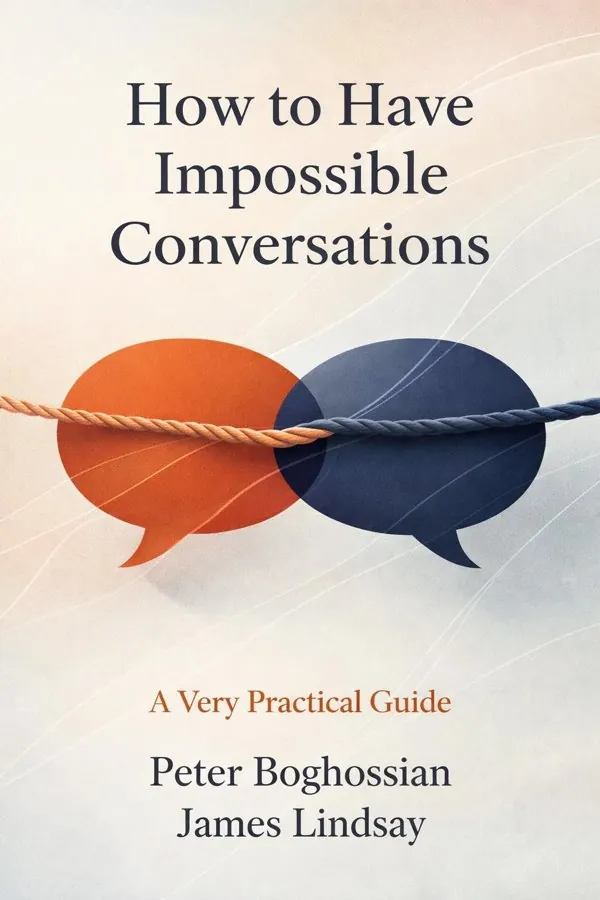
How to Have Impossible Conversations: A Very Practical Guide: Summary & Key Insights
by Peter Boghossian, James Lindsay
 10 min7 chaptersAudio available
What Is How to Have Impossible Conversations: A Very Practical Guide About?
How to Have Impossible Conversations: A Very Practical Guide by Peter Boghossian, James Lindsay is a communication book spanning 7 pages. This book provides a practical framework for engaging in difficult conversations across ideological divides. Drawing on techniques from philosophy, psychology, and communication, the authors offer step-by-step methods to foster mutual understanding, reduce hostility, and promote productive dialogue on controversial topics.
This FizzRead summary covers all 7 key chapters of How to Have Impossible Conversations: A Very Practical Guide in approximately 10 minutes, distilling the most important ideas, arguments, and takeaways from Peter Boghossian, James Lindsay's work. Also available as an audio summary and Key Quotes Podcast.
How to Have Impossible Conversations: A Very Practical Guide
This book provides a practical framework for engaging in difficult conversations across ideological divides. Drawing on techniques from philosophy, psychology, and communication, the authors offer step-by-step methods to foster mutual understanding, reduce hostility, and promote productive dialogue on controversial topics.
Who Should Read How to Have Impossible Conversations: A Very Practical Guide?
This book is perfect for anyone interested in communication and looking to gain actionable insights in a short read. Whether you're a student, professional, or lifelong learner, the key ideas from How to Have Impossible Conversations: A Very Practical Guide by Peter Boghossian, James Lindsay will help you think differently.
- ✓Readers who enjoy communication and want practical takeaways
- ✓Professionals looking to apply new ideas to their work and life
- ✓Anyone who wants the core insights of How to Have Impossible Conversations: A Very Practical Guide in just 10 minutes
Want the full summary?
Get instant access to this book summary and 100K+ more with Fizz Moment.
Get Free SummaryAvailable on App Store • Free to download
Key Chapters
Our journey begins with rapport—the invisible bridge on which all productive conversations stand. Without it, even the most carefully reasoned argument collapses. Rapport communicates one simple message: I see you as a human being worthy of respect, not as an enemy to defeat.
When you first enter a difficult dialogue, your counterpart is assessing not your logic but your intent. They want to know: are you here to understand or to judge? Establishing trust means framing the conversation around curiosity, not confrontation. That might mean lowering your voice, softening your body language, and asking permission to explore sensitive topics. These small acts signal safety. Once safety is perceived, openness follows.
Building rapport isn’t manipulation; it’s empathy in action. When we meet someone in their world, on their terms, we show a willingness to understand before being understood. You can’t shortcut this process. People change their minds only when they believe they have been heard. So begin by listening, by acknowledging feeling and experience before tackling reasoning. It might take just a few moments—or many conversations—but rapport is the seed from which insight grows.
Throughout this foundational stage, patience is your greatest ally. Every word, every tone, every pause matters. Remember that conversation is not a transaction; it’s a relationship. You’re planting trust now so that truth can emerge later.
Effective listening is not passive—it’s active engagement. You listen not to respond but to understand. It requires humility, attention, and sincerity. Most people mistake listening for silence, but real listening is a dynamic process involving inquiry, reflection, and validation.
We encourage the use of Socratic questioning—asking gentle but precise questions that reveal how someone came to hold their belief. Questions such as “What led you to that conclusion?” or “How confident are you that’s true?” invite introspection rather than defense. This approach disarms hostility because it shifts focus from argument to exploration.
True listening also means noticing what remains unsaid—the emotions beneath the words, the pauses that signal uncertainty. Reflecting these subtleties back can show genuine empathy: “It sounds like this issue really frustrates you” or “It seems that’s something you’ve thought deeply about.” Such reflections build trust and help your interlocutor clarify their own thoughts.
The magic of listening lies in its reciprocity. When people feel heard, they become willing to hear in return. When curiosity replaces judgment, dialogue becomes fertile ground for truth-seeking. Your role isn’t to correct; it’s to illuminate. Through questioning, you help both participants trace the map of belief—how evidence, experience, and emotion intertwine to shape conviction.
+ 5 more chapters — available in the FizzRead app
All Chapters in How to Have Impossible Conversations: A Very Practical Guide
About the Authors
Peter Boghossian is an American philosopher and educator known for his work on critical thinking and pedagogy. James Lindsay is a mathematician and author recognized for his writings on cultural criticism and philosophy of science.
Get This Summary in Your Preferred Format
Read or listen to the How to Have Impossible Conversations: A Very Practical Guide summary by Peter Boghossian, James Lindsay anytime, anywhere. FizzRead offers multiple formats so you can learn on your terms — all free.
Available formats: App · Audio · PDF · EPUB — All included free with FizzRead
Download How to Have Impossible Conversations: A Very Practical Guide PDF and EPUB Summary
Key Quotes from How to Have Impossible Conversations: A Very Practical Guide
“Our journey begins with rapport—the invisible bridge on which all productive conversations stand.”
“Effective listening is not passive—it’s active engagement.”
Frequently Asked Questions about How to Have Impossible Conversations: A Very Practical Guide
How to Have Impossible Conversations: A Very Practical Guide by Peter Boghossian, James Lindsay is a communication book that explores key ideas across 7 chapters. This book provides a practical framework for engaging in difficult conversations across ideological divides. Drawing on techniques from philosophy, psychology, and communication, the authors offer step-by-step methods to foster mutual understanding, reduce hostility, and promote productive dialogue on controversial topics.
You Might Also Like

Magic Words: The Science and Secrets Behind Seven Words That Motivate, Engage, and Influence
Tim David
10 min
Talking Across The Divide: How to Communicate with People You Disagree with and Maybe Even Change the World
Justin Lee
10 min
The Exceptional Presenter: A Proven Formula to Open Up! and Own the Room
Timothy J. Koegel
10 min
4 Essential Keys to Effective Communication in Love, Life, Work--Anywhere!: Including the 12-Day Communication Challenge!
Bento C. Leal III
10 min
Active Listening Techniques: 30 Practical Tools to Hone Your Communication Skills
Nisha Gupta
10 min
Bargaining for Advantage: Negotiation Strategies for Reasonable People
G. Richard Shell
10 minBrowse by Category
Ready to read How to Have Impossible Conversations: A Very Practical Guide?
Get the full summary and 100K+ more books with Fizz Moment.