
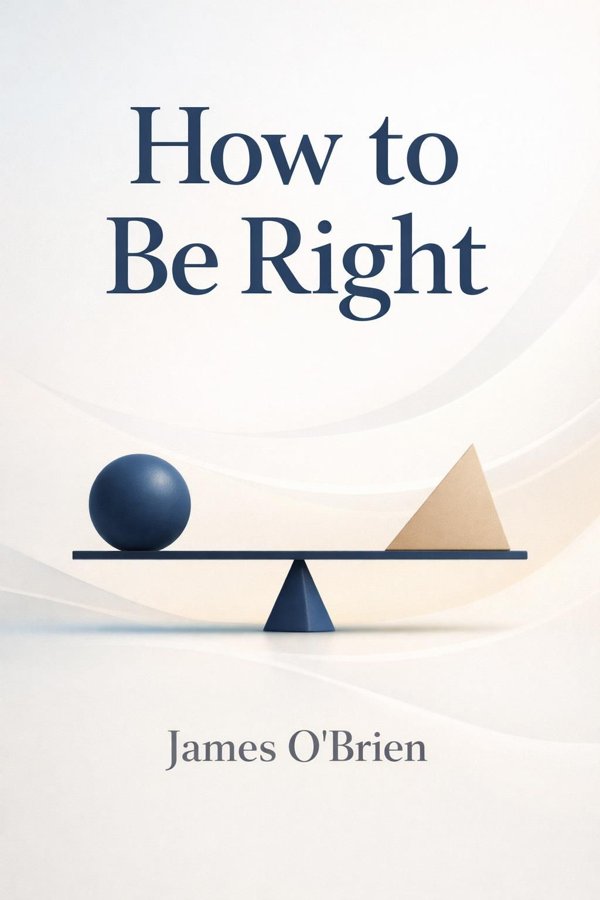
How to Be Right: The Art of Being Persuasively Correct: Summary & Key Insights
 10 min10 chaptersAudio available
Key Takeaways from How to Be Right: The Art of Being Persuasively Correct
One of the book's central provocations is that factual correctness alone rarely changes minds.
This helps explain why smart, decent individuals can defend obvious falsehoods with astonishing confidence.
Empathy is often mistaken for agreement, but O'Brien treats it as a strategic and moral necessity.
Many bad arguments sound persuasive because they borrow the tone of certainty without the structure of reasoning.
O'Brien's case studies from LBC are more than entertaining broadcasting anecdotes.
What Is How to Be Right: The Art of Being Persuasively Correct About?
How to Be Right: The Art of Being Persuasively Correct by James O'Brien is a communication book spanning 10 pages. In How to Be Right, James O'Brien tackles a question that feels increasingly urgent: why do people cling to bad arguments, false claims, and tribal loyalties even when the facts are plainly against them? Drawing on years of live radio conversations as a broadcaster on LBC, O'Brien examines what really happens in public disagreement. He argues that being right is not simply a matter of possessing better information. It also requires understanding how identity, fear, pride, media influence, and emotional investment shape what people are willing to believe. What makes this book especially valuable is O'Brien's mix of journalistic experience, intellectual curiosity, and sharp self-awareness. He has spent countless hours speaking with callers who represent the full spectrum of public opinion, from thoughtful and open-minded to stubborn and conspiratorial. Those encounters give the book an immediacy that abstract books on logic often lack. Rather than teaching readers how to win arguments for the sake of ego, O'Brien offers a more demanding skill: how to challenge misinformation persuasively, humanely, and effectively. In an age of polarization, propaganda, and online outrage, that makes this book both practical and deeply relevant.
This FizzRead summary covers all 10 key chapters of How to Be Right: The Art of Being Persuasively Correct in approximately 10 minutes, distilling the most important ideas, arguments, and takeaways from James O'Brien's work. Also available as an audio summary and Key Quotes Podcast.
How to Be Right: The Art of Being Persuasively Correct
In How to Be Right, James O'Brien tackles a question that feels increasingly urgent: why do people cling to bad arguments, false claims, and tribal loyalties even when the facts are plainly against them? Drawing on years of live radio conversations as a broadcaster on LBC, O'Brien examines what really happens in public disagreement. He argues that being right is not simply a matter of possessing better information. It also requires understanding how identity, fear, pride, media influence, and emotional investment shape what people are willing to believe.
What makes this book especially valuable is O'Brien's mix of journalistic experience, intellectual curiosity, and sharp self-awareness. He has spent countless hours speaking with callers who represent the full spectrum of public opinion, from thoughtful and open-minded to stubborn and conspiratorial. Those encounters give the book an immediacy that abstract books on logic often lack. Rather than teaching readers how to win arguments for the sake of ego, O'Brien offers a more demanding skill: how to challenge misinformation persuasively, humanely, and effectively. In an age of polarization, propaganda, and online outrage, that makes this book both practical and deeply relevant.
Who Should Read How to Be Right: The Art of Being Persuasively Correct?
This book is perfect for anyone interested in communication and looking to gain actionable insights in a short read. Whether you're a student, professional, or lifelong learner, the key ideas from How to Be Right: The Art of Being Persuasively Correct by James O'Brien will help you think differently.
- ✓Readers who enjoy communication and want practical takeaways
- ✓Professionals looking to apply new ideas to their work and life
- ✓Anyone who wants the core insights of How to Be Right: The Art of Being Persuasively Correct in just 10 minutes
Want the full summary?
Get instant access to this book summary and 100K+ more with Fizz Moment.
Get Free SummaryAvailable on App Store • Free to download
Key Chapters
One of the book's central provocations is that factual correctness alone rarely changes minds. Many people assume that if they have stronger evidence, better sources, and cleaner logic, the argument should take care of itself. O'Brien shows why that belief is comforting but incomplete. In real life, arguments are not judged in a vacuum. They are filtered through loyalty, self-image, resentment, class, politics, and emotion. That means you can be right in substance and still fail completely in persuasion.
O'Brien pushes readers to separate two different goals: proving that a claim is true and persuading another person to accept that truth. The first depends on evidence. The second depends on communication. If you confuse the two, you may end up delivering perfect facts in a way that guarantees the other person will reject them. The problem is not always that people hate truth. Often they hate humiliation, condescension, or the feeling that changing their mind would betray their tribe.
This insight has practical consequences. At work, a manager correcting a colleague may get further by asking questions than by issuing a blunt contradiction. In family conversations about politics, acknowledging shared concerns can create enough trust for facts to be heard. Online, where status competition dominates, the chances of persuasion drop further when your real motive is public victory.
O'Brien's point is not that truth should be softened beyond recognition. It is that truth needs delivery as much as content. Being right is only the start. Actionable takeaway: before entering a disagreement, ask yourself whether your goal is to display correctness or help someone genuinely reconsider their view.
A disturbing but liberating insight runs through O'Brien's book: people often believe things not because those things are well supported, but because those beliefs protect who they think they are. This helps explain why smart, decent individuals can defend obvious falsehoods with astonishing confidence. The belief is doing psychological work. It preserves dignity, group belonging, moral innocence, or a sense of control.
O'Brien emphasizes that political and social opinions are rarely just abstract conclusions. They become wrapped around personal stories. A person may reject expert consensus because admitting error would mean accepting they were misled for years. Another may embrace a simplistic scapegoat because it makes a chaotic world feel understandable. Once a belief becomes tied to identity, attacking it can feel like attacking the person.
That is why pure fact-dumping often fails. If a caller believes immigrants, elites, or bureaucrats are the source of every problem, then evidence alone may not move them because the narrative is emotionally useful. In everyday life, you can see this in debates about vaccines, economics, education, or climate change. People are not simply comparing data points. They are defending a self-concept.
This doesn't mean truth is powerless. It means persuasion starts by recognizing what the belief is giving the person. Security? Belonging? Moral superiority? Once you identify that function, you can address the fear beneath the claim rather than just the claim itself. Actionable takeaway: when someone holds a stubborn view, ask not only "Is it true?" but also "What emotional or identity need is this belief serving?"
Empathy is often mistaken for agreement, but O'Brien treats it as a strategic and moral necessity. To understand why someone believes something false is not to excuse the falsehood. It is to give yourself a chance of reaching them. Without empathy, disagreement becomes theatre: two people performing certainty at each other while neither listens. With empathy, argument becomes diagnostic. You begin to see the pressures, humiliations, and assumptions that shaped the other person's view.
O'Brien's experience as a caller-facing broadcaster teaches him that many people reveal far more when they feel heard than when they feel cornered. If you respond to every weak claim with ridicule, the speaker hardens. If you patiently ask what led them there, they often expose the contradictions themselves. Empathy lowers defensiveness. It also prevents you from caricaturing people whose reasoning may be flawed but whose motives are more complicated than malice.
In practical terms, empathy means asking clarifying questions, reflecting concerns back accurately, and resisting the urge to score quick points. If a friend expresses anxiety about social change, immediately branding them a bigot may end the conversation. Exploring what specifically worries them may uncover misinformation that can actually be addressed. The same applies in management, teaching, journalism, and parenting.
Empathy also protects your own thinking. When you can restate an opposing view fairly, you are less likely to become lazy, tribal, or self-righteous. O'Brien insists that persuasion works best when people feel respected enough to think rather than pressured to defend themselves. Actionable takeaway: in your next disagreement, spend the first part of the conversation proving that you understand the other person's concern before trying to change their conclusion.
Many bad arguments sound persuasive because they borrow the tone of certainty without the structure of reasoning. O'Brien devotes significant attention to the kinds of fallacies that repeatedly surface in public debate: false equivalence, straw man arguments, ad hominem attacks, cherry-picking, emotional anecdote masquerading as evidence, and the assumption that personal feeling outweighs documented fact. These errors are not rare exceptions. They are the everyday machinery of misinformation.
A major strength of the book is that it treats fallacies not as dry classroom concepts but as living habits of thought. A caller might cite one dramatic anecdote as proof of a nationwide trend. A politician may deflect criticism by accusing opponents of hypocrisy rather than answering the point. A social media user may present two sides as equally credible when one is grounded in research and the other in rumor. Once you recognize the pattern, the spell weakens.
This skill is valuable well beyond political argument. In business meetings, weak proposals often hide behind selective data. In relationships, people may generalize from one event to sweeping claims. In news consumption, many headlines exploit our instinct to mistake repetition for proof. O'Brien encourages readers to slow down and ask basic questions: What is the evidence? Does the conclusion follow? Is the comparison valid? What is being left out?
The goal is not to become pedantic or smug. It is to develop enough intellectual hygiene to avoid being manipulated by rhetoric. Reasoning can be trained, and trained reasoning makes you harder to fool. Actionable takeaway: when a claim sounds compelling, identify the exact logic behind it before deciding whether to accept it.
O'Brien's case studies from LBC are more than entertaining broadcasting anecdotes. They form the beating heart of the book because they show how flawed reasoning operates in real time. Rather than presenting neat philosophical examples, he brings readers into messy, spontaneous conversations where people improvise beliefs under pressure. This matters because many opinions sound coherent from a distance but collapse when tested with simple follow-up questions.
What these exchanges reveal is not just ignorance, but the complex mix of confidence, confusion, defensiveness, and sincerity that shapes public discourse. Some callers repeat slogans they have absorbed without ever examining them. Others reveal deep emotional wounds beneath political anger. Some are clearly performing for an imagined audience, while others are genuinely startled to discover their own arguments do not hold together. O'Brien uses these moments to illustrate how misinformation spreads through repetition, belonging, and media reinforcement rather than careful thought.
For readers, these examples offer a practical lesson: you do not need a formal debate to understand someone's reasoning. Often a few calm questions are enough. "What do you mean by that?" "How do you know?" "What would change your mind?" "Does that apply in every case?" Questions expose assumptions more gently and more effectively than direct attacks.
The LBC stories also remind us that public debate is not abstract. It involves real people trying, however imperfectly, to make sense of the world. That makes intellectual rigor even more important, not less. Actionable takeaway: use curious, specific follow-up questions in conversation to uncover whether a claim rests on evidence, assumption, or mere repetition.
O'Brien makes a strong defense of evidence and expertise, but he also understands why appeals to expert authority often fail. In theory, expertise should settle many disputes. If climate scientists, economists, doctors, or legal scholars overwhelmingly agree on something, that should count for more than a vague hunch or viral video. In practice, however, people increasingly distrust institutions, and that distrust creates fertile ground for charlatans who market certainty without accountability.
The book argues that expertise is essential precisely because the modern world is too complex for any individual to master alone. We rely on specialists every day when we board a plane, take medicine, or use technology. Yet in politics and culture, many people selectively reject expertise when it threatens their prior beliefs. O'Brien highlights the contradiction: we demand expert competence in every domain except the ones where identity is at stake.
Still, he avoids a simplistic "experts good, public bad" stance. Institutions can be arrogant, opaque, or politically compromised, and those failures damage public trust. The answer is not to abandon expertise but to defend it honestly. Good experts explain uncertainty, revise conclusions when evidence changes, and distinguish between confidence and overreach.
In daily life, this means learning to weigh sources rather than just opinions. A peer-reviewed study is not equal to a meme. A specialist's informed judgment is not merely one viewpoint among many. At the same time, explaining why a source is credible is often more persuasive than simply demanding deference. Actionable takeaway: when citing evidence, pair the facts with a brief explanation of why the source deserves trust and how it reached its conclusion.
One of O'Brien's most useful reminders is that argument is never purely intellectual. Even the most fact-heavy disagreement often runs on emotional fuel: fear, shame, anger, grief, humiliation, nostalgia, or the desire to belong. People do not merely reason toward conclusions; they feel their way toward them. If you ignore that emotional layer, you will misunderstand both the argument and the person making it.
O'Brien repeatedly shows how political opinions can become vehicles for unresolved anxieties. Someone anxious about economic decline may latch onto simplistic nationalist promises. Someone who feels culturally displaced may gravitate toward narratives that blame minorities or elites. Someone embarrassed by uncertainty may prefer a conspiracy theory to the discomfort of complexity. In each case, the emotion comes first and the reasoning follows as justification.
Recognizing this emotional architecture improves communication. If a colleague reacts defensively to criticism, facts about performance may matter less initially than reassurance about respect and shared goals. If a relative is panicking over sensational news, correcting every detail may be less effective than first calming the fear that makes the misinformation attractive. Emotional literacy does not replace evidence; it creates the conditions in which evidence can land.
O'Brien also implies that we should examine our own emotions in disagreement. The desire to feel superior, morally pure, or triumphant can distort how we present valid points. When emotion becomes invisible to us, it becomes harder to control. Actionable takeaway: before challenging someone's argument, identify the dominant emotion in the conversation and respond to that emotional reality as carefully as you respond to the factual claim.
In a polarized culture, many people have forgotten what productive disagreement looks like. O'Brien offers an alternative to both aggressive point-scoring and timid silence. Constructive disagreement does not mean softening every difference or pretending all views are equally valid. It means arguing in a way that increases clarity, accountability, and the possibility of learning. The point is not to avoid friction, but to make friction useful.
A constructive exchange usually includes several disciplines: define terms clearly, stay on the actual issue, avoid attributing motives you cannot know, distinguish evidence from speculation, and admit uncertainty where it exists. O'Brien also stresses the importance of knowing when a conversation is in good faith. Some people are confused and open to challenge. Others are committed to performance, provocation, or endless evasion. Persuasion works very differently in those two situations.
This has immediate application in everyday life. In meetings, summarize the other person's point before criticizing it. In friendships, choose private conversation over public embarrassment. On social media, consider whether responding will illuminate anything or merely feed a spectacle. In family settings, agree on a narrow question rather than relitigating every grievance at once.
Constructive disagreement also requires humility. If your own side exaggerates or distorts, intellectual honesty demands that you say so. Credibility grows when people see that you care about truth more than team loyalty. O'Brien's broader lesson is that good argument is a civic skill, not just a personal talent. Actionable takeaway: structure disagreements around one clear claim, one standard of evidence, and one shared goal for the conversation.
O'Brien is sharply aware that many of the beliefs he encounters do not arise spontaneously. They are cultivated by media ecosystems that profit from attention, anger, and simplification. Modern media often rewards speed over accuracy, conflict over nuance, and emotional resonance over truth. The result is a public sphere where misinformation spreads faster than correction and where confidence routinely outcompetes competence.
He pays particular attention to how repeated exposure can turn fringe claims into familiar common sense. If people hear the same misleading story from tabloids, pundits, partisan websites, and social feeds, they may start treating it as obvious even if they cannot support it. Familiarity creates false credibility. Add tribal branding and outrage incentives, and audiences become less interested in whether something is true than in whether it flatters their side.
This dynamic affects everyone, not just the politically extreme. Even careful readers can absorb framing, exaggeration, and selective emphasis without noticing. O'Brien urges readers to become more deliberate consumers of information: compare sources, notice loaded language, separate news from commentary, and be suspicious of stories designed to trigger instant moral certainty.
In practical terms, that might mean limiting exposure to outrage-driven feeds, following journalists with transparent methods, and pausing before sharing emotionally satisfying content. Better information habits make better conversations possible. If your inputs are distorted, your arguments will be too. Actionable takeaway: audit your media diet and replace at least one outrage-based source with a more credible, evidence-driven outlet that values context over provocation.
Perhaps the book's most important moral contribution is its insistence that persuasion has an ethical dimension. It is possible to be technically correct and still behave badly. It is possible to win an argument by humiliating someone, exploiting their confusion, or performing superiority. O'Brien suggests that if truth matters, then the way we defend it matters too. Persuasion should aim not merely at victory but at greater honesty, mutual recognition, and intellectual responsibility.
This requires humility. O'Brien does not pretend that he is immune to bias, ego, or error. In fact, part of what gives the book credibility is his willingness to reflect on his own reactions and limitations. That self-scrutiny is crucial because anyone who sees themselves as permanently enlightened is in danger of becoming dogmatic. The fight against misinformation can itself become tribal if it turns into a contest of status rather than a search for truth.
Ethical persuasion means being fair to opposing arguments, admitting when evidence is mixed, and resisting manipulation even when it would benefit your side. It also means recognizing that not every conversation must end in conversion. Sometimes the most realistic outcome is planting a seed of doubt, modeling clarity, or refusing to normalize nonsense.
For readers, this idea expands the book beyond debate tactics. It becomes a guide to intellectual character. To be right well is to combine confidence in evidence with discipline in tone, method, and motive. Actionable takeaway: after any heated disagreement, ask yourself not only "Was I correct?" but also "Was I fair, honest, and genuinely interested in truth?"
All Chapters in How to Be Right: The Art of Being Persuasively Correct
About the Author
James O'Brien is a British journalist, broadcaster, author, and television presenter best known for his work on LBC, where he has hosted one of the UK's most recognizable phone-in radio shows. He has built a reputation for incisive interviewing, sharp analysis, and a willingness to challenge misinformation, political spin, and weak reasoning in real time. O'Brien's broadcasting career has made him a prominent voice in discussions about public discourse, media influence, and political culture. His style combines intellectual confidence with a strong interest in why people believe what they believe. As an author, he draws heavily on his experience speaking with callers from across the social and political spectrum, turning those exchanges into wider reflections on truth, persuasion, identity, and the health of democratic debate.
Get This Summary in Your Preferred Format
Read or listen to the How to Be Right: The Art of Being Persuasively Correct summary by James O'Brien anytime, anywhere. FizzRead offers multiple formats so you can learn on your terms — all free.
Available formats: App · Audio · PDF · EPUB — All included free with FizzRead
Download How to Be Right: The Art of Being Persuasively Correct PDF and EPUB Summary
Key Quotes from How to Be Right: The Art of Being Persuasively Correct
“One of the book's central provocations is that factual correctness alone rarely changes minds.”
“A disturbing but liberating insight runs through O'Brien's book: people often believe things not because those things are well supported, but because those beliefs protect who they think they are.”
“Empathy is often mistaken for agreement, but O'Brien treats it as a strategic and moral necessity.”
“Many bad arguments sound persuasive because they borrow the tone of certainty without the structure of reasoning.”
“O'Brien's case studies from LBC are more than entertaining broadcasting anecdotes.”
Frequently Asked Questions about How to Be Right: The Art of Being Persuasively Correct
How to Be Right: The Art of Being Persuasively Correct by James O'Brien is a communication book that explores key ideas across 10 chapters. In How to Be Right, James O'Brien tackles a question that feels increasingly urgent: why do people cling to bad arguments, false claims, and tribal loyalties even when the facts are plainly against them? Drawing on years of live radio conversations as a broadcaster on LBC, O'Brien examines what really happens in public disagreement. He argues that being right is not simply a matter of possessing better information. It also requires understanding how identity, fear, pride, media influence, and emotional investment shape what people are willing to believe. What makes this book especially valuable is O'Brien's mix of journalistic experience, intellectual curiosity, and sharp self-awareness. He has spent countless hours speaking with callers who represent the full spectrum of public opinion, from thoughtful and open-minded to stubborn and conspiratorial. Those encounters give the book an immediacy that abstract books on logic often lack. Rather than teaching readers how to win arguments for the sake of ego, O'Brien offers a more demanding skill: how to challenge misinformation persuasively, humanely, and effectively. In an age of polarization, propaganda, and online outrage, that makes this book both practical and deeply relevant.
You Might Also Like

Magic Words: The Science and Secrets Behind Seven Words That Motivate, Engage, and Influence
Tim David
10 min
Talking Across The Divide: How to Communicate with People You Disagree with and Maybe Even Change the World
Justin Lee
10 min
The Exceptional Presenter: A Proven Formula to Open Up! and Own the Room
Timothy J. Koegel
10 min
4 Essential Keys to Effective Communication in Love, Life, Work--Anywhere!: Including the 12-Day Communication Challenge!
Bento C. Leal III
10 min
Active Listening Techniques: 30 Practical Tools to Hone Your Communication Skills
Nisha Gupta
10 min
Bargaining for Advantage: Negotiation Strategies for Reasonable People
G. Richard Shell
10 minBrowse by Category
Ready to read How to Be Right: The Art of Being Persuasively Correct?
Get the full summary and 100K+ more books with Fizz Moment.