
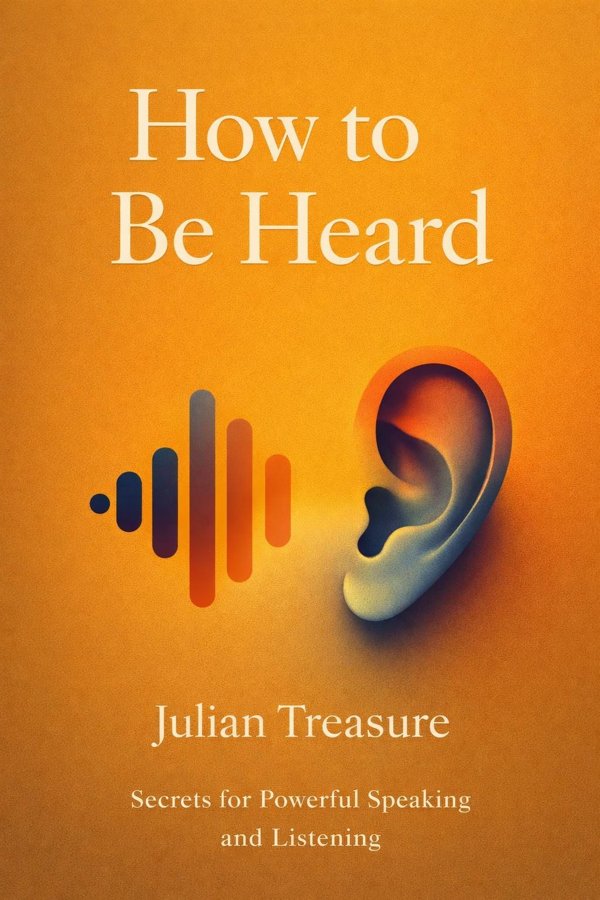
How to Be Heard: Secrets for Powerful Speaking and Listening: Summary & Key Insights
 10 min9 chaptersAudio available
Key Takeaways from How to Be Heard: Secrets for Powerful Speaking and Listening
Most people treat sound as background, but Julian Treasure asks us to see it as an invisible force that constantly influences mood, attention, behavior, and relationships.
Being unheard is often not a content problem but a delivery problem.
Technique matters, but Treasure insists that powerful speaking starts with character.
One of Treasure’s most memorable ideas is that speech has musical qualities, and great communicators learn to play their voice like an instrument.
People do not listen with their ears alone.
What Is How to Be Heard: Secrets for Powerful Speaking and Listening About?
How to Be Heard: Secrets for Powerful Speaking and Listening by Julian Treasure is a communication book spanning 8 pages. In How to Be Heard, Julian Treasure tackles a problem almost everyone feels but few know how to solve: how to communicate in a way that cuts through noise, earns attention, and creates real understanding. This is not just a book about public speaking. It is a practical guide to using voice, listening, intention, and environment so that your words land with clarity and impact. Treasure argues that being heard begins long before you open your mouth. It starts with honesty, presence, vocal awareness, and the ability to listen deeply to others. What makes the book especially valuable is Treasure’s unusual authority. As a sound expert, founder of The Sound Agency, and one of TED’s most recognized speakers, he brings together acoustics, psychology, communication strategy, and stagecraft. He explains why some voices inspire trust while others repel, how digital distraction has weakened our listening, and what anyone can do to speak more powerfully without becoming artificial. For professionals, leaders, teachers, creators, and anyone who wants stronger relationships, this book offers a practical framework for becoming more persuasive, more empathetic, and far more memorable.
This FizzRead summary covers all 9 key chapters of How to Be Heard: Secrets for Powerful Speaking and Listening in approximately 10 minutes, distilling the most important ideas, arguments, and takeaways from Julian Treasure's work. Also available as an audio summary and Key Quotes Podcast.
How to Be Heard: Secrets for Powerful Speaking and Listening
In How to Be Heard, Julian Treasure tackles a problem almost everyone feels but few know how to solve: how to communicate in a way that cuts through noise, earns attention, and creates real understanding. This is not just a book about public speaking. It is a practical guide to using voice, listening, intention, and environment so that your words land with clarity and impact. Treasure argues that being heard begins long before you open your mouth. It starts with honesty, presence, vocal awareness, and the ability to listen deeply to others.
What makes the book especially valuable is Treasure’s unusual authority. As a sound expert, founder of The Sound Agency, and one of TED’s most recognized speakers, he brings together acoustics, psychology, communication strategy, and stagecraft. He explains why some voices inspire trust while others repel, how digital distraction has weakened our listening, and what anyone can do to speak more powerfully without becoming artificial. For professionals, leaders, teachers, creators, and anyone who wants stronger relationships, this book offers a practical framework for becoming more persuasive, more empathetic, and far more memorable.
Who Should Read How to Be Heard: Secrets for Powerful Speaking and Listening?
This book is perfect for anyone interested in communication and looking to gain actionable insights in a short read. Whether you're a student, professional, or lifelong learner, the key ideas from How to Be Heard: Secrets for Powerful Speaking and Listening by Julian Treasure will help you think differently.
- ✓Readers who enjoy communication and want practical takeaways
- ✓Professionals looking to apply new ideas to their work and life
- ✓Anyone who wants the core insights of How to Be Heard: Secrets for Powerful Speaking and Listening in just 10 minutes
Want the full summary?
Get instant access to this book summary and 100K+ more with Fizz Moment.
Get Free SummaryAvailable on App Store • Free to download
Key Chapters
Most people treat sound as background, but Julian Treasure asks us to see it as an invisible force that constantly influences mood, attention, behavior, and relationships. Sound affects us physiologically and emotionally. A harsh alarm can trigger stress. A warm, calm voice can lower defensiveness. Open-plan office noise can reduce concentration, while silence or intentional sound design can improve clarity and focus. In other words, communication never happens in a vacuum. It always happens inside a soundscape.
Treasure’s wider point is that if sound changes how people think and feel, then every act of speaking carries more weight than we assume. Your voice is not only transmitting information; it is also creating an emotional experience. A rushed, nasal, monotone delivery may weaken even a strong idea. A grounded, resonant voice can make a familiar idea feel trustworthy and alive. This helps explain why people sometimes react more strongly to tone than to content.
The idea applies everywhere. In meetings, the room’s acoustics, background chatter, and vocal energy affect whether your message lands. At home, the sound environment influences whether difficult conversations become tense or constructive. In digital settings, poor audio quality can make even smart people seem less credible.
Treasure encourages readers to become conscious listeners first. Notice what sounds energize you, drain you, irritate you, or help you think clearly. Then notice how your own voice affects others. Once you understand that sound is shaping every interaction, communication becomes less accidental and more intentional.
Actionable takeaway: Spend one day auditing your sound environment and your own vocal impact. Identify one distracting sound to reduce and one vocal habit to improve.
Being unheard is often not a content problem but a delivery problem. Treasure argues that many people sabotage themselves long before anyone evaluates their ideas. They speak too fast, rely on filler words, drift into vagueness, overtalk, sound insincere, or fail to adapt to the listener’s needs. In a crowded world, weak communication is easily ignored.
One of the book’s sharpest insights is that attention is now scarce. People are overloaded with emails, notifications, meetings, and opinions. That means poor habits once tolerated are now costly. If you ramble, people tune out. If you speak without structure, your point dissolves. If your tone suggests boredom, tension, or superiority, listeners may reject your message before they consciously process it.
Treasure also points to what he has called the “seven deadly sins” of speaking, including gossip, judging, negativity, complaining, excuses, exaggeration, and dogmatism. These habits corrode trust. A person may be eloquent, but if their speech consistently feels cynical or self-serving, people stop listening. In contrast, those who are clear, concise, and generous with their language build credibility over time.
Consider two managers giving the same update. One mumbles through jargon, blames other teams, and speaks in long, shapeless paragraphs. The other is direct, fair, calm, and structured. The second manager is far more likely to be heard, not because the information is radically different, but because the communication creates confidence.
Actionable takeaway: Record yourself explaining an idea for two minutes. Listen for pace, fillers, vagueness, and tone. Remove one trust-eroding habit and one clarity problem from your speaking this week.
Technique matters, but Treasure insists that powerful speaking starts with character. His HAIL framework stands for Honesty, Authenticity, Integrity, and Love, and it describes the inner foundations of communication people actually want to hear. Without these qualities, vocal polish can become manipulation. With them, even simple speech can carry real power.
Honesty means being truthful and clear, not deceptive or strategically evasive. Authenticity means being yourself rather than performing a persona that feels borrowed. Integrity means doing what you say and aligning speech with action. Love, in Treasure’s broad sense, means wishing others well. It is speaking with generosity, respect, and concern rather than contempt or ego.
The brilliance of HAIL is that it shifts communication from performance anxiety to relational intention. Instead of asking, “How do I sound impressive?” you ask, “Am I speaking truthfully, consistently, and in a way that serves the listener?” That mindset changes everything. A job candidate who answers with honesty and warmth can be more compelling than one who sounds overly rehearsed. A leader delivering difficult news with integrity and empathy can preserve trust even in uncertainty.
HAIL also improves listening. If you approach others with love and authenticity, you listen less defensively. You become more curious and less eager to dominate. People sense this quickly, which makes them more open in return.
Treasure does not present HAIL as abstract virtue signaling. He presents it as practical communication infrastructure. Trust is hard to win and easy to lose, and HAIL helps create the conditions in which words matter.
Actionable takeaway: Before your next important conversation, pause and ask four questions: Am I being honest? Am I being myself? Are my words aligned with my actions? Am I wishing this person well?
One of Treasure’s most memorable ideas is that speech has musical qualities, and great communicators learn to play their voice like an instrument. He highlights tools such as register, timbre, pitch, pace, volume, prosody, and silence. These elements shape meaning just as much as vocabulary does. When you change the music of your speech, you change how your message is received.
For example, pace communicates urgency, confidence, or carelessness. Speaking too quickly can signal anxiety and make listeners work harder. Strategic slowing can add authority and give important ideas room to land. Pitch variation prevents monotony and helps maintain attention. Volume can express confidence, but constant loudness becomes aggression. Silence, often underused, can create emphasis, invite reflection, and signal calm control.
Treasure also encourages readers to cultivate vocal warmth and resonance through breathing and posture. A shallow breath leads to strain and thinness, while a grounded breath supports a fuller, steadier tone. This is especially useful in presentations, interviews, negotiations, and emotionally charged conversations.
Imagine introducing a proposal in a monotone rush versus with measured pacing, downward inflection on key points, and short pauses after major claims. The content may be identical, but the second version sounds more authoritative and memorable. Likewise, reading to a child, apologizing to a partner, or leading a team all require different vocal choices.
The deeper lesson is that effective speaking is embodied. You cannot separate voice from breath, intention, and physical awareness. Treasure invites readers to treat vocal development not as imitation, but as unlocking the best version of their natural sound.
Actionable takeaway: Practice one paragraph aloud using three changes only: slow down, lower your pitch slightly, and add pauses after important points. Notice how much more authority and clarity you create.
People do not listen with their ears alone. They interpret the whole person. Treasure emphasizes that communication is multimodal: posture, gesture, eye contact, facial expression, movement, and spatial presence all influence whether spoken words feel believable. If your body contradicts your message, listeners usually trust the body.
This matters because many communication problems are not verbal at all. A person may say, “I’m open to feedback,” while crossing their arms, avoiding eye contact, and leaning away. A presenter may claim confidence while fidgeting, shrinking physically, or pacing without purpose. In both cases, the nonverbal message undermines the verbal one.
Treasure does not suggest turning body language into a mechanical checklist. Instead, he argues for congruence. Your inner state, your intention, your voice, and your physical presence should align. Open posture can make you appear more trustworthy. Stillness can project authority better than nervous motion. Appropriate eye contact can signal respect and connection. Facial animation, when genuine, helps convey engagement.
Different contexts require different balances. In a one-to-one conversation, softer expressions and relaxed posture may create safety. On a stage, larger gestures and stronger stance may be needed so the back row can feel your energy. In video calls, where the frame is limited, facial clarity, camera placement, and visible attentiveness become more important.
The key is not to perform confidence artificially, but to remove physical habits that leak anxiety or disconnection. When body and voice support the same message, listeners experience coherence, and coherence builds trust.
Actionable takeaway: In your next important conversation, focus on three basics: uncross your body, make calm eye contact, and keep your gestures purposeful rather than restless.
In a culture obsessed with expression, Treasure reminds us that communication fails just as often because people do not listen. Listening is not passive silence. It is active meaning-making. It involves attention, interpretation, empathy, and choice. We hear sound automatically, but listening is a skill, and like any skill, it can weaken through neglect or strengthen through practice.
Treasure argues that poor listening is now widespread because modern life trains distraction. Phones interrupt conversations. People prepare replies instead of absorbing what is being said. Assumptions fill gaps before understanding is complete. As a result, many interactions become parallel monologues rather than genuine dialogue.
Good listening, by contrast, transforms relationships. When someone feels truly heard, defensiveness drops and trust rises. In leadership, listening helps uncover risks, morale issues, and hidden ideas. In sales or negotiation, it reveals needs beneath stated positions. In families, it can prevent escalation by showing care before offering solutions.
Treasure encourages mindful listening practices such as listening for hidden assumptions, noticing emotional tone, reflecting back key points, and becoming comfortable with silence. He also suggests broadening what we listen for. Beyond facts, listen for values, fears, motives, and unspoken concerns. This creates deeper understanding and better responses.
An example is a team member who says, “I’m fine with the change,” but sounds flat and hesitant. A superficial listener hears agreement. A skilled listener notices the mismatch and asks a gentle follow-up. The second response is what allows truth to emerge.
Actionable takeaway: In your next conversation, aim to speak less than half the time, summarize what you heard before replying, and ask one question that explores meaning beneath the words.
One of Treasure’s strongest themes is that modern technology has made connection easier but attention weaker. We are surrounded by pings, alerts, fragmented media, and constant partial attention. In such conditions, both speaking and listening degrade. People skim, interrupt, multitask, and react before reflecting. The result is more noise and less understanding.
Treasure’s answer is mindful communication: bringing deliberate awareness back into how we speak, listen, and use digital tools. Mindfulness here does not require retreating from technology. It means noticing what distracts us, what overstimulates us, and how our habits affect the quality of our interactions. If you check messages during a conversation, you signal that the person in front of you is competing with your device. If you fire off reactive emails, you often communicate heat rather than clarity.
This idea has practical implications for both personal and professional life. Meetings improve when phones are down and one person speaks at a time. Remote calls improve when participants use good microphones, mute background noise, and actually attend. Difficult conversations improve when people pause before responding instead of escalating instantly.
Treasure also links mindfulness to vocal presence. A distracted speaker sounds scattered. A present speaker sounds grounded. This difference is often audible even before content begins. Breath, pace, and attention all reveal whether someone is fully in the room.
In a distracted age, presence itself becomes a competitive advantage. The person who listens fully, speaks clearly, and resists reflexive noise stands out immediately.
Actionable takeaway: Create one communication ritual that restores presence, such as silencing devices during conversations, taking one breath before replying, or waiting five minutes before sending emotionally charged messages.
Communication is often judged as if it were only about the speaker, but Treasure shows that environment plays a major role in whether speech is intelligible, persuasive, and emotionally effective. Acoustics, background noise, layout, lighting, reverberation, and even symbolic aspects of a room affect how people receive a message. A great speaker in a bad environment can still fail.
Treasure brings special authority here because of his background in sound consultancy. He knows that noisy restaurants discourage meaningful conversation, echoing rooms reduce comprehension, and poorly designed workplaces increase fatigue. If listeners must strain to hear, they have less cognitive energy left for understanding and remembering. The environment literally taxes attention.
This insight is widely applicable. If you are giving feedback, choose a quiet and private space rather than a chaotic hallway. If you are hosting a meeting, reduce interruptions and improve room acoustics where possible. If you record videos or podcasts, prioritize audio quality over visual polish. If you work from home, be aware of how HVAC hum, traffic, or room echo affect your voice and your listener’s patience.
Environment also sends emotional signals. A calm, orderly room supports thoughtful exchange. A noisy, rushed setting encourages short, defensive communication. Even seating position can change dynamics: side-by-side collaboration feels different from confrontational across-the-table positioning.
Treasure’s larger lesson is simple: if communication matters, design for it. We often spend time crafting words while ignoring the space in which those words must survive.
Actionable takeaway: Before your next important conversation or presentation, assess the environment for noise, privacy, comfort, and acoustics, and improve at least one factor before you begin.
Not all speech deserves equal time, and Treasure argues that one hallmark of effective communication is intentionality. Powerful speakers know why they are speaking, what change they want to create, and what the listener needs in order to receive the message. Without purpose, speech becomes verbal clutter. With purpose, it becomes influence.
This does not mean every conversation must be scripted. It means communication should have direction. Are you trying to inform, inspire, request, reassure, challenge, or connect? Each purpose calls for different language, pacing, emotional tone, and structure. A status update should not sound like a motivational speech. An apology should not sound like a defense. A persuasive pitch needs clearer framing than a casual brainstorm.
Treasure encourages people to ask simple preparatory questions: What is my intention? What is the listening of the audience? What do I want them to think, feel, or do afterward? These questions sharpen relevance. They also prevent self-indulgent speaking, where the speaker focuses on expression without considering reception.
For example, a founder speaking to investors must communicate confidence, clarity, and strategic logic. The same founder speaking to employees after a setback must communicate honesty, steadiness, and care. Purpose shapes not just message but delivery.
Intentional speaking also helps reduce overcommunication. Many people lose impact because they say too much. Purpose forces selection. When you know your core point, you can cut the extra explanation, lead with what matters, and repeat the key message enough for it to stick.
Actionable takeaway: Before any important interaction, write one sentence beginning with, “By the end of this conversation, I want the listener to…” Then shape your message around that outcome.
All Chapters in How to Be Heard: Secrets for Powerful Speaking and Listening
About the Author
Julian Treasure is a British author, speaker, and expert on sound and communication. He is the founder of The Sound Agency, a consultancy that helps businesses and organizations use sound more consciously to improve customer experience, productivity, and well-being. Treasure is widely known for his TED Talks on listening, speaking, and the effects of sound on human behavior, which have reached millions of viewers around the world. His work stands out because it connects acoustics, psychology, leadership, and everyday communication in a practical way. In his writing and speaking, he helps people understand not only how to present ideas more effectively, but also how to listen with greater attention and empathy. How to Be Heard reflects this broad expertise and his mission to improve the quality of human communication.
Get This Summary in Your Preferred Format
Read or listen to the How to Be Heard: Secrets for Powerful Speaking and Listening summary by Julian Treasure anytime, anywhere. FizzRead offers multiple formats so you can learn on your terms — all free.
Available formats: App · Audio · PDF · EPUB — All included free with FizzRead
Download How to Be Heard: Secrets for Powerful Speaking and Listening PDF and EPUB Summary
Key Quotes from How to Be Heard: Secrets for Powerful Speaking and Listening
“Most people treat sound as background, but Julian Treasure asks us to see it as an invisible force that constantly influences mood, attention, behavior, and relationships.”
“Being unheard is often not a content problem but a delivery problem.”
“Technique matters, but Treasure insists that powerful speaking starts with character.”
“One of Treasure’s most memorable ideas is that speech has musical qualities, and great communicators learn to play their voice like an instrument.”
“People do not listen with their ears alone.”
Frequently Asked Questions about How to Be Heard: Secrets for Powerful Speaking and Listening
How to Be Heard: Secrets for Powerful Speaking and Listening by Julian Treasure is a communication book that explores key ideas across 9 chapters. In How to Be Heard, Julian Treasure tackles a problem almost everyone feels but few know how to solve: how to communicate in a way that cuts through noise, earns attention, and creates real understanding. This is not just a book about public speaking. It is a practical guide to using voice, listening, intention, and environment so that your words land with clarity and impact. Treasure argues that being heard begins long before you open your mouth. It starts with honesty, presence, vocal awareness, and the ability to listen deeply to others. What makes the book especially valuable is Treasure’s unusual authority. As a sound expert, founder of The Sound Agency, and one of TED’s most recognized speakers, he brings together acoustics, psychology, communication strategy, and stagecraft. He explains why some voices inspire trust while others repel, how digital distraction has weakened our listening, and what anyone can do to speak more powerfully without becoming artificial. For professionals, leaders, teachers, creators, and anyone who wants stronger relationships, this book offers a practical framework for becoming more persuasive, more empathetic, and far more memorable.
You Might Also Like

Magic Words: The Science and Secrets Behind Seven Words That Motivate, Engage, and Influence
Tim David
10 min
Talking Across The Divide: How to Communicate with People You Disagree with and Maybe Even Change the World
Justin Lee
10 min
The Exceptional Presenter: A Proven Formula to Open Up! and Own the Room
Timothy J. Koegel
10 min
4 Essential Keys to Effective Communication in Love, Life, Work--Anywhere!: Including the 12-Day Communication Challenge!
Bento C. Leal III
10 min
Active Listening Techniques: 30 Practical Tools to Hone Your Communication Skills
Nisha Gupta
10 min
Bargaining for Advantage: Negotiation Strategies for Reasonable People
G. Richard Shell
10 minBrowse by Category
Ready to read How to Be Heard: Secrets for Powerful Speaking and Listening?
Get the full summary and 100K+ more books with Fizz Moment.