
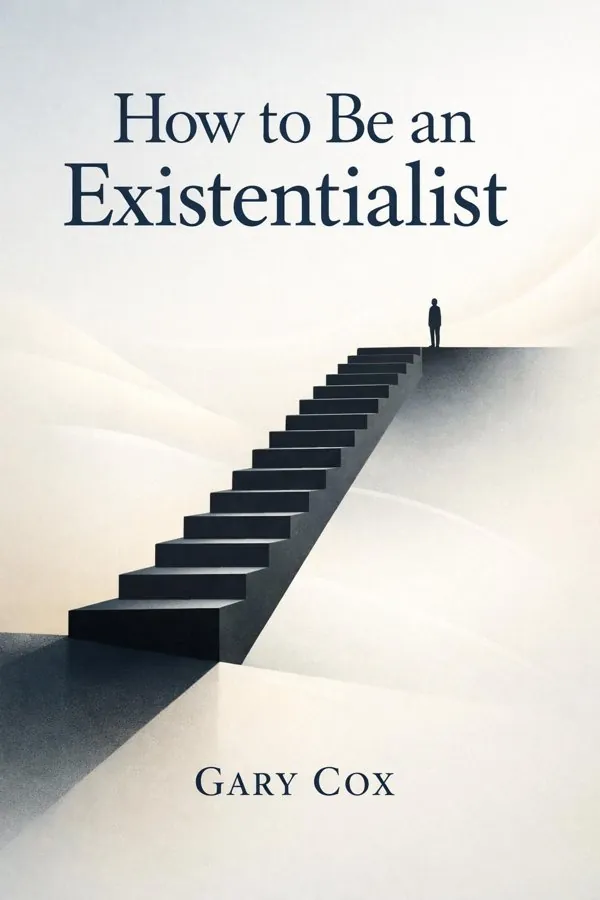
How to Be an Existentialist: Or How to Get Real, Get a Grip and Stop Making Excuses: Summary & Key Insights
by Gary Cox
 10 min7 chaptersAudio available
What Is How to Be an Existentialist: Or How to Get Real, Get a Grip and Stop Making Excuses About?
How to Be an Existentialist: Or How to Get Real, Get a Grip and Stop Making Excuses by Gary Cox is a western_phil book spanning 7 pages. A concise and accessible introduction to existentialist philosophy, this book by Gary Cox explains how existentialism can be applied to everyday life. It challenges readers to take responsibility for their choices, confront the absurdity of existence, and live authentically without excuses. Written in a direct and often humorous style, it demystifies complex philosophical ideas from Sartre, Nietzsche, and others, showing how they remain relevant to modern self-understanding and freedom.
This FizzRead summary covers all 7 key chapters of How to Be an Existentialist: Or How to Get Real, Get a Grip and Stop Making Excuses in approximately 10 minutes, distilling the most important ideas, arguments, and takeaways from Gary Cox's work. Also available as an audio summary and Key Quotes Podcast.
How to Be an Existentialist: Or How to Get Real, Get a Grip and Stop Making Excuses
A concise and accessible introduction to existentialist philosophy, this book by Gary Cox explains how existentialism can be applied to everyday life. It challenges readers to take responsibility for their choices, confront the absurdity of existence, and live authentically without excuses. Written in a direct and often humorous style, it demystifies complex philosophical ideas from Sartre, Nietzsche, and others, showing how they remain relevant to modern self-understanding and freedom.
Who Should Read How to Be an Existentialist: Or How to Get Real, Get a Grip and Stop Making Excuses?
This book is perfect for anyone interested in western_phil and looking to gain actionable insights in a short read. Whether you're a student, professional, or lifelong learner, the key ideas from How to Be an Existentialist: Or How to Get Real, Get a Grip and Stop Making Excuses by Gary Cox will help you think differently.
- ✓Readers who enjoy western_phil and want practical takeaways
- ✓Professionals looking to apply new ideas to their work and life
- ✓Anyone who wants the core insights of How to Be an Existentialist: Or How to Get Real, Get a Grip and Stop Making Excuses in just 10 minutes
Want the full summary?
Get instant access to this book summary and 100K+ more with Fizz Moment.
Get Free SummaryAvailable on App Store • Free to download
Key Chapters
One of the first barriers to living authentically is the addiction to excuses. We cling to narratives that help us dodge responsibility — ‘I couldn’t help it,’ ‘That’s just how I am,’ or ‘The world won’t let me.’ Existentialism strips these illusions bare. Jean-Paul Sartre insisted that we are ‘condemned to be free.’ This condemnation doesn’t mean punishment; it means that freedom is unavoidable. Whether you act with courage or cowardice, you cannot escape the fact that you are choosing. Even choosing not to act is a choice.
I want you to see how your mind constructs these excuses as a defence against freedom. It’s far easier to believe that fate, genetics, or society determine your life than to confront the truth that you are shaping your reality moment by moment. Existentialism isn’t content with half-measures. It demands that you accept total ownership of your choices. When you stop blaming your upbringing, your boss, or your luck, you begin to reclaim yourself. Every obstacle becomes a mirror reflecting your decisions. And the terrifying truth becomes liberating: you are responsible for your own existence.
So why do people resist this idea so desperately? Because it exposes our comfort zones. Once you realize you are always free to choose differently, your excuses evaporate. You can no longer pretend that your current life — whether miserable or mediocre — is someone else’s fault. The existentialist act is to stand naked before this truth, without self-deception.
Existential freedom isn’t the cheerful slogan of unlimited possibilities. It’s the hardest truth imaginable, because it means that there are no predetermined meanings, no fixed moral codes handed down from above. Sartre’s notion of radical freedom reveals that every value, every commitment, every purpose is something we invent. You create meaning through your choices, but that creation carries weight. You can’t claim freedom without also accepting responsibility for what you make of it.
Living freely means refusing to hide behind institutions, ideologies, or habits. Take, for example, your job. You might say you ‘have to’ work there because of economic necessity. But even that necessity involves a choice — a choice to value security over passion, to prioritize family stability over personal risk. Existentialism forces you to see the truth in that: freedom persists even under constraint. What matters is not the circumstances themselves but the integrity with which you engage them.
Responsibility, then, is not punishment but empowerment. You must recognize that your decisions ripple through the world, affecting others and defining who you become. This isn’t a philosophical abstraction; it’s the heartbeat of your daily existence. Whether you create art, raise children, or wash dishes, each act expresses who you are choosing to be. To be human, says existential philosophy, is to be the author of yourself — and that authorship is never complete.
+ 5 more chapters — available in the FizzRead app
All Chapters in How to Be an Existentialist: Or How to Get Real, Get a Grip and Stop Making Excuses
About the Author
Get This Summary in Your Preferred Format
Read or listen to the How to Be an Existentialist: Or How to Get Real, Get a Grip and Stop Making Excuses summary by Gary Cox anytime, anywhere. FizzRead offers multiple formats so you can learn on your terms — all free.
Available formats: App · Audio · PDF · EPUB — All included free with FizzRead
Download How to Be an Existentialist: Or How to Get Real, Get a Grip and Stop Making Excuses PDF and EPUB Summary
Key Quotes from How to Be an Existentialist: Or How to Get Real, Get a Grip and Stop Making Excuses
“One of the first barriers to living authentically is the addiction to excuses.”
“Existential freedom isn’t the cheerful slogan of unlimited possibilities.”
Frequently Asked Questions about How to Be an Existentialist: Or How to Get Real, Get a Grip and Stop Making Excuses
How to Be an Existentialist: Or How to Get Real, Get a Grip and Stop Making Excuses by Gary Cox is a western_phil book that explores key ideas across 7 chapters. A concise and accessible introduction to existentialist philosophy, this book by Gary Cox explains how existentialism can be applied to everyday life. It challenges readers to take responsibility for their choices, confront the absurdity of existence, and live authentically without excuses. Written in a direct and often humorous style, it demystifies complex philosophical ideas from Sartre, Nietzsche, and others, showing how they remain relevant to modern self-understanding and freedom.
You Might Also Like

A Little History of Philosophy
Nigel Warburton
10 min
Areopagitica
John Milton
10 min
How To Think Like A Philosopher: Essential Principles For Clear Thinking
Peter Cave
10 min
Language, Truth and Logic
A. J. Ayer
10 min
The Age of Reason
Thomas Paine
10 min
The Essays
Michel De Montaigne
10 minBrowse by Category
Ready to read How to Be an Existentialist: Or How to Get Real, Get a Grip and Stop Making Excuses?
Get the full summary and 100K+ more books with Fizz Moment.