
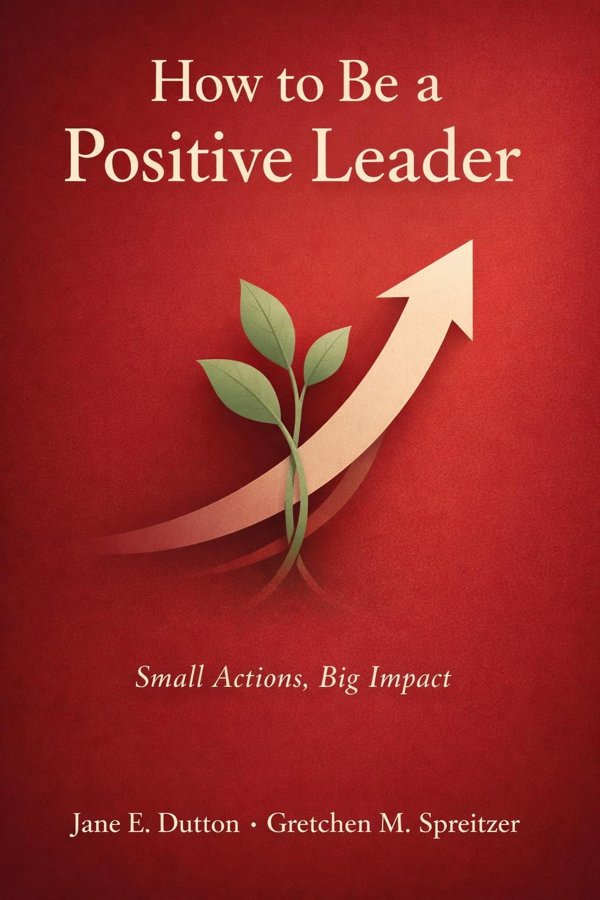
How to Be a Positive Leader: Small Actions, Big Impact: Summary & Key Insights
by Jane E. Dutton, Gretchen M. Spreitzer
 10 min10 chaptersAudio available
What Is How to Be a Positive Leader: Small Actions, Big Impact About?
How to Be a Positive Leader: Small Actions, Big Impact by Jane E. Dutton, Gretchen M. Spreitzer is a leadership book spanning 10 pages. This book explores how leaders can foster positive organizational practices that enhance employee engagement, resilience, and performance. Drawing on research in positive organizational scholarship, the authors present actionable strategies for creating workplaces that enable people to thrive and contribute meaningfully.
This FizzRead summary covers all 10 key chapters of How to Be a Positive Leader: Small Actions, Big Impact in approximately 10 minutes, distilling the most important ideas, arguments, and takeaways from Jane E. Dutton, Gretchen M. Spreitzer's work. Also available as an audio summary and Key Quotes Podcast.
How to Be a Positive Leader: Small Actions, Big Impact
This book explores how leaders can foster positive organizational practices that enhance employee engagement, resilience, and performance. Drawing on research in positive organizational scholarship, the authors present actionable strategies for creating workplaces that enable people to thrive and contribute meaningfully.
Who Should Read How to Be a Positive Leader: Small Actions, Big Impact?
This book is perfect for anyone interested in leadership and looking to gain actionable insights in a short read. Whether you're a student, professional, or lifelong learner, the key ideas from How to Be a Positive Leader: Small Actions, Big Impact by Jane E. Dutton, Gretchen M. Spreitzer will help you think differently.
- ✓Readers who enjoy leadership and want practical takeaways
- ✓Professionals looking to apply new ideas to their work and life
- ✓Anyone who wants the core insights of How to Be a Positive Leader: Small Actions, Big Impact in just 10 minutes
Want the full summary?
Get instant access to this book summary and 100K+ more with Fizz Moment.
Get Free SummaryAvailable on App Store • Free to download
Key Chapters
Positive organizational scholarship (POS) emerged from a simple question: what gives life to organizations? Jane Dutton, Kim Cameron, and other researchers at the University of Michigan began investigating not merely what makes organizations survive, but what makes them flourish. Unlike traditional management theories that focus on correcting weaknesses, POS highlights the processes and relationships that enable excellence, resilience, and meaning.
As authors, we view POS as a scientific and philosophical framework that challenges how we traditionally view success. It teaches leaders to recognize that performance and well-being are not in conflict—they are deeply intertwined. When people feel valued, respected, and energized, they innovate more, collaborate better, and recover faster from setbacks.
Within this foundation lie several core principles: thriving, high-quality connections, meaningful work, and compassion. Each principle serves as a lens through which leaders can examine their behaviors and systems. Are your interactions energizing or depleting others? Do your decisions reinforce respect and trust? Do your teams see purpose in their everyday tasks?
The evidence is compelling. Studies at dozens of firms—ranging from hospitals and schools to multinational corporations—demonstrate that positivity leads to measurable gains: higher engagement, fewer absentee days, stronger customer satisfaction, and improved creativity. But most importantly, it helps organizations become communities, spaces where people feel seen and appreciated. POS reframes leadership from a technical exercise into a relational art—an ongoing practice of elevating humanity within the workplace.
A high-quality connection is more than a friendly interaction; it’s a moment that uplifts, even transforms. In our research, we found that these micro-connections—brief exchanges marked by trust, respect, and positive regard—can dramatically influence an employee’s day, motivation, and even physical health. Leaders who intentionally cultivate these moments sow the seeds of engagement and resilience.
Imagine walking into a meeting where the leader listens fully, acknowledges your perspective, and responds with genuine curiosity. Such an exchange, though small, strengthens the relational fabric of the team. High-quality connections are characterized by mutuality, energy, and openness. They make the workplace feel alive.
As a leader, you create these connections through empathy and authenticity. Something as simple as learning an employee’s aspirations, celebrating effort, or expressing gratitude can uplift an entire department. Our studies have shown that when people experience high-quality connections, they recover from stress faster, show more initiative, and develop greater trust in leadership.
The underlying message is this: connection is not a soft skill—it’s a performance driver. The most innovative cultures are built on relationships that invite vulnerability, dialogue, and collaboration. Positive leaders understand that every interaction is a chance to connect at a higher quality and in doing so, unleash potential that charts the course toward organizational flourishing.
+ 8 more chapters — available in the FizzRead app
All Chapters in How to Be a Positive Leader: Small Actions, Big Impact
About the Authors
Jane E. Dutton is a professor at the University of Michigan’s Ross School of Business, known for her work on positive organizational scholarship and compassion in the workplace. Gretchen M. Spreitzer is also a professor at the Ross School of Business, specializing in empowerment, leadership, and thriving at work.
Get This Summary in Your Preferred Format
Read or listen to the How to Be a Positive Leader: Small Actions, Big Impact summary by Jane E. Dutton, Gretchen M. Spreitzer anytime, anywhere. FizzRead offers multiple formats so you can learn on your terms — all free.
Available formats: App · Audio · PDF · EPUB — All included free with FizzRead
Download How to Be a Positive Leader: Small Actions, Big Impact PDF and EPUB Summary
Key Quotes from How to Be a Positive Leader: Small Actions, Big Impact
“Positive organizational scholarship (POS) emerged from a simple question: what gives life to organizations?”
“A high-quality connection is more than a friendly interaction; it’s a moment that uplifts, even transforms.”
Frequently Asked Questions about How to Be a Positive Leader: Small Actions, Big Impact
How to Be a Positive Leader: Small Actions, Big Impact by Jane E. Dutton, Gretchen M. Spreitzer is a leadership book that explores key ideas across 10 chapters. This book explores how leaders can foster positive organizational practices that enhance employee engagement, resilience, and performance. Drawing on research in positive organizational scholarship, the authors present actionable strategies for creating workplaces that enable people to thrive and contribute meaningfully.
You Might Also Like

Extreme Ownership
Jocko Willink
10 min
Dare to Lead
Brene Brown
10 min
Leaders Eat Last
Simon Sinek
10 min
The 21 Irrefutable Laws of Leadership
John Maxwell
10 min
Start With Why
Simon Sinek
10 min
How to Lead When You're Not in Charge
Clay Scroggins
10 minBrowse by Category
Ready to read How to Be a Positive Leader: Small Actions, Big Impact?
Get the full summary and 100K+ more books with Fizz Moment.