
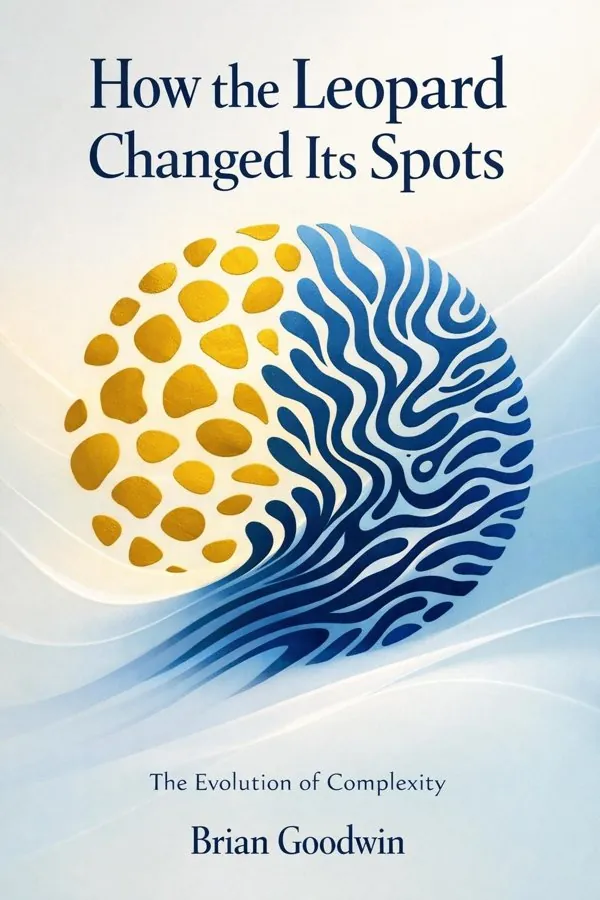
How the Leopard Changed Its Spots: The Evolution of Complexity: Summary & Key Insights
 10 min8 chaptersAudio available
What Is How the Leopard Changed Its Spots: The Evolution of Complexity About?
How the Leopard Changed Its Spots: The Evolution of Complexity by Brian Goodwin is a life_science book spanning 8 pages. This influential work by theoretical biologist Brian Goodwin explores how complex biological forms and patterns arise in nature. Drawing on mathematics, physics, and developmental biology, Goodwin argues that the diversity of life is shaped not only by natural selection but also by inherent principles of self-organization and morphogenesis. The book challenges reductionist views of evolution and offers a holistic perspective on the emergence of biological complexity.
This FizzRead summary covers all 8 key chapters of How the Leopard Changed Its Spots: The Evolution of Complexity in approximately 10 minutes, distilling the most important ideas, arguments, and takeaways from Brian Goodwin's work. Also available as an audio summary and Key Quotes Podcast.
How the Leopard Changed Its Spots: The Evolution of Complexity
This influential work by theoretical biologist Brian Goodwin explores how complex biological forms and patterns arise in nature. Drawing on mathematics, physics, and developmental biology, Goodwin argues that the diversity of life is shaped not only by natural selection but also by inherent principles of self-organization and morphogenesis. The book challenges reductionist views of evolution and offers a holistic perspective on the emergence of biological complexity.
Who Should Read How the Leopard Changed Its Spots: The Evolution of Complexity?
This book is perfect for anyone interested in life_science and looking to gain actionable insights in a short read. Whether you're a student, professional, or lifelong learner, the key ideas from How the Leopard Changed Its Spots: The Evolution of Complexity by Brian Goodwin will help you think differently.
- ✓Readers who enjoy life_science and want practical takeaways
- ✓Professionals looking to apply new ideas to their work and life
- ✓Anyone who wants the core insights of How the Leopard Changed Its Spots: The Evolution of Complexity in just 10 minutes
Want the full summary?
Get instant access to this book summary and 100K+ more with Fizz Moment.
Get Free SummaryAvailable on App Store • Free to download
Key Chapters
When Darwin proposed natural selection, his insights were revolutionary. He showed that complex forms could emerge gradually from variation and competition—a vision both elegant and deeply material. Yet as biology modernized, this vision narrowed. The synthesis between Mendelian genetics and Darwin’s principles reduced evolution to a molecular formula: genes mutate; selection favors the fittest. Complexity, beauty, and order were seen as the products of chance filtered by survival.
This mechanistic view proved immensely powerful. It explained inheritance, predicted evolutionary change, and unified vast swaths of biology. But when we turned to the living organism itself—its form, its symmetry, the choreography of its development—the gene-based model began to falter. How do identical genetic instructions produce the vastly differing forms of feathers, shells, or leaves? Where in this reductionist scheme lies the pattern inherent in the material?
The reductionist approach dissected life into its smallest units, yet each fragment lost the living coherence that defines the whole. Just as physics learned to move beyond Newtonian simplicity into the nonlinear dynamism of complex systems, biology too must evolve beyond mere molecular mechanics. The new challenge is to rediscover the language of form—the principles that allow matter itself to self-organize into structure.
Life’s forms arise not only by selection acting on variation, but also through the spontaneous ordering tendencies of living matter itself. This principle, known as self-organization, means that systems can generate order internally, without a builder or designer. You see it when snowflakes form geometric perfection, when sand dunes ripple under the wind, or when chemical reactions oscillate in colored waves.
In biological systems, this same intrinsic order manifests as tissues, organs, and morphologies. Cells communicate through chemical signals, but the resulting patterns are not centrally programmed—they emerge through local interactions, much as flocks of birds form their mesmerizing shapes through simple behavioral rules.
I emphasize that self-organization does not replace natural selection. It provides the substrate on which selection acts. Just as the laws of physics constrain the architectures possible for molecules, the laws of morphogenesis constrain the forms available for life. Evolution, in this sense, is a collaboration between necessity and chance, self-organization and selection. The natural world’s diversity is not accidental; it is an exploration of the universe’s own creative potential.
+ 6 more chapters — available in the FizzRead app
All Chapters in How the Leopard Changed Its Spots: The Evolution of Complexity
About the Author
Brian Goodwin (1931–2009) was a British theoretical biologist and professor known for his pioneering work in complexity theory and morphogenesis. He taught at the Open University and was a founding member of the Santa Fe Institute, contributing significantly to the field of theoretical biology and the study of self-organizing systems in nature.
Get This Summary in Your Preferred Format
Read or listen to the How the Leopard Changed Its Spots: The Evolution of Complexity summary by Brian Goodwin anytime, anywhere. FizzRead offers multiple formats so you can learn on your terms — all free.
Available formats: App · Audio · PDF · EPUB — All included free with FizzRead
Download How the Leopard Changed Its Spots: The Evolution of Complexity PDF and EPUB Summary
Key Quotes from How the Leopard Changed Its Spots: The Evolution of Complexity
“When Darwin proposed natural selection, his insights were revolutionary.”
“Life’s forms arise not only by selection acting on variation, but also through the spontaneous ordering tendencies of living matter itself.”
Frequently Asked Questions about How the Leopard Changed Its Spots: The Evolution of Complexity
How the Leopard Changed Its Spots: The Evolution of Complexity by Brian Goodwin is a life_science book that explores key ideas across 8 chapters. This influential work by theoretical biologist Brian Goodwin explores how complex biological forms and patterns arise in nature. Drawing on mathematics, physics, and developmental biology, Goodwin argues that the diversity of life is shaped not only by natural selection but also by inherent principles of self-organization and morphogenesis. The book challenges reductionist views of evolution and offers a holistic perspective on the emergence of biological complexity.
You Might Also Like
The Selfish Gene
Richard Dawkins
10 min
Awakenings
Oliver Sacks
10 min
Parasite Rex: Inside the Bizarre World of Nature's Most Dangerous Creatures
Carl Zimmer
10 min
The Atlas of Life on Earth
Various
10 min
The Book of Humans: The Story of How We Became Us
Adam Rutherford
10 min
The Horse
Wendy Williams
10 minBrowse by Category
Ready to read How the Leopard Changed Its Spots: The Evolution of Complexity?
Get the full summary and 100K+ more books with Fizz Moment.