
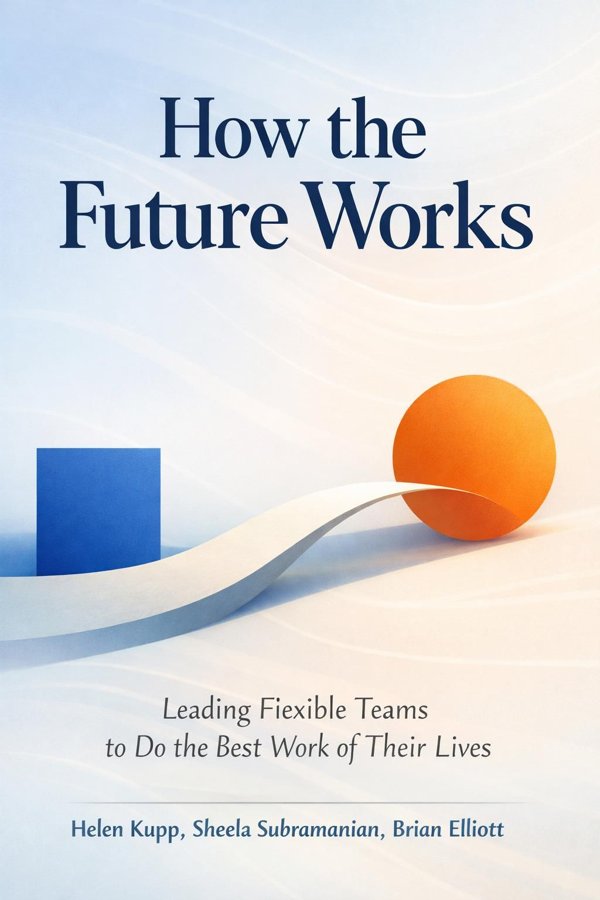
How the Future Works: Leading Flexible Teams to Do the Best Work of Their Lives: Summary & Key Insights
by Helen Kupp, Sheela Subramanian, Brian Elliott
 10 min9 chaptersAudio available
Key Takeaways from How the Future Works: Leading Flexible Teams to Do the Best Work of Their Lives
The biggest mistake leaders can make is treating flexible work as a short-term adjustment instead of a long-term structural shift.
Flexibility sounds simple until organizations define it too narrowly.
When people are no longer sitting in front of managers, weak leadership habits become impossible to hide.
Flexible work does not fail because people are far apart; it fails when they do not trust one another.
An office can create the illusion of inclusion while quietly rewarding the people who are most visible, most available, or most similar to those in power.
What Is How the Future Works: Leading Flexible Teams to Do the Best Work of Their Lives About?
How the Future Works: Leading Flexible Teams to Do the Best Work of Their Lives by Helen Kupp, Sheela Subramanian, Brian Elliott is a leadership book spanning 6 pages. How do you build a company where people can do exceptional work without being trapped by outdated assumptions about when, where, and how work must happen? In How the Future Works, Helen Kupp, Sheela Subramanian, and Brian Elliott argue that flexible work is not a temporary perk or a crisis-era compromise. It is a fundamental redesign of work itself. Drawing on research from Future Forum, a consortium backed by Slack, the authors combine data, executive interviews, and practical leadership lessons to show why the old model of office-centric management no longer fits a digital, distributed world. Their focus is not simply on remote work, but on creating organizations built around trust, inclusion, autonomy, and clarity. This matters because the debate over flexible work often gets reduced to logistics, while the real challenge is organizational design. Leaders who understand this shift can improve performance, retention, and employee well-being. Leaders who resist it risk disengagement, inequity, and irrelevance. This book offers a thoughtful, practical roadmap for navigating one of the most important workplace transformations of our time.
This FizzRead summary covers all 9 key chapters of How the Future Works: Leading Flexible Teams to Do the Best Work of Their Lives in approximately 10 minutes, distilling the most important ideas, arguments, and takeaways from Helen Kupp, Sheela Subramanian, Brian Elliott's work. Also available as an audio summary and Key Quotes Podcast.
How the Future Works: Leading Flexible Teams to Do the Best Work of Their Lives
How do you build a company where people can do exceptional work without being trapped by outdated assumptions about when, where, and how work must happen? In How the Future Works, Helen Kupp, Sheela Subramanian, and Brian Elliott argue that flexible work is not a temporary perk or a crisis-era compromise. It is a fundamental redesign of work itself. Drawing on research from Future Forum, a consortium backed by Slack, the authors combine data, executive interviews, and practical leadership lessons to show why the old model of office-centric management no longer fits a digital, distributed world. Their focus is not simply on remote work, but on creating organizations built around trust, inclusion, autonomy, and clarity. This matters because the debate over flexible work often gets reduced to logistics, while the real challenge is organizational design. Leaders who understand this shift can improve performance, retention, and employee well-being. Leaders who resist it risk disengagement, inequity, and irrelevance. This book offers a thoughtful, practical roadmap for navigating one of the most important workplace transformations of our time.
Who Should Read How the Future Works: Leading Flexible Teams to Do the Best Work of Their Lives?
This book is perfect for anyone interested in leadership and looking to gain actionable insights in a short read. Whether you're a student, professional, or lifelong learner, the key ideas from How the Future Works: Leading Flexible Teams to Do the Best Work of Their Lives by Helen Kupp, Sheela Subramanian, Brian Elliott will help you think differently.
- ✓Readers who enjoy leadership and want practical takeaways
- ✓Professionals looking to apply new ideas to their work and life
- ✓Anyone who wants the core insights of How the Future Works: Leading Flexible Teams to Do the Best Work of Their Lives in just 10 minutes
Want the full summary?
Get instant access to this book summary and 100K+ more with Fizz Moment.
Get Free SummaryAvailable on App Store • Free to download
Key Chapters
The biggest mistake leaders can make is treating flexible work as a short-term adjustment instead of a long-term structural shift. The authors argue that the world of work has moved beyond the industrial-era logic that linked productivity to visibility, standard hours, and centralized offices. That older model was built for repeatable tasks, physical supervision, and rigid hierarchies. But modern knowledge work depends far more on creativity, problem-solving, collaboration, and access to digital tools than on physical proximity alone.
This shift was accelerated by the pandemic, but it did not begin there. Even before global disruption forced organizations to experiment, employees were already demanding more autonomy, better balance, and more meaningful work. Technology had made distributed collaboration possible, while rising burnout exposed the cost of systems built around constant availability. The result is not just a change in location. It is a deeper reconsideration of how work should be organized, measured, and led.
The authors stress that leaders who frame this transition as a temporary exception often revert to outdated habits: attendance-based evaluation, excessive meetings, and office-first decision making. By contrast, forward-looking organizations recognize that flexible work requires redesigning workflows, communication norms, and management practices around outcomes rather than presence.
A practical example is replacing assumptions like “serious work happens in person” with intentional choices about which tasks benefit from synchronous collaboration and which are better done independently. Team rituals, project planning, and performance systems must all reflect this reality.
Actionable takeaway: Stop asking how to restore the old workplace and start asking what kind of work environment best supports performance, equity, and adaptability in a digital world.
Flexibility sounds simple until organizations define it too narrowly. Many companies reduce it to a policy about how many days employees can work from home, but the authors show that real flexibility is broader and more human-centered. It includes control over time, work patterns, communication expectations, and the ability to adapt work to different roles, responsibilities, and life circumstances.
This distinction matters because a company can offer hybrid schedules while still operating through rigid, controlling norms. If people are technically remote but expected to respond instantly, attend endless meetings, and conform to office-based workflows, they are not truly working flexibly. Genuine flexibility gives employees more agency over how they accomplish their goals while preserving alignment around outcomes and team needs.
The authors encourage leaders to think in terms of flexibility as choice within a clear framework. That might mean allowing employees to shift their hours for caregiving, creating meeting-free blocks for deep work, or enabling asynchronous collaboration across time zones. It also means recognizing that different functions require different approaches. A sales team, engineering team, and customer support team may not need identical rules, but they do need fairness, clarity, and transparency.
One practical application is creating team agreements that define response-time expectations, core collaboration hours, and when live meetings are truly necessary. This gives structure without unnecessary rigidity. Employees gain freedom, and teams avoid chaos.
Actionable takeaway: Redefine flexibility as autonomy over time, focus, and workflow, not just location, and build explicit norms that help teams use that autonomy effectively.
When people are no longer sitting in front of managers, weak leadership habits become impossible to hide. The book argues that flexible work exposes a central truth: many organizations have relied on visibility as a substitute for management. Leaders often felt in control because they could observe activity, hold spontaneous check-ins, and reinforce authority through physical presence. But in distributed environments, those habits break down. What matters instead is clarity of purpose, priorities, and decision rights.
The authors present leadership in the flexible era as a move away from supervision toward enablement. Great leaders set direction, define outcomes, remove obstacles, and create the conditions for people to do their best work. They do not micromanage calendars or equate responsiveness with commitment. This requires more intentional communication and stronger operating discipline. Teams need clear goals, explicit ownership, and shared understanding of how progress will be tracked.
For example, instead of measuring performance by who joins early-morning meetings or appears most active online, a leader might establish quarterly objectives, weekly deliverables, and predictable review cadences. Managers then focus on coaching, coordination, and support rather than surveillance. This approach not only improves accountability but also reduces the anxiety that often comes from unclear expectations.
The authors also highlight the importance of manager training. Many managers have never been taught how to lead with trust, structure one-on-ones effectively, or support well-being in a flexible environment. Organizations that want flexibility to succeed must invest in these capabilities.
Actionable takeaway: Replace management by observation with management by outcomes, and equip leaders to communicate priorities, coach consistently, and measure what truly matters.
Flexible work does not fail because people are far apart; it fails when they do not trust one another. One of the book’s strongest themes is that trust is not a soft cultural extra. It is a hard operational requirement. Without trust, managers over-monitor, employees withhold concerns, and collaboration becomes slow and defensive. Transparency helps build that trust by reducing uncertainty and making decisions, priorities, and expectations visible.
The authors argue that trust grows when leaders share context instead of merely issuing instructions. In a flexible workplace, employees cannot rely on hallway conversations to fill in missing information. They need access to the reasoning behind strategic choices, the goals of the team, and the criteria used to evaluate success. Transparency also includes openness about tradeoffs, workload, and what is still unknown. Leaders who communicate honestly create psychological safety and reduce speculation.
A practical example is documenting decisions in shared channels rather than keeping them trapped in private meetings. Another is using written updates that explain not just what is changing, but why. Teams can also build trust by making work visible through project boards, status dashboards, and regular asynchronous reporting. This reduces the need for constant interruption and allows people to coordinate more effectively.
Importantly, trust must be mutual. Employees also need to communicate proactively, surface blockers early, and follow through on commitments. Trust does not mean the absence of accountability. It means assuming good intent while building reliable systems.
Actionable takeaway: Increase trust by making goals, decisions, and progress more transparent, and create routines that let people stay aligned without relying on constant supervision.
An office can create the illusion of inclusion while quietly rewarding the people who are most visible, most available, or most similar to those in power. The authors show that flexible work can either widen inequality or help correct it, depending on how it is designed. Inclusion does not emerge automatically from hybrid schedules. It requires conscious systems that give all employees fair access to information, opportunity, and influence.
One major risk in hybrid environments is proximity bias. When some employees spend more time in the office, they may gain informal access to leaders, learn news sooner, and be perceived as more committed. Without safeguards, remote workers can become second-class contributors even if they perform just as well or better. The authors urge organizations to create “digital-first” practices so everyone participates on equal footing, regardless of location.
This can include having everyone join meetings from their own screen, documenting discussions, rotating speaking opportunities, and evaluating employees based on results rather than physical presence. Inclusion also means accounting for different life experiences. Flexibility can be especially valuable for caregivers, people with disabilities, workers in expensive cities, and those who need quieter environments to focus. But these benefits only materialize when leaders remove stigma from using flexibility.
Teams should regularly ask who is being left out of decisions, who is overburdened by always-on norms, and whose voice is not being heard in meetings. Inclusion becomes operational when leaders measure belonging, monitor advancement patterns, and correct inequities early.
Actionable takeaway: Build hybrid systems that default to equal access, reduce proximity bias, and ensure that flexibility expands opportunity instead of concentrating it among the already privileged.
Many leaders fear that if people are not together physically, culture will disappear. The authors challenge this assumption by arguing that culture was never the office itself. Culture is the set of shared behaviors, norms, and values that shape how people work together. A beautiful headquarters may symbolize culture, but it does not create trust, inclusion, accountability, or purpose on its own.
In flexible organizations, culture has to be more intentional because it can no longer rely on osmosis. Casual observation and office rituals once helped transmit expectations, but they also often excluded people and reinforced unwritten rules. The future of culture depends on making those rules explicit. How do we communicate? How quickly do we respond? How are decisions made? When do we collaborate live, and when do we work asynchronously? What behaviors earn recognition? These questions define culture far more than office snacks or branded events.
The book suggests that leaders should treat culture as a design challenge. Instead of asking how to preserve every old ritual, they should identify the values those rituals were meant to support and recreate them in more inclusive ways. For example, social connection can be fostered through thoughtful onboarding, mentorship, and recurring team gatherings with clear purpose. Learning can be supported through accessible documentation and open knowledge-sharing channels. Recognition can happen publicly in digital spaces where everyone can see it.
Strong culture in a flexible environment is not accidental. It emerges from repeated, visible practices that match stated values.
Actionable takeaway: Define culture through observable behaviors and team norms, then build rituals, communication systems, and recognition practices that reinforce those behaviors wherever people work.
If every question becomes a meeting, flexibility quickly collapses under the weight of coordination. One of the book’s practical contributions is its emphasis on asynchronous work as a core operating principle for modern teams. Async work means people do not have to be online at the same time to contribute effectively. Instead, information is documented, decisions are recorded, and collaboration happens through tools and processes that allow thoughtful participation across different schedules and locations.
This approach matters because constant synchronous communication creates hidden costs. It fragments attention, penalizes people in different time zones, and favors those who are more outspoken in live discussion. It can also make organizations slower, not faster, because employees spend so much time talking about work that they have less time to actually do it. Async practices restore deep work and improve traceability.
Practical examples include writing project briefs before meetings, recording status updates in shared documents, using comment threads for feedback, and reserving live meetings for moments that genuinely benefit from real-time debate or relationship building. Teams can also create templates for decisions, handoffs, and updates so information becomes easier to find and understand.
The authors do not argue that meetings are bad. They argue that meetings should be intentional. Synchronous time is valuable, but precisely because it is valuable, it should be used sparingly and for the right reasons.
Actionable takeaway: Audit your team’s communication habits and shift routine updates, documentation, and low-stakes decisions into asynchronous formats so live time can be used for the conversations that truly need it.
Burnout is not simply an individual resilience problem; it is often a sign of broken work design. The authors make the case that flexibility should improve not just convenience, but the sustainability of performance. In many organizations, the old model rewarded long hours, instant responsiveness, and blurred boundaries. Digital tools made work more mobile, but also made it easier for work to invade every hour of the day. Without intentional boundaries, flexible work can become an endless workday.
The book links well-being directly to effectiveness. People do better work when they have autonomy, recovery time, and clarity about expectations. They struggle when they are overloaded with meetings, interrupted constantly, and judged by how available they seem rather than by the quality of what they produce. This is especially important for managers, who often absorb both execution pressure and emotional labor.
Practical solutions include establishing focus time, limiting after-hours communication, encouraging real use of time off, and training managers to identify signs of overload. Leaders can also measure employee experience through regular pulse surveys rather than waiting for burnout to show up in turnover. A healthy system is one where employees can meet high standards without sacrificing their mental health or personal responsibilities.
The authors warn against treating well-being initiatives as cosmetic. Meditation apps cannot fix a culture that glorifies exhaustion. Sustainable performance comes from redesigning workloads, expectations, and norms.
Actionable takeaway: Treat well-being as an organizational design issue by setting healthier defaults around time, responsiveness, and workload so people can perform at a high level over the long term.
The future is not a simple choice between office and remote. The authors argue that the most effective organizations design hybrid work intentionally rather than drifting into it. Hybrid is powerful because it can combine the flexibility of distributed work with the connection and creativity that can come from being together. But when left unmanaged, it becomes the worst of both worlds: confusing expectations, inequitable experiences, and inefficient use of time.
Intentional hybrid design starts with purpose. Leaders should ask what the office is for rather than assuming it should remain the default workspace. In many cases, the office is most valuable for onboarding, relationship building, complex collaboration, strategy sessions, and moments of celebration. It is less useful as a place where people commute only to sit on video calls all day. By clarifying the purpose of in-person time, organizations can make those moments more meaningful.
The authors also emphasize consistency and communication. Employees need to know when presence is expected, why it matters, and how those expectations align with role requirements. Team-level flexibility can coexist with company-wide principles, but ambiguity creates stress. Companies should invest in tools, workspace design, and meeting practices that support equal participation across locations.
An intentional hybrid model is not about maximizing office attendance. It is about matching the mode of work to the need. When done well, it strengthens performance, belonging, and autonomy at the same time.
Actionable takeaway: Define the specific purpose of in-person work, communicate clear expectations, and design hybrid practices so office time becomes a strategic advantage rather than a default habit.
All Chapters in How the Future Works: Leading Flexible Teams to Do the Best Work of Their Lives
About the Authors
Helen Kupp, Sheela Subramanian, and Brian Elliott are leaders and workplace thinkers behind Future Forum, a research consortium launched by Slack to help organizations reimagine work for the digital era. Their expertise spans leadership, organizational transformation, product strategy, employee experience, and the design of high-performing teams. Through research, executive advising, and direct work with companies navigating hybrid and remote models, they have developed a strong understanding of how flexibility affects productivity, inclusion, well-being, and culture. In How the Future Works, they combine data-driven insight with practical management guidance, making them credible voices in one of the most important business conversations of the modern workplace: how to build organizations where people can do excellent work with greater autonomy and trust.
Get This Summary in Your Preferred Format
Read or listen to the How the Future Works: Leading Flexible Teams to Do the Best Work of Their Lives summary by Helen Kupp, Sheela Subramanian, Brian Elliott anytime, anywhere. FizzRead offers multiple formats so you can learn on your terms — all free.
Available formats: App · Audio · PDF · EPUB — All included free with FizzRead
Download How the Future Works: Leading Flexible Teams to Do the Best Work of Their Lives PDF and EPUB Summary
Key Quotes from How the Future Works: Leading Flexible Teams to Do the Best Work of Their Lives
“The biggest mistake leaders can make is treating flexible work as a short-term adjustment instead of a long-term structural shift.”
“Flexibility sounds simple until organizations define it too narrowly.”
“When people are no longer sitting in front of managers, weak leadership habits become impossible to hide.”
“Flexible work does not fail because people are far apart; it fails when they do not trust one another.”
“An office can create the illusion of inclusion while quietly rewarding the people who are most visible, most available, or most similar to those in power.”
Frequently Asked Questions about How the Future Works: Leading Flexible Teams to Do the Best Work of Their Lives
How the Future Works: Leading Flexible Teams to Do the Best Work of Their Lives by Helen Kupp, Sheela Subramanian, Brian Elliott is a leadership book that explores key ideas across 9 chapters. How do you build a company where people can do exceptional work without being trapped by outdated assumptions about when, where, and how work must happen? In How the Future Works, Helen Kupp, Sheela Subramanian, and Brian Elliott argue that flexible work is not a temporary perk or a crisis-era compromise. It is a fundamental redesign of work itself. Drawing on research from Future Forum, a consortium backed by Slack, the authors combine data, executive interviews, and practical leadership lessons to show why the old model of office-centric management no longer fits a digital, distributed world. Their focus is not simply on remote work, but on creating organizations built around trust, inclusion, autonomy, and clarity. This matters because the debate over flexible work often gets reduced to logistics, while the real challenge is organizational design. Leaders who understand this shift can improve performance, retention, and employee well-being. Leaders who resist it risk disengagement, inequity, and irrelevance. This book offers a thoughtful, practical roadmap for navigating one of the most important workplace transformations of our time.
You Might Also Like

Extreme Ownership
Jocko Willink
10 min
Dare to Lead
Brene Brown
10 min
Leaders Eat Last
Simon Sinek
10 min
The 21 Irrefutable Laws of Leadership
John Maxwell
10 min
Start With Why
Simon Sinek
10 min
How to Lead When You're Not in Charge
Clay Scroggins
10 minBrowse by Category
Ready to read How the Future Works: Leading Flexible Teams to Do the Best Work of Their Lives?
Get the full summary and 100K+ more books with Fizz Moment.