
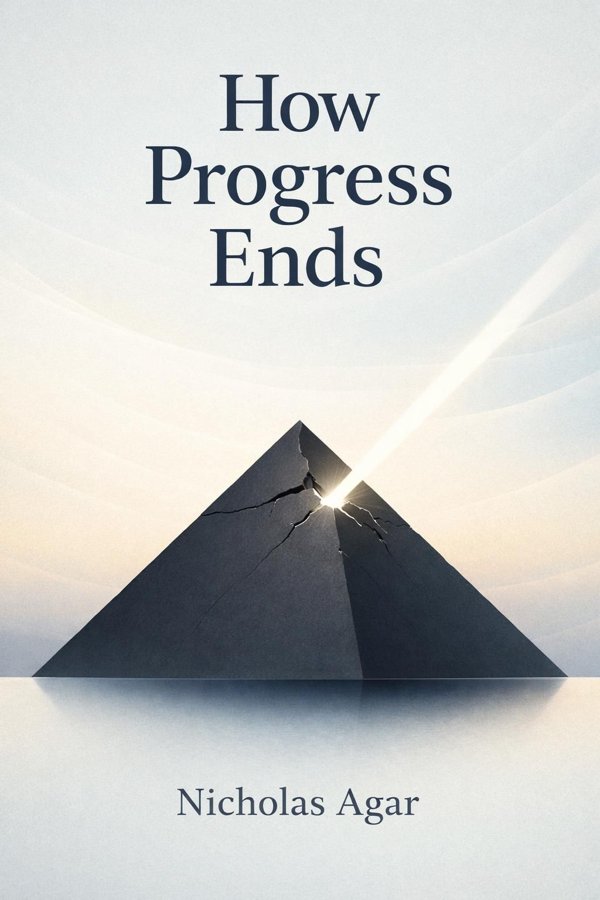
How Progress Ends: Summary & Key Insights
 10 min9 chaptersAudio available
What Is How Progress Ends About?
How Progress Ends by Nicholas Agar is a philosophy book spanning 9 pages. In this thought-provoking work, philosopher Nicholas Agar explores the limits of human progress and the potential consequences of technological and scientific advancement. He argues that while progress has brought immense benefits, it may also lead humanity toward existential risks and moral dilemmas that challenge our understanding of what it means to live a good life.
This FizzRead summary covers all 9 key chapters of How Progress Ends in approximately 10 minutes, distilling the most important ideas, arguments, and takeaways from Nicholas Agar's work. Also available as an audio summary and Key Quotes Podcast.
How Progress Ends
In this thought-provoking work, philosopher Nicholas Agar explores the limits of human progress and the potential consequences of technological and scientific advancement. He argues that while progress has brought immense benefits, it may also lead humanity toward existential risks and moral dilemmas that challenge our understanding of what it means to live a good life.
Who Should Read How Progress Ends?
This book is perfect for anyone interested in philosophy and looking to gain actionable insights in a short read. Whether you're a student, professional, or lifelong learner, the key ideas from How Progress Ends by Nicholas Agar will help you think differently.
- ✓Readers who enjoy philosophy and want practical takeaways
- ✓Professionals looking to apply new ideas to their work and life
- ✓Anyone who wants the core insights of How Progress Ends in just 10 minutes
Want the full summary?
Get instant access to this book summary and 100K+ more with Fizz Moment.
Get Free SummaryAvailable on App Store • Free to download
Key Chapters
To understand why we see progress as inevitable and good, we must return to the intellectual ferment of the Enlightenment. Philosophers such as Kant, Condorcet, and Bacon articulated a vision of human history as upward movement—a march toward greater knowledge, freedom, and moral improvement. The belief that reason could liberate humankind from ignorance and superstition became civilization’s guiding myth. Science promised to replace fate with mastery; technology appeared as the instrument of that promise.
But the Enlightenment ideal rested on certain assumptions: that reason was universally accessible, that knowledge would naturally yield virtue, and that more control over nature meant more fulfillment. These claims carried a moral weight. They assured us that to progress scientifically was to progress ethically. In the industrial and digital revolutions that followed, these premises were amplified beyond what eighteenth-century minds could have imagined. Yet the moral thread that united science and the good life began to fray. We have gained power faster than we have gained wisdom.
Reflecting as a philosopher of technology, I see the Enlightenment’s dual legacy: it gave birth both to modern democracy and to the technological world that now overwhelms our ethical capacities. We cannot simply reject its inheritance—we owe it nearly every social advance we cherish—but we must reinterpret it. Perhaps progress, once tied to rational mastery, must now yield to an ethic of restraint and relationship, where our measure of advancement is not dominance over nature but coexistence within it.
The twentieth and twenty-first centuries have compressed centuries of development into mere decades. Digital revolutions multiply the pace of discovery as algorithms design new materials, and artificial intelligence redraws what knowledge itself means. The shape of progress has changed: it no longer unfolds at a human rhythm but at the tempo of machines. We inhabit an age where exponential growth has become cultural dogma.
This acceleration transforms not only what we can do but how we live and perceive ourselves. Where innovation once promised liberation from toil, it now threatens to displace meaning. Continuous connection blurs rest into productivity; constant novelty breeds disorientation. The human mind—biologically tuned for linear change—struggles to adapt to exponential speed.
In this condition, progress begins to devour its own rationale. We innovate because innovation is demanded, not because it enriches life. Economic and technological systems propel themselves independently of human deliberation. I see this as a moral hazard: when technological change exceeds our moral comprehension, progress becomes mere motion. Our challenge, then, is to slow down—not to halt discovery, but to reintroduce reflection into our collective evolution.
+ 7 more chapters — available in the FizzRead app
All Chapters in How Progress Ends
About the Author
Nicholas Agar is a New Zealand philosopher known for his work on ethics, technology, and human enhancement. He has written extensively on the philosophical implications of emerging technologies and the future of humanity.
Get This Summary in Your Preferred Format
Read or listen to the How Progress Ends summary by Nicholas Agar anytime, anywhere. FizzRead offers multiple formats so you can learn on your terms — all free.
Available formats: App · Audio · PDF · EPUB — All included free with FizzRead
Download How Progress Ends PDF and EPUB Summary
Key Quotes from How Progress Ends
“To understand why we see progress as inevitable and good, we must return to the intellectual ferment of the Enlightenment.”
“The twentieth and twenty-first centuries have compressed centuries of development into mere decades.”
Frequently Asked Questions about How Progress Ends
How Progress Ends by Nicholas Agar is a philosophy book that explores key ideas across 9 chapters. In this thought-provoking work, philosopher Nicholas Agar explores the limits of human progress and the potential consequences of technological and scientific advancement. He argues that while progress has brought immense benefits, it may also lead humanity toward existential risks and moral dilemmas that challenge our understanding of what it means to live a good life.
You Might Also Like

Browse by Category
Ready to read How Progress Ends?
Get the full summary and 100K+ more books with Fizz Moment.