
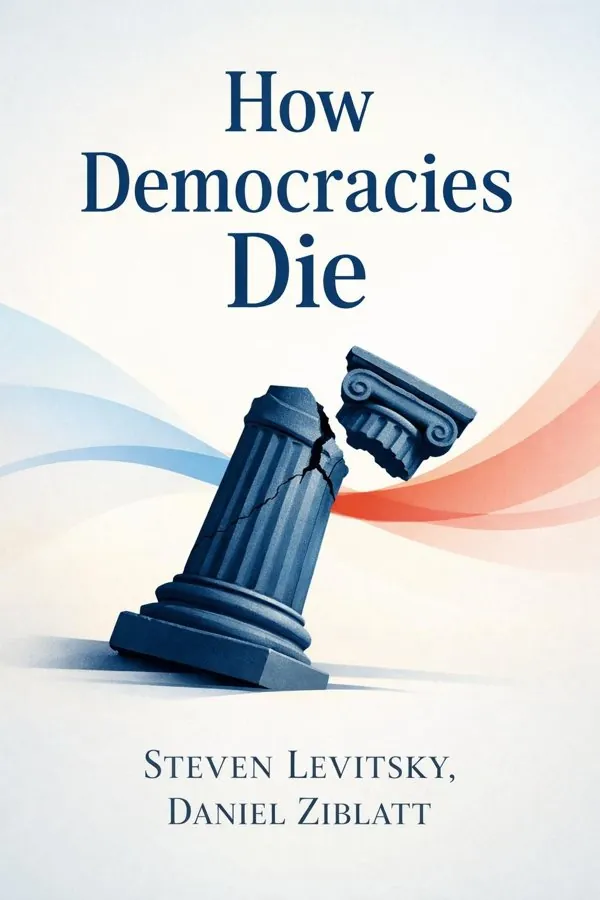
How Democracies Die: Summary & Key Insights
by Steven Levitsky, Daniel Ziblatt
 10 min9 chaptersAudio available
What Is How Democracies Die About?
How Democracies Die by Steven Levitsky, Daniel Ziblatt is a politics book spanning 9 pages. In this influential work, political scientists Steven Levitsky and Daniel Ziblatt examine how democracies around the world have historically collapsed—not through violent coups, but through the gradual erosion of democratic norms. Drawing on examples from Europe, Latin America, and the United States, the authors argue that democracies die when elected leaders subvert the very institutions that brought them to power. They identify key warning signs of authoritarian behavior and explore how citizens and institutions can defend democracy from within.
This FizzRead summary covers all 9 key chapters of How Democracies Die in approximately 10 minutes, distilling the most important ideas, arguments, and takeaways from Steven Levitsky, Daniel Ziblatt's work. Also available as an audio summary and Key Quotes Podcast.
How Democracies Die
In this influential work, political scientists Steven Levitsky and Daniel Ziblatt examine how democracies around the world have historically collapsed—not through violent coups, but through the gradual erosion of democratic norms. Drawing on examples from Europe, Latin America, and the United States, the authors argue that democracies die when elected leaders subvert the very institutions that brought them to power. They identify key warning signs of authoritarian behavior and explore how citizens and institutions can defend democracy from within.
Who Should Read How Democracies Die?
This book is perfect for anyone interested in politics and looking to gain actionable insights in a short read. Whether you're a student, professional, or lifelong learner, the key ideas from How Democracies Die by Steven Levitsky, Daniel Ziblatt will help you think differently.
- ✓Readers who enjoy politics and want practical takeaways
- ✓Professionals looking to apply new ideas to their work and life
- ✓Anyone who wants the core insights of How Democracies Die in just 10 minutes
Want the full summary?
Get instant access to this book summary and 100K+ more with Fizz Moment.
Get Free SummaryAvailable on App Store • Free to download
Key Chapters
History is a stern but illuminating teacher. In studying numerous cases—from interwar Europe to twentieth-century Latin America—we discovered that democracies rarely fall all at once. They rot in stages, often beginning with leaders who were freely elected. Adolf Hitler, Hugo Chávez, Recep Tayyip Erdoğan, Alberto Fujimori—each came to power through legitimate elections, promising to restore dignity and order. Yet each followed a similar sequence: attacking opponents, undermining checks and balances, and reshaping institutions to entrench their rule.
We traced these developments through the lens of comparative politics. In pre-war Europe, economic despair and social division created fertile ground for extremists who dismissed liberal democracy as weak. In Latin America, fragile institutions struggled against military influence and chronic inequality. Across contexts, one truth prevails: democracy demands both competing powers and shared restraint. When that restraint erodes, even strong constitutions falter.
Take Venezuela, where Chávez cultivated a populist movement that equated criticism with treason. Over time, independent institutions were dismantled, elections manipulated, and the judiciary rendered compliant. The pattern mirrored those we saw in 1930s Germany or in Turkey under Erdoğan—a slow concentration of power, framed as reform. What emerges from these studies is the understanding that no democracy is immune. The conditions of decline—polarization, charismatic populism, institutional weakness—can reappear anywhere. To see them coming is to have the chance to act before the fall.
+ 7 more chapters — available in the FizzRead app
All Chapters in How Democracies Die
About the Authors
Steven Levitsky is a professor of government at Harvard University specializing in comparative politics and Latin American studies. Daniel Ziblatt is the Eaton Professor of Government at Harvard University and a senior fellow at the Center for European Studies, focusing on the history and development of democracy in Europe.
Get This Summary in Your Preferred Format
Read or listen to the How Democracies Die summary by Steven Levitsky, Daniel Ziblatt anytime, anywhere. FizzRead offers multiple formats so you can learn on your terms — all free.
Available formats: App · Audio · PDF · EPUB — All included free with FizzRead
Download How Democracies Die PDF and EPUB Summary
Key Quotes from How Democracies Die
“Every democratic system faces moments when ambitious leaders test its limits.”
“History is a stern but illuminating teacher.”
Frequently Asked Questions about How Democracies Die
How Democracies Die by Steven Levitsky, Daniel Ziblatt is a politics book that explores key ideas across 9 chapters. In this influential work, political scientists Steven Levitsky and Daniel Ziblatt examine how democracies around the world have historically collapsed—not through violent coups, but through the gradual erosion of democratic norms. Drawing on examples from Europe, Latin America, and the United States, the authors argue that democracies die when elected leaders subvert the very institutions that brought them to power. They identify key warning signs of authoritarian behavior and explore how citizens and institutions can defend democracy from within.
You Might Also Like

Antifa: The Anti-Fascist Handbook
Mark Bray
10 min
Attack from Within: How Disinformation Is Sabotaging America
Barbara McQuade
10 min
Coercion, Capital, and European States, AD 990–1992
Charles Tilly
10 min
Digital Democracy: Concepts, Methodologies, Tools, and Applications
Various Authors
10 min
Fascism
Stanley G. Payne
10 min
Fire And Fury: Inside The Trump White House
Michael Wolff
10 minBrowse by Category
Ready to read How Democracies Die?
Get the full summary and 100K+ more books with Fizz Moment.