
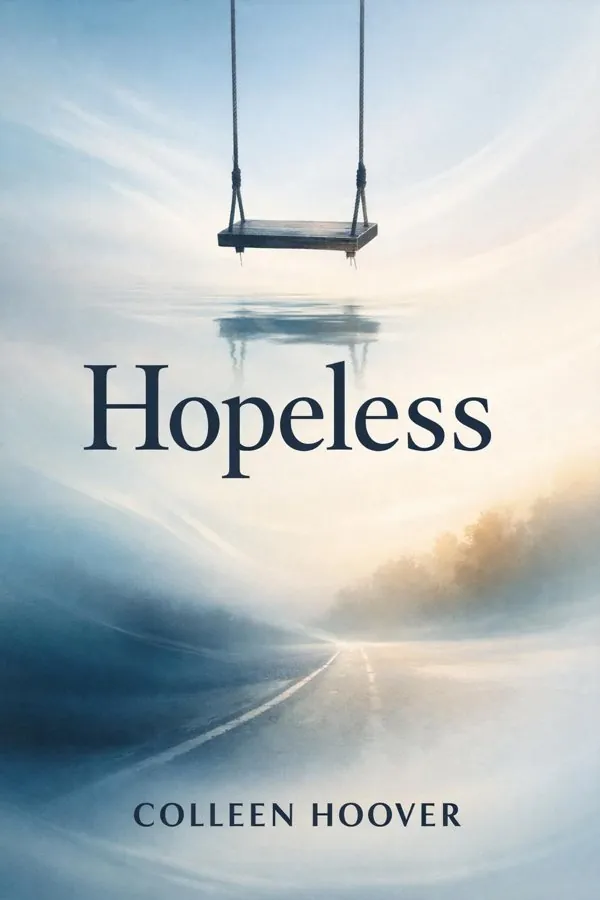
Hopeless: Summary & Key Insights
 10 min8 chaptersAudio available
Key Takeaways from Hopeless
A protected life can feel safe until you realize it has also kept you from understanding yourself.
Sometimes the people who unsettle us most are the ones who stand closest to our buried truth.
The mind does not always forget because it is weak; sometimes it forgets because remembering would be unbearable.
Discovering the truth about your past does not simply answer questions; it can shatter the person you thought you were.
Romance may open the door to healing, but it cannot do the healing for us.
What Is Hopeless About?
Hopeless by Colleen Hoover is a romantic_relationships book spanning 6 pages. Hopeless by Colleen Hoover is a contemporary romance that begins like a story about first love and quickly deepens into something far more unsettling, tender, and unforgettable. At its center is Sky Davis, a teenage girl raised under unusually strict rules: no internet, no television, no phone, and a life carefully controlled by her adoptive mother. When Sky meets Dean Holder, a boy with a troubled reputation and an intensity she cannot ignore, her world starts to crack open. What follows is not only a romance, but also a painful search for truth, identity, and survival. What makes Hopeless matter is the way it combines emotional suspense with difficult questions about trauma, memory, and healing. Hoover does not use romance as a simple escape; she uses it to explore how people protect themselves from unbearable pain and what it takes to face the past honestly. Known for emotionally charged storytelling and shocking twists, Hoover has become one of the most widely read voices in contemporary romance. In Hopeless, she delivers one of her boldest novels: a love story shaped by secrets, grief, and the possibility that truth, however devastating, can also be the beginning of freedom.
This FizzRead summary covers all 8 key chapters of Hopeless in approximately 10 minutes, distilling the most important ideas, arguments, and takeaways from Colleen Hoover's work. Also available as an audio summary and Key Quotes Podcast.
Hopeless
Hopeless by Colleen Hoover is a contemporary romance that begins like a story about first love and quickly deepens into something far more unsettling, tender, and unforgettable. At its center is Sky Davis, a teenage girl raised under unusually strict rules: no internet, no television, no phone, and a life carefully controlled by her adoptive mother. When Sky meets Dean Holder, a boy with a troubled reputation and an intensity she cannot ignore, her world starts to crack open. What follows is not only a romance, but also a painful search for truth, identity, and survival.
What makes Hopeless matter is the way it combines emotional suspense with difficult questions about trauma, memory, and healing. Hoover does not use romance as a simple escape; she uses it to explore how people protect themselves from unbearable pain and what it takes to face the past honestly. Known for emotionally charged storytelling and shocking twists, Hoover has become one of the most widely read voices in contemporary romance. In Hopeless, she delivers one of her boldest novels: a love story shaped by secrets, grief, and the possibility that truth, however devastating, can also be the beginning of freedom.
Who Should Read Hopeless?
This book is perfect for anyone interested in romantic_relationships and looking to gain actionable insights in a short read. Whether you're a student, professional, or lifelong learner, the key ideas from Hopeless by Colleen Hoover will help you think differently.
- ✓Readers who enjoy romantic_relationships and want practical takeaways
- ✓Professionals looking to apply new ideas to their work and life
- ✓Anyone who wants the core insights of Hopeless in just 10 minutes
Want the full summary?
Get instant access to this book summary and 100K+ more with Fizz Moment.
Get Free SummaryAvailable on App Store • Free to download
Key Chapters
A protected life can feel safe until you realize it has also kept you from understanding yourself. At the start of Hopeless, Sky believes her unusual upbringing is simply a quirk of her home life. She has been homeschooled, kept away from technology, and largely isolated from the social rhythms that define most teenagers’ lives. Her adoptive mother, Karen, appears strict but caring, and Sky has learned to accept this controlled environment without fully questioning it. Yet beneath that structure lies a quieter truth: when someone is shielded from information, relationships, and independent experience, they may also be shielded from reality.
Sky’s first steps into public school and a more ordinary teenage life reveal how fragile her certainty really is. She is both curious and disconnected, trying to act normal while sensing that something about her life does not fit. This tension matters because it shows how identity is shaped not only by what we know, but by what we have been prevented from knowing. A person can function, laugh, date, and go to school while still living inside a carefully managed version of the truth.
In real life, this idea applies whenever families, institutions, or even our own fears limit what we are allowed to explore. Overprotection can become a form of control, even when it is motivated by love or fear. Sky’s story reminds us that maturity begins when we start asking uncomfortable questions about the rules we inherited.
Actionable takeaway: Examine one belief about your life that you have accepted without question, and ask where it came from, who benefits from it, and whether it still serves your growth.
Sometimes the people who unsettle us most are the ones who stand closest to our buried truth. Dean Holder enters Hopeless with the force of a contradiction. He is magnetic yet frightening, deeply attentive yet emotionally volatile, and his reputation suggests danger long before Sky gets to know him. Their connection is immediate, but not in a simple romantic way. Sky feels drawn to him with an urgency that she cannot explain, as though he is both familiar and threatening at once.
This makes Holder more than a love interest. He functions as a catalyst, a person whose presence disturbs Sky’s emotional defenses and forces hidden memories toward the surface. His intensity reflects the novel’s larger point that healing rarely arrives in a comfortable form. Sometimes the person who helps us most is not the one who makes life easier, but the one whose existence makes denial impossible.
Holder also complicates the common romance archetype of the damaged, mysterious boy. His pain is real, and his behavior is imperfect, but Hoover gradually reveals that his actions are rooted in grief, guilt, and desperate concern. As readers, we are asked to look beyond labels and rumor. Sky initially sees what others say about Holder; over time, she learns to see the wounded person beneath the reputation.
In everyday life, this idea is useful because first impressions often hide the deeper story. People can seem angry when they are grieving, distant when they are ashamed, or intense when they are protecting something fragile. That does not mean all difficult behavior should be excused, but it does mean understanding requires patience.
Actionable takeaway: The next time someone triggers a strong reaction in you, pause before judging and ask whether your discomfort might be pointing to a deeper truth, in them or in yourself.
The mind does not always forget because it is weak; sometimes it forgets because remembering would be unbearable. One of the most powerful ideas in Hopeless is that memory is not a perfect archive. Sky experiences gaps, flashes of fear, and emotional responses that seem disconnected from the life she consciously remembers. At first, these moments feel confusing, even irrational. But as the story unfolds, they reveal a painful psychological reality: memory can fragment under trauma.
Hoover presents this not as a puzzle for entertainment alone, but as an emotional truth. Sky’s buried memories are not simply hidden clues. They are survival mechanisms. Her mind has protected her by sealing away experiences too overwhelming to process. Yet that protection comes at a cost. What is repressed does not disappear; it returns through anxiety, confusion, dread, and a haunting sense that something is terribly wrong.
This idea matters because many people assume healing begins with clear understanding. In reality, healing often begins with symptoms that do not make sense yet. Someone may overreact to a smell, avoid a place, distrust affection, or feel panic without knowing why. Hopeless shows that these reactions may be the language of hidden pain.
Practically, the novel encourages compassion toward ourselves and others when emotions seem disproportionate or mysterious. Rather than demanding immediate clarity, it can be wiser to ask what experience a reaction might be connected to. Therapy, journaling, and trusted conversation can help uncover patterns without forcing disclosure before a person is ready.
Actionable takeaway: When you have an emotional reaction that feels bigger than the moment, do not dismiss it. Write down what happened, what you felt, and what it might be connected to beneath the surface.
Discovering the truth about your past does not simply answer questions; it can shatter the person you thought you were. As Sky begins to uncover the realities hidden from her, the revelations are not abstract facts. They alter her understanding of family, safety, love, and even her own name and history. This is one of the hardest emotional turns in Hopeless: truth is freeing, but first it is destabilizing.
Many stories celebrate revelation as a clean breakthrough. Hoover instead shows that truth can feel violent when it dismantles the emotional structure a person has built to survive. Sky must reevaluate the motives of the people who raised her, the meaning of her childhood, and the source of her fears. She is not just learning new information; she is mourning the life she believed she had.
This reflects a broader human experience. Whether the truth concerns family secrets, betrayal, abuse, addiction, or concealed grief, it often arrives with two opposing effects. It clarifies the past while simultaneously making the present feel uncertain. People may feel anger at being deceived, shame for not seeing earlier, and confusion about what to trust next. These reactions are not signs of weakness; they are normal responses to a disrupted identity.
In practical terms, Hopeless reminds readers that once difficult truths emerge, emotional adjustment takes time. Understanding something intellectually is not the same as integrating it emotionally. Support systems, boundaries, and patience become essential. The goal is not to return to the old self, but to build a more truthful one.
Actionable takeaway: If a hard truth has altered how you see your past, give yourself permission to grieve the story you lost before demanding that you immediately become whole again.
Romance may open the door to healing, but it cannot do the healing for us. Hopeless is often remembered for its emotional love story, yet one of its strongest lessons is that affection alone is not enough to repair trauma. Sky and Holder care deeply for each other, and their bond becomes a source of comfort, recognition, and courage. But Hoover does not pretend that love magically erases damage. Both characters carry wounds that require honesty, endurance, and confrontation with painful reality.
This distinction matters because many romantic narratives blur the line between being loved and being healed. In Hopeless, love helps Sky feel less alone, but it does not restore memory, undo violence, or spare her from grief. Likewise, Holder’s devotion does not remove his guilt or his own emotional burdens. Their relationship becomes meaningful not because it is perfect, but because it creates space for truth.
This idea is deeply practical. People often enter relationships hoping to be rescued from old pain. They may expect a partner to provide constant reassurance, rewrite past injuries, or fill emotional emptiness. While love can be transformative, it becomes unhealthy when it carries the impossible burden of total repair. Sustainable healing usually includes multiple forms of support: self-reflection, professional help, trusted friendships, and time.
Hoover’s portrayal is valuable because it honors romance while refusing fantasy. The healthiest aspect of Sky and Holder’s connection is not intensity, but mutual willingness to face what hurts. That is a more durable model of love than constant passion.
Actionable takeaway: Ask yourself whether you are expecting love to save you, or allowing it to support the real work of healing that you still need to do.
What remains unspoken often grows more powerful in the dark. A central emotional force in Hopeless is the damage caused by secrecy. Traumatic experiences, family lies, and unprocessed grief create a web of silence that shapes every major relationship in the novel. Characters are not only hurt by what happened to them, but by how long those truths were hidden, denied, or misunderstood.
The novel shows that silence can come from many places. It can be imposed by an abuser, maintained by fear, justified as protection, or internalized as shame. In Sky’s case, silence has distorted her entire understanding of herself. In Holder’s case, silence has deepened guilt and grief. The tragedy is not only the original harm, but the loneliness that follows when pain has no language and no witness.
This is why disclosure matters so much in the story. Speaking the truth does not make suffering disappear, but it breaks isolation. Once pain is named, it can be responded to. It can be believed, contextualized, mourned, and slowly integrated into a fuller life. This applies far beyond the book. Many people carry secrets because they fear judgment, chaos, or disbelief. Yet what is hidden often controls them more than what is spoken.
Of course, telling the truth requires safety. Not every listener is trustworthy, and not every moment is right. Hopeless does not suggest careless confession. It suggests the necessity of finding people and places where truth can be held with care.
Actionable takeaway: Identify one safe person, professional, or private outlet where you can begin to put difficult experiences into words instead of carrying them alone.
We often mistake public narratives for personal truth, and Hopeless exposes how dangerous that can be. Holder enters the novel branded by rumor. He is the boy people talk about, the one associated with volatility and tragedy. Sky, too, is perceived through partial information, as someone unusual, detached, or difficult to classify. Around them, characters are constantly being reduced to what others say they are.
Hoover uses this social dynamic to show how easily communities flatten complexity. A person becomes a headline version of themselves: troubled, wild, damaged, strange. Once that label settles, it influences every interaction. Others stop asking questions because they think they already know the answer. But Hopeless insists that every visible behavior has an invisible history.
This idea matters in schools, families, workplaces, and online life. Someone known as dramatic may actually be overwhelmed. Someone dismissed as cold may be traumatized. Someone called difficult may be carrying grief that has nowhere to go. Reputation can become a shortcut that protects observers from the harder work of empathy.
At the same time, the novel does not claim that hidden pain excuses every action. Accountability still matters. The point is subtler: understanding a person requires context, and context is rarely available through gossip or first impressions alone. By looking past Holder���s reputation, Sky sees his humanity. By looking past appearances in general, readers are invited to do the same.
Actionable takeaway: Before repeating a judgment about someone, ask whether you know firsthand evidence, full context, and the possibility that their behavior reflects pain rather than character alone.
Recovery is not the moment the truth appears; it is the moment a person chooses to live by it. By the later stages of Hopeless, the novel shifts from revelation to response. Sky cannot unknow what she has learned. The real question becomes how she will carry that knowledge forward. Will she remain defined by violation and deception, or can she build a life that honors the truth without surrendering to it?
This is where the novel becomes quietly hopeful. Healing is not presented as forgetting, forgiving everything, or returning to innocence. Instead, it means creating a future in which the past is acknowledged but no longer hidden. Sky’s growth comes through reclaiming agency. She begins to decide what relationships mean, what trust requires, and how she wants to live after devastation. Holder, too, must learn that love includes patience, honesty, and the willingness to stay present with pain rather than trying to erase it.
This framework is useful in real life because many people wait to feel fully healed before making meaningful choices. Hopeless suggests the opposite. We often rebuild while still hurting. We choose therapy while grieving, set boundaries while confused, and seek connection while still afraid. Progress is not the absence of pain; it is the refusal to let pain dictate every future possibility.
The novel’s title points toward despair, but its emotional destination is more complex. Hopelessness is challenged not by fantasy, but by truth, connection, and the courage to keep going after innocence is gone.
Actionable takeaway: Choose one small future-facing act today, such as setting a boundary, asking for help, or naming what you need, to prove that your past does not get the final word.
All Chapters in Hopeless
About the Author
Colleen Hoover is an American author of contemporary romance and emotional fiction, born in Sulphur Springs, Texas, in 1979. She first rose to prominence in 2012 with Slammed, a self-published novel that quickly gained a devoted readership and helped launch her career. Since then, she has become one of the most recognizable names in modern commercial fiction, with multiple New York Times bestselling titles. Hoover is known for combining accessible prose with emotionally intense plots, often exploring love, grief, trauma, family secrets, and personal resilience. Her novels frequently feature dramatic twists and morally complicated relationships, which have made her especially popular with readers who want page-turning stories that also deliver strong emotional impact. Hopeless remains one of her most talked-about books for its dark themes and unforgettable revelations.
Get This Summary in Your Preferred Format
Read or listen to the Hopeless summary by Colleen Hoover anytime, anywhere. FizzRead offers multiple formats so you can learn on your terms — all free.
Available formats: App · Audio · PDF · EPUB — All included free with FizzRead
Download Hopeless PDF and EPUB Summary
Key Quotes from Hopeless
“A protected life can feel safe until you realize it has also kept you from understanding yourself.”
“Sometimes the people who unsettle us most are the ones who stand closest to our buried truth.”
“The mind does not always forget because it is weak; sometimes it forgets because remembering would be unbearable.”
“Discovering the truth about your past does not simply answer questions; it can shatter the person you thought you were.”
“Romance may open the door to healing, but it cannot do the healing for us.”
Frequently Asked Questions about Hopeless
Hopeless by Colleen Hoover is a romantic_relationships book that explores key ideas across 8 chapters. Hopeless by Colleen Hoover is a contemporary romance that begins like a story about first love and quickly deepens into something far more unsettling, tender, and unforgettable. At its center is Sky Davis, a teenage girl raised under unusually strict rules: no internet, no television, no phone, and a life carefully controlled by her adoptive mother. When Sky meets Dean Holder, a boy with a troubled reputation and an intensity she cannot ignore, her world starts to crack open. What follows is not only a romance, but also a painful search for truth, identity, and survival. What makes Hopeless matter is the way it combines emotional suspense with difficult questions about trauma, memory, and healing. Hoover does not use romance as a simple escape; she uses it to explore how people protect themselves from unbearable pain and what it takes to face the past honestly. Known for emotionally charged storytelling and shocking twists, Hoover has become one of the most widely read voices in contemporary romance. In Hopeless, she delivers one of her boldest novels: a love story shaped by secrets, grief, and the possibility that truth, however devastating, can also be the beginning of freedom.
More by Colleen Hoover




You Might Also Like

Rebel
Beverly Jenkins
10 min
The Last Letter
Rebecca Yarros
10 min
A Thousand Boy Kisses
Tillie Cole
10 min
Aflame
Penelope Douglas
10 min
After The Bite
Lynsay Sands
10 min
Alchemised
SenLinYu
10 minBrowse by Category
Ready to read Hopeless?
Get the full summary and 100K+ more books with Fizz Moment.