
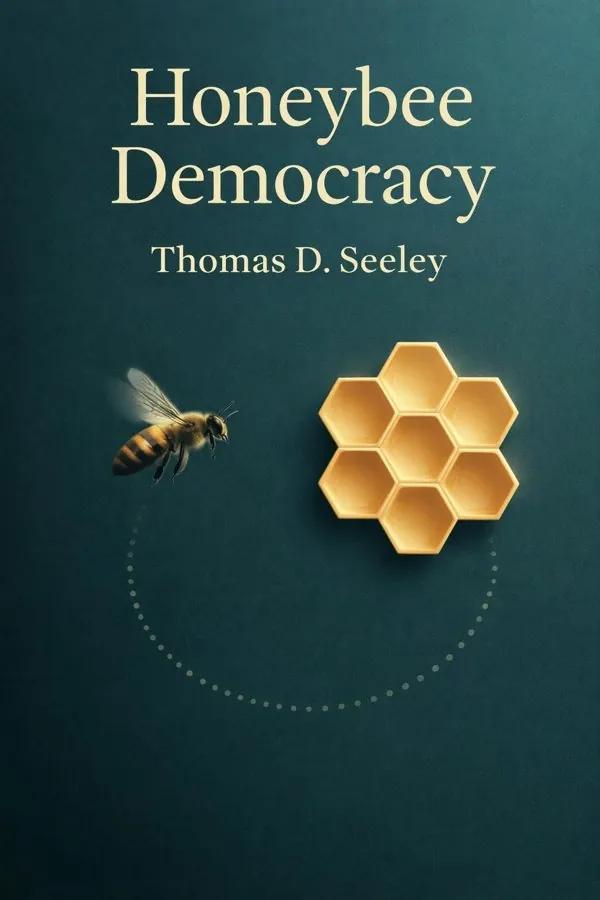
Honeybee Democracy: Summary & Key Insights
 10 min9 chaptersAudio available
Key Takeaways from Honeybee Democracy
A honeybee colony looks like a crowd, but it behaves like a single creature.
Good group decisions begin with good information, and in a bee swarm that work belongs to the scouts.
Communication becomes powerful when it is both expressive and constrained.
Consensus is often praised, but premature consensus can be dangerous.
At some point, a group must stop discussing and start acting.
What Is Honeybee Democracy About?
Honeybee Democracy by Thomas D. Seeley is a life_science book spanning 5 pages. How can a brainless-looking swarm make better group decisions than many human teams? In Honeybee Democracy, biologist Thomas D. Seeley answers that question by taking readers deep inside one of nature’s most elegant systems of collective intelligence: a honeybee swarm searching for a new home. The book follows a life-or-death moment in the colony’s existence, when thousands of bees must leave their old hive and agree on a new nesting site quickly, accurately, and without any central leader. Seeley shows how they do it through decentralized exploration, honest signaling, competition among options, and a decision rule based on quorum rather than authority. What makes the book so compelling is that it is not just about insects. It is about how groups can think. Drawing on decades of field experiments and observation, Seeley reveals principles that resonate far beyond biology, offering lessons for organizations, communities, and democratic systems. As a leading Cornell scientist specializing in animal behavior and social insects, he brings rare authority, clarity, and enthusiasm to a subject that becomes surprisingly relevant to human life.
This FizzRead summary covers all 9 key chapters of Honeybee Democracy in approximately 10 minutes, distilling the most important ideas, arguments, and takeaways from Thomas D. Seeley's work. Also available as an audio summary and Key Quotes Podcast.
Honeybee Democracy
How can a brainless-looking swarm make better group decisions than many human teams? In Honeybee Democracy, biologist Thomas D. Seeley answers that question by taking readers deep inside one of nature’s most elegant systems of collective intelligence: a honeybee swarm searching for a new home. The book follows a life-or-death moment in the colony’s existence, when thousands of bees must leave their old hive and agree on a new nesting site quickly, accurately, and without any central leader. Seeley shows how they do it through decentralized exploration, honest signaling, competition among options, and a decision rule based on quorum rather than authority. What makes the book so compelling is that it is not just about insects. It is about how groups can think. Drawing on decades of field experiments and observation, Seeley reveals principles that resonate far beyond biology, offering lessons for organizations, communities, and democratic systems. As a leading Cornell scientist specializing in animal behavior and social insects, he brings rare authority, clarity, and enthusiasm to a subject that becomes surprisingly relevant to human life.
Who Should Read Honeybee Democracy?
This book is perfect for anyone interested in life_science and looking to gain actionable insights in a short read. Whether you're a student, professional, or lifelong learner, the key ideas from Honeybee Democracy by Thomas D. Seeley will help you think differently.
- ✓Readers who enjoy life_science and want practical takeaways
- ✓Professionals looking to apply new ideas to their work and life
- ✓Anyone who wants the core insights of Honeybee Democracy in just 10 minutes
Want the full summary?
Get instant access to this book summary and 100K+ more with Fizz Moment.
Get Free SummaryAvailable on App Store • Free to download
Key Chapters
A honeybee colony looks like a crowd, but it behaves like a single creature. That is the essential insight behind Seeley’s account of swarming. A colony is not merely a collection of insects sharing space; it is a superorganism whose members divide labor, share information, and act in ways that support the survival of the whole. Swarming is the colony’s method of reproduction. When a hive becomes crowded and healthy, the old queen departs with roughly two-thirds of the workers, leaving the rest behind to raise a new queen. What seems like chaos is actually a carefully timed biological transition: one colony becomes two.
This matters because the swarm faces an immediate problem. Once it leaves its old cavity, it has no durable shelter, no brood nest, and limited time to find a secure home before weather, predators, or exhaustion take a toll. The bees temporarily cluster on a branch while scouts search the surrounding landscape. In that suspended moment, the future of the colony depends on collective judgment.
Seeley’s framing changes how we think about intelligence. The colony’s success does not come from one brilliant bee issuing orders. It comes from distributed roles and simple behaviors that, when combined, produce sophisticated outcomes. Human groups often forget this. We tend to assume that smart decisions require concentrated expertise at the top, yet many complex systems function best when information is spread across participants and coordinated through reliable rules.
In practical terms, the superorganism idea encourages us to evaluate teams by how well they integrate contributions, not by how impressive any one member appears. If you lead a group, ask: have we designed a system where individuals can sense, share, and respond for the good of the whole? Actionable takeaway: focus less on heroic leadership and more on building structures that let collective intelligence emerge.
Good group decisions begin with good information, and in a bee swarm that work belongs to the scouts. Several hundred experienced worker bees leave the hanging cluster and fly out in different directions, independently inspecting possible nesting sites. They are not wandering aimlessly. They are evaluating cavities according to meaningful criteria: size, entrance width, entrance orientation, height above ground, and dryness. Each scout returns with a private assessment of a public problem.
Seeley shows that this search phase is one of the swarm’s greatest strengths. The colony does not send every bee everywhere, nor does it wait for universal expertise. It allocates exploration to a minority capable of gathering evidence while the majority conserve energy and remain together. This balance between search and stability is crucial. Too little exploration and the colony risks choosing a poor site. Too much and it wastes time and coordination.
The principle applies widely. In business, product teams often fail because they debate options before anyone has done enough real-world discovery. In public policy, leaders may prematurely commit to solutions before gathering diverse local evidence. Bee scouts demonstrate a better sequence: investigate broadly, assess independently, then bring findings back for comparison.
There is also a lesson about diversity of search. Because different scouts inspect different locations, the swarm avoids tunnel vision. Independent exploration reduces the risk that one bad initial suggestion dominates simply because it appeared first. This resembles strong decision-making in human groups, where parallel research, field testing, and dissenting inputs often improve outcomes.
Actionable takeaway: before your group makes an important choice, assign a small set of people to independently explore options and report back with evidence, not just opinions.
Communication becomes powerful when it is both expressive and constrained. The honeybee waggle dance is one of nature’s most remarkable examples. When a scout finds a promising nesting site, she returns to the swarm cluster and performs a dance that conveys direction, distance, and enthusiasm. The angle of the dance indicates where the site lies relative to the sun, while the duration of the waggle run communicates distance. Just as important, the vigor and repetition of the dance reflect the scout’s level of support for the site.
This is not language in the human sense, but it is a functional signaling system that lets a group compare opportunities indirectly. A scout does not force others to agree; she advertises an option. Other bees can then choose to inspect the location themselves. If they also judge it favorably, they return and dance for it too. Support builds through recruitment, but only when new scouts independently confirm the site’s quality.
That verification step is essential. Human groups frequently confuse persuasion with proof. A charismatic speaker can rally support for a weak idea if listeners have no way to evaluate it. In the swarm, advocacy invites scrutiny rather than replacing it. Better sites generate stronger and more sustained dances because repeated inspection tends to confirm their value.
Seeley’s analysis suggests that healthy communication systems do two things at once: they spread promising information quickly and preserve room for independent checking. In workplaces, this might mean presenting proposals alongside data and encouraging peer review. In communities, it may mean amplifying ideas while keeping channels open for fact-finding and challenge.
Actionable takeaway: when promoting an idea, pair strong signaling with easy pathways for others to verify the evidence themselves.
Consensus is often praised, but premature consensus can be dangerous. One of the most surprising features of a bee swarm is that agreement emerges only after real competition among alternatives. Different scouts may dance for different nesting sites at the same time, creating a temporary marketplace of options. Better sites usually gain support more quickly because they inspire stronger dances and more successful recruitment. Weaker sites may attract some followers but often lose momentum over time.
Seeley emphasizes that this competition is not a flaw in the system. It is the mechanism through which the swarm compares possibilities without a chairman or vote count. Competing signals allow the colony to test multiple candidates in parallel. Importantly, individual bees can switch allegiance after inspecting a superior site. The process is fluid, evidence-sensitive, and reversible early on.
Human organizations often dislike visible disagreement, interpreting it as dysfunction. Yet the bee swarm shows that structured contention can be deeply productive. If several project strategies are allowed to compete, and each is subjected to testing, the final choice is more likely to be robust. By contrast, if a team suppresses alternatives too quickly in the name of harmony, it may miss better solutions.
The swarm also avoids endless rivalry. Competition is bounded by shared purpose: all scouts seek the best home for the colony, not personal status. That distinction matters. Human debates become toxic when participants are rewarded for winning rather than for helping the group choose well. Good institutions channel disagreement toward collective success.
Actionable takeaway: create decision processes where multiple options can compete on evidence for a limited time before the group converges on the strongest choice.
At some point, a group must stop discussing and start acting. In honeybee swarms, that shift happens through quorum sensing. Scouts do not wait until every bee is convinced or every alternative disappears. Instead, when enough scouts gather at one promising site, they trigger a change in behavior: they begin producing piping signals and preparing the swarm for flight. The decision rule is not unanimity but a threshold of sufficient support.
This is one of Seeley’s most important contributions. Quorum allows the swarm to balance accuracy and speed. If bees waited for complete agreement, they could remain exposed too long. If they acted on too little support, they might choose badly. A quorum threshold solves the problem by setting a practical standard: once enough independently informed individuals converge, the colony commits.
Many human groups struggle here. Some rush into action after hearing one persuasive voice; others drift in endless meetings because they treat total consensus as a requirement. Bee democracy suggests a middle path. The right question is not, “Has everyone agreed?” but, “Have enough informed people independently validated this option that action is now wiser than delay?”
This principle can guide everything from product launches to community decisions. A company might define clear criteria for moving forward after a pilot. A neighborhood association might agree that once enough residents review and support a proposal, implementation begins. The key is transparency: people should know in advance what counts as a quorum and why.
Actionable takeaway: define explicit commitment thresholds before deliberation begins so your group knows when to transition from exploration to execution.
Some of the swarm’s most sophisticated behavior happens without anyone being in charge. There is no executive bee reviewing reports, ranking sites, and issuing commands. Even the queen, often imagined as the ruler of the hive, plays no leadership role in choosing the new home. She is carried by the process, not directing it. Decision-making is distributed across many workers following simple behavioral rules.
This challenges a deeply rooted human assumption: that complex coordination requires centralized control. Seeley demonstrates that under the right conditions, decentralized systems can be highly effective. Individual scouts contribute local knowledge. Recruitment amplifies good options. Quorum converts growing support into action. The result is coherent collective behavior without a mastermind.
Decentralization has practical advantages. It reduces single points of failure, allows rapid response to changing information, and makes use of many observers rather than a narrow leadership channel. We see similar strengths in open-source communities, well-designed markets, and emergency response networks where local actors feed information upward and sideways instead of waiting passively for top-down instructions.
Of course, decentralization is not the same as disorder. The bees succeed because their interactions are governed by dependable rules and aligned incentives. Human groups often fail when they decentralize authority without clarifying goals or communication protocols. The lesson is not to eliminate leadership entirely, but to recognize that leaders may be most effective when they design the process rather than dictate the answer.
Actionable takeaway: whenever possible, distribute information gathering and evaluation broadly, and have leaders focus on setting rules, goals, and thresholds instead of making every decision themselves.
What makes Honeybee Democracy especially persuasive is that Seeley does not rely on metaphor alone; he builds his case through careful experiments. He and his collaborators tracked swarms, placed nest boxes with different qualities in the landscape, observed dance patterns, measured scout numbers, and tested how changes in site quality affected recruitment. These studies transformed a charming natural spectacle into a rigorous window on decision-making.
The experiments revealed that bees consistently prefer high-quality cavities and that their decision process can be described in algorithmic terms. Independent search generates options. Differential signaling ranks them. Positive feedback recruits supporters. Quorum triggers commitment. This is not random behavior. It is a repeatable system shaped by evolution to solve a recurring problem under uncertainty.
For readers, the scientific method matters as much as the findings. Seeley models a way of learning from nature that is disciplined rather than romantic. He does not claim bees are tiny human democrats. Instead, he asks what specific mechanisms explain their success and how those mechanisms compare with human institutions. That makes the book valuable to scientists, managers, and curious readers alike.
There is a broader lesson here about problem-solving. We often admire successful outcomes without understanding the processes that created them. But durable improvement comes from studying mechanisms. If a team consistently makes good decisions, ask what information flows, feedback loops, and incentives make that possible. Observation should lead to design.
Actionable takeaway: do not just copy successful groups’ outcomes; study and replicate the decision processes that generate those outcomes.
Nature does not hand us political blueprints, but it can sharpen our thinking about governance. Seeley draws cautious yet provocative comparisons between bee swarms and human democracy. In both cases, good collective decisions depend on broad information gathering, open competition among alternatives, honest signaling, and a decision rule that converts debate into action. The bees’ system is not democratic because individuals have rights or because they vote in a moral sense. It is democratic in the functional sense that many participants contribute to a shared decision without centralized command.
The comparison matters because modern societies often face exactly the tradeoffs the swarm has solved elegantly: how to combine expertise with inclusion, speed with accuracy, and freedom of advocacy with safeguards against bad choices. Bee swarms show the value of independent scouts, which resembles investigative journalism, field research, and local representation. They show the value of signal competition, which resembles public debate. And they show the value of quorum, which resembles procedures that prevent paralysis.
At the same time, Seeley’s comparisons carry a warning. Human systems fail when communication is distorted, when participants cannot verify claims, or when institutions reward dominance over truth. Bees avoid some of these traps because their signals are tightly linked to direct experience and because scouts can inspect proposed sites themselves. Humans need institutions to achieve something similar.
Actionable takeaway: improve group governance by protecting independent information sources, encouraging evidence-based debate, and setting fair procedures for timely decisions.
The deepest lesson of Honeybee Democracy is not simply that groups can be smart. It is that groups become smart only under the right conditions. A swarm’s excellence depends on a specific architecture: diverse searchers, shared interests, transparent signaling, opportunities for independent verification, and a clear threshold for commitment. Remove these features, and the system would degrade.
This has major implications for human life. We often speak of teamwork and collaboration as though putting people together automatically creates wisdom. Seeley’s bees show otherwise. Collective intelligence is designed, not assumed. If teams lack diversity of information, they become echo chambers. If status overrides evidence, poor ideas spread. If there is no rule for ending deliberation, they stall. If there is no mechanism for rechecking claims, rhetoric wins over reality.
The book therefore offers a practical framework for any group facing uncertainty. Start by encouraging independent exploration. Make proposals visible and comparable. Allow competition among options without personalizing the conflict. Require some form of verification. Then decide using predefined thresholds. These are not abstract ideals; they can be applied in classrooms, startups, nonprofit boards, research labs, and family decisions.
Seeley ultimately invites humility. Human beings are not superior because we are more centralized or more verbal. In some decision contexts, we can learn from insects that have evolved elegant solutions over millions of years. The point is not to imitate bees mechanically, but to notice that wise systems often emerge from simple rules well arranged.
Actionable takeaway: when a group repeatedly makes poor choices, diagnose the decision environment itself and redesign the process before blaming the people.
All Chapters in Honeybee Democracy
About the Author
Thomas D. Seeley is a renowned biologist, writer, and professor at Cornell University, where he has long studied animal behavior and the social life of honeybees. His research explores how bee colonies communicate, forage, reproduce, regulate their internal environment, and make collective decisions. Over several decades, Seeley has become one of the most influential scientific voices on honeybee behavior, combining meticulous field experiments with an unusual gift for clear explanation. His work has helped illuminate how complex group intelligence can emerge from simple individual actions. In addition to Honeybee Democracy, he has written other respected books on bees and social behavior, earning admiration from both scientists and general readers. His writing stands out for turning specialized research into vivid, accessible insights about nature, cooperation, and decision-making.
Get This Summary in Your Preferred Format
Read or listen to the Honeybee Democracy summary by Thomas D. Seeley anytime, anywhere. FizzRead offers multiple formats so you can learn on your terms — all free.
Available formats: App · Audio · PDF · EPUB — All included free with FizzRead
Download Honeybee Democracy PDF and EPUB Summary
Key Quotes from Honeybee Democracy
“A honeybee colony looks like a crowd, but it behaves like a single creature.”
“Good group decisions begin with good information, and in a bee swarm that work belongs to the scouts.”
“Communication becomes powerful when it is both expressive and constrained.”
“Consensus is often praised, but premature consensus can be dangerous.”
“At some point, a group must stop discussing and start acting.”
Frequently Asked Questions about Honeybee Democracy
Honeybee Democracy by Thomas D. Seeley is a life_science book that explores key ideas across 9 chapters. How can a brainless-looking swarm make better group decisions than many human teams? In Honeybee Democracy, biologist Thomas D. Seeley answers that question by taking readers deep inside one of nature’s most elegant systems of collective intelligence: a honeybee swarm searching for a new home. The book follows a life-or-death moment in the colony’s existence, when thousands of bees must leave their old hive and agree on a new nesting site quickly, accurately, and without any central leader. Seeley shows how they do it through decentralized exploration, honest signaling, competition among options, and a decision rule based on quorum rather than authority. What makes the book so compelling is that it is not just about insects. It is about how groups can think. Drawing on decades of field experiments and observation, Seeley reveals principles that resonate far beyond biology, offering lessons for organizations, communities, and democratic systems. As a leading Cornell scientist specializing in animal behavior and social insects, he brings rare authority, clarity, and enthusiasm to a subject that becomes surprisingly relevant to human life.
You Might Also Like

The Selfish Gene
Richard Dawkins
10 min
Awakenings
Oliver Sacks
10 min
Parasite Rex: Inside the Bizarre World of Nature's Most Dangerous Creatures
Carl Zimmer
10 min
The Atlas of Life on Earth
Various
10 min
The Book of Humans: The Story of How We Became Us
Adam Rutherford
10 min
The Horse
Wendy Williams
10 minBrowse by Category
Ready to read Honeybee Democracy?
Get the full summary and 100K+ more books with Fizz Moment.