
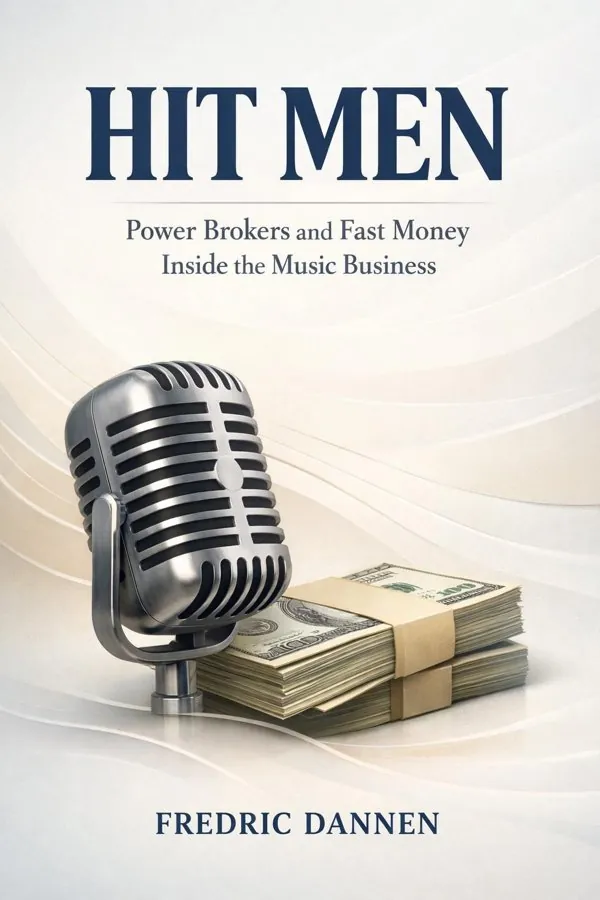
Hit Men: Power Brokers and Fast Money Inside the Music Business: Summary & Key Insights
 10 min6 chaptersAudio available
What Is Hit Men: Power Brokers and Fast Money Inside the Music Business About?
Hit Men: Power Brokers and Fast Money Inside the Music Business by Fredric Dannen is a music_film book spanning 6 pages. Hit Men es una investigación periodística que revela las prácticas corruptas, las luchas de poder y las intrigas dentro de la industria musical estadounidense durante las décadas de 1970 y 1980. Fredric Dannen expone cómo ejecutivos, promotores y artistas se vieron envueltos en una red de sobornos, manipulación de listas de éxitos y control corporativo, ofreciendo una mirada crítica al lado oscuro del negocio de la música.
This FizzRead summary covers all 6 key chapters of Hit Men: Power Brokers and Fast Money Inside the Music Business in approximately 10 minutes, distilling the most important ideas, arguments, and takeaways from Fredric Dannen's work. Also available as an audio summary and Key Quotes Podcast.
Hit Men: Power Brokers and Fast Money Inside the Music Business
Hit Men es una investigación periodística que revela las prácticas corruptas, las luchas de poder y las intrigas dentro de la industria musical estadounidense durante las décadas de 1970 y 1980. Fredric Dannen expone cómo ejecutivos, promotores y artistas se vieron envueltos en una red de sobornos, manipulación de listas de éxitos y control corporativo, ofreciendo una mirada crítica al lado oscuro del negocio de la música.
Who Should Read Hit Men: Power Brokers and Fast Money Inside the Music Business?
This book is perfect for anyone interested in music_film and looking to gain actionable insights in a short read. Whether you're a student, professional, or lifelong learner, the key ideas from Hit Men: Power Brokers and Fast Money Inside the Music Business by Fredric Dannen will help you think differently.
- ✓Readers who enjoy music_film and want practical takeaways
- ✓Professionals looking to apply new ideas to their work and life
- ✓Anyone who wants the core insights of Hit Men: Power Brokers and Fast Money Inside the Music Business in just 10 minutes
Want the full summary?
Get instant access to this book summary and 100K+ more with Fizz Moment.
Get Free SummaryAvailable on App Store • Free to download
Key Chapters
By the 1970s, the record industry had become one of America’s most lucrative entertainment businesses. At the top sat CBS Records, Warner, and RCA — powerhouses sustained not by artistic discovery alone, but by a deeply hierarchical corporate structure that mirrored Wall Street more than Woodstock. These were empires of distribution and marketing, and they were run by executives who viewed records primarily as commodities.
CBS Records, under Walter Yetnikoff, dominated not only in market share but in psychological influence. Yetnikoff was a man of volcanic temperament and magnetic charm, capable of nurturing artists yet feared by colleagues for his explosive power plays. As I investigated his tenure, what emerged was a portrait of an executive at once visionary and destructive: he built careers for stars like Michael Jackson but also presided over an environment where excess and intimidation ruled.
The music industry’s alignment with corporate America during this period changed everything. A&R departments became less about instinct and discovery and more about spreadsheets. Decisions about which artists to sign or promote came to depend on the projections of profit rather than the depth of artistic merit. The hit became the central metric, and every node of the corporate system — from regional promotion to distribution — was oriented around producing that metric. The label thus transformed from an artistic incubator into a competitive empire, obsessed with quarterly results.
From the executive suites in New York to the studios in Los Angeles, the ethos was simple: control the airwaves, control the charts, control the culture. This structure set the stage for the emergence of the industry’s most dangerous inheritors — the independent promoters who connected money with access.
As I traced the path of influence within the industry, I found that the real nerve centers were not necessarily inside the record labels but in the network of independent radio promoters — a loosely connected fraternity known simply as the ‘indies.’ They were the silent brokers between labels and radio stations, the ones who could turn a regional single into a national hit. They operated outside formal corporate parameters, relying instead on cash deals and personal favors.
An indie’s power derived from their control of access: if you wanted airplay, you paid. Labels justified these payments as promotion expenses, but in reality, they were bribes to secure rotation on major stations. This system flourished precisely because it was unofficial — it allowed plausible deniability for the executives who benefitted from its results. The indies were the bridge between legality and illegality, transforming marketing into extortion.
Through interviews and documentation, I pieced together how promoters like Joe Isgro amassed fortunes by controlling playlists across dozens of cities. Isgro and his peers cultivated relationships with radio programmers, nurtured trust through lavish gifts, and maintained an unspoken code of loyalty. None of this was written down, but everyone understood the stakes: play the song, get the envelope, stay in the circle.
What made the indies indispensable was their speed and efficiency. A corporate promotion team couldn’t move as rapidly or as discreetly. Yet the indies also introduced organized crime into the bloodstream of the music business. Many had direct associations with Mafia figures who used radio promotion as a front for money laundering and control of entertainment markets. Once this network was established, it became nearly impossible for labels to bypass it — doing business without indies meant forfeiting hits.
The growing dependence on this parallel system cemented corruption as structural. Even the executives who disapproved found themselves trapped by competitive logic: if one label paid, the others had to do the same or be drowned out. The hit-making machine had evolved into a marketplace of obligation and fear, and it would soon provoke federal intervention.
+ 4 more chapters — available in the FizzRead app
All Chapters in Hit Men: Power Brokers and Fast Money Inside the Music Business
About the Author
Fredric Dannen es un periodista y escritor estadounidense conocido por su trabajo de investigación sobre la industria del entretenimiento. Ha colaborado con publicaciones como The New York Times y Vanity Fair, y es reconocido por su estilo incisivo y su capacidad para revelar las dinámicas ocultas del poder en el mundo de la música y los medios.
Get This Summary in Your Preferred Format
Read or listen to the Hit Men: Power Brokers and Fast Money Inside the Music Business summary by Fredric Dannen anytime, anywhere. FizzRead offers multiple formats so you can learn on your terms — all free.
Available formats: App · Audio · PDF · EPUB — All included free with FizzRead
Download Hit Men: Power Brokers and Fast Money Inside the Music Business PDF and EPUB Summary
Key Quotes from Hit Men: Power Brokers and Fast Money Inside the Music Business
“By the 1970s, the record industry had become one of America’s most lucrative entertainment businesses.”
“’ They were the silent brokers between labels and radio stations, the ones who could turn a regional single into a national hit.”
Frequently Asked Questions about Hit Men: Power Brokers and Fast Money Inside the Music Business
Hit Men: Power Brokers and Fast Money Inside the Music Business by Fredric Dannen is a music_film book that explores key ideas across 6 chapters. Hit Men es una investigación periodística que revela las prácticas corruptas, las luchas de poder y las intrigas dentro de la industria musical estadounidense durante las décadas de 1970 y 1980. Fredric Dannen expone cómo ejecutivos, promotores y artistas se vieron envueltos en una red de sobornos, manipulación de listas de éxitos y control corporativo, ofreciendo una mirada crítica al lado oscuro del negocio de la música.
You Might Also Like
Beethoven: A Documentary Study
H. C. Robbins Landon
10 min
Cinema Speculation
Quentin Tarantino
10 min
Deep Listening: A Composer's Sound Practice
Pauline Oliveros
10 min
Dylan Goes Electric!: Newport, Seeger, Dylan, and the Night That Split the Sixties
Elijah Wald
10 min
Future Frames
Maria Walsh
10 min
Hamilton: The Revolution: Being the Complete Libretto of the Broadway Musical, with a True Account of Its Creation, and Concise Remarks on Hip-Hop, the Power of Stories, and the New America
Lin-Manuel Miranda, Jeremy McCarter
10 minBrowse by Category
Ready to read Hit Men: Power Brokers and Fast Money Inside the Music Business?
Get the full summary and 100K+ more books with Fizz Moment.