
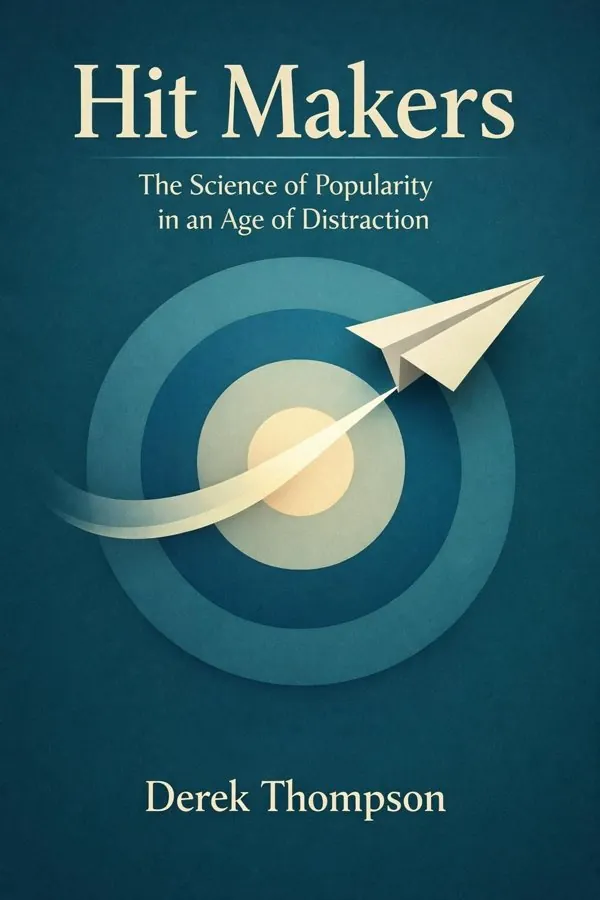
Hit Makers: The Science of Popularity in an Age of Distraction: Summary & Key Insights
 10 min9 chaptersAudio available
Key Takeaways from Hit Makers: The Science of Popularity in an Age of Distraction
We love to imagine that hits explode out of nowhere, but popularity is usually engineered long before it looks spontaneous.
People say they want novelty, but they usually choose what feels comfortably recognizable.
Originality is overrated when it ignores human behavior.
In a world obsessed with open platforms, it is easy to forget how much tastemakers still influence what becomes visible.
The modern economy is not just a market for products; it is a market for attention.
What Is Hit Makers: The Science of Popularity in an Age of Distraction About?
Hit Makers: The Science of Popularity in an Age of Distraction by Derek Thompson is a marketing book spanning 12 pages. Why do certain songs, apps, books, political messages, and brands become unavoidable while others disappear almost instantly? In Hit Makers, Derek Thompson investigates popularity not as magic, but as a pattern. Drawing from psychology, economics, media history, art, technology, and advertising, he shows that hits rarely emerge from pure randomness. Instead, they are shaped by a powerful mix of familiarity, distribution, timing, storytelling, and social influence. What feels spontaneous on the surface is often the product of deep cultural forces working behind the scenes. This book matters because we live in an age of relentless distraction, where attention is scarce and competition is brutal. Whether you are a marketer, creator, entrepreneur, executive, or simply curious about why culture spreads the way it does, Thompson offers a framework for understanding how popularity actually works. As a senior editor at The Atlantic known for covering media, business, and culture, he brings both journalistic range and analytical clarity to the subject. Hit Makers is ultimately a practical guide to understanding why people notice, share, adopt, and remember certain ideas over countless others.
This FizzRead summary covers all 9 key chapters of Hit Makers: The Science of Popularity in an Age of Distraction in approximately 10 minutes, distilling the most important ideas, arguments, and takeaways from Derek Thompson's work. Also available as an audio summary and Key Quotes Podcast.
Hit Makers: The Science of Popularity in an Age of Distraction
Why do certain songs, apps, books, political messages, and brands become unavoidable while others disappear almost instantly? In Hit Makers, Derek Thompson investigates popularity not as magic, but as a pattern. Drawing from psychology, economics, media history, art, technology, and advertising, he shows that hits rarely emerge from pure randomness. Instead, they are shaped by a powerful mix of familiarity, distribution, timing, storytelling, and social influence. What feels spontaneous on the surface is often the product of deep cultural forces working behind the scenes.
This book matters because we live in an age of relentless distraction, where attention is scarce and competition is brutal. Whether you are a marketer, creator, entrepreneur, executive, or simply curious about why culture spreads the way it does, Thompson offers a framework for understanding how popularity actually works. As a senior editor at The Atlantic known for covering media, business, and culture, he brings both journalistic range and analytical clarity to the subject. Hit Makers is ultimately a practical guide to understanding why people notice, share, adopt, and remember certain ideas over countless others.
Who Should Read Hit Makers: The Science of Popularity in an Age of Distraction?
This book is perfect for anyone interested in marketing and looking to gain actionable insights in a short read. Whether you're a student, professional, or lifelong learner, the key ideas from Hit Makers: The Science of Popularity in an Age of Distraction by Derek Thompson will help you think differently.
- ✓Readers who enjoy marketing and want practical takeaways
- ✓Professionals looking to apply new ideas to their work and life
- ✓Anyone who wants the core insights of Hit Makers: The Science of Popularity in an Age of Distraction in just 10 minutes
Want the full summary?
Get instant access to this book summary and 100K+ more with Fizz Moment.
Get Free SummaryAvailable on App Store • Free to download
Key Chapters
People say they want novelty, but they usually choose what feels comfortably recognizable. Thompson highlights the “mere exposure effect,” the psychological tendency to prefer things we have encountered before. Familiarity lowers risk. It reduces cognitive effort. It creates the reassuring sense that something belongs. This is one of the hidden foundations of popularity.
But familiarity alone does not create a hit. Audiences also crave freshness. The winning formula is often what researchers describe as “new, but not too new.” Hits tend to combine surprise with recognizability. A successful pop song may use an original hook inside a familiar song structure. A blockbuster film may present a new world through an old narrative arc. A startup may introduce a novel product category using language people already understand.
This explains why many breakthrough ideas are actually hybrids. They feel innovative without being alien. Apple did not invent every technology it popularized; it packaged technologies in forms people could immediately grasp. Streaming services, social platforms, and bestselling authors often succeed by translating the unfamiliar into familiar patterns.
For marketing, this principle is crucial. If your message is too strange, people ignore it. If it is too predictable, people forget it. Effective branding often works by anchoring a new offering in known categories: “the Netflix for...,” “the Airbnb of...,” or a product design that resembles an established habit. Familiar cues help audiences understand value quickly.
Actionable takeaway: When launching something new, wrap innovation in recognizable language, design, and structure so people can adopt it without feeling lost.
Originality is overrated when it ignores human behavior. Thompson shows that many hit makers do not succeed by inventing from scratch, but by borrowing intelligently from what already works. This is not lazy imitation. It is strategic adaptation. Cultural products spread more easily when they connect to existing tastes, formats, and expectations.
Across entertainment, business, and media, the pattern repeats. Genres develop conventions because conventions help audiences orient themselves. News formats, social media content styles, bestselling book categories, and consumer product designs all become legible through repetition. This is why so many successful creators study predecessors obsessively. They know the market rewards variation on a theme more often than total reinvention.
Yet imitation alone is never enough. Audiences do not want a carbon copy; they want a familiar frame with a memorable twist. Think of a television show that uses the classic workplace comedy format but introduces a fresh setting or emotional tone. Think of a brand that adopts a standard subscription model but differentiates through community, aesthetics, or convenience. Innovation often looks less like rupture and more like remix.
For entrepreneurs and marketers, this insight can be liberating. You do not need to be unprecedented to be valuable. Instead, ask what category rules people already understand and where a meaningful improvement can be inserted. Borrow the structure, improve the experience, sharpen the story.
Actionable takeaway: Study the patterns your audience already trusts, then create a distinct twist that feels both intuitive and unmistakably better.
In a world obsessed with open platforms, it is easy to forget how much tastemakers still influence what becomes visible. Thompson argues that gatekeepers never disappeared; they changed form. Traditional gatekeepers included radio programmers, TV executives, newspaper editors, publishers, and retailers. Today, playlists, algorithms, platform recommendation systems, curators, influencers, and major media accounts play a similar role.
Gatekeepers matter because attention is scarce. Audiences cannot evaluate everything, so they rely on filters. A Netflix homepage placement, a Spotify playlist inclusion, an Amazon ranking badge, a TikTok creator endorsement, or a respected newsletter mention can dramatically accelerate adoption. These signals reduce uncertainty and create social proof. Once something appears worthy of attention, more people are willing to sample it.
This does not mean quality is irrelevant. Rather, quality needs a pathway. A brilliant idea hidden from view usually loses to a decent idea with superior distribution. This is why many creators misdiagnose failure. They assume the product lacked merit when the real issue was discoverability.
Marketers can use this principle by identifying who or what acts as a gatekeeper in their niche. In one industry it may be review sites; in another, niche influencers; in another, app store rankings or trade publications. The goal is not only to persuade end users but also to persuade the filters that shape exposure.
Actionable takeaway: Build your launch strategy around the modern gatekeepers of your market, because distribution partners often determine whether quality ever gets a fair chance.
The modern economy is not just a market for products; it is a market for attention. Thompson emphasizes that in an age of abundance, the scarcest resource is not supply but human focus. People are flooded with content, messages, choices, and notifications. This means that every creator and company competes not only against direct rivals, but against everything else demanding the audience’s time.
This changes how hits are made. Success depends on reducing friction, creating curiosity fast, and rewarding attention quickly. Long before consumers evaluate deep value, they decide whether something deserves even a few seconds. Headlines, thumbnails, packaging, first lines, trailers, app onboarding, and visual identity all matter because they function as entry points into an overcrowded environment.
Thompson also shows that attention is not equally distributed. A small number of products often capture a disproportionate share of audience time, creating winner-take-most dynamics. This is why tiny differences in discoverability or retention can create massive gaps in outcomes.
For marketers, this means strategy must account for the full journey of attention. First, capture interest. Then sustain it. Then convert it into habit. A campaign that gets clicks but cannot hold interest is weak. A product that delights existing users but never earns trial is also weak. Hits require both attraction and retention.
Actionable takeaway: Audit every customer touchpoint through the lens of attention: what earns the first glance, what keeps people engaged, and what makes them come back again.
Ideas rarely spread person by person in a simple straight line. They travel through networks, and networks are shaped by trust, status, and social clustering. Thompson explains that popularity is deeply social. People do not adopt cultural products in isolation; they watch what peers, communities, and influential nodes are doing. A recommendation from a trusted friend or admired figure can matter far more than a generic advertisement.
This helps explain why some content performs modestly in one context and explodes in another. The same song, article, or product can thrive if it enters a highly connected community where members copy one another’s behavior. Cultural transmission is often less about reaching the largest possible audience immediately and more about reaching the right network first.
Subcultures are especially important here. Many mainstream hits begin in smaller communities that confer authenticity and momentum. Fashion trends, memes, music genres, software tools, and consumer products often move from niche to mass once a core group adopts and evangelizes them. The network acts as both testing ground and amplification engine.
For practical application, this means audience size is not the only metric that matters. Connection density, trust, and influence pathways are equally important. A smaller community with strong internal recommendation loops may outperform a broad but indifferent audience.
Actionable takeaway: Identify the communities most likely to adopt your idea early, and design campaigns that encourage trusted peer-to-peer sharing inside those networks before chasing mass reach.
Facts inform, but stories move people. Thompson shows that storytelling is not decorative; it is central to popularity. Humans are wired to remember narratives better than isolated data points because stories organize information into emotion, sequence, conflict, and resolution. A message with a strong narrative frame becomes easier to understand, repeat, and share.
This applies far beyond novels and films. Brands tell stories about identity. Politicians tell stories about national decline or renewal. Startups tell stories about a broken system and a better future. Journalists frame events through narrative arcs. Even product launches often succeed when they cast the customer as the hero overcoming a frustrating problem.
A compelling story also provides social currency. People like sharing content that makes them feel insightful, informed, amused, or emotionally connected. Narrative creates that value. Consider how much more memorable a company becomes when it has a clear origin story, a mission-driven struggle, or a vivid customer transformation. By contrast, feature lists and abstract claims are harder to spread.
For marketers, the lesson is not to fabricate drama but to clarify narrative structure. What tension does your audience feel? What obstacle stands in the way? What change becomes possible with your product, message, or idea? The strongest campaigns are often those that translate complex value into a human journey.
Actionable takeaway: Reframe your message as a story with a problem, a turning point, and a meaningful outcome so audiences can remember it and retell it easily.
A brilliant idea can fail simply because it arrives too early, too late, or in the wrong cultural mood. Thompson stresses that timing is not a minor variable but one of the decisive ingredients of popularity. Markets, audiences, and technologies are always changing, and a hit often occurs when a product or message aligns with a moment of readiness.
Context shapes receptivity. A political slogan lands differently during prosperity than during crisis. A media format thrives when technology makes it easy to access. A fashion trend can feel perfectly timed when it matches a generation’s identity. Sometimes the exact same idea that was ignored years earlier succeeds later because surrounding conditions have changed.
This perspective helps explain why predicting hits is so difficult. Quality matters, but readiness matters too. The public must be prepared to understand and desire the thing being offered. This is why “first mover advantage” is often exaggerated. Being first can be a disadvantage if the audience, infrastructure, or culture has not matured enough to support adoption.
For businesses, timing should influence both product development and launch strategy. Watch for shifts in consumer behavior, regulation, technology, and sentiment. Ask not only whether your idea is good, but whether the market is prepared to embrace it now. In some cases, the right move is acceleration; in others, patience.
Actionable takeaway: Evaluate your idea against the current cultural and technological moment, and adjust launch timing to when audience readiness is strongest rather than merely when your internal schedule says go.
Everyone wants a formula for guaranteed success, but Thompson’s deeper conclusion is more subtle: hits can be studied, influenced, and improved, yet never fully predicted. Popularity emerges from an interaction between psychology, social networks, distribution, timing, and luck. This means there are patterns, but no foolproof recipe.
The practical value of the book lies in replacing superstition with better odds. Rather than searching for certainty, hit makers design conditions that increase the likelihood of adoption. They test messages, refine packaging, learn from audience behavior, build distribution channels, and improve retention. They respect uncertainty without surrendering to it.
This is especially important in a fragmented digital landscape where trends move quickly and audience attention is splintered across platforms. Rigid prediction models often fail because culture is dynamic. What works is adaptive learning. Smart creators observe signals early, iterate fast, and remain sensitive to how audiences actually respond rather than how they hope audiences will respond.
For marketers and creators, this mindset encourages discipline over mythology. Use data, but do not worship it. Study past hits, but do not simply copy them. Build systems for experimentation, because repeated testing often reveals what abstract theorizing misses. The goal is not to control culture completely, but to work skillfully with its patterns.
Actionable takeaway: Treat popularity as a probability game—use research, testing, and distribution strategy to improve your chances, while staying flexible enough to adapt when the audience surprises you.
All Chapters in Hit Makers: The Science of Popularity in an Age of Distraction
About the Author
Derek Thompson is an American journalist, author, and commentator known for his sharp analysis of media, economics, technology, and culture. He rose to prominence as a senior editor at The Atlantic, where he wrote widely read pieces on how modern life is shaped by business models, consumer behavior, attention, and social change. Thompson is especially skilled at translating complex research into engaging, accessible narratives for a broad audience. His work often connects data with everyday experience, making abstract trends feel concrete and relevant. In Hit Makers, he applies that talent to the question of popularity, examining why certain ideas and products capture mass attention. He is also a frequent podcast guest and public speaker, recognized for his ability to explain the hidden forces behind contemporary culture and markets.
Get This Summary in Your Preferred Format
Read or listen to the Hit Makers: The Science of Popularity in an Age of Distraction summary by Derek Thompson anytime, anywhere. FizzRead offers multiple formats so you can learn on your terms — all free.
Available formats: App · Audio · PDF · EPUB — All included free with FizzRead
Download Hit Makers: The Science of Popularity in an Age of Distraction PDF and EPUB Summary
Key Quotes from Hit Makers: The Science of Popularity in an Age of Distraction
“We love to imagine that hits explode out of nowhere, but popularity is usually engineered long before it looks spontaneous.”
“People say they want novelty, but they usually choose what feels comfortably recognizable.”
“Originality is overrated when it ignores human behavior.”
“In a world obsessed with open platforms, it is easy to forget how much tastemakers still influence what becomes visible.”
“The modern economy is not just a market for products; it is a market for attention.”
Frequently Asked Questions about Hit Makers: The Science of Popularity in an Age of Distraction
Hit Makers: The Science of Popularity in an Age of Distraction by Derek Thompson is a marketing book that explores key ideas across 9 chapters. Why do certain songs, apps, books, political messages, and brands become unavoidable while others disappear almost instantly? In Hit Makers, Derek Thompson investigates popularity not as magic, but as a pattern. Drawing from psychology, economics, media history, art, technology, and advertising, he shows that hits rarely emerge from pure randomness. Instead, they are shaped by a powerful mix of familiarity, distribution, timing, storytelling, and social influence. What feels spontaneous on the surface is often the product of deep cultural forces working behind the scenes. This book matters because we live in an age of relentless distraction, where attention is scarce and competition is brutal. Whether you are a marketer, creator, entrepreneur, executive, or simply curious about why culture spreads the way it does, Thompson offers a framework for understanding how popularity actually works. As a senior editor at The Atlantic known for covering media, business, and culture, he brings both journalistic range and analytical clarity to the subject. Hit Makers is ultimately a practical guide to understanding why people notice, share, adopt, and remember certain ideas over countless others.
More by Derek Thompson

You Might Also Like
Captivology: The Science of Capturing People's Attention
Ben Parr
10 min
Marketing 5.0: Technology for Humanity
Philip Kotler, Hermawan Kartajaya, Iwan Setiawan
10 min
Marketing Strategy
Paul Fifield
10 min
UnMarketing: Stop Marketing. Start Engaging.
Scott Stratten
10 min
$100M Leads: How to Get Strangers to Want to Buy Your Stuff
Alex Hormozi
10 min
80/20 Sales and Marketing: The Definitive Guide to Working Less and Making More
Perry Marshall
10 minBrowse by Category
Ready to read Hit Makers: The Science of Popularity in an Age of Distraction?
Get the full summary and 100K+ more books with Fizz Moment.