
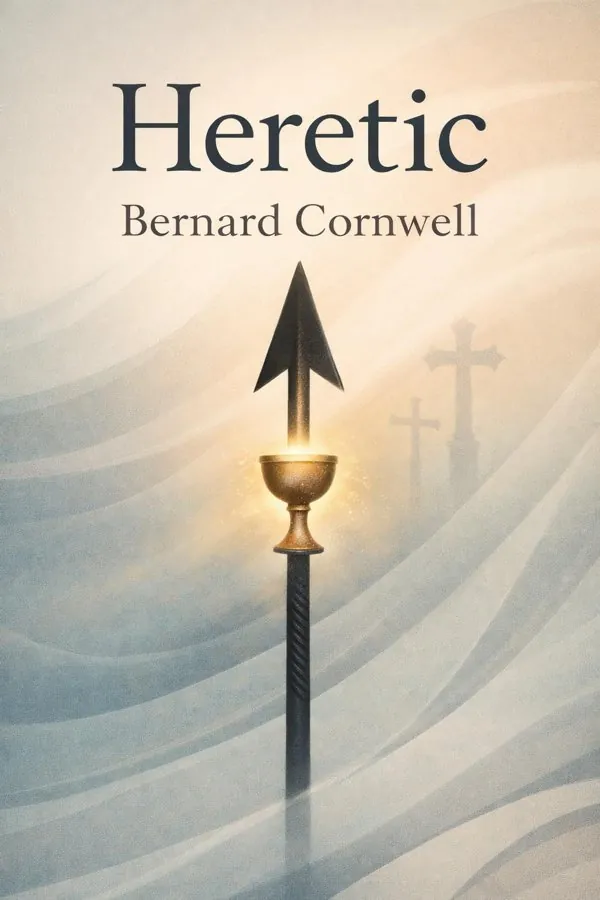
Heretic: Summary & Key Insights
 10 min9 chaptersAudio available
Key Takeaways from Heretic
War strips away illusion faster than almost anything else.
What society condemns as dangerous often reveals what it is most afraid to question.
Civilization often hides its brutality behind stone walls.
Some enemies are dangerous not because they are stronger, but because they make hatred into a vocation.
People rarely pursue sacred objects for purely sacred reasons.
What Is Heretic About?
Heretic by Bernard Cornwell is a war_military book spanning 4 pages. Heretic is the third novel in Bernard Cornwell’s The Grail Quest series, and it stands at the point where battlefield adventure deepens into something darker and more searching. Set during the Hundred Years’ War, the novel follows Thomas of Hookton, an English archer hardened by violence and driven by a personal quest tied to the Holy Grail. What begins as a military tale soon becomes a broader exploration of belief, power, love, and the uses of religion in a fractured medieval world. As Thomas moves through Gascony and into Languedoc, he encounters sieges, betrayals, fanatics, and a woman condemned as a heretic whose presence forces him to question everything he has been taught. The novel matters because it does more than recreate medieval warfare with visceral intensity; it asks why people kill for faith, why institutions fear dissent, and how individuals preserve conscience in brutal times. Bernard Cornwell is uniquely qualified to tell this story. Renowned for his meticulous research and his unmatched ability to animate historical combat, he combines authenticity, pace, and psychological depth to make Heretic both an exciting war novel and a powerful meditation on truth.
This FizzRead summary covers all 9 key chapters of Heretic in approximately 10 minutes, distilling the most important ideas, arguments, and takeaways from Bernard Cornwell's work. Also available as an audio summary and Key Quotes Podcast.
Heretic
Heretic is the third novel in Bernard Cornwell’s The Grail Quest series, and it stands at the point where battlefield adventure deepens into something darker and more searching. Set during the Hundred Years’ War, the novel follows Thomas of Hookton, an English archer hardened by violence and driven by a personal quest tied to the Holy Grail. What begins as a military tale soon becomes a broader exploration of belief, power, love, and the uses of religion in a fractured medieval world. As Thomas moves through Gascony and into Languedoc, he encounters sieges, betrayals, fanatics, and a woman condemned as a heretic whose presence forces him to question everything he has been taught. The novel matters because it does more than recreate medieval warfare with visceral intensity; it asks why people kill for faith, why institutions fear dissent, and how individuals preserve conscience in brutal times. Bernard Cornwell is uniquely qualified to tell this story. Renowned for his meticulous research and his unmatched ability to animate historical combat, he combines authenticity, pace, and psychological depth to make Heretic both an exciting war novel and a powerful meditation on truth.
Who Should Read Heretic?
This book is perfect for anyone interested in war_military and looking to gain actionable insights in a short read. Whether you're a student, professional, or lifelong learner, the key ideas from Heretic by Bernard Cornwell will help you think differently.
- ✓Readers who enjoy war_military and want practical takeaways
- ✓Professionals looking to apply new ideas to their work and life
- ✓Anyone who wants the core insights of Heretic in just 10 minutes
Want the full summary?
Get instant access to this book summary and 100K+ more with Fizz Moment.
Get Free SummaryAvailable on App Store • Free to download
Key Chapters
War strips away illusion faster than almost anything else. In Heretic, Bernard Cornwell opens in Gascony, a land scorched by the long conflict between England and France, and he uses this setting to show how Thomas of Hookton has changed from a talented archer into a scarred, disciplined survivor. Gascony is not just a backdrop for action; it is a place where loyalty is unstable, violence is routine, and every village bears the marks of political struggle. Through Thomas’s eyes, we see that medieval warfare is not glorious pageantry but exhaustion, fear, and opportunism.
Thomas’s growth matters because he is no longer driven only by revenge or duty. He now carries a deeper burden: a search for meaning in a world where courage does not always lead to justice. Cornwell uses skirmishes, raids, and military tension to reveal Thomas’s practical intelligence. He reads terrain, senses danger, and understands the morale of fighting men. These details make the novel feel grounded, but they also show that survival depends on observation as much as strength.
A practical lesson emerges from this opening. People often imagine that character is formed in moments of triumph, but Cornwell suggests it is formed in prolonged hardship. Thomas survives because he adapts without surrendering his core purpose. Modern readers can apply this idea in less dramatic settings: during workplace instability, personal loss, or prolonged uncertainty, resilience comes from balancing flexibility with conviction.
The beginning of Heretic reminds us that the environments we endure reshape us. Pay attention to what your battles are teaching you, and choose which parts of yourself you refuse to let the fire consume.
What society condemns as dangerous often reveals what it is most afraid to question. One of the novel’s most compelling threads is Thomas’s encounter with Genevieve, a woman accused of heresy and linked to beliefs that echo the destroyed Cathar tradition of southern France. She is not presented merely as a romantic interest or a symbolic victim. Instead, she becomes a challenge to the entire religious and social order that Thomas has inherited.
Through Genevieve, Cornwell explores the political nature of faith. Heresy in the novel is not simply theological error; it is a label used to isolate, punish, and erase those who threaten established authority. Genevieve’s independence, intelligence, and spiritual difference make her vulnerable in a world where the Church claims moral supremacy while often acting from fear and control. Thomas is drawn to her not only personally, but morally. In defending her, he begins to see that official religion and spiritual truth are not always the same.
This idea remains strikingly relevant. In any era, institutions may frame dissent as disorder. Whether in religion, politics, or organizations, people who ask uncomfortable questions are often treated as threats before they are heard. Genevieve represents the human cost of that reflex. She also demonstrates the strength required to hold to a truth that offers no safety.
Readers can take from this a practical challenge: examine where labels are being used to silence rather than clarify. When someone is dismissed as dangerous, unorthodox, or disloyal, ask who benefits from that judgment. Courage sometimes begins with listening to the person everyone else has already condemned.
Civilization often hides its brutality behind stone walls. In Heretic, Cornwell’s treatment of castles, sieges, and fortified places reveals that architecture is never just physical. Fortresses are expressions of power. They define who belongs inside, who is excluded, and how authority protects itself. As Thomas moves through contested territory, walls and towers repeatedly become symbols of fear, ambition, and control.
Cornwell is especially strong in showing how military technology and psychology interact. A fortress can repel an army, but it can also trap the people within it. Siege warfare in the novel is patient, cruel, and deeply strategic. Supply lines matter. Morale matters. Deception matters. Thomas and his companions must think not only like fighters but like planners. This makes the war feel less like a chain of heroic duels and more like a chess game conducted with hunger, arrows, and terror.
On a deeper level, the fortresses in Heretic mirror the ideological walls built by churchmen and nobles. Both kinds of walls are meant to preserve order, but both can become prisons. Cornwell suggests that institutions defend themselves in the same way castles do: by narrowing access, punishing intrusion, and turning fear into policy.
Modern readers can see the same pattern in organizations that become rigid under pressure. Rules meant to provide security can become barriers to truth, innovation, or compassion. The lesson is not that structure is bad, but that defensive systems need constant scrutiny.
When you encounter a stronghold, whether physical, cultural, or institutional, ask what it protects, whom it excludes, and whether its security has begun to serve power more than justice.
Some enemies are dangerous not because they are stronger, but because they make hatred into a vocation. In Heretic, Guy Vexille remains one of Thomas of Hookton’s most personal and relentless adversaries. He is more than a villain inserted to heighten suspense. He embodies the long memory of grievance, the way old wounds can harden into identity and drive people to acts that outlast reason.
Cornwell uses the conflict between Thomas and Vexille to give the novel emotional continuity across the series. Their feud is rooted in family, humiliation, violence, and competing claims over sacred and worldly power. Vexille’s menace lies in his refusal to let the past stay buried. He transforms injury into obsession, and obsession into action. This makes every encounter with him feel charged with history.
The practical importance of this theme is easy to miss if we focus only on the swordplay. Cornwell is showing that unresolved hatred expands. It recruits allies, distorts judgment, and turns every new situation into another theater for an old war. Vexille does not merely oppose Thomas’s goals; he tries to define Thomas’s life through enmity.
This dynamic appears far beyond fiction. In families, companies, and politics, individuals often repeat conflicts long after the original cause has faded. The result is wasted energy and needless destruction. Heretic does not suggest that evil should be ignored, but it does reveal the cost of allowing revenge to become your organizing principle.
The actionable lesson is clear: identify the grudges that are shaping your decisions. If an old injury is still dictating your present, confront it directly before it turns your future into a battlefield you never meant to inhabit.
People rarely pursue sacred objects for purely sacred reasons. In Heretic, the search for the Holy Grail continues to drive the plot, but Cornwell treats the Grail less as a simple treasure and more as a mirror for human desire. For some, it promises divine favor. For others, legitimacy, wealth, political leverage, or personal vindication. The Grail matters not only because of what it may be, but because of what people imagine it can do for them.
This ambiguity is one of the novel’s greatest strengths. Cornwell resists reducing the Grail to either unquestioned miracle or complete fraud. Instead, he shows how belief itself creates power. If enough people think an object carries heaven’s authority, then armies may move, priests may lie, and desperate men may kill to possess it. Thomas’s relationship to the Grail is especially complex because his quest is bound to family legacy, faith, and the need to make sense of suffering.
The broader insight is that symbols become dangerous when people stop seeing their own motives inside them. Whether the object is a relic, title, ideology, or corporate mission, we often project purity onto things that are carrying our ambition. Cornwell asks readers to look not only at what is sought, but why it is sought.
In practical terms, this applies to any high-stakes goal. Before chasing prestige, certainty, or a supposedly life-changing prize, pause and ask what need the goal is really serving. Is it purpose, ego, belonging, or fear?
Heretic teaches that the thing you seek may matter less than the hunger driving you toward it. Clarify your desire before you let it rule your choices.
The most unsettling religious stories are often the ones that separate faith from the institutions claiming to guard it. Heretic repeatedly returns to this divide. Cornwell does not mock belief; in fact, he takes spiritual longing very seriously. What he questions is the machinery of religious authority when it becomes entangled with coercion, money, punishment, and political convenience.
Clergy and noble patrons in the novel often use sacred language to justify worldly aims. Charges of heresy can eliminate rivals. Relics can inspire loyalty. Ritual can sanctify violence. Yet amid this corruption, genuine faith still exists. Thomas’s struggle is compelling because he is neither cynic nor unquestioning believer. He is trying to discern whether truth can survive inside systems that so often exploit it.
That tension gives the novel unusual depth for historical adventure fiction. Cornwell shows that religion can console the wounded, bind communities, and offer moral courage. But the same structures can become ruthless when protecting their own authority. The conflict is not between belief and unbelief; it is between living conviction and institutional self-preservation.
Readers can apply this lens broadly. Every institution, religious or secular, risks confusing its survival with its mission. Schools, nonprofits, governments, and businesses all develop rituals, hierarchies, and orthodoxies. The challenge is to keep asking whether these serve the original purpose or merely defend the people at the top.
The takeaway is practical and urgent: respect the power of faith and shared ideals, but never stop examining the systems that claim exclusive ownership over them. Truth deserves loyalty; institutions deserve scrutiny.
In violent times, tenderness becomes a form of resistance. One of the most human dimensions of Heretic is the way Cornwell ties large historical forces to intimate choices. Thomas is surrounded by warlords, priests, mercenaries, and enemies, yet his most meaningful decisions often revolve around loyalty, love, and the protection of specific people. This keeps the novel from becoming a purely strategic or ideological narrative.
His relationship with Genevieve is central here, but the theme extends beyond romance. Friendship among soldiers, obligations to companions, and acts of personal trust all shape the story’s moral landscape. Cornwell suggests that in a world of shifting alliances, private loyalty may be more honorable than public declarations. This is not sentimental idealism. Personal bonds in the novel are dangerous. They expose weakness, complicate plans, and force Thomas to risk more than survival.
That is precisely the point. Moral life is tested when affection collides with convenience. It is easy to talk about values in the abstract. It is much harder to defend someone when doing so threatens your status, safety, or objective. Thomas’s choices reveal that character is measured not only by bravery in battle but by whom you refuse to abandon.
In modern life, the same principle appears whenever loyalty has a cost: standing by a colleague under unfair attack, caring for family through hardship, or protecting someone whose reputation has been damaged by rumor.
The lesson is simple but demanding. Decide in advance what kind of loyalty you believe in, because when pressure comes, you will act according to habits already formed. Love becomes meaningful when it survives inconvenience.
History becomes memorable when it feels lived rather than summarized. One reason Heretic is so powerful is Bernard Cornwell’s ability to render medieval warfare with tactile realism. He pays close attention to longbows, armor, horse movement, castle layouts, weather, terrain, and the emotional rhythm of combat. This creates excitement, but more importantly, it restores consequences to violence.
Battles in the novel are not abstract demonstrations of courage. They involve confusion, noise, miscalculation, terror, and luck. Men die from small errors. Leaders depend on information they may not have. Archers matter because training, range, discipline, and timing matter. Cornwell’s research gives the book authority, yet he never lets detail become inert exposition. Technical facts are always tied to decision-making.
For readers, this realism offers a useful model of how expertise works. True mastery combines knowledge with timing under pressure. Thomas is effective not because he is invulnerable, but because he knows his craft and can apply it amid chaos. That principle carries into modern professions. In medicine, law, engineering, sports, or management, performance depends on translating preparation into action when conditions are imperfect.
Cornwell also reminds us that glamour often enters history after suffering has been edited out. By restoring pain and uncertainty, he makes bravery more meaningful. Courage is not the absence of fear; it is skilled action despite fear.
An actionable takeaway follows: if you want to be dependable in high-pressure moments, train with specificity. Study your tools, understand the environment, and rehearse under realistic conditions. Competence becomes visible when circumstances stop being kind.
The deepest heresy in any age may be the refusal to accept easy certainty. Beneath its battles and quests, Heretic is ultimately about the search for truth in a world crowded with competing claims. Priests assert doctrine, nobles assert lineage, warriors assert strength, and legends assert destiny. Thomas moves through all of these without finding a stable authority he can wholly trust.
What makes him compelling is not that he has perfect answers, but that experience forces him into a more difficult kind of honesty. He sees hypocrisy in the Church, brutality in war, and selfishness in men who speak the language of honor. Yet he also sees courage, devotion, and real yearning for God. The world of the novel is morally mixed, and Cornwell refuses to simplify it. This is why the title Heretic resonates beyond religious accusation. To think independently, to compare claim against evidence, and to hold complexity without surrendering to despair is itself a kind of rebellion.
This theme gives the novel lasting relevance. We live amid our own flood of authority, ideology, and emotional manipulation. The temptation is always to choose the story that feels most reassuring. Cornwell points another way: remain open, remain observant, and let truth emerge through testing rather than submission.
A practical application is straightforward. When facing strong claims, ask three questions: who benefits, what evidence supports this, and what contradictions are being ignored? Those habits do not make life simpler, but they make judgment stronger.
Heretic leaves readers with a demanding but liberating lesson: truth rarely belongs to the loudest voice. It is found by those willing to keep questioning, even when questioning carries a cost.
All Chapters in Heretic
About the Author
Bernard Cornwell is a British historical novelist widely regarded as one of the finest writers of action-driven historical fiction. Born in London in 1944, he built his reputation through bestselling series such as Sharpe, The Saxon Stories, and The Grail Quest. His novels are known for meticulous research, vivid period detail, and battle scenes that feel both immediate and believable. Cornwell has a particular gift for placing fictional protagonists inside real historical conflicts, allowing readers to experience the past at ground level through war, politics, and personal struggle. His work has reached a global audience and influenced modern historical fiction through its blend of scholarship and storytelling. In books like Heretic, he combines military realism with moral complexity, making history feel urgent, human, and alive.
Get This Summary in Your Preferred Format
Read or listen to the Heretic summary by Bernard Cornwell anytime, anywhere. FizzRead offers multiple formats so you can learn on your terms — all free.
Available formats: App · Audio · PDF · EPUB — All included free with FizzRead
Download Heretic PDF and EPUB Summary
Key Quotes from Heretic
“War strips away illusion faster than almost anything else.”
“What society condemns as dangerous often reveals what it is most afraid to question.”
“Civilization often hides its brutality behind stone walls.”
“Some enemies are dangerous not because they are stronger, but because they make hatred into a vocation.”
“People rarely pursue sacred objects for purely sacred reasons.”
Frequently Asked Questions about Heretic
Heretic by Bernard Cornwell is a war_military book that explores key ideas across 9 chapters. Heretic is the third novel in Bernard Cornwell’s The Grail Quest series, and it stands at the point where battlefield adventure deepens into something darker and more searching. Set during the Hundred Years’ War, the novel follows Thomas of Hookton, an English archer hardened by violence and driven by a personal quest tied to the Holy Grail. What begins as a military tale soon becomes a broader exploration of belief, power, love, and the uses of religion in a fractured medieval world. As Thomas moves through Gascony and into Languedoc, he encounters sieges, betrayals, fanatics, and a woman condemned as a heretic whose presence forces him to question everything he has been taught. The novel matters because it does more than recreate medieval warfare with visceral intensity; it asks why people kill for faith, why institutions fear dissent, and how individuals preserve conscience in brutal times. Bernard Cornwell is uniquely qualified to tell this story. Renowned for his meticulous research and his unmatched ability to animate historical combat, he combines authenticity, pace, and psychological depth to make Heretic both an exciting war novel and a powerful meditation on truth.
You Might Also Like

Patriot
Andrew Britton
10 min
War
John Hersey
10 min
An Army at Dawn: The War in North Africa, 1942–1943
Rick Atkinson
10 min
Brave New War: The Next Stage of Terrorism and the End of Globalization
John Robb
10 min
Catch-22
Joseph Heller
10 min
Command and Control: Nuclear Weapons, the Damascus Accident, and the Illusion of Safety
Eric Schlosser
10 minBrowse by Category
Ready to read Heretic?
Get the full summary and 100K+ more books with Fizz Moment.