
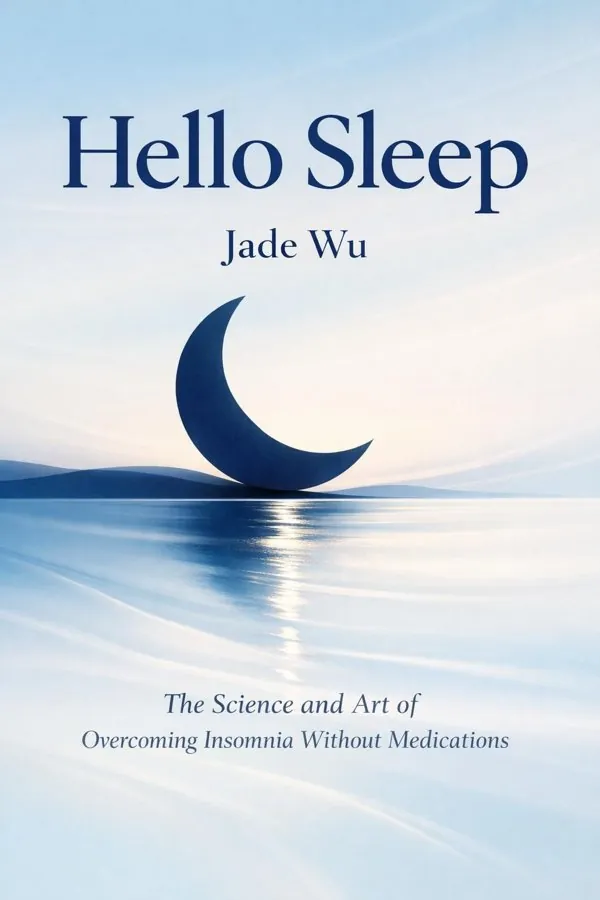
Hello Sleep: The Science and Art of Overcoming Insomnia Without Medications: Summary & Key Insights
by Jade Wu
 10 min11 chaptersAudio available
What Is Hello Sleep: The Science and Art of Overcoming Insomnia Without Medications About?
Hello Sleep: The Science and Art of Overcoming Insomnia Without Medications by Jade Wu is a health_med book spanning 11 pages. Hello Sleep is a practical and compassionate guide to repairing your relationship with sleep. Written by Dr. Jade Wu, a behavioral sleep medicine specialist, the book combines scientific insights and therapeutic strategies to help readers overcome insomnia without relying on medication. It emphasizes understanding the natural rhythms of sleep, addressing anxiety around sleeplessness, and building sustainable habits for restful nights.
This FizzRead summary covers all 11 key chapters of Hello Sleep: The Science and Art of Overcoming Insomnia Without Medications in approximately 10 minutes, distilling the most important ideas, arguments, and takeaways from Jade Wu's work. Also available as an audio summary and Key Quotes Podcast.
Hello Sleep: The Science and Art of Overcoming Insomnia Without Medications
Hello Sleep is a practical and compassionate guide to repairing your relationship with sleep. Written by Dr. Jade Wu, a behavioral sleep medicine specialist, the book combines scientific insights and therapeutic strategies to help readers overcome insomnia without relying on medication. It emphasizes understanding the natural rhythms of sleep, addressing anxiety around sleeplessness, and building sustainable habits for restful nights.
Who Should Read Hello Sleep: The Science and Art of Overcoming Insomnia Without Medications?
This book is perfect for anyone interested in health_med and looking to gain actionable insights in a short read. Whether you're a student, professional, or lifelong learner, the key ideas from Hello Sleep: The Science and Art of Overcoming Insomnia Without Medications by Jade Wu will help you think differently.
- ✓Readers who enjoy health_med and want practical takeaways
- ✓Professionals looking to apply new ideas to their work and life
- ✓Anyone who wants the core insights of Hello Sleep: The Science and Art of Overcoming Insomnia Without Medications in just 10 minutes
Want the full summary?
Get instant access to this book summary and 100K+ more with Fizz Moment.
Get Free SummaryAvailable on App Store • Free to download
Key Chapters
To heal your sleep, you must first understand it. Sleep is not a passive shutdown but an active, rhythmic dance performed by your brain and body. Every 24 hours, your circadian rhythm—the internal clock in your hypothalamus—directs temperature, hormones, and energy levels to prepare you for waking and sleeping. Meanwhile, another force, called the sleep drive, accumulates throughout the day, like sand filling a jar. The longer you’re awake, the more that drive builds; when you finally rest, it empties again.
But when people struggle with insomnia, this natural rhythm goes out of tune. Often it isn’t the biology that’s broken but the relationship you have with that biology. Staying in bed while anxious, clock-watching, or napping irregularly confuses the brain about when it’s supposed to be awake or asleep. Understanding that sleep thrives on consistency—on giving the body clear signals about timing and safety—is the first step to restoring your rhythm.
I often remind my patients: sleep is not commanded; it is allowed. Your job is not to force it but to create the conditions in which it can unfold. By learning to align your daily schedule, light exposure, and behaviors with your internal clock, you give your brain the cues it needs to rest naturally. The body wants equilibrium; we simply have to stop fighting it.
Insomnia rarely begins out of nowhere. Often there’s a trigger—a stressful week, illness, a major life change—that temporarily disrupts sleep. For most people, the body recovers. But for others, that disruption sets off a cycle. You start worrying about not sleeping. You stay in bed longer to ‘catch up.’ You check the clock at 2 AM. Each of these efforts, meant to fix the problem, actually fuels it. The bedroom becomes a place of wakefulness and tension. The result is a learned association: bed equals struggle.
In sleep science, we call this the cycle of hyperarousal. The fear of not sleeping activates stress hormones like cortisol, making you more alert exactly when you want to wind down. Over time, the brain learns to stay on guard in the very context where it should relax. That is why insomnia feels self-sustaining: anxiety feeds wakefulness, which feeds more anxiety.
Breaking this cycle begins with recognition. You are not failing to sleep; your brain is simply doing its job of protecting you from perceived threats. The key is to retrain it—to teach it that the bed is once again a safe, restful place. When you understand this, you stop blaming yourself and start working with your biology instead of against it.
+ 9 more chapters — available in the FizzRead app
All Chapters in Hello Sleep: The Science and Art of Overcoming Insomnia Without Medications
About the Author
Dr. Jade Wu is a clinical psychologist and behavioral sleep medicine specialist. She earned her Ph.D. in clinical psychology from Boston University and completed her fellowship at Duke University School of Medicine. Her research and clinical work focus on sleep disorders, circadian rhythms, and the intersection of mental health and sleep.
Get This Summary in Your Preferred Format
Read or listen to the Hello Sleep: The Science and Art of Overcoming Insomnia Without Medications summary by Jade Wu anytime, anywhere. FizzRead offers multiple formats so you can learn on your terms — all free.
Available formats: App · Audio · PDF · EPUB — All included free with FizzRead
Download Hello Sleep: The Science and Art of Overcoming Insomnia Without Medications PDF and EPUB Summary
Key Quotes from Hello Sleep: The Science and Art of Overcoming Insomnia Without Medications
“To heal your sleep, you must first understand it.”
“Often there’s a trigger—a stressful week, illness, a major life change—that temporarily disrupts sleep.”
Frequently Asked Questions about Hello Sleep: The Science and Art of Overcoming Insomnia Without Medications
Hello Sleep: The Science and Art of Overcoming Insomnia Without Medications by Jade Wu is a health_med book that explores key ideas across 11 chapters. Hello Sleep is a practical and compassionate guide to repairing your relationship with sleep. Written by Dr. Jade Wu, a behavioral sleep medicine specialist, the book combines scientific insights and therapeutic strategies to help readers overcome insomnia without relying on medication. It emphasizes understanding the natural rhythms of sleep, addressing anxiety around sleeplessness, and building sustainable habits for restful nights.
You Might Also Like
On Immunity
Eula Biss
10 min
The Three-Body Problem
Liu Cixin
10 min
Community Health Volunteer Toolkit: Training and Practical Activities
World Health Organization
10 min
Healing Back Pain: The Mind-Body Connection
John E. Sarno
10 min
Health Literacy for All: Practical Guides to Communicate Health Information (Compilations)
World Health Organization
10 min
The Complete Guide to Sports Supplements: An Evidence-Based Review
Anita Bean
10 minBrowse by Category
Ready to read Hello Sleep: The Science and Art of Overcoming Insomnia Without Medications?
Get the full summary and 100K+ more books with Fizz Moment.