
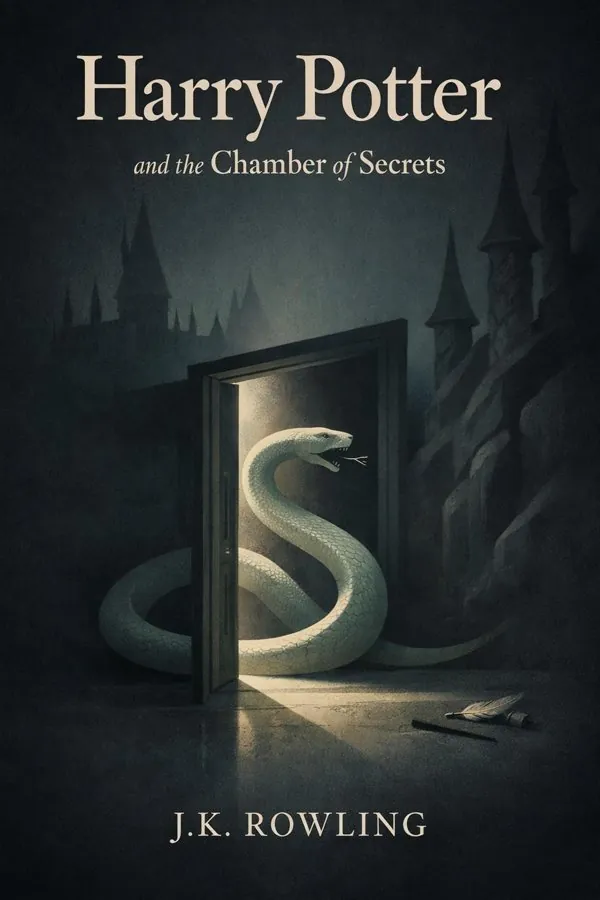
Harry Potter and the Chamber of Secrets: Summary & Key Insights
by J.K. Rowling
 10 min9 chaptersAudio available
Key Takeaways from Harry Potter and the Chamber of Secrets
Fear often arrives before danger does.
The first sign that a year will test you is often absurd rather than dramatic.
One of the book’s deepest questions is whether who we are is determined by what we inherit or by what we choose.
Courage is rarely a solo performance.
Mysteries are solved not by dramatic genius but by sustained attention.
What Is Harry Potter and the Chamber of Secrets About?
Harry Potter and the Chamber of Secrets by J.K. Rowling is a bestsellers book spanning 5 pages. Harry Potter and the Chamber of Secrets is the second novel in J.K. Rowling’s landmark fantasy series, and it deepens the wonder of Hogwarts by pairing enchantment with genuine menace. Harry returns to school expecting friendship, classes, and adventure, but the year quickly turns dark when a hidden chamber is said to have been opened and students begin turning up petrified. As fear spreads through the castle, Harry, Ron, and Hermione must untangle a mystery rooted in Hogwarts’ past, prejudice within the wizarding world, and a sinister force determined to act through the shadows. What makes this book so memorable is not just its suspense, but the way it expands the moral scope of the series. Rowling explores identity, courage, loyalty, and the dangers of judging people by lineage or reputation. She also sharpens the emotional stakes: Harry is no longer simply discovering magic, but learning that power, choice, and truth often come wrapped in confusion and fear. Rowling’s authority comes from her rare ability to blend page-turning plot, unforgettable world-building, and emotional clarity into a story that speaks to both young and adult readers.
This FizzRead summary covers all 9 key chapters of Harry Potter and the Chamber of Secrets in approximately 10 minutes, distilling the most important ideas, arguments, and takeaways from J.K. Rowling's work. Also available as an audio summary and Key Quotes Podcast.
Harry Potter and the Chamber of Secrets
Harry Potter and the Chamber of Secrets is the second novel in J.K. Rowling’s landmark fantasy series, and it deepens the wonder of Hogwarts by pairing enchantment with genuine menace. Harry returns to school expecting friendship, classes, and adventure, but the year quickly turns dark when a hidden chamber is said to have been opened and students begin turning up petrified. As fear spreads through the castle, Harry, Ron, and Hermione must untangle a mystery rooted in Hogwarts’ past, prejudice within the wizarding world, and a sinister force determined to act through the shadows. What makes this book so memorable is not just its suspense, but the way it expands the moral scope of the series. Rowling explores identity, courage, loyalty, and the dangers of judging people by lineage or reputation. She also sharpens the emotional stakes: Harry is no longer simply discovering magic, but learning that power, choice, and truth often come wrapped in confusion and fear. Rowling’s authority comes from her rare ability to blend page-turning plot, unforgettable world-building, and emotional clarity into a story that speaks to both young and adult readers.
Who Should Read Harry Potter and the Chamber of Secrets?
This book is perfect for anyone interested in bestsellers and looking to gain actionable insights in a short read. Whether you're a student, professional, or lifelong learner, the key ideas from Harry Potter and the Chamber of Secrets by J.K. Rowling will help you think differently.
- ✓Readers who enjoy bestsellers and want practical takeaways
- ✓Professionals looking to apply new ideas to their work and life
- ✓Anyone who wants the core insights of Harry Potter and the Chamber of Secrets in just 10 minutes
Want the full summary?
Get instant access to this book summary and 100K+ more with Fizz Moment.
Get Free SummaryAvailable on App Store • Free to download
Key Chapters
Fear often arrives before danger does. At the start of Harry’s second year, the story opens not with wonder but with confinement, as he spends a miserable summer isolated in the Dursleys’ house, cut off from his friends and from the magical world where he truly belongs. This emotional setup matters because it reminds us that external adventure means more when we first understand internal loneliness. Harry’s hunger for connection makes the sudden arrival of Dobby the house-elf especially powerful. Dobby warns Harry not to return to Hogwarts, insisting terrible things will happen if he does. The warning introduces a central tension in the book: when should we listen to fear, and when must we move forward despite it? Harry’s answer comes through action. Even after Dobby sabotages his summer and causes chaos, Harry still chooses the path that leads back to meaning, friendship, and danger. Then comes one of the novel’s most joyful reversals: Ron, Fred, and George arrive in the flying Ford Anglia to rescue Harry from privation and passivity. Rowling turns rescue into a statement about chosen family. The Weasleys do not merely save Harry physically; they restore his sense of belonging. In practical terms, this opening reflects a familiar truth: difficult environments can distort our judgment, and caring people can help us recover perspective. Warnings are valuable, but they should not automatically govern our choices. The key is to weigh fear against purpose. Harry’s decision to return to Hogwarts shows that growth often requires us to step back into uncertain places because the alternative is to let isolation make decisions for us. Actionable takeaway: when fear tells you to retreat, ask whether it is protecting you from harm or preventing you from living fully, then seek wise support before choosing your path.
The first sign that a year will test you is often absurd rather than dramatic. When Harry and Ron are mysteriously blocked from entering Platform Nine and Three-Quarters, the scene initially feels comic, almost like a mishap caused by poor timing and adolescent panic. Yet their reckless decision to fly the enchanted car to Hogwarts sets the tone for the book: ordinary rules are failing, hidden interference is at work, and impulsive choices can produce lasting consequences. Rowling uses this episode to show how confusion can lead people into avoidable mistakes. Harry and Ron are not malicious; they are anxious, pressed for time, and afraid of being left behind. That emotional cocktail is familiar in real life. We often make poor decisions not because we lack values, but because urgency narrows our thinking. Once they arrive, the mystery deepens quickly. Strange messages appear on the walls, Mrs. Norris is petrified, and whispers of “the Chamber of Secrets” spread through Hogwarts. The school, which once represented safety and discovery, becomes an arena of suspicion. Rowling is especially effective here because she layers the mystery through institutional fragility: teachers do not have clear answers, rumors multiply, and history suddenly feels dangerous rather than decorative. The chamber itself functions as a symbol for buried truths. Every community has stories it half-remembers and prejudices it leaves unexamined, and those unresolved legacies can shape present fear. The novel suggests that when systems fail to explain what is happening, people often reach for rumor, blame, and spectacle. Harry and Ron’s misadventure is a small-scale version of that pattern. Practical application is straightforward: when blocked, do not let panic force a shortcut that creates bigger problems. Slow down, gather information, and question whether your first response is driven by urgency rather than wisdom. Actionable takeaway: when an unexpected barrier appears, resist the impulse to improvise recklessly; pause, assess the situation, and choose the response that protects both your goal and your integrity.
One of the book’s deepest questions is whether who we are is determined by what we inherit or by what we choose. Harry becomes increasingly unsettled when he discovers he can speak Parseltongue, the language of snakes, a rare ability associated with Salazar Slytherin and dark magic. Combined with the suspicions surrounding the attacks, this gift makes him fear there may be something sinister in his own nature. Rowling uses this crisis to explore a universal anxiety: what if the traits we carry, the labels others place on us, or the histories attached to us define us more than our intentions do? The wizarding world is full of inherited categories—pure-blood, Muggle-born, house affiliation, family reputation—and Chamber of Secrets shows how destructive those categories become when treated as moral verdicts. Draco Malfoy openly embraces blood prejudice, while others quietly enable it through assumptions and silence. Harry’s struggle matters because he refuses to accept that a frightening ability automatically makes him dangerous. Dumbledore later sharpens the lesson when he tells Harry that it is our choices, far more than our abilities, that show who we truly are. This is the moral center of the novel. It has practical relevance beyond fantasy. People are often judged by family background, social class, ethnicity, education, or even one misunderstood trait. The book argues for a more demanding and humane standard: evaluate character by decisions, not by origin. It also warns against internalizing outside judgment. Harry briefly wonders if he belongs among the villains because he shares a trait with them, but shared features do not equal shared values. In daily life, this means refusing simplistic narratives about yourself and others. Actionable takeaway: when you are tempted to define someone—or yourself—by background, talent, or label alone, look instead at repeated choices, because character is built through action, not inheritance.
Courage is rarely a solo performance. Although Harry is the novel’s central hero, Chamber of Secrets repeatedly shows that he succeeds because friendship converts confusion into action. Ron provides loyalty, humor, and instinctive bravery even when he is afraid, while Hermione supplies intelligence, discipline, and the habit of looking beyond the obvious. Their strengths are different, but together they form a practical model of teamwork: emotional support, strategic thinking, and moral trust. Rowling highlights this most clearly through the trio’s investigation into the Heir of Slytherin. They brew Polyjuice Potion, follow clues, compare suspicions, and test theories. None of them could do all of this alone. Even Hermione, often the most prepared of the three, depends on Harry and Ron to carry forward the investigation after she is petrified. Friendship here is not sentimental decoration; it is a survival skill. The novel also shows that good friends do more than agree with us. They challenge, steady, and enlarge us. Ron’s family offers Harry warmth and normalcy, and Hermione teaches both boys that knowledge is not abstract—it becomes powerful when applied with courage. In real life, people facing uncertainty often isolate themselves, believing they must solve problems privately to prove competence. Rowling offers the opposite insight: trustworthy allies increase resilience. Shared effort reduces panic, broadens perception, and helps correct blind spots. The trio also demonstrates that different personalities can become complementary rather than divisive when united by trust. A practical lesson follows: build relationships before crisis arrives, because support systems are most effective when already rooted in loyalty. Seek friends who tell the truth, contribute different strengths, and stay present under pressure. Actionable takeaway: when facing a difficult problem, do not rely only on your own perspective; bring in trusted people whose strengths differ from yours, and let collaboration turn fear into momentum.
Mysteries are solved not by dramatic genius but by sustained attention. Much of Chamber of Secrets unfolds through fragments: an old legend, a ghost’s memory, strange voices in the walls, a torn page in Hermione’s hand, and the uneasy pattern linking each attack. Rowling structures the novel so that the truth is always present in pieces before it becomes visible as a whole. This makes the reading experience satisfying, but it also reinforces one of the story’s most practical lessons: understanding complex problems requires patience with incomplete information. Harry’s ability to hear the basilisk moving through the pipes is terrifying because he does not understand it. The clues around him are real, but without context they produce anxiety rather than clarity. Hermione’s research into magical creatures and Hogwarts history gives those clues structure. In other words, observation matters, but interpretation matters just as much. The book also shows how easy it is to misread evidence. Hagrid becomes a convenient suspect because of his past, Aragog’s existence, and the school’s eagerness for a simple answer. Yet the truth lies deeper, hidden behind official conclusions and selective memory. This is a sharp lesson in critical thinking. People often stop investigating once they find a plausible explanation, especially one that confirms existing prejudice. Rowling warns against that intellectual laziness. Practical application extends to everyday decisions, from workplace issues to personal conflicts. If facts seem contradictory, the answer is not to choose the loudest explanation, but to gather more context. Ask what is missing. Ask who benefits from the current narrative. Ask whether a conclusion rests on evidence or assumption. Harry, Ron, and Hermione solve the mystery because they keep noticing what others ignore. Actionable takeaway: when a situation feels confusing, collect small clues carefully, resist premature conclusions, and remember that the truth often reveals itself only to those willing to look beneath the surface.
Hatred often survives by pretending to be tradition. The Chamber of Secrets is not just a physical mystery; it is the embodiment of blood prejudice within the wizarding world. The attacks target Muggle-born students, and the phrase “Mudblood” becomes one of the book’s ugliest reminders that language can be used to dehumanize before violence escalates. Rowling uses Hogwarts, a school meant to nurture talent, to show how institutions are never automatically free from bias. Old hierarchies can remain embedded in stories, house identities, and social assumptions long after people stop naming them directly. Salazar Slytherin’s legacy becomes dangerous because it combines ideology with secrecy. What is hidden is not merely a monster, but a worldview that claims some people are less worthy than others because of their ancestry. This is why the novel resonates so strongly: beneath the fantasy plot is a clear moral argument against inherited superiority. The fear spreading through Hogwarts also reveals how prejudice gains power. In tense environments, people look for scapegoats, outsiders become more vulnerable, and many remain quiet rather than confront ugliness directly. Characters such as Draco weaponize the moment openly, while others participate more passively by allowing suspicion and division to grow. The lesson is painfully realistic. Communities rarely become just through good intentions alone; they require active resistance to exclusionary thinking. Readers can apply this insight by paying attention to the words people normalize, the assumptions they repeat, and the histories they excuse as harmless tradition. Prejudice is sustained not only by aggressors but by bystanders who treat contempt as trivial. Chamber of Secrets asks readers to notice that line early. Actionable takeaway: challenge demeaning language and inherited bias when you encounter them, because silence allows prejudice to harden into culture and culture can become a weapon.
Charisma can attract attention, but it cannot replace character. Professor Gilderoy Lockhart enters the novel as a comic figure—famous, polished, self-promoting, and adored for accomplishments that seem dazzling on the surface. Yet as the crisis at Hogwarts intensifies, Lockhart becomes a case study in hollow leadership. He prefers applause to responsibility, stories to truth, and image to competence. Rowling uses him brilliantly to expose a pattern that appears far beyond fiction: people are often tempted to trust confidence more quickly than substance. Lockhart’s celebrity shields his mediocrity because others project greatness onto him. Only under pressure does his emptiness become undeniable. By contrasting Lockhart with figures like Hermione, Ron, Ginny, and even Hagrid, the novel redefines what worth looks like. Real integrity is usually quieter. It appears in showing up, doing unglamorous work, admitting fear, protecting others, and accepting risk without demanding recognition. Harry himself is uncomfortable with fame, which makes him a natural foil to Lockhart. The book therefore asks readers to distinguish appearance from reliability. This is a practical skill in school, work, and public life. A persuasive speaker is not always a capable leader; a celebrated expert is not always honest; a polished brand is not always backed by substance. The strongest contributors are often the ones more committed to outcomes than to attention. Chamber of Secrets does not reject achievement or admiration, but it insists they must be anchored in truth. Otherwise they become performance. Actionable takeaway: before trusting someone’s authority, look past visibility and ask what they actually do under pressure, because competence and integrity reveal themselves most clearly when admiration is no longer enough.
The most decisive moments in life arrive when there is no guarantee of success. In the novel’s climax, Harry descends into the Chamber of Secrets not because he feels invincible, but because Ginny Weasley’s life is at stake and no one else can reach her in time. This descent transforms the story from school mystery into moral trial. Harry faces Tom Riddle, the preserved memory of a young Voldemort, and discovers that the true enemy is both external and psychological. Riddle is manipulative, intelligent, and obsessed with lineage and domination. He represents the seductive logic that power grants legitimacy. Harry, by contrast, enters the chamber with loyalty, incomplete knowledge, and a willingness to act for someone else’s sake. Rowling emphasizes that bravery is not the absence of fear; it is the refusal to let fear decide the outcome. Fawkes the phoenix and the Sorting Hat then become symbols of earned help. Assistance arrives not randomly, but in response to Harry’s character and choices. The sword of Gryffindor appears because Harry proves himself worthy through courage and selflessness. This is a crucial message: support often meets us in motion, not in avoidance. The battle with the basilisk is dramatic, but the deeper victory lies in Harry’s resistance to Riddle’s worldview. He does not win because he is more powerful by nature; he wins because he remains aligned with love, loyalty, and sacrifice. In practical life, many important decisions feel like entering a chamber—dark, uncertain, and beyond easy help. Waiting for complete confidence can mean never acting at all. Chamber of Secrets suggests that moral clarity matters more than comfort. Actionable takeaway: when a difficult moment demands action, do not wait to feel fearless; identify what must be protected, move with integrity, and trust that courage often becomes possible only after you step forward.
Resolution is not only about defeating evil; it is about seeing clearly again. After Harry destroys Tom Riddle’s diary and defeats the basilisk, the novel’s final movement focuses on restoration—Ginny is saved, the petrified students recover, Hagrid is released, and Dobby is freed. These outcomes matter because they show that truth repairs more than a single crisis. Throughout the book, fear has distorted perception: students distrust one another, authorities grasp at convenient explanations, and innocent people suffer under suspicion. The ending untangles those distortions by exposing the actual mechanism of harm. Tom Riddle’s diary is especially important as a symbol. It looks private, harmless, even intimate, yet it acts as a vessel for manipulation. Rowling suggests that evil often enters through things that invite trust while draining autonomy. Once the diary is destroyed, Ginny regains herself and the broader community can recover. The freeing of Dobby adds a second layer to the resolution. Liberation is not confined to the main plot; it extends to those trapped in smaller systems of power and humiliation. This broadens the moral scope of the ending, reminding readers that victory should produce justice, not just relief. The novel closes on a note of warmth, but not simplicity. Harry understands more clearly that danger can be hidden inside history, objects, institutions, and even parts of himself he does not fully understand. Yet he also learns that truth, friendship, and moral choice are stronger than inherited darkness. In practical terms, the ending encourages readers to revisit distorted situations once the immediate crisis passes. Ask what was misunderstood, who was wrongly blamed, and what structures need changing so fear does not rule again. Actionable takeaway: after any conflict, do not stop at relief alone—seek the full truth, repair the damage done to others, and make sure restoration includes justice as well as safety.
All Chapters in Harry Potter and the Chamber of Secrets
About the Author
J.K. Rowling is a British author best known for creating the Harry Potter series, a global publishing phenomenon that has sold hundreds of millions of copies and been translated into numerous languages. Born in England, she developed the idea for Harry Potter in the 1990s and went on to build one of the most recognizable fictional worlds in modern literature. Her writing is celebrated for its imaginative scope, memorable characters, and ability to combine fantasy, mystery, humor, and emotional depth. Beyond the original seven Harry Potter novels, Rowling has written companion works and fiction for both children and adults. Her influence on contemporary reading culture has been enormous, helping inspire a new generation of readers and establishing her as one of the most commercially successful and widely discussed authors of her time.
Get This Summary in Your Preferred Format
Read or listen to the Harry Potter and the Chamber of Secrets summary by J.K. Rowling anytime, anywhere. FizzRead offers multiple formats so you can learn on your terms — all free.
Available formats: App · Audio · PDF · EPUB — All included free with FizzRead
Download Harry Potter and the Chamber of Secrets PDF and EPUB Summary
Key Quotes from Harry Potter and the Chamber of Secrets
“The first sign that a year will test you is often absurd rather than dramatic.”
“One of the book’s deepest questions is whether who we are is determined by what we inherit or by what we choose.”
“Although Harry is the novel’s central hero, Chamber of Secrets repeatedly shows that he succeeds because friendship converts confusion into action.”
“Mysteries are solved not by dramatic genius but by sustained attention.”
“Hatred often survives by pretending to be tradition.”
Frequently Asked Questions about Harry Potter and the Chamber of Secrets
Harry Potter and the Chamber of Secrets by J.K. Rowling is a bestsellers book that explores key ideas across 9 chapters. Harry Potter and the Chamber of Secrets is the second novel in J.K. Rowling’s landmark fantasy series, and it deepens the wonder of Hogwarts by pairing enchantment with genuine menace. Harry returns to school expecting friendship, classes, and adventure, but the year quickly turns dark when a hidden chamber is said to have been opened and students begin turning up petrified. As fear spreads through the castle, Harry, Ron, and Hermione must untangle a mystery rooted in Hogwarts’ past, prejudice within the wizarding world, and a sinister force determined to act through the shadows. What makes this book so memorable is not just its suspense, but the way it expands the moral scope of the series. Rowling explores identity, courage, loyalty, and the dangers of judging people by lineage or reputation. She also sharpens the emotional stakes: Harry is no longer simply discovering magic, but learning that power, choice, and truth often come wrapped in confusion and fear. Rowling’s authority comes from her rare ability to blend page-turning plot, unforgettable world-building, and emotional clarity into a story that speaks to both young and adult readers.
More by J.K. Rowling

You Might Also Like
The Godfather
Mario Puzo
10 min
The Handmaid's Tale
Margaret Atwood
10 min
The Hunger Games
Suzanne Collins
10 min
The Nightingale
Kristin Hannah
10 min
The Seven Husbands of Evelyn Hugo
Taylor Jenkins Reid
10 min
Backwater Justice
Fern Michaels
10 minBrowse by Category
Ready to read Harry Potter and the Chamber of Secrets?
Get the full summary and 100K+ more books with Fizz Moment.