
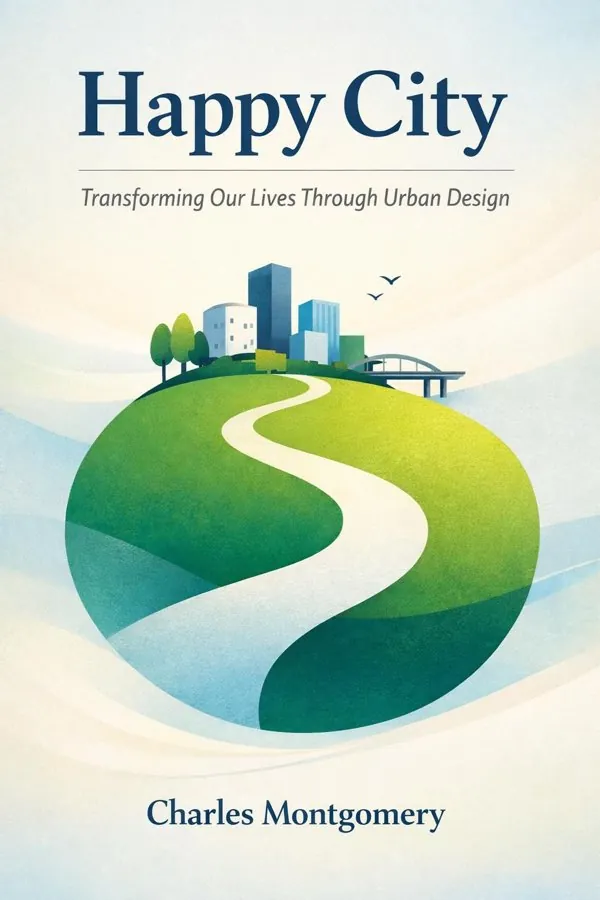
Happy City: Transforming Our Lives Through Urban Design: Summary & Key Insights
 10 min9 chaptersAudio available
Key Takeaways from Happy City: Transforming Our Lives Through Urban Design
We often treat happiness as something purely internal, but our surroundings quietly script much of our emotional life.
The modern city promised freedom, space, and convenience, yet it often delivered loneliness and fragmentation.
One of the book’s most memorable lessons is that urban happiness is not a luxury reserved for rich cities.
Movement is essential to city life, but not all mobility makes people feel free.
A healthy city is not only a place where people live near one another.
What Is Happy City: Transforming Our Lives Through Urban Design About?
Happy City: Transforming Our Lives Through Urban Design by Charles Montgomery is a sociology book spanning 6 pages. What if the secret to a better life is not only found in personal habits, income, or mindset, but in the streets we walk, the homes we inhabit, and the public spaces we share? In Happy City, journalist Charles Montgomery argues that urban design is not a technical background issue reserved for planners and architects. It is a daily force that shapes our stress, health, freedom, relationships, and sense of belonging. Drawing on psychology, sociology, neuroscience, transportation research, and vivid case studies from cities around the world, Montgomery shows how the built environment can either isolate and exhaust us or help us flourish. This book matters because more than half the world now lives in cities, and the choices made about roads, housing, transit, parks, and public space affect billions of people. Montgomery writes with the curiosity of a reporter and the insight of a social thinker, translating complex research into practical lessons about how cities can become more humane, joyful, and equitable. Happy City is ultimately a hopeful book: it insists that happiness is not just a private pursuit, but a collective design challenge.
This FizzRead summary covers all 9 key chapters of Happy City: Transforming Our Lives Through Urban Design in approximately 10 minutes, distilling the most important ideas, arguments, and takeaways from Charles Montgomery's work. Also available as an audio summary and Key Quotes Podcast.
Happy City: Transforming Our Lives Through Urban Design
What if the secret to a better life is not only found in personal habits, income, or mindset, but in the streets we walk, the homes we inhabit, and the public spaces we share? In Happy City, journalist Charles Montgomery argues that urban design is not a technical background issue reserved for planners and architects. It is a daily force that shapes our stress, health, freedom, relationships, and sense of belonging. Drawing on psychology, sociology, neuroscience, transportation research, and vivid case studies from cities around the world, Montgomery shows how the built environment can either isolate and exhaust us or help us flourish.
This book matters because more than half the world now lives in cities, and the choices made about roads, housing, transit, parks, and public space affect billions of people. Montgomery writes with the curiosity of a reporter and the insight of a social thinker, translating complex research into practical lessons about how cities can become more humane, joyful, and equitable. Happy City is ultimately a hopeful book: it insists that happiness is not just a private pursuit, but a collective design challenge.
Who Should Read Happy City: Transforming Our Lives Through Urban Design?
This book is perfect for anyone interested in sociology and looking to gain actionable insights in a short read. Whether you're a student, professional, or lifelong learner, the key ideas from Happy City: Transforming Our Lives Through Urban Design by Charles Montgomery will help you think differently.
- ✓Readers who enjoy sociology and want practical takeaways
- ✓Professionals looking to apply new ideas to their work and life
- ✓Anyone who wants the core insights of Happy City: Transforming Our Lives Through Urban Design in just 10 minutes
Want the full summary?
Get instant access to this book summary and 100K+ more with Fizz Moment.
Get Free SummaryAvailable on App Store • Free to download
Key Chapters
We often treat happiness as something purely internal, but our surroundings quietly script much of our emotional life. Montgomery begins by challenging the assumption that happiness is just about pleasure, wealth, or personal success. Research in psychology and behavioral science suggests that lasting well-being comes from a combination of autonomy, meaningful activity, social connection, health, and a sense of purpose. Cities influence every one of these dimensions.
A neighborhood can encourage walking or trap people in sedentary routines. A public square can invite conversation or create fear and avoidance. Long commutes can steadily drain time, attention, and energy, while mixed-use communities can restore some control over daily life. Even small environmental details, such as noise, access to trees, and the visibility of other people, shape stress levels and mood. In this sense, happiness is not just a personal achievement. It is partly designed into the structure of everyday life.
Montgomery’s great contribution is to connect scientific findings about well-being to concrete urban choices. If humans need belonging, cities should offer places to meet. If we thrive on movement, cities should make walking and cycling easy. If mental health benefits from beauty and variety, urban spaces should avoid monotony and hostility. The city is not a backdrop to life; it is an active participant in how life feels.
The practical lesson is simple: when evaluating any place, ask not only whether it is efficient or profitable, but whether it helps people feel connected, capable, and alive.
The modern city promised freedom, space, and convenience, yet it often delivered loneliness and fragmentation. Montgomery explores how twentieth-century urban development, especially suburban sprawl and car-centered planning, separated homes from work, shopping, and recreation. What looked like progress frequently came at a hidden emotional cost. When destinations are spread far apart, daily life becomes organized around driving rather than human interaction.
This shift weakens spontaneous social contact. Streets become corridors for vehicles instead of places where neighbors meet. Children lose the freedom to move independently. Adults spend more time commuting and less time with family, friends, and community. Even when homes are larger, lives may feel smaller because so much energy is consumed by distance. The result is a paradox: people may gain private space but lose public life.
Montgomery does not romanticize old cities, but he shows that urban design deeply affects how often we encounter others and how much control we feel over our time. Sociological research consistently links stronger communities and higher well-being to environments where people can meet casually, recognize familiar faces, and participate in shared spaces. A place built only for speed can become emotionally impoverished.
Today, this problem appears in many forms: subdivisions with no sidewalks, business districts emptied after office hours, and neighborhoods where basic errands require a car. The takeaway is not that density is automatically good, but that separation and distance should be treated as social risks. If you want a better neighborhood, support development that brings daily needs closer together and restores life to the street.
One of the book’s most memorable lessons is that urban happiness is not a luxury reserved for rich cities. Bogotá demonstrates that political imagination can transform urban life even under difficult conditions. Faced with inequality, congestion, and weak infrastructure, city leaders began rethinking what mobility and dignity should mean. Instead of measuring success only by the speed of cars, they asked who the city was really serving.
Policies such as bus rapid transit, expanded public space, bike infrastructure, and car-free initiatives shifted attention toward ordinary residents. Events like Ciclovía, where streets are temporarily opened to cyclists and pedestrians, showed that public space could become a stage for joy, exercise, and shared civic identity. These interventions did more than improve transport. They changed how people experienced one another and the city itself.
Montgomery uses Bogotá to show that design carries moral meaning. When a city invests in sidewalks, transit, and safe public areas, it signals that everyone deserves access, not just those who can afford a private vehicle. This is especially powerful in unequal societies, where public infrastructure can either reinforce exclusion or create common ground.
The broader insight is that cities do not need to wait for perfect conditions before acting. Tactical changes, temporary experiments, and bold public leadership can quickly alter daily behavior and expectations. Residents begin to imagine new possibilities once they experience them.
The actionable takeaway: support local pilot projects—car-free days, pop-up bike lanes, expanded bus priority, reclaimed plazas—because temporary changes often build the public confidence needed for lasting transformation.
Movement is essential to city life, but not all mobility makes people feel free. Montgomery argues that the dominant transportation model in many cities has confused speed with liberation. Cars can provide convenience, yet dependence on them often creates congestion, financial burden, pollution, and exhausting commutes. The result is a system where people move a lot but feel trapped.
A truly liberating transportation network gives people choices. It allows them to walk when they want to walk, bike when they want to bike, and use reliable transit when they need to travel farther. This kind of flexibility increases autonomy, one of the key ingredients of well-being. It also reduces the daily stress of traffic and parking while making the city more accessible to children, older adults, and lower-income residents.
Montgomery highlights a critical point from transportation research: the commute is often one of the least enjoyable parts of the day. Long, car-dependent commutes correlate with lower life satisfaction, worse health, and reduced social trust. By contrast, active transportation and well-designed transit can improve mood, create mild exercise, and even generate moments of reflection or human contact.
Examples are easy to see. A protected bike lane can convert a dangerous route into a pleasant one. Frequent buses can reduce uncertainty. A mixed-use neighborhood can turn a thirty-minute drive into a ten-minute walk. These are not minor conveniences; they change the texture of everyday life.
The practical takeaway is to judge transportation policies by a human question: do they expand people’s real choices and reduce daily stress? If not, they may be moving vehicles without improving lives.
Many people fear density because they associate it with crowding, noise, and loss of privacy. Montgomery makes an important distinction: density is not the same as overcrowding. When done well, density can support convenience, environmental sustainability, cultural vitality, and social interaction. When done badly, it can feel oppressive and alienating. The difference lies in design.
Human-centered density places homes near shops, schools, parks, and transit while preserving dignity, light, greenery, and access to quiet. It avoids both extremes: isolated sprawl on one side and dehumanizing towers without community life on the other. The most livable dense neighborhoods often combine mid-rise buildings, walkable streets, active ground floors, and local gathering spots. These environments can offer both efficiency and pleasure.
Montgomery shows that proximity creates opportunities. When people live closer to daily needs, they spend less time traveling and more time participating in life. Businesses benefit from foot traffic. Streets become safer through regular presence. Public transit becomes more viable. At the same time, successful dense neighborhoods must protect against stress through thoughtful design: trees, noise control, shared open space, and architectural variety all matter.
This insight is especially relevant as cities confront housing shortages and climate pressure. Rejecting density altogether often pushes growth outward, increasing car dependence and infrastructure costs. The real question is not whether to build compactly, but how to do so in a way that supports mental and social well-being.
The practical takeaway is to advocate for gentle, mixed-use density paired with parks, walkability, and amenities. Density becomes desirable when it serves human rhythms instead of just maximizing units.
People often choose housing based on price, size, or status, but Montgomery reminds us that the location and surrounding environment of a home may matter just as much as the home itself. A large house can become a burden if it requires long commutes, social isolation, and dependence on driving for every errand. Conversely, a smaller home in a lively, connected neighborhood may produce a richer daily experience.
This challenges a deeply rooted idea of success. Many households stretch finances to gain more private space while sacrificing time, flexibility, and access. Yet happiness research suggests that time, relationships, and manageable stress are often more important than square footage. The neighborhood outside the front door—its walkability, safety, social life, and convenience—shapes everyday satisfaction in ways buyers frequently underestimate.
Montgomery does not deny the value of privacy or affordability. Instead, he broadens the definition of a good home. A home should support a good life, not simply display one. Families may benefit from asking different questions: Can children reach parks safely? Are there places to meet neighbors? How long is the commute? Is there transit nearby? Can basic needs be met without planning every movement around a car?
At the policy level, this means housing cannot be separated from transportation and public space. A so-called affordable home may be less affordable once commuting costs and lost time are included.
The actionable takeaway is to think of housing as a bundle of daily experiences. When choosing where to live—or what projects to support—consider time, access, and community alongside price and floor area.
Sustainability is often framed as sacrifice, but Montgomery offers a more compelling vision: greener cities can also be happier cities. Environmental design is not only about reducing emissions or conserving resources. It is about creating places where people can breathe easier, move more naturally, and feel more connected to the world around them.
Trees, parks, waterfront access, and green streets improve urban life in direct and measurable ways. They cool neighborhoods, reduce noise, improve air quality, and provide restorative contact with nature. Research has shown that even brief exposure to greenery can lower stress and improve mental focus. At the same time, compact development and multimodal transport reduce car dependence, which benefits both the climate and personal well-being.
Montgomery’s point is that ecological responsibility and human pleasure do not have to conflict. A shaded walking route is both climate adaptation and a better daily experience. A bike-friendly neighborhood lowers emissions while promoting health. A well-used park supports biodiversity and social life at once. The best urban sustainability strategies are often the ones people enjoy enough to adopt willingly.
This perspective matters because policies framed only in technical or moral terms can feel abstract. People are more likely to support change when they can feel the benefits in their own routines: cleaner air, quieter streets, safer crossings, and more inviting public spaces. Sustainability succeeds when it improves life now, not only in the future.
The takeaway is to champion environmental improvements that residents can immediately experience. When green design feels pleasurable, it becomes easier to sustain politically and culturally.
A city cannot be called happy if its benefits are available only to the privileged. One of Montgomery’s most powerful themes is that urban design is inseparable from justice. Streets, transit, parks, and housing policies distribute opportunity unevenly. Some people receive short commutes, safe sidewalks, and beautiful public spaces, while others inherit pollution, exclusion, danger, and distance from essential services.
Design choices can either widen these inequalities or reduce them. Reliable public transit connects people to jobs and education. Inclusive parks and libraries create common spaces across class lines. Safe streets help children, elders, and people with disabilities participate in daily life. Affordable housing near opportunity prevents segregation from hardening into destiny. In each case, design is not neutral; it shapes who gets freedom and who bears friction.
Montgomery argues that the emotional experience of the city is political. Feeling welcome, safe, and visible in public space is part of dignity. Feeling constantly displaced, monitored, or cut off erodes trust and belonging. A happy city therefore requires more than aesthetic improvements. It requires asking who public investments serve and who may be pushed aside by redevelopment.
This is especially important in an era when urban revitalization can raise property values while displacing longtime residents. Improvements should not simply make cities more attractive to capital; they should make them more livable for the people already there.
The actionable takeaway is to evaluate urban policies through an equity lens: who gains access, who bears costs, and how can improvements be designed so that well-being is shared rather than concentrated?
All Chapters in Happy City: Transforming Our Lives Through Urban Design
About the Author
Charles Montgomery is a Canadian journalist, author, and public thinker best known for exploring how cities shape human experience. His work sits at the intersection of urbanism, sociology, psychology, sustainability, and public policy. In Happy City, he draws on years of reporting, interviews, and interdisciplinary research to show how the built environment influences happiness, health, and social connection. Montgomery is widely respected for making complex urban issues accessible to general readers without sacrificing nuance. His writing combines storytelling with evidence, allowing him to move fluidly between case studies, scientific findings, and practical civic questions. Through his books, lectures, and urban engagement work, he has become an influential voice in conversations about walkability, public space, transportation, and designing cities that are not only efficient, but more humane and joyful.
Get This Summary in Your Preferred Format
Read or listen to the Happy City: Transforming Our Lives Through Urban Design summary by Charles Montgomery anytime, anywhere. FizzRead offers multiple formats so you can learn on your terms — all free.
Available formats: App · Audio · PDF · EPUB — All included free with FizzRead
Download Happy City: Transforming Our Lives Through Urban Design PDF and EPUB Summary
Key Quotes from Happy City: Transforming Our Lives Through Urban Design
“We often treat happiness as something purely internal, but our surroundings quietly script much of our emotional life.”
“The modern city promised freedom, space, and convenience, yet it often delivered loneliness and fragmentation.”
“One of the book’s most memorable lessons is that urban happiness is not a luxury reserved for rich cities.”
“Movement is essential to city life, but not all mobility makes people feel free.”
“A healthy city is not only a place where people live near one another.”
Frequently Asked Questions about Happy City: Transforming Our Lives Through Urban Design
Happy City: Transforming Our Lives Through Urban Design by Charles Montgomery is a sociology book that explores key ideas across 9 chapters. What if the secret to a better life is not only found in personal habits, income, or mindset, but in the streets we walk, the homes we inhabit, and the public spaces we share? In Happy City, journalist Charles Montgomery argues that urban design is not a technical background issue reserved for planners and architects. It is a daily force that shapes our stress, health, freedom, relationships, and sense of belonging. Drawing on psychology, sociology, neuroscience, transportation research, and vivid case studies from cities around the world, Montgomery shows how the built environment can either isolate and exhaust us or help us flourish. This book matters because more than half the world now lives in cities, and the choices made about roads, housing, transit, parks, and public space affect billions of people. Montgomery writes with the curiosity of a reporter and the insight of a social thinker, translating complex research into practical lessons about how cities can become more humane, joyful, and equitable. Happy City is ultimately a hopeful book: it insists that happiness is not just a private pursuit, but a collective design challenge.
You Might Also Like

Between the World and Me
Ta-Nehisi Coates
10 min
Half the Sky
Nicholas D. Kristof, Sheryl WuDunn
10 min
Men Explain Things To Me
Rebecca Solnit
10 min
Rational Ritual
Michael Suk-Young Chwe
10 min
The New Jim Crow
Michelle Alexander
10 min
Beyond Culture
Edward T. Hall
10 minBrowse by Category
Ready to read Happy City: Transforming Our Lives Through Urban Design?
Get the full summary and 100K+ more books with Fizz Moment.