
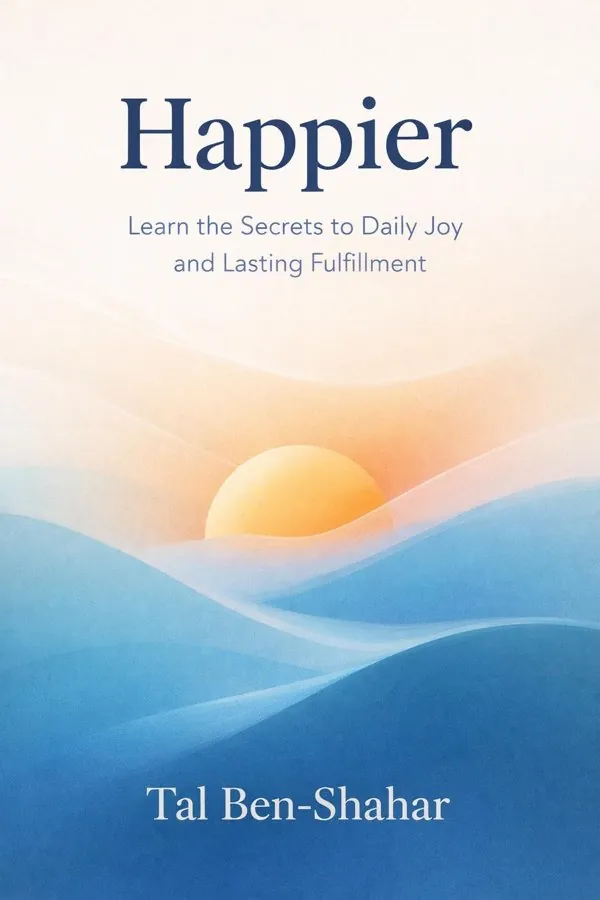
Happier: Learn the Secrets to Daily Joy and Lasting Fulfillment: Summary & Key Insights
 10 min10 chaptersAudio available
Key Takeaways from Happier: Learn the Secrets to Daily Joy and Lasting Fulfillment
One of the book’s most important insights is that many people spend years chasing what feels good in the moment while neglecting what creates deep satisfaction over time.
A surprisingly common modern problem is being busy without knowing why.
A counterintuitive but liberating idea in Happier is that the refusal to feel painful emotions often makes people less happy, not more.
Much of modern life pushes people toward one of two extremes: live only for today, or sacrifice today entirely for tomorrow.
Because work occupies such a large part of adult life, Ben-Shahar treats it as a major source of either vitality or misery.
What Is Happier: Learn the Secrets to Daily Joy and Lasting Fulfillment About?
Happier: Learn the Secrets to Daily Joy and Lasting Fulfillment by Tal Ben-Shahar is a positive_psych book spanning 10 pages. In Happier, Tal Ben-Shahar asks a deceptively simple question: why do so many accomplished, intelligent, hardworking people still feel unsatisfied? His answer is both reassuring and demanding. Happiness is not a lucky accident or a personality trait reserved for a few fortunate people; it is a skill that can be studied, practiced, and strengthened. Drawing from positive psychology, philosophy, behavioral science, and his own experience teaching one of Harvard’s most popular courses, Ben-Shahar shows that lasting well-being comes from aligning pleasure with purpose, ambition with presence, and self-acceptance with growth. What makes this book matter is its refusal to offer shallow optimism. Ben-Shahar does not promise a life without pain, uncertainty, or disappointment. Instead, he presents happiness as a realistic, sustainable way of living—one that makes room for difficult emotions while helping us build meaning, gratitude, resilience, and healthier habits. Rich with examples, reflections, and practical exercises, Happier remains a powerful guide for anyone who wants more than momentary excitement. It is a book for readers who want to live well, not just succeed outwardly.
This FizzRead summary covers all 10 key chapters of Happier: Learn the Secrets to Daily Joy and Lasting Fulfillment in approximately 10 minutes, distilling the most important ideas, arguments, and takeaways from Tal Ben-Shahar's work. Also available as an audio summary and Key Quotes Podcast.
Happier: Learn the Secrets to Daily Joy and Lasting Fulfillment
In Happier, Tal Ben-Shahar asks a deceptively simple question: why do so many accomplished, intelligent, hardworking people still feel unsatisfied? His answer is both reassuring and demanding. Happiness is not a lucky accident or a personality trait reserved for a few fortunate people; it is a skill that can be studied, practiced, and strengthened. Drawing from positive psychology, philosophy, behavioral science, and his own experience teaching one of Harvard’s most popular courses, Ben-Shahar shows that lasting well-being comes from aligning pleasure with purpose, ambition with presence, and self-acceptance with growth.
What makes this book matter is its refusal to offer shallow optimism. Ben-Shahar does not promise a life without pain, uncertainty, or disappointment. Instead, he presents happiness as a realistic, sustainable way of living—one that makes room for difficult emotions while helping us build meaning, gratitude, resilience, and healthier habits. Rich with examples, reflections, and practical exercises, Happier remains a powerful guide for anyone who wants more than momentary excitement. It is a book for readers who want to live well, not just succeed outwardly.
Who Should Read Happier: Learn the Secrets to Daily Joy and Lasting Fulfillment?
This book is perfect for anyone interested in positive_psych and looking to gain actionable insights in a short read. Whether you're a student, professional, or lifelong learner, the key ideas from Happier: Learn the Secrets to Daily Joy and Lasting Fulfillment by Tal Ben-Shahar will help you think differently.
- ✓Readers who enjoy positive_psych and want practical takeaways
- ✓Professionals looking to apply new ideas to their work and life
- ✓Anyone who wants the core insights of Happier: Learn the Secrets to Daily Joy and Lasting Fulfillment in just 10 minutes
Want the full summary?
Get instant access to this book summary and 100K+ more with Fizz Moment.
Get Free SummaryAvailable on App Store • Free to download
Key Chapters
One of the book’s most important insights is that many people spend years chasing what feels good in the moment while neglecting what creates deep satisfaction over time. Ben-Shahar draws a clear distinction between pleasure and happiness. Pleasure is immediate, sensory, and temporary: a delicious meal, a shopping spree, public praise, a weekend getaway. These experiences are not bad; in fact, they are part of a good life. The problem begins when we mistake them for the whole of happiness.
Lasting fulfillment, he argues, comes from combining present enjoyment with future meaning. A life built only on short-term rewards can become empty, no matter how comfortable or exciting it looks from the outside. This explains why people with success, wealth, or status often still feel restless. Their lives may be full of stimulation but lacking in purpose.
A practical example is work. Someone may choose a prestigious job because it pays well and impresses others, yet feel drained every day. Another person may earn less but feel energized because the work expresses their values. The second person is more likely to experience enduring happiness, because the activity itself matters.
Ben-Shahar encourages readers to ask better questions: Does this activity bring me joy now? Will it also matter to me later? If the answer to both is yes, it is likely contributing to real well-being. If the answer is only yes for the present, it may be a pleasant distraction rather than a foundation for a meaningful life.
Actionable takeaway: This week, review how you spend your time and label activities as pleasure, purpose, or both—then intentionally increase the ones that offer both enjoyment and meaning.
A surprisingly common modern problem is being busy without knowing why. Ben-Shahar argues that happiness is inseparable from purpose because human beings do not thrive on comfort alone; we need direction. Without meaning, even successful lives can feel fragmented. Purpose organizes our choices, helps us tolerate difficulty, and gives emotional weight to our efforts.
This does not mean everyone needs a grand mission or world-changing career. Purpose can be found in raising children, building a craft, serving a community, learning deeply, creating beauty, or supporting others. What matters is that your daily actions connect to values you genuinely care about. When they do, effort feels less like a burden and more like an expression of identity.
Ben-Shahar also challenges the assumption that purpose is something we discover once and then keep forever. Often, meaning is clarified through action. You volunteer, teach, mentor, write, lead, or build—and gradually notice what gives you energy and what leaves you numb. Purpose emerges through engagement, not endless abstract thinking.
For example, a student unsure of career direction may feel pressure to choose the perfect path immediately. Ben-Shahar would likely suggest experimentation: internships, conversations, classes, side projects. Through experience, the student can identify which pursuits feel significant and alive. Meaning often becomes visible in retrospect.
Purpose also acts as emotional ballast. When life becomes stressful or painful, a meaningful framework helps people endure setbacks without collapsing into despair. Difficulty is easier to bear when it serves something valuable.
Actionable takeaway: Write down three moments from the past year when you felt most alive, useful, or proud, and identify the values those moments expressed. Use that list as a guide for future decisions.
A counterintuitive but liberating idea in Happier is that the refusal to feel painful emotions often makes people less happy, not more. Ben-Shahar calls for what might be described as permission to be human. Sadness, anxiety, envy, anger, and disappointment are not signs that life is broken. They are part of being alive. The more we insist on constant positivity, the more guilty or defective we feel whenever we inevitably suffer.
This perfectionistic relationship to emotion creates a trap. People tell themselves they should always be grateful, productive, confident, and upbeat. When reality does not match that expectation, they begin suppressing their feelings or pretending they are fine. But suppressed emotions tend to intensify. Avoided sadness often becomes numbness; ignored stress can become burnout.
Ben-Shahar’s alternative is acceptance. Acceptance does not mean resignation or self-pity. It means acknowledging reality without unnecessary resistance. If you are grieving, you allow grief. If you are frustrated, you name the frustration. Once reality is accepted, constructive action becomes possible.
Imagine someone who loses an important opportunity at work. One response is denial or harsh self-criticism: “I shouldn’t feel this upset.” Another is acceptance: “This hurts. I’m disappointed. That reaction makes sense.” The second response is healthier because it makes emotional recovery easier and prevents shame from compounding the original pain.
By allowing negative emotions to exist, people become more resilient and more emotionally honest. Happiness then stops being a forced performance and becomes a fuller, more stable state.
Actionable takeaway: When a difficult emotion appears, pause and describe it in one sentence without judgment—for example, “I feel anxious because this matters to me.” Naming the feeling is the first step toward processing it.
Much of modern life pushes people toward one of two extremes: live only for today, or sacrifice today entirely for tomorrow. Ben-Shahar argues that both approaches fail. The truly happy life, he suggests, is one in which present enjoyment and future benefit are integrated rather than treated as enemies.
He contrasts several life patterns. Some people are hedonists: they seek immediate pleasure with little concern for long-term consequences. Others are what he describes as rat racers: they endure the present for some future payoff—promotion, recognition, security, prestige—but rarely enjoy the journey. There are also nihilists who feel neither present joy nor future hope. The healthiest path is the “happy” model, where what we do now is both meaningful and rewarding.
This idea applies everywhere. In health, punishing exercise routines often fail because they are all sacrifice and no enjoyment. Sustainable well-being comes from finding forms of movement that feel good now and support future vitality. In careers, working nonstop for a vague future happiness often leads to exhaustion. Better choices align skill, contribution, and interest so daily work is not merely endured.
This is not an argument against discipline. Rather, it is a call to build lives where discipline serves values we care about and where the process contains moments of engagement, not just deferred reward. If you constantly say, “I’ll be happy when…,” happiness keeps moving farther away.
Actionable takeaway: Choose one important goal and redesign the process so it includes immediate sources of satisfaction—such as learning, social support, creativity, or visible progress—instead of relying only on the final result.
Because work occupies such a large part of adult life, Ben-Shahar treats it as a major source of either vitality or misery. Happiness at work is not determined only by salary or status, though both can matter. More important is whether the work connects to strengths, values, relationships, and a sense of contribution. People are far more likely to flourish when they can see how their efforts matter.
He suggests that many individuals sleepwalk into careers based on external pressures: parental expectations, social comparison, financial fear, prestige, or habit. Over time, this creates a painful split between outer success and inner emptiness. The job may look impressive but feel emotionally deadening.
Meaningful work, by contrast, often includes several ingredients: personal interest, challenge, opportunities for growth, supportive relationships, and some connection to a larger purpose. A teacher who feels they are shaping lives, an engineer who loves solving problems, or a nurse who values care may all experience long-term satisfaction even in demanding environments.
Importantly, not everyone can instantly leave an unfulfilling job. Ben-Shahar’s message is still useful because meaning can sometimes be expanded before careers are changed. People can take on projects that reflect their strengths, cultivate better relationships at work, or reconnect with the human impact of what they do. Small changes in framing and behavior can improve the experience of work significantly.
At the same time, the book invites honest reflection. If your work consistently drains your energy and conflicts with your values, no amount of rationalization may solve the problem. Long-term happiness may require courageous change.
Actionable takeaway: List the three moments at work when you feel most engaged and the three when you feel most depleted. Use the pattern to adjust your role, your routines, or your longer-term career direction.
One of the strongest findings in happiness research is also one of the oldest human truths: we need one another. Ben-Shahar emphasizes that close relationships are not a luxury added to an otherwise successful life. They are among the central conditions of happiness. Achievement without connection leaves people isolated, while love, friendship, and emotional intimacy often sustain well-being through every other uncertainty.
Meaningful relationships do not require a huge social network. What matters more is depth than quantity: people with whom we can be honest, vulnerable, playful, and supported. These bonds create emotional safety. They remind us we are seen for who we are, not only for what we produce.
Ben-Shahar also highlights that healthy relationships require investment. In busy lives, people often treat relationships as what remains after work is done. But neglected connection tends to weaken quietly. A marriage erodes through inattention, friendships fade through postponement, families become functional but emotionally distant. Happiness suffers not because of one dramatic event, but because of accumulated absence.
Practical care matters: shared meals, regular conversations, listening without multitasking, expressing affection, and making room for repair after conflict. Even small rituals can be powerful. A ten-minute evening check-in with a partner, a weekly call with a close friend, or undistracted playtime with a child can deepen connection more than occasional grand gestures.
The quality of our relationships also shapes our inner world. Supportive relationships buffer stress, encourage growth, and make joy more durable because it is shared.
Actionable takeaway: Strengthen one important relationship this week by scheduling protected time, asking a deeper question than usual, and giving your full attention without phones or distractions.
Ben-Shahar presents gratitude not as politeness or forced cheerfulness, but as a disciplined way of seeing. Human attention is naturally drawn to threats, shortcomings, and what is missing. This bias once helped us survive, but in modern life it can make abundance invisible. Gratitude corrects that distortion by training the mind to notice what is already meaningful, supportive, and good.
Importantly, gratitude is not denial. It does not ask us to ignore pain, injustice, or frustration. Instead, it broadens awareness so hardship is not the only thing we see. A person may be stressed at work and still grateful for a loyal friend, good health, a useful skill, or a quiet morning walk. This shift in attention changes emotional tone and increases resilience.
Ben-Shahar often recommends simple reflective practices because they shape experience over time. A gratitude journal, for instance, may sound small, but it gradually rewires what people register during the day. If you know you will write down what went well, you start noticing moments you would normally overlook: a helpful colleague, a satisfying conversation, a completed task, sunlight through a window.
Gratitude also improves relationships when expressed directly. Thanking a partner, colleague, mentor, or parent for something specific strengthens connection and reduces the tendency to take others for granted.
The key is sincerity. Generic positivity can feel hollow, but concrete appreciation feels real. “I’m grateful for my life” is fine; “I’m grateful that my friend listened to me without trying to fix me” is transformative.
Actionable takeaway: Every evening for seven days, write down three specific things you appreciated that day and why they mattered. Keep the list concrete, personal, and varied.
Many people assume that self-criticism is necessary for improvement. Ben-Shahar challenges this belief by showing that harshness often undermines growth rather than promoting it. When people constantly judge themselves for not being better, happier, more disciplined, or more successful, they create inner resistance. Shame narrows energy; acceptance frees it.
Self-acceptance does not mean passivity or complacency. It means recognizing your current reality—strengths, flaws, hopes, fears—without contempt. From that position, change becomes more honest and sustainable. You can work on impatience, insecurity, procrastination, or fear without turning these traits into proof that you are fundamentally inadequate.
This distinction matters in everyday life. Consider someone trying to become healthier. If they miss a workout and respond with self-attack—“I’m lazy; I always fail”—they are more likely to give up. If they respond with self-acceptance—“I slipped today; that happens; I can begin again tomorrow”—they preserve motivation. Compassion is often more effective than punishment.
Ben-Shahar’s broader point is that flourishing depends on embracing our humanity. We are not machines to optimize endlessly. We are imperfect beings who learn unevenly, regress sometimes, and grow through repetition. The healthiest kind of ambition is grounded in self-respect, not self-rejection.
This mindset also improves relationships, because people who are gentler with themselves tend to be less defensive and more open to feedback. Inner acceptance creates outer flexibility.
Actionable takeaway: Replace one recurring self-critical thought with a more accurate, compassionate sentence. For example, change “I’m terrible at this” to “I’m still learning this, and progress takes practice.”
A powerful theme running through Happier is that happiness is not built primarily through dramatic breakthroughs but through ordinary habits repeated over time. Insight matters, but behavior matters more. People often wait for motivation, clarity, or the perfect moment before changing their lives. Ben-Shahar instead encourages the creation of rituals—small, structured practices that make well-being more likely.
Rituals are effective because they reduce reliance on willpower. If exercise, journaling, reading, reflection, time with loved ones, or rest are left to chance, they are easily crowded out by urgency. But when these become regular commitments, they begin shaping identity and emotional stability.
Examples can be simple: a morning walk before checking email, a weekly review of meaningful goals, a nightly gratitude practice, uninterrupted family dinner, twenty minutes of reading, or a standing appointment with a friend. These routines may seem modest, yet they quietly create a life that feels more grounded and intentional.
Ben-Shahar’s approach is realistic. He does not suggest perfection. Rituals should be manageable enough to survive imperfect days. A ten-minute meditation habit sustained for months is more valuable than an ambitious daily routine abandoned after one week.
The deeper lesson is that happiness is not only a feeling to wait for. It is a pattern of living. What we repeatedly do shapes what we repeatedly feel. By designing daily life with care, people create conditions in which well-being can grow.
Actionable takeaway: Choose one happiness-supporting ritual that takes less than fifteen minutes and commit to doing it at the same time each day for the next two weeks.
Ben-Shahar’s final message is that happiness should not be treated as a distant reward at the end of achievement. It is better understood as the melody of life rather than a single triumphant note. Too often, people postpone living until they have reached some external milestone: the degree, the promotion, the relationship, the house, the financial threshold. But if life is built entirely around postponement, the habit of deferral becomes permanent.
Living happily does not mean constant pleasure or the absence of struggle. It means inhabiting your days in a way that honors both present experience and long-term meaning. It means making room for joy, relationships, gratitude, work that matters, rest, growth, and emotional honesty. It means understanding that the quality of a life is shaped not just by what is achieved, but by how it is experienced while being lived.
This perspective changes decision-making. Instead of asking only, “Will this help me get ahead?” a happier life asks, “Will this also help me live well now?” That question leads to wiser choices about career, ambition, relationships, health, and time.
It also redefines success. A successful life is not merely productive or admired. It is one in which a person feels engaged, connected, purposeful, and fully human. Ben-Shahar’s contribution is to show that such a life is neither accidental nor mystical. It can be cultivated through attention, practice, and courage.
Actionable takeaway: At the end of each day, ask yourself two questions: “What gave me energy today?” and “What gave today meaning?” Use your answers to gradually redesign your life around both.
All Chapters in Happier: Learn the Secrets to Daily Joy and Lasting Fulfillment
About the Author
Tal Ben-Shahar is an Israeli author, lecturer, and leading voice in the field of positive psychology. He became widely known for teaching some of Harvard University’s most popular courses, including classes on happiness and leadership that drew thousands of students. His work focuses on the practical application of psychological research to everyday life, helping people build greater well-being, resilience, purpose, and self-acceptance. Ben-Shahar is especially respected for translating academic ideas into clear, useful guidance without losing depth or nuance. In addition to Happier, he has written several influential books on flourishing, leadership, and personal development. Through his writing, speaking, and teaching, he has helped popularize the idea that happiness is not a vague ideal, but a skill that can be cultivated intentionally.
Get This Summary in Your Preferred Format
Read or listen to the Happier: Learn the Secrets to Daily Joy and Lasting Fulfillment summary by Tal Ben-Shahar anytime, anywhere. FizzRead offers multiple formats so you can learn on your terms — all free.
Available formats: App · Audio · PDF · EPUB — All included free with FizzRead
Download Happier: Learn the Secrets to Daily Joy and Lasting Fulfillment PDF and EPUB Summary
Key Quotes from Happier: Learn the Secrets to Daily Joy and Lasting Fulfillment
“One of the book’s most important insights is that many people spend years chasing what feels good in the moment while neglecting what creates deep satisfaction over time.”
“A surprisingly common modern problem is being busy without knowing why.”
“A counterintuitive but liberating idea in Happier is that the refusal to feel painful emotions often makes people less happy, not more.”
“Much of modern life pushes people toward one of two extremes: live only for today, or sacrifice today entirely for tomorrow.”
“Because work occupies such a large part of adult life, Ben-Shahar treats it as a major source of either vitality or misery.”
Frequently Asked Questions about Happier: Learn the Secrets to Daily Joy and Lasting Fulfillment
Happier: Learn the Secrets to Daily Joy and Lasting Fulfillment by Tal Ben-Shahar is a positive_psych book that explores key ideas across 10 chapters. In Happier, Tal Ben-Shahar asks a deceptively simple question: why do so many accomplished, intelligent, hardworking people still feel unsatisfied? His answer is both reassuring and demanding. Happiness is not a lucky accident or a personality trait reserved for a few fortunate people; it is a skill that can be studied, practiced, and strengthened. Drawing from positive psychology, philosophy, behavioral science, and his own experience teaching one of Harvard’s most popular courses, Ben-Shahar shows that lasting well-being comes from aligning pleasure with purpose, ambition with presence, and self-acceptance with growth. What makes this book matter is its refusal to offer shallow optimism. Ben-Shahar does not promise a life without pain, uncertainty, or disappointment. Instead, he presents happiness as a realistic, sustainable way of living—one that makes room for difficult emotions while helping us build meaning, gratitude, resilience, and healthier habits. Rich with examples, reflections, and practical exercises, Happier remains a powerful guide for anyone who wants more than momentary excitement. It is a book for readers who want to live well, not just succeed outwardly.
You Might Also Like
Don't Sweat the Small Stuff... and It's All Small Stuff
Richard Carlson
10 min
Option B
Sheryl Sandberg & Adam Grant
10 min
Hallelujah Anyway: Rediscovering Mercy
Anne Lamott
10 min
I Can Do It: How to Use Affirmations to Change Your Life
Louise Hay
10 min
The Coffee Bean: A Simple Lesson to Create Positive Change
Jon Gordon, Damon West
10 min
The Happiness Hypothesis: Finding Modern Truth in Ancient Wisdom
Jonathan Haidt
10 minBrowse by Category
Ready to read Happier: Learn the Secrets to Daily Joy and Lasting Fulfillment?
Get the full summary and 100K+ more books with Fizz Moment.