
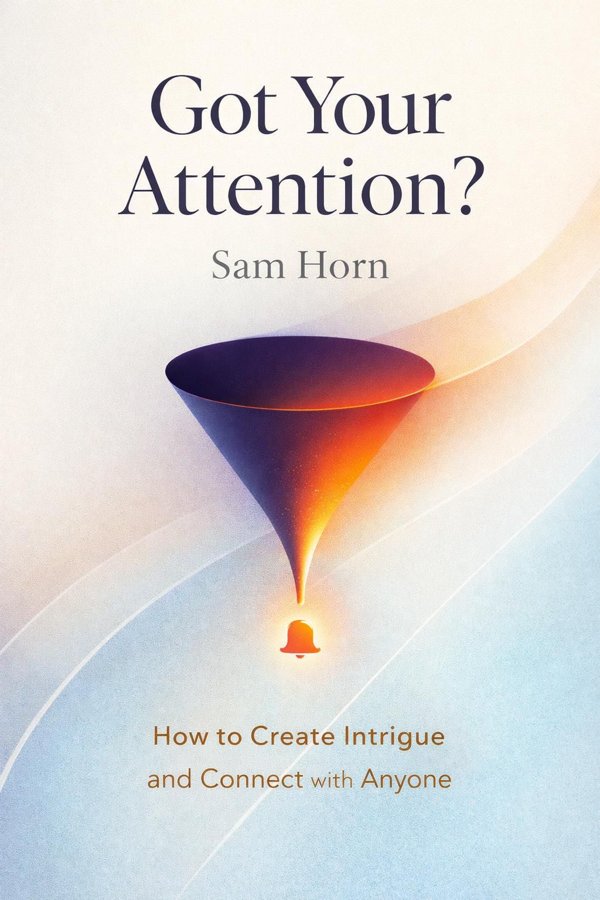
Got Your Attention?: How to Create Intrigue and Connect with Anyone: Summary & Key Insights
by Sam Horn
 10 min9 chaptersAudio available
Key Takeaways from Got Your Attention?: How to Create Intrigue and Connect with Anyone
Most people communicate as if attention is automatically granted, but Sam Horn insists that attention must be earned in the first few moments.
Predictability is the enemy of attention.
The strongest communication does not merely deliver information; it activates the listener.
A common communication mistake is choosing between being clear and being interesting, as if those goals conflict.
Getting attention is only half the battle; keeping it requires trust.
What Is Got Your Attention?: How to Create Intrigue and Connect with Anyone About?
Got Your Attention?: How to Create Intrigue and Connect with Anyone by Sam Horn is a communication book spanning 13 pages. In Got Your Attention?, communication expert Sam Horn tackles one of the defining challenges of modern life: how to be heard in a world overflowing with noise. Whether you are pitching an idea, introducing yourself at a networking event, writing an email, leading a meeting, or trying to make a meaningful first impression, Horn argues that success often depends less on how much you say and more on how quickly you spark curiosity. The book is a practical guide to creating intrigue so people want to listen, ask questions, and remember what you said. What makes this book especially useful is its focus on immediate application. Horn does not offer vague advice about “being engaging.” Instead, she gives readers repeatable methods for crafting openings, refining messages, telling stories, handling resistance, and making communication feel both concise and compelling. Her ideas are grounded in years of work as a keynote speaker, message strategist, and advisor to organizations including NASA, Intel, and the U.S. Navy. The result is a highly practical communication playbook for anyone who wants to stand out without sounding pushy, polished without sounding scripted, and memorable without saying more than necessary.
This FizzRead summary covers all 9 key chapters of Got Your Attention?: How to Create Intrigue and Connect with Anyone in approximately 10 minutes, distilling the most important ideas, arguments, and takeaways from Sam Horn's work. Also available as an audio summary and Key Quotes Podcast.
Got Your Attention?: How to Create Intrigue and Connect with Anyone
In Got Your Attention?, communication expert Sam Horn tackles one of the defining challenges of modern life: how to be heard in a world overflowing with noise. Whether you are pitching an idea, introducing yourself at a networking event, writing an email, leading a meeting, or trying to make a meaningful first impression, Horn argues that success often depends less on how much you say and more on how quickly you spark curiosity. The book is a practical guide to creating intrigue so people want to listen, ask questions, and remember what you said.
What makes this book especially useful is its focus on immediate application. Horn does not offer vague advice about “being engaging.” Instead, she gives readers repeatable methods for crafting openings, refining messages, telling stories, handling resistance, and making communication feel both concise and compelling. Her ideas are grounded in years of work as a keynote speaker, message strategist, and advisor to organizations including NASA, Intel, and the U.S. Navy. The result is a highly practical communication playbook for anyone who wants to stand out without sounding pushy, polished without sounding scripted, and memorable without saying more than necessary.
Who Should Read Got Your Attention?: How to Create Intrigue and Connect with Anyone?
This book is perfect for anyone interested in communication and looking to gain actionable insights in a short read. Whether you're a student, professional, or lifelong learner, the key ideas from Got Your Attention?: How to Create Intrigue and Connect with Anyone by Sam Horn will help you think differently.
- ✓Readers who enjoy communication and want practical takeaways
- ✓Professionals looking to apply new ideas to their work and life
- ✓Anyone who wants the core insights of Got Your Attention?: How to Create Intrigue and Connect with Anyone in just 10 minutes
Want the full summary?
Get instant access to this book summary and 100K+ more with Fizz Moment.
Get Free SummaryAvailable on App Store • Free to download
Key Chapters
Most people communicate as if attention is automatically granted, but Sam Horn insists that attention must be earned in the first few moments. In an overloaded environment, people are constantly sorting, deleting, ignoring, and deciding what deserves their mental energy. That means your audience is not starting from a place of interest. They are starting from a place of skepticism, distraction, or fatigue. If your message sounds generic, predictable, or self-focused, it will likely be filtered out before it has a chance to land.
Horn’s central insight is that communication should begin where the listener is, not where the speaker is. Instead of leading with what you want to say, start with what will make the other person curious enough to stay engaged. This applies to presentations, interviews, emails, networking conversations, and even everyday small talk. A stale opener like “I’d like to tell you about our company” invites disengagement. A stronger opener like “We help hospitals cut patient wait times without adding staff” gives people a reason to keep listening.
This idea also reframes the role of preparation. Good communicators do not simply prepare more content; they prepare better entry points. They ask: What will matter to this audience? What problem do they care about? What surprising angle could interrupt autopilot? When you respect how scarce attention is, you become more selective, clear, and audience-aware.
Actionable takeaway: Before any important interaction, identify the one sentence that would make a distracted person stop and think, “Tell me more.” Use that as your opening instead of beginning with background or biography.
Predictability is the enemy of attention. Horn argues that intrigue works because it creates a small gap between what people expect and what they hear. That gap triggers curiosity. When something feels slightly incomplete, surprising, or fresh, people lean in because they want resolution. Intrigue is not about being mysterious for its own sake; it is about giving people just enough information to make them want the rest.
An intriguing opener often avoids over-explaining. Compare “I’m a consultant who helps organizations improve employee engagement through strategic leadership development” with “I help leaders stop losing their best people.” The second statement is shorter, sharper, and more concrete. It raises questions naturally. How do you do that? Why are they losing people? What makes your approach different? Those questions pull the conversation forward.
Horn shows that intrigue is especially powerful in introductions, headlines, book titles, subject lines, and opening remarks. It can transform forgettable communication into memorable communication. The goal is not to withhold essential information forever, but to sequence it well. First win attention, then deepen understanding. Without the first, the second never happens.
This principle can also help people who ramble. If you tend to over-explain, intrigue forces you to distill. You stop trying to say everything and instead choose the one angle that will make someone ask for more. That shift feels risky at first, but it often creates more connection than a polished speech.
Actionable takeaway: Rewrite your self-introduction, email subject line, or presentation opener so it highlights a tension, surprise, or concrete result that naturally invites a follow-up question.
The strongest communication does not merely deliver information; it activates the listener. Horn emphasizes that curiosity turns passive audiences into active participants. When people become curious, they stop feeling like they are being talked at and start feeling involved in a discovery process. That difference changes the entire emotional tone of an interaction.
One reason curiosity is so powerful is that it respects the audience’s intelligence. Instead of spelling out every point too soon, you let people connect dots, imagine possibilities, and ask questions. This can be done through a provocative question, an unexpected comparison, a bold claim that demands explanation, or a story that begins in the middle of tension. For example, a manager opening a team meeting with “What’s one thing we’re doing that wastes everyone’s time?” is far more engaging than “Today we’ll discuss process improvement.” Curiosity creates ownership.
Horn also warns against confusing clarity with overexposure. If you front-load every detail, you often kill momentum. Effective communicators reveal information in stages. They know when to pause, when to ask, and when to leave room for the audience to lean in. This is useful in sales conversations, teaching, leadership, and even parenting. People remember what they mentally helped uncover.
Curiosity should also be relevant. Random cleverness wears thin. The intrigue has to connect to a real concern, pain point, or aspiration. If the curiosity you create feels gimmicky, people may listen briefly but lose trust. If it feels meaningful, they will stay with you.
Actionable takeaway: In your next conversation or presentation, replace one explanatory statement with a question or tension-building line that invites others to think before you give the answer.
A common communication mistake is choosing between being clear and being interesting, as if those goals conflict. Horn’s Half-and-Half rule offers a smarter balance: say enough so people understand the relevance, but not so much that you remove all intrigue. Give them half the picture so they can grasp the value, and leave half unstated so they want to know more.
This rule is especially useful when describing your work, your idea, or your offer. Many people either undershare and sound vague or overshare and lose attention. Half-and-Half helps you avoid both extremes. For instance, instead of saying, “I’m in organizational development,” which is too abstract, or offering a five-minute explanation of your methodology, you might say, “I help companies fix the hidden habits that make meetings expensive.” That sentence gives enough clarity to signal what you do and enough intrigue to generate conversation.
The same principle improves writing. Email subject lines that reveal everything often feel dull, while vague subject lines feel unhelpful. A balanced subject line might be “A simple fix for low event turnout” rather than “Marketing ideas” or a detailed summary. In presentations, you can preview the stakes without spilling every conclusion immediately.
Half-and-Half also reflects respect for timing. Not every interaction requires full detail upfront. Sometimes the first job is simply to earn the next minute, the next meeting, or the next question. When you do that well, deeper explanation becomes welcome instead of burdensome.
Actionable takeaway: Review how you usually describe your work or ideas and trim it to one sentence that is specific enough to make sense and open-ended enough to invite curiosity.
Getting attention is only half the battle; keeping it requires trust. Horn’s E.I. formula, Empathy plus Intrigue, shows that memorable communication is not just about clever phrasing. It works when people feel you understand them and are offering something worth hearing. Intrigue gets their attention, but empathy makes them receptive.
Empathy means framing your message around the listener’s reality rather than your own agenda. Instead of talking first about your features, credentials, or intentions, speak to the problem they are facing, the pressure they are under, or the result they want. A recruiter might say, “We know top candidates often tune out generic outreach, so let me be specific about why your background stood out.” A leader might open with, “I know everyone is stretched thin, so today’s change needs to make your work easier, not harder.” These openings lower resistance because they show understanding.
When empathy is combined with intrigue, communication becomes both human and compelling. You are not trying to manipulate attention; you are earning it by showing relevance. This matters especially in difficult conversations, persuasion, customer communication, and change management. People rarely resist because they hate information. More often, they resist because they do not feel seen or they assume the message will waste their time.
Horn’s point is that effective communication starts with emotional alignment. Once people feel understood, they are much more willing to consider unfamiliar ideas. The best communicators therefore prepare not just what they want to say, but what their audience may be thinking, fearing, or hoping.
Actionable takeaway: Before your next important message, write down your audience’s top concern in one sentence and make your opening line respond to that concern directly.
Facts inform, but stories travel. Horn highlights storytelling as one of the most reliable ways to capture attention and make a message memorable. A well-chosen story does more than entertain; it gives abstract ideas emotional weight and practical shape. When people hear a story, they can see themselves in it. That makes the lesson easier to remember and harder to dismiss.
Stories are particularly useful when you need to explain value, overcome skepticism, or make a principle concrete. Instead of saying, “Our onboarding process improves retention,” you might tell a brief story about a new employee who nearly quit in week two but stayed because of one change in the onboarding experience. Instead of lecturing about better communication, you might share a moment when one revised sentence changed a client’s response. The story creates stakes, sequence, and outcome.
Horn favors concise stories with a clear point. They do not need to be dramatic or elaborate. In fact, shorter is often better. A useful story often includes a challenge, a shift, and a result. Why was there a problem? What changed? What happened afterward? This structure keeps stories purposeful rather than self-indulgent.
She also connects storytelling to intrigue. A story can begin with a line that creates tension immediately: “We almost lost the deal because of one word in the email subject line.” That kind of opening invites instant attention because it promises both drama and a lesson.
Actionable takeaway: Prepare two or three short stories from your own experience that illustrate your key ideas, and open with the moment of tension rather than with background details.
Many people assume that being persuasive requires giving more information, but Horn argues the opposite: brevity often increases impact. Her “Say It in 60 Seconds” method is built on the reality that most opportunities to gain attention are brief. If you cannot explain who you are, what you do, or why it matters quickly, you risk losing people before the conversation really starts.
This is not a call for superficiality. It is a call for disciplined relevance. A strong 60-second explanation should be clear, specific, and listener-focused. It should answer the practical question: why should this matter to me? Instead of reciting your full history or process, identify the problem you solve, the people you help, and the result you create. A nonprofit leader might say, “We help first-generation students finish college by giving them the support most scholarships leave out.” That statement is easier to remember than a mission paragraph.
Horn’s approach is useful in networking, interviews, media appearances, sales calls, and social settings. It also serves as a diagnostic tool. If your message cannot be expressed briefly, you may not fully understand it yet. Compression reveals confusion. It forces you to eliminate jargon, trim side points, and sharpen purpose.
The broader lesson is that concise communication respects the listener. It signals that you value their time and can think clearly under constraint. Ironically, the shorter your message, the more likely people are to invite you to say more.
Actionable takeaway: Draft a 60-second version of your core message using plain language, then test it on someone unfamiliar with your work and revise until they can repeat it back accurately.
Attention does not guarantee agreement. Horn recognizes that even the most intriguing message can meet skepticism, objections, or indifference. The key is not to push harder but to respond in a way that keeps the conversation open. When people feel pressured, corrected, or cornered, they become more resistant. When they feel heard, they are more likely to reconsider.
A productive response starts by not taking resistance personally. Questions, hesitation, and doubt are often normal parts of decision-making, not signs of rejection. Horn encourages communicators to meet concerns with curiosity. Instead of arguing immediately, ask clarifying questions. What specifically gives them pause? What have they tried before? What outcome do they need to see? This shifts the exchange from confrontation to collaboration.
She also suggests reframing rather than rebutting. If someone says, “We don’t have time for this,” a defensive answer would be, “Actually, this won’t take long.” A stronger response might be, “That’s exactly why I’m raising it. If we fix this now, it could save time every week.” The concern is acknowledged and redirected toward shared benefit.
This principle matters in leadership, negotiation, sales, conflict resolution, and family conversations. Resistance often reveals what matters most to the other person. If you listen well, objections become useful data for refining your message.
Actionable takeaway: The next time someone pushes back, pause before explaining. First name their concern, then ask one clarifying question before offering your response.
Words matter, but they never travel alone. Horn emphasizes that body language, tone, pace, and presence strongly influence whether a message feels believable, engaging, and worth attention. Two people can say the exact same sentence and get completely different reactions depending on how they deliver it. Communication is interpreted not only through meaning, but through energy.
This is especially relevant when trying to create intrigue. If your words are interesting but your delivery is rushed, monotone, uncertain, or overly rehearsed, the impact drops. A pause can create anticipation. Eye contact can signal confidence. Vocal variety can highlight what matters. An open posture can make you seem approachable rather than guarded. Small shifts in delivery often produce disproportionate gains in attention.
Horn also extends this principle to digital communication and networking. In digital spaces, tone shows up through word choice, structure, and timing. A dense, formal email may discourage response, while a concise message with a relevant subject line and conversational tone is more inviting. In networking, memorable connections often come not from having the perfect script but from being genuinely attentive, responsive, and easy to talk to.
The underlying lesson is that effective communication is relational. People are not just evaluating your content; they are evaluating whether you seem clear, credible, and human. Presence helps your message feel alive rather than mechanical.
Actionable takeaway: Practice delivering your key message aloud and pay attention to pace, pauses, and tone. Then simplify one digital message this week so it sounds more natural, specific, and reader-friendly.
All Chapters in Got Your Attention?: How to Create Intrigue and Connect with Anyone
About the Author
Sam Horn is an American author, keynote speaker, and communication strategist best known for her work on intrigue, messaging, and presentation effectiveness. She has spent years helping professionals, entrepreneurs, and organizations express their ideas in ways that are concise, compelling, and memorable. Her clients and audiences have included major institutions such as NASA, Intel, and the U.S. Navy, reflecting the broad appeal of her practical communication frameworks. Horn is also known as the founder of the Intrigue Agency, where she has focused on helping people stand out in crowded markets and conversations. Across her books and speaking engagements, she combines strategic insight with highly usable tools, making her a respected voice for anyone who wants to communicate with greater clarity, confidence, and impact.
Get This Summary in Your Preferred Format
Read or listen to the Got Your Attention?: How to Create Intrigue and Connect with Anyone summary by Sam Horn anytime, anywhere. FizzRead offers multiple formats so you can learn on your terms — all free.
Available formats: App · Audio · PDF · EPUB — All included free with FizzRead
Download Got Your Attention?: How to Create Intrigue and Connect with Anyone PDF and EPUB Summary
Key Quotes from Got Your Attention?: How to Create Intrigue and Connect with Anyone
“Most people communicate as if attention is automatically granted, but Sam Horn insists that attention must be earned in the first few moments.”
“Predictability is the enemy of attention.”
“The strongest communication does not merely deliver information; it activates the listener.”
“A common communication mistake is choosing between being clear and being interesting, as if those goals conflict.”
“Getting attention is only half the battle; keeping it requires trust.”
Frequently Asked Questions about Got Your Attention?: How to Create Intrigue and Connect with Anyone
Got Your Attention?: How to Create Intrigue and Connect with Anyone by Sam Horn is a communication book that explores key ideas across 9 chapters. In Got Your Attention?, communication expert Sam Horn tackles one of the defining challenges of modern life: how to be heard in a world overflowing with noise. Whether you are pitching an idea, introducing yourself at a networking event, writing an email, leading a meeting, or trying to make a meaningful first impression, Horn argues that success often depends less on how much you say and more on how quickly you spark curiosity. The book is a practical guide to creating intrigue so people want to listen, ask questions, and remember what you said. What makes this book especially useful is its focus on immediate application. Horn does not offer vague advice about “being engaging.” Instead, she gives readers repeatable methods for crafting openings, refining messages, telling stories, handling resistance, and making communication feel both concise and compelling. Her ideas are grounded in years of work as a keynote speaker, message strategist, and advisor to organizations including NASA, Intel, and the U.S. Navy. The result is a highly practical communication playbook for anyone who wants to stand out without sounding pushy, polished without sounding scripted, and memorable without saying more than necessary.
You Might Also Like

Magic Words: The Science and Secrets Behind Seven Words That Motivate, Engage, and Influence
Tim David
10 min
Talking Across The Divide: How to Communicate with People You Disagree with and Maybe Even Change the World
Justin Lee
10 min
The Exceptional Presenter: A Proven Formula to Open Up! and Own the Room
Timothy J. Koegel
10 min
4 Essential Keys to Effective Communication in Love, Life, Work--Anywhere!: Including the 12-Day Communication Challenge!
Bento C. Leal III
10 min
Active Listening Techniques: 30 Practical Tools to Hone Your Communication Skills
Nisha Gupta
10 min
Bargaining for Advantage: Negotiation Strategies for Reasonable People
G. Richard Shell
10 minBrowse by Category
Ready to read Got Your Attention?: How to Create Intrigue and Connect with Anyone?
Get the full summary and 100K+ more books with Fizz Moment.