
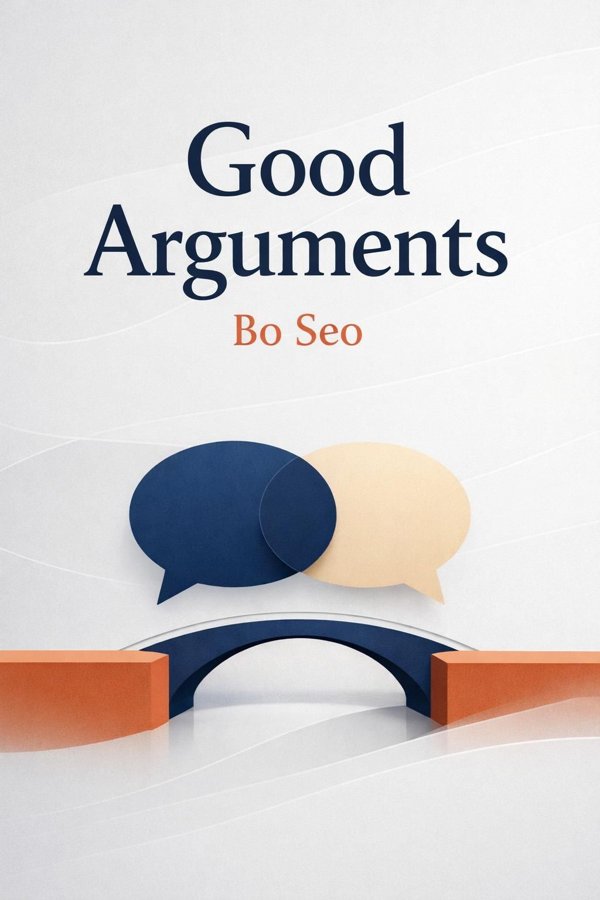
Good Arguments: How Debate Teaches Us to Listen and Be Heard: Summary & Key Insights
by Bo Seo
 10 min5 chaptersAudio available
What Is Good Arguments: How Debate Teaches Us to Listen and Be Heard About?
Good Arguments: How Debate Teaches Us to Listen and Be Heard by Bo Seo is a communication book spanning 5 pages. In this book, Bo Seo, a two-time world debating champion, explores how the art of argument can help us communicate better, think more clearly, and bridge divides in an increasingly polarized world. Drawing from his experiences in competitive debate and journalism, Seo offers practical lessons on how to disagree productively and listen empathetically, showing that good arguments can strengthen relationships and communities.
This FizzRead summary covers all 5 key chapters of Good Arguments: How Debate Teaches Us to Listen and Be Heard in approximately 10 minutes, distilling the most important ideas, arguments, and takeaways from Bo Seo's work. Also available as an audio summary and Key Quotes Podcast.
Good Arguments: How Debate Teaches Us to Listen and Be Heard
In this book, Bo Seo, a two-time world debating champion, explores how the art of argument can help us communicate better, think more clearly, and bridge divides in an increasingly polarized world. Drawing from his experiences in competitive debate and journalism, Seo offers practical lessons on how to disagree productively and listen empathetically, showing that good arguments can strengthen relationships and communities.
Who Should Read Good Arguments: How Debate Teaches Us to Listen and Be Heard?
This book is perfect for anyone interested in communication and looking to gain actionable insights in a short read. Whether you're a student, professional, or lifelong learner, the key ideas from Good Arguments: How Debate Teaches Us to Listen and Be Heard by Bo Seo will help you think differently.
- ✓Readers who enjoy communication and want practical takeaways
- ✓Professionals looking to apply new ideas to their work and life
- ✓Anyone who wants the core insights of Good Arguments: How Debate Teaches Us to Listen and Be Heard in just 10 minutes
Want the full summary?
Get instant access to this book summary and 100K+ more with Fizz Moment.
Get Free SummaryAvailable on App Store • Free to download
Key Chapters
When I arrived in Australia as a child, I quickly learned that silence could be safer than misunderstanding. My English was limited, and each attempt to speak felt like exposing myself to error. Then one day, I discovered debate. To many, it seemed a strange remedy for shyness—standing up to argue before others—but for me it became a path to voice and confidence. Debate gave me rules. It offered structure where chaos had reigned. I realized that when language follows principles of fairness and reasoning, communication can become not only possible but empowering.
Those early experiences shaped my belief that speaking well is not innate—it’s cultivated. Debate taught me that words could be used not to wound but to clarify. It also taught me discipline: to listen before responding, to prepare before performing, and to separate ideas from identities. As I improved, I felt my world widen. I wasn’t just learning how to talk; I was learning how to think. Every round was an exercise in perspective-taking, a rehearsal in empathy. Even when I disagreed, I was trained to understand the other side so deeply that I could argue it convincingly myself.
What began as a classroom exercise eventually became a lifelong practice. I went on to compete internationally, eventually winning two world championships. But what mattered most wasn’t the trophies; it was the habit of mind I developed—the ability to step outside my own certainty and consider the world through another lens. Argument, I came to realize, was not about defeating people; it was about connecting with them. My first victory, then, wasn’t a debate title; it was escaping silence.
We often think of arguments as verbal combat—a contest of domination where one side emerges triumphant and the other humiliated. Yet this view is both destructive and mistaken. A good argument is not driven by ego or aggression; it’s guided by curiosity and respect. In my world of competitive debate, success is measured by reason, evidence, and fairness. Arguments are evaluated not by who shouts louder, but by who makes more sense.
I define a good argument as one that seeks truth rather than victory. It begins with a genuine question—What is right? What is best? What is true?—not with the aim of crushing an opponent. This distinction holds immense power, especially today. Our society often rewards certainty and scorns humility. But good argumentation is built on the opposite posture: openness and intellectual courage.
When I train debaters, I teach them to identify the key issues—the points that actually divide two sides—and focus the discussion there. This clarity prevents confusion and helps participants engage meaningfully instead of spiraling into irrelevant noise. A good argument has three pillars: claim, reasoning, and evidence. The claim is your position, the reasoning explains why it makes sense, and the evidence supports it with facts or experiences. Remove any one, and your argument collapses.
But beyond structure, the spirit matters most. Argument, at its best, is a cooperative enterprise in pursuit of understanding. It’s like building a bridge from two ends—each person contributing their materials, hoping to meet in the middle. When we argue with this mindset, we stop seeing disagreement as danger and start seeing it as opportunity. The purpose is not to destroy but to discover.
+ 3 more chapters — available in the FizzRead app
All Chapters in Good Arguments: How Debate Teaches Us to Listen and Be Heard
About the Author
Bo Seo is a journalist, author, and two-time world debating champion. Born in South Korea and raised in Australia, he has written for publications such as The Atlantic and The New York Times. Seo studied at Harvard and works on communication and public discourse, focusing on how argumentation can foster understanding in modern society.
Get This Summary in Your Preferred Format
Read or listen to the Good Arguments: How Debate Teaches Us to Listen and Be Heard summary by Bo Seo anytime, anywhere. FizzRead offers multiple formats so you can learn on your terms — all free.
Available formats: App · Audio · PDF · EPUB — All included free with FizzRead
Download Good Arguments: How Debate Teaches Us to Listen and Be Heard PDF and EPUB Summary
Key Quotes from Good Arguments: How Debate Teaches Us to Listen and Be Heard
“When I arrived in Australia as a child, I quickly learned that silence could be safer than misunderstanding.”
“We often think of arguments as verbal combat—a contest of domination where one side emerges triumphant and the other humiliated.”
Frequently Asked Questions about Good Arguments: How Debate Teaches Us to Listen and Be Heard
Good Arguments: How Debate Teaches Us to Listen and Be Heard by Bo Seo is a communication book that explores key ideas across 5 chapters. In this book, Bo Seo, a two-time world debating champion, explores how the art of argument can help us communicate better, think more clearly, and bridge divides in an increasingly polarized world. Drawing from his experiences in competitive debate and journalism, Seo offers practical lessons on how to disagree productively and listen empathetically, showing that good arguments can strengthen relationships and communities.
You Might Also Like

Magic Words: The Science and Secrets Behind Seven Words That Motivate, Engage, and Influence
Tim David
10 min
Talking Across The Divide: How to Communicate with People You Disagree with and Maybe Even Change the World
Justin Lee
10 min
The Exceptional Presenter: A Proven Formula to Open Up! and Own the Room
Timothy J. Koegel
10 min
4 Essential Keys to Effective Communication in Love, Life, Work--Anywhere!: Including the 12-Day Communication Challenge!
Bento C. Leal III
10 min
Active Listening Techniques: 30 Practical Tools to Hone Your Communication Skills
Nisha Gupta
10 min
Bargaining for Advantage: Negotiation Strategies for Reasonable People
G. Richard Shell
10 minBrowse by Category
Ready to read Good Arguments: How Debate Teaches Us to Listen and Be Heard?
Get the full summary and 100K+ more books with Fizz Moment.