
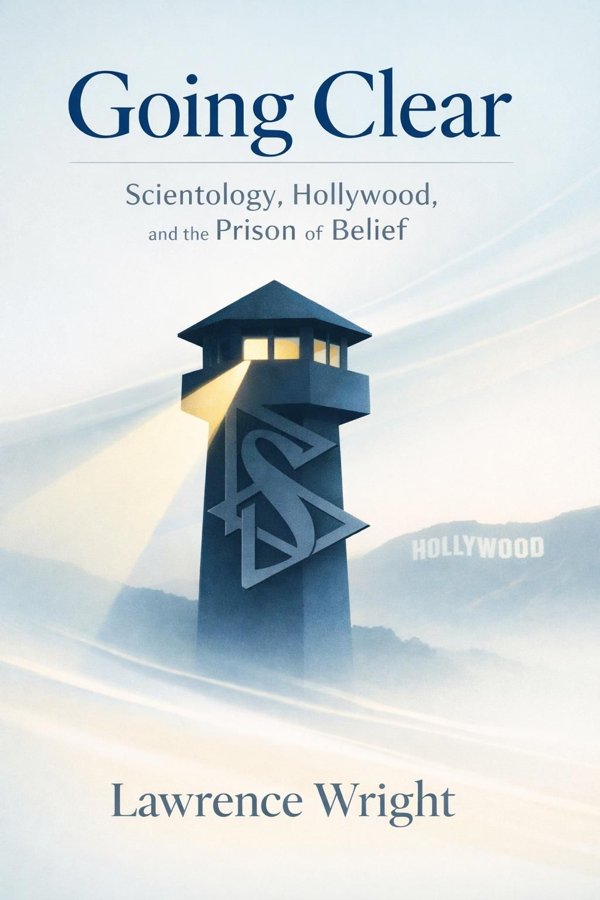
Going Clear: Scientology, Hollywood, and the Prison of Belief: Summary & Key Insights
 10 min12 chaptersAudio available
What Is Going Clear: Scientology, Hollywood, and the Prison of Belief About?
Going Clear: Scientology, Hollywood, and the Prison of Belief by Lawrence Wright is a sociology book spanning 12 pages. Going Clear: Scientology, Hollywood, and the Prison of Belief es una investigación exhaustiva sobre la Iglesia de la Cienciología, su historia, sus líderes y sus seguidores más famosos. El periodista Lawrence Wright examina los orígenes del movimiento fundado por L. Ron Hubbard, su expansión en Hollywood y las controversias que lo rodean, incluyendo testimonios de exmiembros y documentos internos que revelan las prácticas y estructuras de poder dentro de la organización.
This FizzRead summary covers all 12 key chapters of Going Clear: Scientology, Hollywood, and the Prison of Belief in approximately 10 minutes, distilling the most important ideas, arguments, and takeaways from Lawrence Wright's work. Also available as an audio summary and Key Quotes Podcast.
Going Clear: Scientology, Hollywood, and the Prison of Belief
Going Clear: Scientology, Hollywood, and the Prison of Belief es una investigación exhaustiva sobre la Iglesia de la Cienciología, su historia, sus líderes y sus seguidores más famosos. El periodista Lawrence Wright examina los orígenes del movimiento fundado por L. Ron Hubbard, su expansión en Hollywood y las controversias que lo rodean, incluyendo testimonios de exmiembros y documentos internos que revelan las prácticas y estructuras de poder dentro de la organización.
Who Should Read Going Clear: Scientology, Hollywood, and the Prison of Belief?
This book is perfect for anyone interested in sociology and looking to gain actionable insights in a short read. Whether you're a student, professional, or lifelong learner, the key ideas from Going Clear: Scientology, Hollywood, and the Prison of Belief by Lawrence Wright will help you think differently.
- ✓Readers who enjoy sociology and want practical takeaways
- ✓Professionals looking to apply new ideas to their work and life
- ✓Anyone who wants the core insights of Going Clear: Scientology, Hollywood, and the Prison of Belief in just 10 minutes
Want the full summary?
Get instant access to this book summary and 100K+ more with Fizz Moment.
Get Free SummaryAvailable on App Store • Free to download
Key Chapters
Before there was Scientology, there was Hubbard—the restless author, adventurer, and dreamer whose imagination knew no limits. To understand the Church of Scientology, one must first understand the man behind it. Hubbard’s early years were steeped in exploration and contradiction: naval service, dabbles in mysticism, and an emerging career as a prolific science fiction writer. He was captivated by the power of narrative, and through his stories he built worlds where intellect and belief intertwined. Yet, beneath these tales lay his recurring obsession with the mind’s potential—its hidden structures, its ability to create or destroy reality.
Hubbard’s writing career not only honed his craft but shaped his psychology. He saw fiction as truth’s disguise, a place where ideas could test their limits. His literary work in pulp magazines prepared him for what would later become the foundation of Dianetics, a system promising to transcend psychiatry and expose the mind’s full capacity. His travels, claims of military heroism, and encounters with the occult framed his self-image as a misunderstood genius—an image crucial to the mythos he would later cultivate within Scientology.
I approached Hubbard’s life as both biographer and investigator, disentangling fact from the mythology he constructed about himself. His flair for reinvention, his theatricality, and his need for recognition formed the psychological blueprint of the organization he would build—one that prizes secrecy, loyalty, and storytelling as instruments of control. It was in Hubbard’s own life that the seeds of the Church’s authoritarian yet idealistic character were sown.
In 1950, Hubbard published *Dianetics: The Modern Science of Mental Health*, and overnight he transformed from novelist to prophet. The book promised not therapy, but revolution—a new way of freeing the mind from the chains of pain and irrationality. Within weeks, Dianetics groups sprang up across America, filled with people performing ‘auditing,’ an exercise meant to expose and erase painful memories or 'engrams.' Hubbard captured the postwar spirit of self-improvement and scientific optimism. The language of Dianetics blended psychology, metaphysics, and pseudo-science into a message that was irresistibly modern.
As I examined the archives, it became clear that Dianetics worked not because it was scientific, but because it was theatrical. Hubbard gave ordinary people a script for transcendence. Readers were told they could become 'Clear'—a state of pure consciousness unharmed by trauma or fear. The beauty and danger of Dianetics lay in its simplicity: it was accessible, but unverifiable. And as enthusiasm soared, Hubbard faced a dilemma—his movement was growing faster than his capacity to control it.
When financial and organizational troubles threatened to unravel his Dianetics empire, Hubbard reimagined both the method and its meaning. This moment marked the pivot from science to religion. By invoking spiritual dimensions and cosmic history, he made the leap from therapist to messiah. The pattern was clear: every crisis in Hubbard’s life became a creative spark. Every confrontation generated a new creed.
+ 10 more chapters — available in the FizzRead app
All Chapters in Going Clear: Scientology, Hollywood, and the Prison of Belief
About the Author
Lawrence Wright es un periodista, guionista y autor estadounidense, ganador del Premio Pulitzer. Es conocido por su trabajo de investigación en temas de religión, terrorismo y cultura contemporánea. Wright ha sido colaborador habitual de The New Yorker y autor de varios libros aclamados, incluyendo The Looming Tower y Going Clear.
Get This Summary in Your Preferred Format
Read or listen to the Going Clear: Scientology, Hollywood, and the Prison of Belief summary by Lawrence Wright anytime, anywhere. FizzRead offers multiple formats so you can learn on your terms — all free.
Available formats: App · Audio · PDF · EPUB — All included free with FizzRead
Download Going Clear: Scientology, Hollywood, and the Prison of Belief PDF and EPUB Summary
Key Quotes from Going Clear: Scientology, Hollywood, and the Prison of Belief
“Before there was Scientology, there was Hubbard—the restless author, adventurer, and dreamer whose imagination knew no limits.”
“In 1950, Hubbard published *Dianetics: The Modern Science of Mental Health*, and overnight he transformed from novelist to prophet.”
Frequently Asked Questions about Going Clear: Scientology, Hollywood, and the Prison of Belief
Going Clear: Scientology, Hollywood, and the Prison of Belief by Lawrence Wright is a sociology book that explores key ideas across 12 chapters. Going Clear: Scientology, Hollywood, and the Prison of Belief es una investigación exhaustiva sobre la Iglesia de la Cienciología, su historia, sus líderes y sus seguidores más famosos. El periodista Lawrence Wright examina los orígenes del movimiento fundado por L. Ron Hubbard, su expansión en Hollywood y las controversias que lo rodean, incluyendo testimonios de exmiembros y documentos internos que revelan las prácticas y estructuras de poder dentro de la organización.
You Might Also Like

Between the World and Me
Ta-Nehisi Coates
10 min
Half the Sky
Nicholas D. Kristof, Sheryl WuDunn
10 min
Men Explain Things To Me
Rebecca Solnit
10 min
Rational Ritual
Michael Suk-Young Chwe
10 min
The New Jim Crow
Michelle Alexander
10 min
Beyond Culture
Edward T. Hall
10 minBrowse by Category
Ready to read Going Clear: Scientology, Hollywood, and the Prison of Belief?
Get the full summary and 100K+ more books with Fizz Moment.