
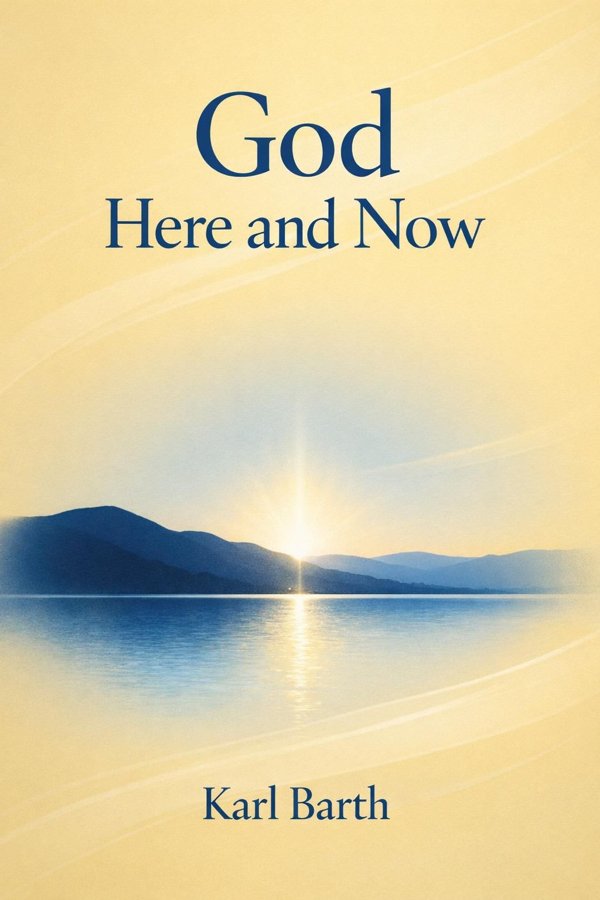
God Here and Now: Summary & Key Insights
by Karl Barth
 10 min7 chaptersAudio available
What Is God Here and Now About?
God Here and Now by Karl Barth is a western_phil book spanning 7 pages. God Here and Now is a collection of seven addresses delivered by Swiss theologian Karl Barth between 1950 and 1956. In these talks, Barth summarizes key themes of his theology, emphasizing the immediacy of God's presence in the here and now. He calls for understanding Christian faith not as an abstract doctrine but as a living encounter with God that remains relevant in the modern world.
This FizzRead summary covers all 7 key chapters of God Here and Now in approximately 10 minutes, distilling the most important ideas, arguments, and takeaways from Karl Barth's work. Also available as an audio summary and Key Quotes Podcast.
God Here and Now
God Here and Now is a collection of seven addresses delivered by Swiss theologian Karl Barth between 1950 and 1956. In these talks, Barth summarizes key themes of his theology, emphasizing the immediacy of God's presence in the here and now. He calls for understanding Christian faith not as an abstract doctrine but as a living encounter with God that remains relevant in the modern world.
Who Should Read God Here and Now?
This book is perfect for anyone interested in western_phil and looking to gain actionable insights in a short read. Whether you're a student, professional, or lifelong learner, the key ideas from God Here and Now by Karl Barth will help you think differently.
- ✓Readers who enjoy western_phil and want practical takeaways
- ✓Professionals looking to apply new ideas to their work and life
- ✓Anyone who wants the core insights of God Here and Now in just 10 minutes
Want the full summary?
Get instant access to this book summary and 100K+ more with Fizz Moment.
Get Free SummaryAvailable on App Store • Free to download
Key Chapters
When I speak of the Word of God, I do not mean merely the words printed in the Bible or recited in churches. The Book itself, apart from the living speech of God through it, would be paper and ink. The Word is event—it happens. God speaks, and this speaking brings reality into being and summons humanity to decision. This conviction, central to my entire theology, resists two temptations of modern thought: that Scripture is but an ancient record, and that revelation is a private, mystical experience. The Word confronts us; it is not ours to control.
In each encounter with Scripture rightly heard, there is a moment in which the eternal God addresses the human creature anew. Revelation, then, is not information about God but the self-disclosure of God Himself. It is relational, dynamic, and direct. To hear the Word is to stand before the living God who judges and reconciles. The preacher, the theologian, and the believer are all recipients before they are interpreters.
Why does this matter now? Because in a world where speech is cheap—where every ideology claims its own truth—the Word of God remains free. It does not submit to our systems; instead, it interrupts them. This is the Word that created the cosmos, raised Christ from the dead, and continues to call the Church into being. Our task is not to capture it but to listen in awe. Every genuine moment of theology begins here: with hearing the Word that happens to us.
Faith is not a possession or a doctrine one carries about. It is the event in which a person is met by God and responds. In my addresses I insisted that faith arises not from human capacity or inner strength but from God’s initiative. To believe means to be grasped by a reality greater than oneself—one that awakens trust, obedience, and joy. Faith is therefore never static; it is renewed in every encounter.
This understanding challenges all forms of religious self-sufficiency. We cannot believe *because* we choose to, nor can institutions claim to manage faith. God calls, and we respond; that is faith’s rhythm. It is relational rather than intellectual. Imagine a man meeting the gaze of Christ—his entire world is redefined in that moment. That is the nature of belief: personal, transformative, wholly dependent on the One who speaks to us.
In the modern world, people tend to imagine faith as either superstition or private sentiment. Yet I maintain that genuine faith is the most radical openness possible—it is the courage to stand before God’s revelation and to say yes. Living faith changes our posture toward everything else. It frees us to act responsibly, because in trusting God’s Word we participate in His ongoing work in the world.
+ 5 more chapters — available in the FizzRead app
All Chapters in God Here and Now
About the Author
Karl Barth (1886–1968) was a Swiss Reformed theologian and one of the most influential Protestant thinkers of the twentieth century. He taught in Göttingen, Münster, Bonn, and Basel, and was a principal author of the Barmen Declaration. Barth is best known for his role in developing dialectical theology, which stresses the primacy of divine revelation.
Get This Summary in Your Preferred Format
Read or listen to the God Here and Now summary by Karl Barth anytime, anywhere. FizzRead offers multiple formats so you can learn on your terms — all free.
Available formats: App · Audio · PDF · EPUB — All included free with FizzRead
Download God Here and Now PDF and EPUB Summary
Key Quotes from God Here and Now
“When I speak of the Word of God, I do not mean merely the words printed in the Bible or recited in churches.”
“Faith is not a possession or a doctrine one carries about.”
Frequently Asked Questions about God Here and Now
God Here and Now by Karl Barth is a western_phil book that explores key ideas across 7 chapters. God Here and Now is a collection of seven addresses delivered by Swiss theologian Karl Barth between 1950 and 1956. In these talks, Barth summarizes key themes of his theology, emphasizing the immediacy of God's presence in the here and now. He calls for understanding Christian faith not as an abstract doctrine but as a living encounter with God that remains relevant in the modern world.
You Might Also Like
A Little History of Philosophy
Nigel Warburton
10 min
Areopagitica
John Milton
10 min
How To Think Like A Philosopher: Essential Principles For Clear Thinking
Peter Cave
10 min
Language, Truth and Logic
A. J. Ayer
10 min
The Age of Reason
Thomas Paine
10 min
The Essays
Michel De Montaigne
10 minBrowse by Category
Ready to read God Here and Now?
Get the full summary and 100K+ more books with Fizz Moment.